Is It a Real Shift in How Companies Scale, or a Trend You'll Regret Following?
B2B founders at $1M to $10M ARR are hiring Fractional Sales Leaders instead of a VP of Sales because the job at that stage is mostly building a sales system, not running one. A full-time VP costs $250,000 to $400,000 a year and is a hard decision to undo. A Fractional Sales Leader builds the system for roughly half the cost, in renewable 12-week terms. The shift is real, but it isn't right for every company.
Key Takeaways
- Founders are choosing Fractional Sales Leaders because a $1M to $10M company needs someone to build the sales system first, and most full-time VPs of Sales are hired to run a system that doesn't exist yet.
- The growth is measurable: at least 34,000 U.S. workers held a "fractional" job title in 2025, up 265% from 2019, and 97% of fractional job postings in 2026 came from small and mid-size companies (Lightcast, 2026).
- A full-time VP of Sales costs $250,000 to $400,000 a year. Gong's 2018 analysis put average VP of Sales tenure at 19 months, down from 26, which means a founder can end up paying for the search twice.
- A Fractional Sales Leader is a reversible decision. At $14K a month in 12-week terms, a founder can test the fit, keep what works, and walk away from what doesn't without a severance conversation.
- Before you choose, list the work you need done in the next 12 months. If it's mostly writing the playbook, defining stages and hiring the first reps, go fractional. If it's managing three managers every day, hire the VP.
Five years ago, if you told a board you were bringing in a part-time sales leader, someone would ask why you couldn't afford a real one.
Today, that same board is more likely to ask why you'd lock in $300,000 a year before you know what the job is.
The rise of fractional sales leadership comes from founders noticing that the VP of Sales job they were hiring for didn't exist yet at their stage.
If you're a founder at $1M to $10M ARR, still closing most deals yourself, and wondering whether everyone going fractional is smart or just following the crowd, here's what's actually driving the shift, and where it goes wrong.
Is the rise of fractional sales leadership real, or just hype?
The rise of fractional leadership is real and measurable, and it's concentrated in smaller companies. Labor-market data shows fractional job titles and fractional job postings both growing fast since 2019, with almost all the demand coming from small and mid-size businesses rather than large enterprises.
What the data shows
Lightcast, the labor-market analytics firm, published the clearest numbers I've found in August 2026 (Lightcast):
- At least 34,000 U.S. workers had "fractional" in their current job title in 2025, up 265% from 2019.
- U.S. employers posted 677 fractional roles in 2025, more than double the year before, and nearly 1,000 in just the first seven months of 2026.
- 97% of fractional job postings in 2026 came from small and mid-size companies. Only 3% came from Fortune 1000 companies.
- Finance led the way, with 46% of U.S. fractional postings. The fractional CFO went mainstream first.
Two cautions. Posting counts are still small in absolute numbers, because most fractional work is found through referrals, not job boards. And you'll see much bigger figures online, such as "110,000 fractional executives on LinkedIn," that I couldn't trace back to a published method. I wouldn't cite them.
Sales is following the CFO path
The fractional CFO caught on because a growing company needs CFO-level judgment long before it needs a CFO for 50 hours a week. Sales leadership works the same way. A company at $3M ARR needs someone who's built sales teams before. It rarely needs that person five days a week.
Why doesn't a full-time VP of Sales fit a $1M to $10M company?
A full-time VP of Sales usually doesn't fit a $1M to $10M company because the work at that stage is building, not running. The company needs a playbook written, pipeline stages defined and the first reps hired. Most VPs are hired, paid and wired to manage a team and a process that already work.
Build work and run work are different jobs
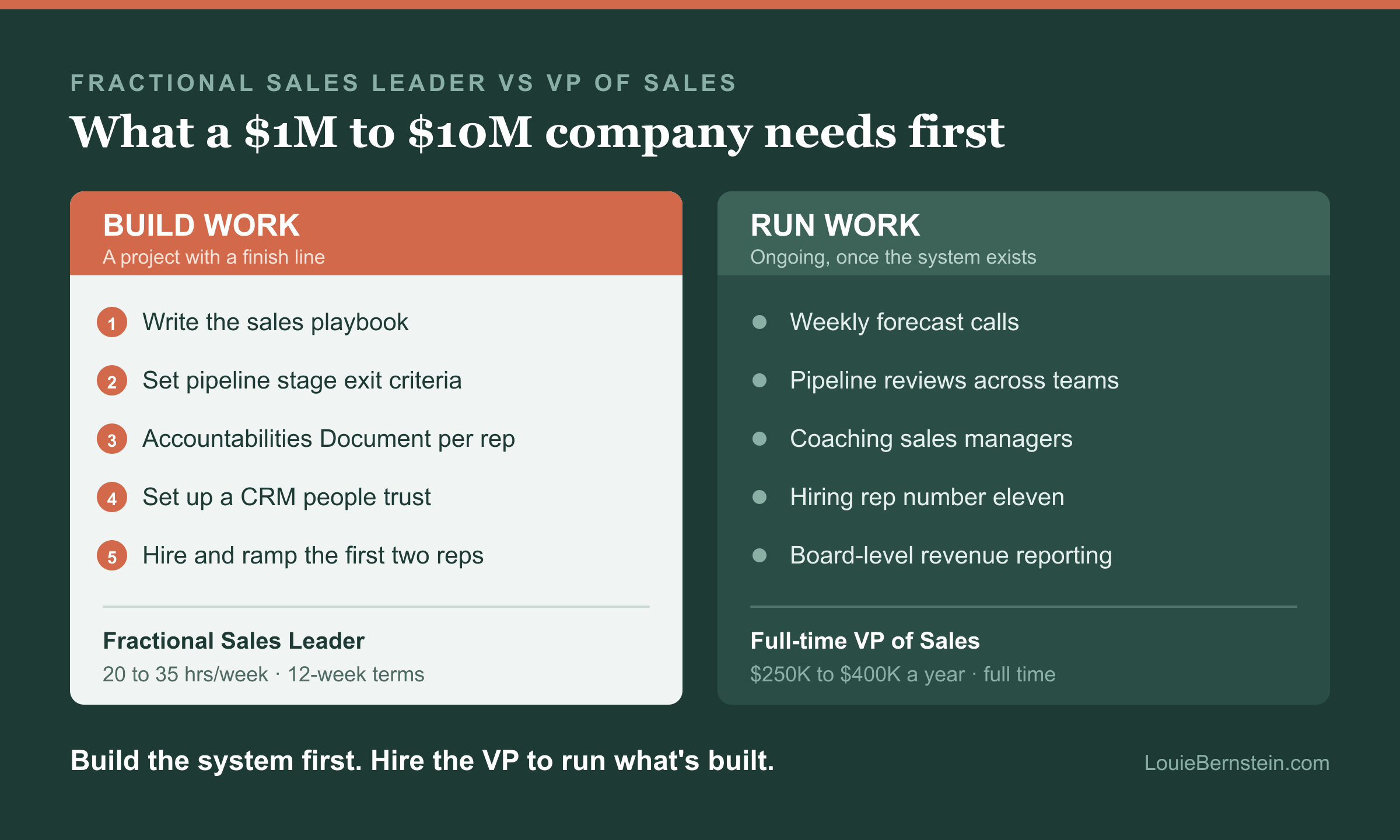
Build work is a project with an end date: document how deals actually close, write the sales playbook, set stage exit criteria, write each rep's Accountabilities Document, set up the CRM, and hire and ramp the first two reps. Run work is ongoing: forecast calls, weekly pipeline reviews, coaching, hiring rep number eleven, managing managers.
A full-time VP of Sales is priced for run work. When that VP arrives at a company with no playbook and an empty CRM, they spend their first six months doing build work, often the parts they've never had to do, because someone before them built the foundation at their last company.
Build work has a finish line
Because build work ends, you don't need to pay for it forever. That's the part founders miss. A Fractional Sales Leader working 20 to 35 hours a week can build the system, run it long enough to prove it, and hand a working team to a full-time VP when revenue justifies one. My article on building the sales team your future VP inherits walks through that hand-off.
What does a wrong VP of Sales hire actually cost?
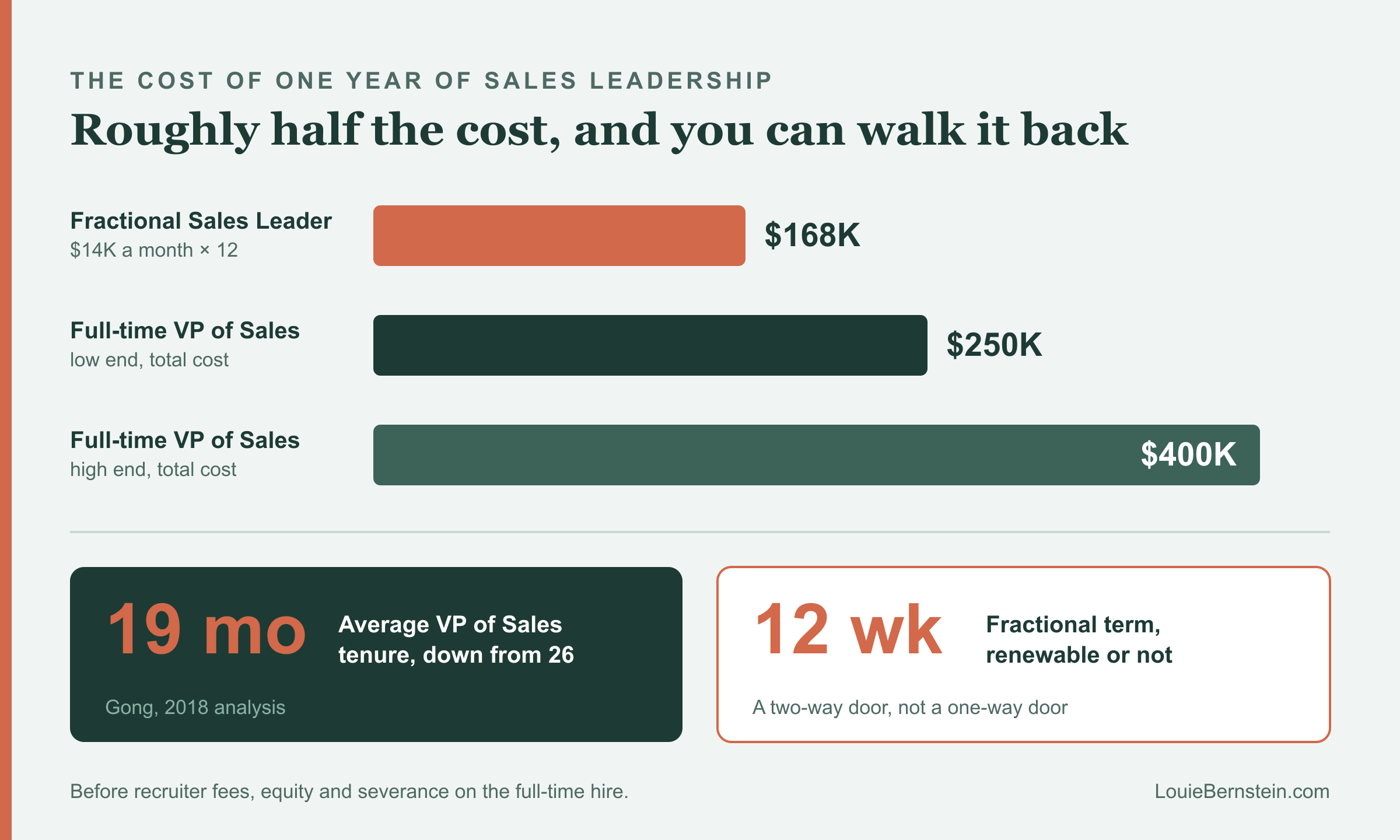
A wrong VP of Sales hire costs far more than the salary. Founders pay $250,000 to $400,000 a year, plus recruiting fees, equity and severance, then lose months of pipeline while the next search runs. Short tenure makes the risk real: average VP of Sales tenure was 19 months in Gong's 2018 analysis.
The tenure problem
Gong reported in 2018 that average VP of Sales tenure had fallen from 26 months to 19 months over the previous seven years (Gong). It's an older number, and Gong didn't publish its method, so I don't treat it as precise. But I haven't seen any newer data suggesting tenure got longer, and it matches what founders tell me: the first VP of Sales often doesn't make it to year two.
Nineteen months can be shorter than it takes to hire a VP, ramp the VP, hire reps under the VP and ramp those reps. The VP often leaves before the system they started is finished.
The math founders actually compare
A year of fractional sales leadership at $14K a month is $168,000. A full-time VP of Sales runs $250,000 to $400,000 a year in total cost. That makes fractional roughly half the cost, before you count the recruiter's fee or the cost of getting the hire wrong. My guide to fractional sales leadership pricing models covers how other fractional leaders price, from $10K to $20K a month.
Why do founders now prefer a decision they can reverse?
Founders now prefer reversible sales leadership decisions because hiring a full-time VP of Sales is hard to undo, and the cost of undoing it lands on the company's runway. A Fractional Sales Leader in renewable 12-week terms turns a one-way decision into a two-way one.
One-way doors and two-way doors
Jeff Bezos split decisions into two types in Amazon's 2015 shareholder letter: one-way doors you can't easily walk back through, and two-way doors you can (Amazon). One-way doors deserve slow, careful decisions. Two-way doors deserve fast ones.
A full-time VP of Sales is a one-way door. You run a long search, negotiate equity, announce the hire to the team and the board, and if it doesn't work, you face a severance conversation and a second search. A Fractional Sales Leader is a two-way door. You agree to 12 weeks, look at what got built, and decide whether to renew. Most of my clients renew for six to twelve months in total, but the choice stays theirs at every renewal.
What reversible really buys you
A reversible decision lets you find out whether the person can build your system by looking at the system, not by reading a resume. After 12 weeks you should be able to see a written playbook, defined stages and a pipeline review that runs without you. If you can't, you've lost a quarter, not two years.
What I've seen: founders hire a VP of Sales when they're frustrated
Founders usually hire a full-time VP of Sales when they're frustrated with founder-led sales, usually before the company is ready for a VP. The frustration is real. It means the founder needs relief. Whether the company needs a full-time executive depends on whether there's a sales system for one to run.
In 50 years of sales, I've watched this pattern more times than I can count. The founder is closing every deal. The pipeline is up one month and empty the next. Revenue is lumpy. And the founder thinks: a real sales VP will fix all of this.
So they hire one. The VP walks in, finds no playbook, no stage definitions, a CRM nobody trusts and a founder who still takes every big call. The VP either does build work they weren't hired for, or tries to run a process that isn't there. Either way, the founder is frustrated again within a year, and now they're frustrated with a $300,000 line item.
Before you hire a VP of Sales, ask one question: is there anything here yet for a VP of Sales to run?
That's why I think the rise of fractional sales leadership is mostly a correction. Founders are buying the job they actually need done. If you're not sure where you stand, my page on whether you're ready to hire a VP of Sales yet has a checklist.
When is a Fractional Sales Leader the wrong call?
A Fractional Sales Leader is the wrong call when the company needs daily, full-time leadership of an established team, or when the real problem isn't sales leadership at all. Fractional works for building. It struggles when the job is managing a large team every day, or when the product isn't selling for reasons no sales leader can fix.
Signs fractional fits, and signs it doesn't
| Fractional is the wrong call | Fractional is the right call |
|---|---|
| You have three or more sales managers who need daily leadership. | You have zero to five reps and the founder still manages them. |
| Your playbook, stages and forecast already work. You need someone to run them. | Nothing about how deals close is written down. |
| You don't have product-market fit yet, so buyers aren't buying from anyone. | Customers buy, but only when the founder sells. |
| You need another closer carrying a quota, not a leader. | You need someone to build the system the next closers will use. |
| The founder won't give up any deals or decisions. | The founder is ready to hand off, with help. |
| Revenue is well past $10M ARR and the team is growing every quarter. | Revenue is $1M to $10M ARR and a full-time VP would be premature. |
The founder is often the deciding factor
The most common way a fractional engagement fails is a founder who hires help and then keeps every deal. No sales leader, fractional or full-time, can build a team around a founder who won't let the team sell. If that's you, fix the hand-off first. My page on the $250K mistake of hiring a VP of Sales too early covers the other side of that decision.
Related ReadingThe VP of Sales Post-Mortem: 7 Warning Signs Your $250K Hire Is About to Fail →
Frequently Asked Questions
Is fractional sales leadership just a cheaper VP of Sales?
No. A Fractional Sales Leader does a different job than a VP of Sales at a different stage. The fractional leader builds the playbook, stages and hiring process. A VP of Sales runs and scales that system once it exists. Choose based on the work you need done, then compare cost.
Will my reps take a part-time sales leader seriously?
Reps take a Fractional Sales Leader seriously when the leader shows up on a fixed weekly rhythm and the founder backs the leader's decisions in front of the team. Reps follow consistency and authority. If the founder overrules the leader in public, reps notice within a week.
How do I know the fractional trend won't fade in a few years?
The fractional model has lasted in finance for years, and Lightcast's 2026 data shows fractional postings in the U.S. still more than doubling. Even if the label fades, the underlying need won't: companies at $1M to $10M ARR still need executive judgment before they can afford a full-time executive.
Can a Fractional Sales Leader help me hire my eventual VP of Sales?
Yes, and that's one of the best uses of the role. A Fractional Sales Leader who built your system knows exactly what your VP will need to run it, so the leader can write the job, run the interviews and hand over a working team.
What should be finished after the first 12 weeks?
After 12 weeks with a Fractional Sales Leader, you should see a written sales playbook, pipeline stages with exit criteria, a weekly pipeline review that runs without the founder, and an Accountabilities Document for each rep. If those aren't in place or clearly underway, don't renew.
Hire for the job you actually have.
If you're closing every deal yourself and wondering whether it's time for a VP of Sales, let's talk about what your company needs built first. See how Fractional Sales Leadership at LouieBernstein.com can build the system before you commit $300,000 a year to running it.
Schedule a 30-Minute CallAbout the Author
Louie Bernstein is a Fractional Sales Leader with 50 years of sales experience and has worked as a Fractional Sales Leader since 2017. He helps B2B founders at $1M to $10M ARR build sales processes, define roles, and coach teams to sell without the founder in every deal.
Subscribe to The Sunday Starter for practical sales leadership guidance.