Hiring two AEs before you have a VP of Sales only creates a mess if you make promises instead of writing rules. The mess a VP has to clean up is almost always the same: inflated titles, verbal comp deals, accounts promised on a handshake, and pipeline data that lives in the founder's head. Write down the roles, the comp, the account rules, the process, and six months of numbers, and your future VP inherits a working team instead of rebuilding one.
Key Takeaways:
- Hiring AEs with no VP isn't the mistake. Running the team on verbal promises is.
- Four promises turn into a VP's cleanup: inflated titles, verbal comp deals, handshake account splits, and data that lives in your head.
- A VP of Sales lasts about 2.0 years on average (Pave data, via SaaStr). Every month they spend cleaning up comes out of a short window.
- Build in three layers: People (roles, comp, reporting line), Process (playbook, stage exit criteria, escalation rule), and Proof (CRM history, scorecards, win/loss notes).
- The test is simple. If a new VP can read it, they can run it.
This is the question under this whole series. "I can't afford a VP, and I shouldn't hire one yet. But if I hire two AEs with no VP, am I just building a mess I'll have to clean up later?"
It's a fair worry. I've watched it happen. A founder hires two reps, runs the team out of their head for 18 months, then hires a VP. The VP spends the first two quarters untangling titles, comp, and account fights before they can add a single rep.
I've also watched the other version. Same founder, same two reps, same 18 months. But everything was written down. The VP walks in, reads the playbook, looks at six months of numbers, and starts hiring rep three in the first month.
The reps weren't the difference. The paper was.
Every promise you make to close a hire today is a conversation your VP has to have tomorrow.
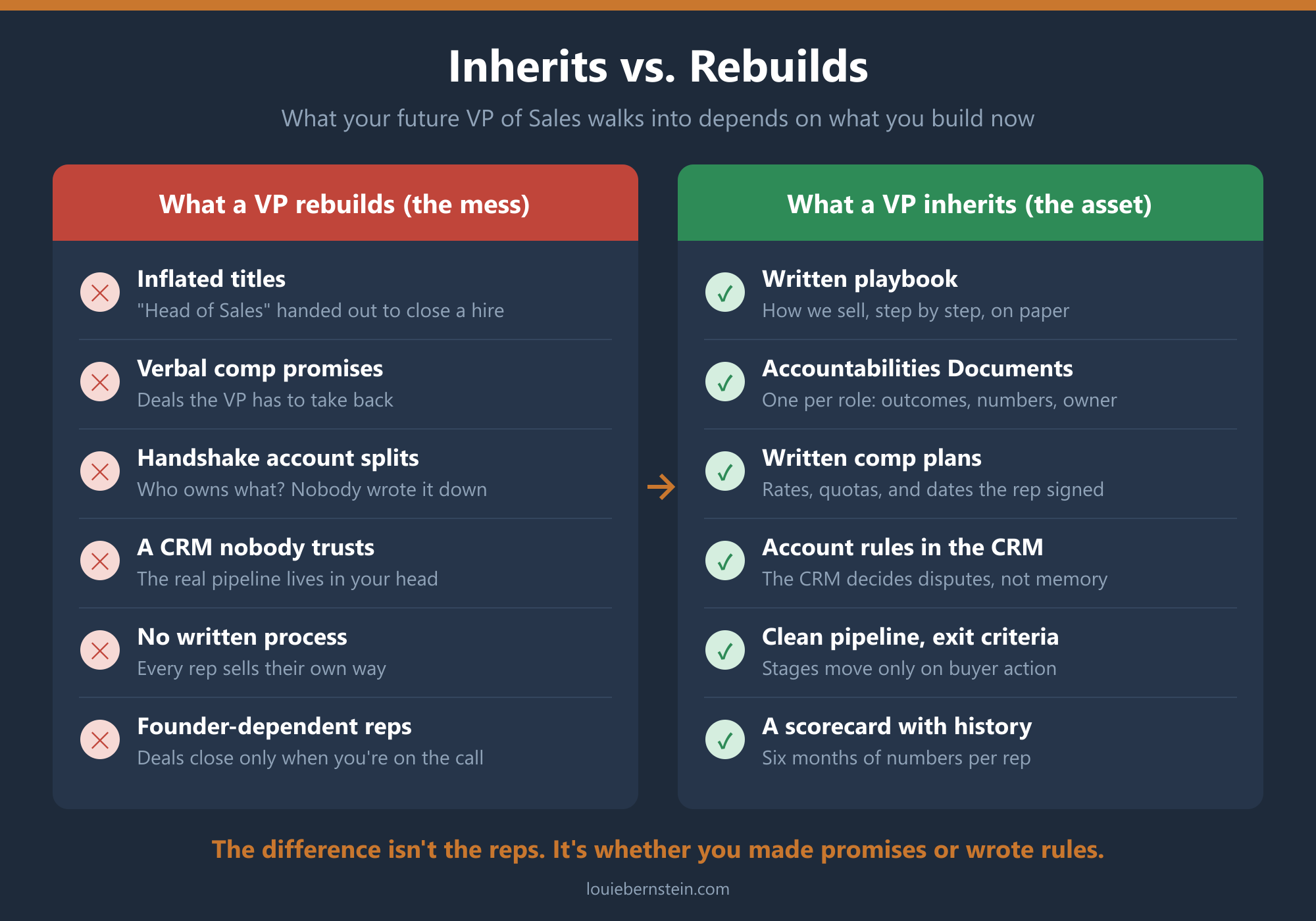
Will hiring AEs without a VP create a mess?
Only if you run them on promises. The reps themselves aren't the mess. The mess is every deal you made out loud to get them in the door and keep them happy.
Here's why it matters. Pave's data on 14,000 executives puts the average VP of Sales tenure at 2.0 years (Pave, via SaaStr). That's a short window. If your VP spends the first six months cleaning up, that's a quarter of their likely tenure gone before they build anything. I cover the VP hire itself in how to hire a VP of Sales for a B2B startup. This article is about what they walk into.
What "inherit" means
A VP inherits a team when they can read how it works and run it on day one. Roles are written. Comp is written. Who owns which account is in the CRM. The pipeline stages mean the same thing to everyone. There's enough history to tell what's working.
What "rebuild" means
A VP rebuilds a team when the rules only exist in the founder's memory. Before they can scale anything, they have to interview everyone, piece together who was promised what, and make decisions that should have been made a year ago. Most of those decisions take something away from someone. That's how a new VP loses a good rep in month two.
Which four promises turn into your VP's cleanup?
They all start the same way. You're short on time, you want the hire, and a promise is faster than a document.
1. The inflated title
You're competing for a strong rep. They want "Head of Sales" or "Sales Director." It costs you nothing today, so you say yes. Then you hire a VP, and your rep's title now says they were passed over. Either the VP takes the title back, or the rep leaves, or both. I'd rather pay a little more cash than hand out a title I'll have to take back. My rule of thumb: early reps get "Account Executive." Titles follow the work, not the offer letter.
2. The comp promise
"If you close it, you'll get a bigger cut." "We'll revisit your quota next quarter." "Keep the house accounts you touch." Each one is a deal the VP has to honor or break. Write the comp plan down: base, rate, quota, ramp, and the date it changes. Have the rep sign it. If you want a starting point, see how to pay your first sales rep.
3. The handshake account split
"You take the East Coast." "That one's yours since you found it." Six months later, two reps think they own the same account, and you're the only one who remembers what you said. Put the account ownership rules in writing and in the CRM. I lay out the full set in splitting accounts between you and your first two AEs.
4. The data in your head
You know which deals are real. You know why you lost the big one in March. None of it is in the CRM. A new VP can't run on your memory, and they shouldn't trust a CRM your reps don't keep up. In Validity's 2022 survey of CRM admins, 44% estimated their company loses more than 10% of annual revenue to poor CRM data (Validity, 2022). If it isn't in the CRM, it never happened. And your VP will treat it that way.
A VP can scale anything they can read. They have to rebuild anything they can't.
What should you build now so your VP inherits it?
Three layers: People, Process, and Proof. If you've followed this series, you've already built most of it. This is where it comes together.
People: roles, comp, and a reporting line
Every rep has an Accountabilities Document: what they own, the numbers they're measured on, and who they report to. Every rep has a signed comp plan. And there's a clear answer to "who's my manager?" even with no VP. I cover that split in who your first two AEs report to. When the VP arrives, the reporting line moves to them. Nothing else has to change.
Process: playbook, stages, and the escalation rule
A written playbook covers how you find, qualify, demo, propose, and close. Your pipeline stages need exit criteria based on buyer action, not hope. A deal moves when the buyer does something, like agreeing to a demo with the decision-maker. Write down how much pipeline each rep is expected to build on their own, too. I make that case in should your first AEs build their own pipeline.
Then write down when you still get on a call. If the rule is "whenever the founder feels like it," your VP inherits reps who can't close without you. A written founder escalation rule fixes that before it hardens into habit.
Proof: history the VP can trust
This is the layer founders skip, and it's the one VPs value most. Six months of clean CRM data. A monthly scorecard for each rep. Short win/loss notes on every closed deal: why we won, why we lost, who we lost to. With that, a VP can tell in a week what's working. Without it, they spend a quarter guessing. The scorecard I use is in the 6-month scorecard for your first AEs.
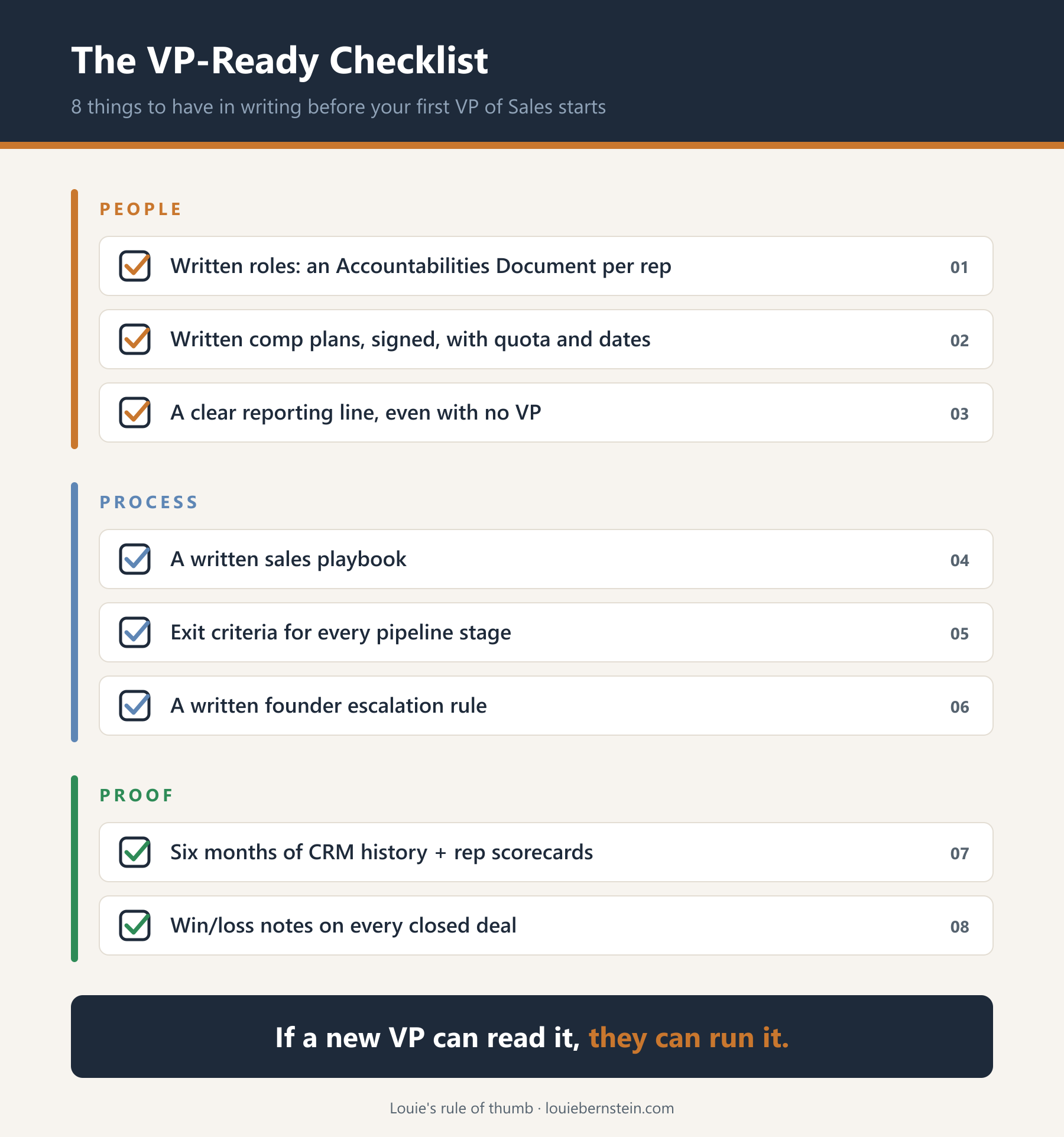
The VP-ready checklist (copy this)
Here's the checklist in plain text. Paste it into your planning doc and check it once a quarter.
People
- [ ] Every rep has a written Accountabilities Document.
- [ ] Every rep has a signed comp plan with base, rate, quota, ramp, and dates.
- [ ] Every rep knows who they report to, in writing.
Process
- [ ] A written sales playbook a new rep could follow.
- [ ] Exit criteria for every pipeline stage, based on buyer action.
- [ ] A written founder escalation rule.
Proof
- [ ] Six months of CRM history and a monthly scorecard for each rep.
- [ ] Win/loss notes on every closed deal.
The test: if a new VP can read it, they can run it.
What if you've already made some promises?
Most founders have. You don't need to wait for the VP to fix them. In fact, it's better if you don't. A promise you unwind yourself, with time and a reason, lands better than one a stranger takes away in their first month.
Write down what you already promised
Sit with each rep and ask, "What do you think I've promised you?" Titles, comp, accounts, future roles. Write it all down. You'll be surprised how often your memory and theirs don't match. That gap is exactly what a VP would have walked into.
Convert promises into rules, with a date
Keep the promises you can keep, and put them in writing. For the ones you can't, give a reason and a date. "Starting January, comp moves to this written plan. Here's how it compares to today." Salespeople don't quit companies. They quit chaos. A clear change with notice isn't chaos. A surprise from a new boss is.
Clean the CRM before the VP does
Close out dead deals. Fill in owners on every account. Make sure each open deal has a stage that matches its exit criteria and a next step with a date. My rule of thumb is to do this once, fully, then hold the line with a short weekly review. It's a few hours now versus months of a VP's time later.
Unwind your own promises. It's kinder to the rep and cheaper for the VP.
How do you know the team is ready for a VP?
Run the read-it-and-run-it test. Hand the playbook, the comp plans, the account rules, and the scorecards to someone who's never seen your company. Could they explain how your team sells and who owns what? If yes, you've built something a VP can inherit.
My rule of thumb for a second check: take two weeks off from sales. If deals keep moving and the reps' numbers hold, the system is doing the work. If everything waits for you, you're not ready to hand it off yet, and a VP won't fix that for you. They'll inherit it.
Where a Fractional Sales Leader fits
This is most of what I do. A Fractional Sales Leader writes the roles, the comp plans, the account rules, the playbook, and the stage exit criteria. Then I run the monthly scorecard, so there's real history when the VP shows up. When it's time, I help you hire the VP and hand them a team they can scale instead of a project they have to start over.
I've spent 50 years in sales, including 22 years building MindIQ into an INC 500 company. The best VP hand-offs I've seen weren't about the VP. They were about what the founder wrote down before the VP arrived.
That's the answer to this series. Hiring your first two AEs without a VP doesn't create a mess. Running them on promises does. Write the rules, and your future VP inherits an engine instead of building one.
Frequently Asked Questions
Q: Will hiring AEs before a VP of Sales create problems later?
Only if the team runs on verbal promises. Problems come from inflated titles, unwritten comp deals, handshake account splits, and data that lives in the founder's head. Put roles, comp, account rules, and your process in writing, and a future VP inherits the team instead of rebuilding it.
Q: What should be in place before I hire a VP of Sales?
Eight things, in writing: an Accountabilities Document per rep, signed comp plans, a clear reporting line, a sales playbook, stage exit criteria, a founder escalation rule, six months of CRM history and rep scorecards, and win/loss notes. If a new VP can read it, they can run it.
Q: Should I give my first sales hire a "Head of Sales" title?
I wouldn't. It's free today and expensive later. When you hire a VP, that rep either loses the title or feels passed over, and you risk losing a good seller. My rule of thumb is to give early reps "Account Executive" and let titles follow the work.
Q: What does a new VP of Sales do in the first 90 days?
It depends on what they inherit. With written roles, comp, process, and clean data, they can spend the first 90 days hiring and scaling. Without them, they spend it interviewing reps, rebuilding the CRM, and renegotiating promises. You decide which version by what you build now.
Q: How do I undo comp or account promises I already made to my reps?
Do it yourself, before the VP arrives. Ask each rep what they think you promised and write it down. Keep what you can and put it in writing. For what you can't keep, give a reason, a written new plan, and a start date with real notice.
Q: Can a Fractional Sales Leader prepare my team for a VP of Sales?
Yes. That's a core part of the role. A Fractional Sales Leader writes the roles, comp plans, account rules, and playbook, runs the monthly scorecard so there's real history, and helps you hire the VP and hand off a team that's ready to scale.
Will your future VP inherit or rebuild?
In 30 minutes we'll run your team against the VP-ready checklist and show you the first three things to write down.
Schedule a 30-Minute CallAbout the Author
Louie Bernstein
Fractional Sales Leader with 50 years of sales experience helping $1M–$10M ARR companies build scalable, repeatable sales systems. Founder of MindIQ (INC 500). LinkedIn Top Voice in Sales Management, Sales Operations, and Sales Coaching.