Key Takeaways:
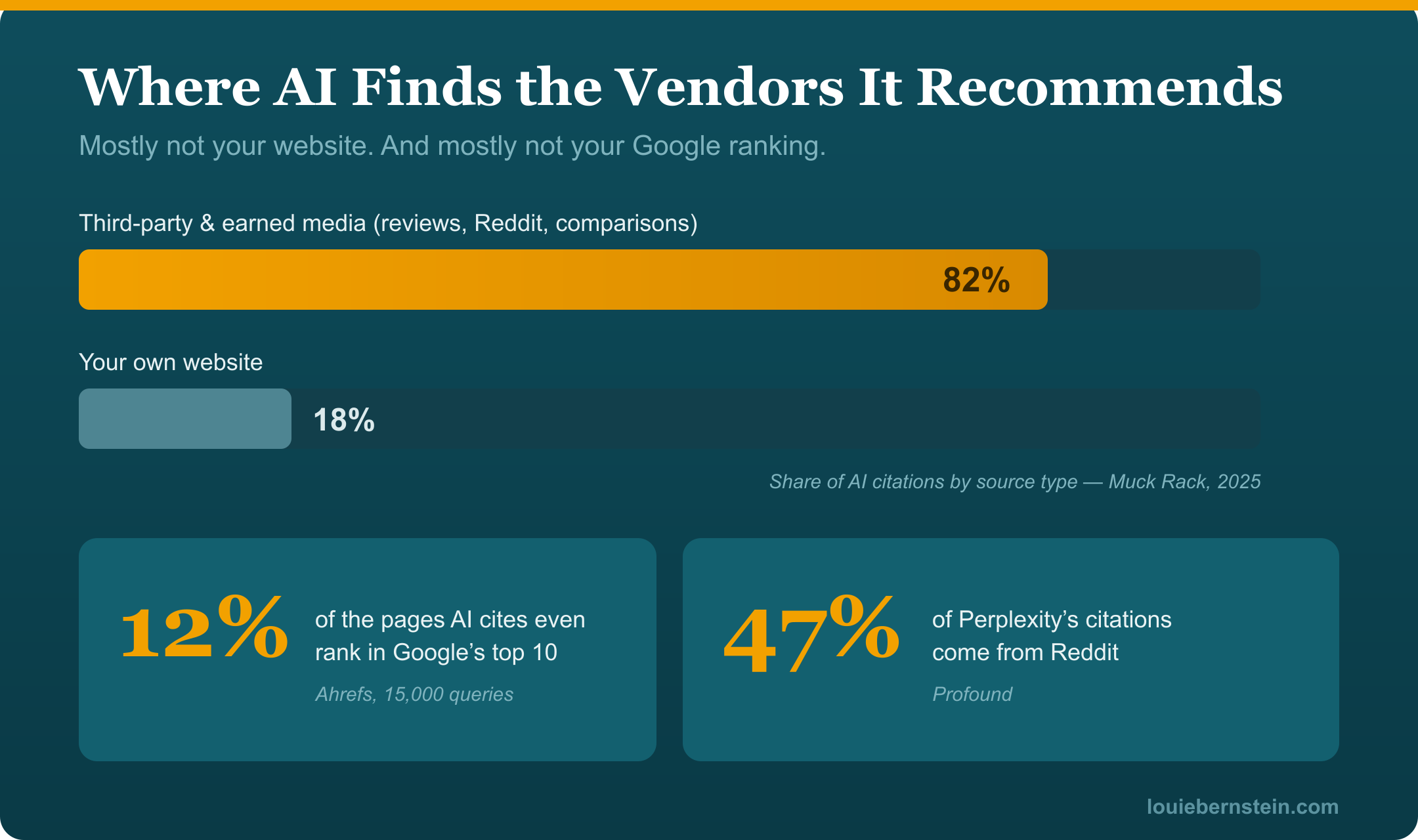
- AI builds vendor shortlists from the conversation about you, not the marketing you publish. 82% of AI citations come from earned media, not brand sites (Muck Rack).
- Your Google ranking barely helps. Only 12% of the pages AI cites even rank in Google's top 10 for the same question (Ahrefs). You can be #1 on Google and invisible in ChatGPT.
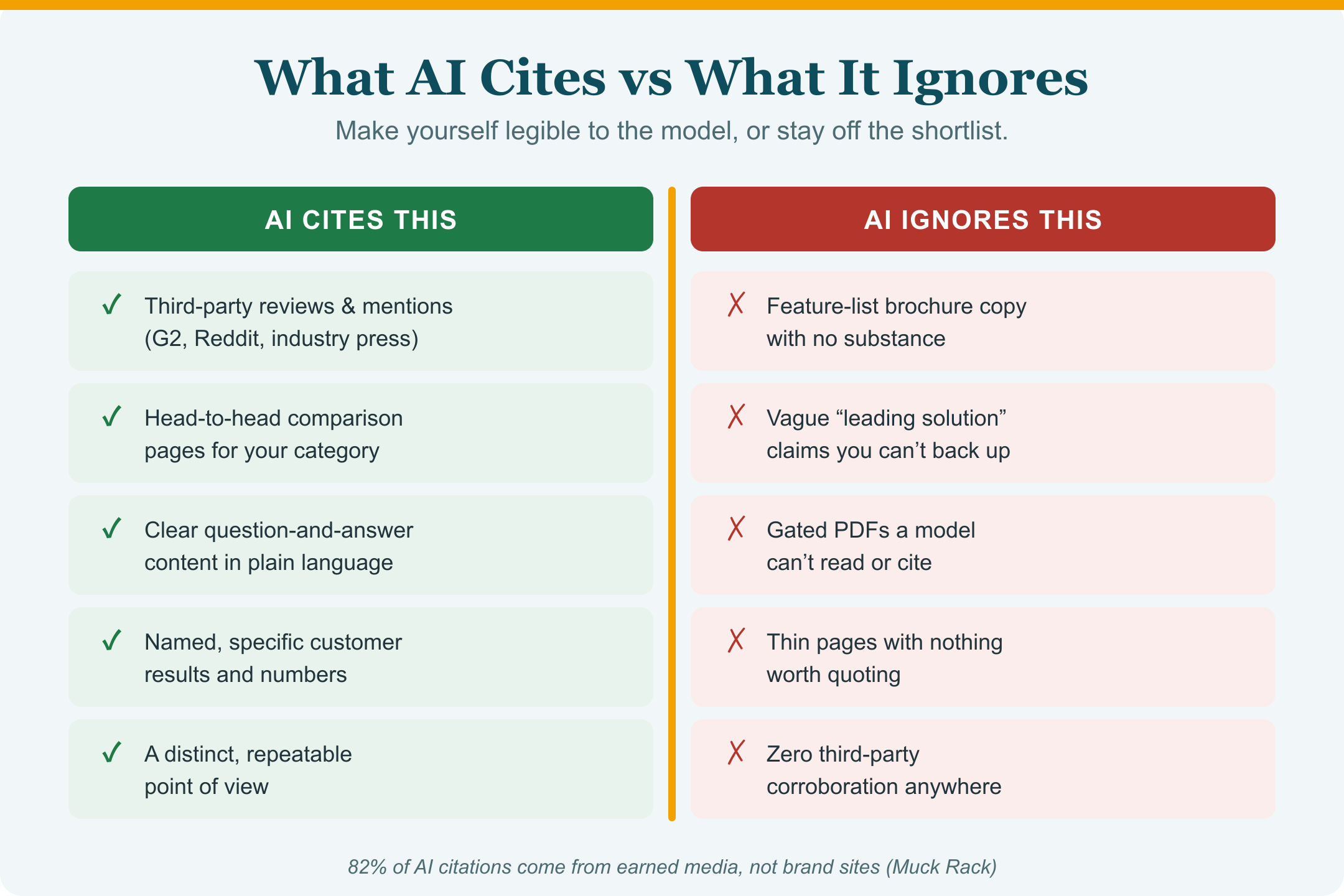
- Models cite what they can read and quote: clear Q&A, comparison pages, named results, and third-party reviews. They ignore feature lists, vague claims, and gated PDFs.
- Your competitors aren't getting named because they're better. They're getting named because they're more legible. That gap is your opportunity.
- The fix is sales-led, not a marketing department: answer the questions buyers actually ask, in public, in plain language. The same things that make you legible to AI make you persuasive to humans.
Try this right now. Open ChatGPT or Perplexity and ask it the exact question your buyer asks: "What are the best [your category] options for a company like mine?" Read the answer. If your company isn't named, you just watched yourself get left off a shortlist, and the buyer never even knew you existed.
This isn't a fringe scenario. 94% of B2B buyers now use generative AI in their research (Forrester), and 60% use it specifically to build or augment their vendor list (Google). When the model doesn't name you, you're not in the running. You've been filtered out before a human ever compared you to anyone.
In the last piece, I showed you that 95% of winning vendors are already on the buyer's Day-One shortlist (6sense). This is the mechanical question underneath it: when an AI builds that shortlist, why does it skip you, and what do you actually do about it? Let me walk through how the machine decides, then exactly how to get named.
How an AI Assistant Actually Builds a Vendor Shortlist
There's no magic here, and understanding the mechanics changes everything. When you ask a model for recommendations, it pulls from what it has read: its training data plus, increasingly, live web results it retrieves and cites on the spot. It's hunting for sources that clearly name vendors, describe what each one does, and back it up. Then it assembles a shortlist from the most credible, most quotable material it can find.
Here's the part that catches founders off guard: most of what it cites isn't your website. 82% of AI citations come from earned media, third-party reviews, press, and community, not the brand's own domain (Muck Rack). Perplexity leans especially hard on community sources, with roughly 47% of its citations coming from Reddit (Profound). The model is building its shortlist from the conversation happening about you, not the brochure you wrote about yourself. If there's no conversation, there's nothing for it to pull, and you don't get named.
Why Ranking on Google No Longer Means You Get Named
If you've invested years in SEO, brace yourself. Your Google rank barely predicts whether an AI names you. Only about 12% of the pages AI cites even rank in Google's top 10 for the same query (Ahrefs, from a study of 15,000 queries). Moz found that 88% of Google's own AI Mode citations don't come from the organic top 10. These are different engines running on different logic.
Google rewards pages optimized to rank against a thousand ranking signals. An AI assistant rewards sources that clearly and credibly answer the question, wherever they happen to live. So you can be sitting at position one on Google and be completely absent from ChatGPT's answer at the same time. That's not a bug you can SEO your way out of. It's a different game with different rules, and most of your competitors haven't figured that out yet either.
The Content That Makes You Legible to a Model
"Legible" means a model can find you, understand what you do, and quote something specific and credible about you. That's a low bar most founders still fail, because their best thinking lives in sales calls and slide decks the model can't read. Here's what actually makes you legible:
- Answer real questions in plain language. Q&A and FAQ content is easy for a model to lift and quote directly.
- Publish honest comparison content for your category, including how you stack up against alternatives.
- Put named, specific results in plain text, not locked inside a gated PDF or baked into an image the model can't parse.
- State a clear point of view so there's something distinctive worth quoting.
- Get onto the sources models already trust: review sites like G2, relevant communities, and earned press.
Why Your Competitors Are Getting Cited and You Aren't
It's rarely because their product is better. It's because they're more legible. They show up on the review sites, they have comparison pages, their customers talk about them in communities, and their content answers the buyer's real questions in words a model can quote. You might have the superior product and still lose, simply because the machine can't find anything credible to say about you.
Meanwhile, your sharpest thinking, the stuff that wins deals, is trapped in your head, in your live sales calls, and in a deck nobody outside a meeting ever sees. A model can't read a sales call. It can only recommend what's been written down, in public, in a form it can parse. Your competitors didn't out-market you. They just made their expertise readable.
"AI doesn't recommend the best vendor. It recommends the most legible one. Those aren't the same thing, and the gap is your opening."
Fixing Your Absence Without Turning Into a Marketing Agency
You don't need a content team or a six-month campaign. You need a focused, sales-led fix you can start this month:
- Mine your sales calls for the 10 questions buyers actually ask. Answer each one publicly, in plain language, on your site.
- Build one honest comparison page for your category. Buyers and models both love a clear head-to-head.
- Claim and populate your review profiles. Ask five happy customers for a G2 review this week.
- Write your point of view down once, then reuse it everywhere. One strong take beats ten bland posts.
- Re-test monthly. Ask the AI your buyer's question and watch whether you start showing up.
This is founder-led work because it runs on your judgment, your take on the problem you solve. It's also exactly the kind of system a Fractional Sales Leader helps you install and enforce, so it actually gets done instead of drifting onto a someday list while you're busy closing deals.
The Same Things That Make You Legible to AI Make You Persuasive to Humans
Here's the payoff, and it's the reason none of this is a gimmick. Everything above, clear answers, honest comparisons, specific proof, a real point of view, doesn't just win the model. It wins the human. A buyer who reads your comparison page trusts you more. A prospect who found you through a Reddit thread or a G2 review arrives warmer than any cold lead. And buyers already tell Forrester they now rate generative AI as a more meaningful source than any other single channel, so the material that feeds it is doing double duty.
So this isn't about gaming an algorithm. It's about finally saying clearly, in public, what you already say every day on sales calls. The model rewards it. The buyer rewards it. And you stop quietly losing deals you never even knew you were in. One honest caveat, though: if you don't yet have a real point of view or proof that you win, no amount of this will save you. You'll just be very clearly invisible. Fix the substance first, then make it legible. If you're a founder between $1M and $10M in ARR with a motion that works, getting named is one of the highest-leverage moves you can make right now.
Related Reading
Frequently Asked Questions
Q: Why isn't ChatGPT recommending my company?
Because AI assistants build recommendations from what they can find and quote, and 82% of AI citations come from earned media and third-party sources, not your own website (Muck Rack). If there's little credible content out there that names you, describes what you do, and backs it up, the model has nothing to pull. It's not judging your product. It literally can't see enough about you to include you. The fix is to make your expertise legible: clear answers, comparison content, reviews, and a point of view worth quoting.
Q: I rank #1 on Google. Doesn't that get me cited by AI?
Barely. Only about 12% of the pages AI cites even rank in Google's top 10 for the same query (Ahrefs), and 88% of Google's own AI Mode citations don't come from the organic top 10 (Moz). Google and AI assistants run on different logic. Google rewards pages optimized to rank; AI rewards sources that clearly and credibly answer the question, wherever they live. You can be first on Google and invisible in ChatGPT at the same time, which is exactly why so many well-ranked founders are surprised to find they're never named.
Q: What kind of content does AI actually cite?
Content it can read and quote credibly: clear question-and-answer pages in plain language, honest head-to-head comparison pages, named and specific customer results in text, and a distinct point of view. It also leans heavily on third-party corroboration, review sites like G2 and community sources like Reddit. It ignores feature-list brochure copy, vague "leading solution" claims, thin pages with nothing worth quoting, and anything locked in a gated PDF or an image it can't parse.
Q: How do I get onto the third-party sources AI trusts?
Start where your buyers already are. Claim and fill out your G2 and review profiles and ask happy customers to leave honest reviews. Get mentioned in the communities and industry press relevant to your category. Publish comparison content that a reviewer or journalist can reference. You don't need to be everywhere, you need credible corroboration in a few places the model already reads. Perplexity alone pulls roughly 47% of its citations from Reddit (Profound), so even one active, honest presence in the right community moves the needle.
Q: Isn't this just "GEO" hype, gaming the AI?
No, and that's the best part. The same things that make you legible to a model, clear answers, honest comparisons, specific proof, and a real point of view, are exactly what make you persuasive to a human buyer. You're not tricking an algorithm. You're finally publishing, in plain sight, what you already say on every sales call. If the substance is real, this just gets it in front of the people and the tools deciding your shortlist. If the substance isn't real yet, no tactic saves you, so build that first.
Q: I'm a small founder-led team with no marketing department. Where do I start?
Start with your own sales calls. Write down the ten questions buyers ask you most, and answer each one publicly in plain language. Build one honest comparison page for your category. Claim your review profiles and ask five happy customers for a review this week. Write your point of view down once and reuse it. Then re-test monthly by asking the AI your buyer's question. It's a few hours of focused work built on knowledge you already have, and it's exactly the kind of system a Fractional Sales Leader installs so it actually gets done.
Want to be the company AI names?
If you're a founder between $1M and $10M in ARR, I'll help you turn what you already know into content that gets you named by AI and trusted by buyers, without hiring a marketing agency. See how it works at louiebernstein.com.
Schedule a 30-Minute CallAbout the Author
Louie Bernstein
Fractional Sales Leader with 50 years of sales experience helping $1M–$10M ARR companies build scalable, repeatable sales systems. Founder of MindIQ (INC 500). LinkedIn Top Voice in Sales Management, Sales Operations, and Sales Coaching.