Key Takeaways:
- The founder who says "I just need someone who can sell like me" is trying to hire a system disguised as a person. That hire almost always fails, and the founder blames the talent.
- Companies with a formal sales process generate 18% more revenue growth than those without one (Harvard Business Review). The process is the asset. People operate it.
- A sales system has five parts: a playbook, a qualification bar, CRM hygiene, a cadence, and an Accountabilities Document. Install all five and an ordinary strong hire performs like your best rep.
- Sales turnover runs near 35% a year (Xactly) and replacing one rep costs roughly $97,690 (DePaul University). A system is the only thing that survives the churn.
- The system is the product you're building. The people are the operators. Get that order right and you can finally scale past yourself.
I've heard the same sentence from founders for fifty years, and it hasn't changed a word: "I just need to find someone who can sell like me."
I understand why. You built the thing. You closed the first hundred deals on instinct, charm, and a deep understanding of the problem you solve. So it feels obvious that the fix for your growth is another you. Find that person, hand them the phone, and get your evenings back.
Here's the hard truth. That person doesn't exist, and even if they did, you couldn't afford to bet your company on finding them. What you're actually trying to hire isn't a human being. It's everything in your head that makes you good at selling your product. That's not a person. That's a system. And you can't recruit a system. You have to build one.
This is the single most expensive misunderstanding I see in companies between $1M and $10M ARR. So let's take it apart.
The Clone You're Trying to Hire Doesn't Exist
When you sell, you're running a system you can't see. You qualify a prospect in the first four minutes without knowing you're doing it. You skip the demo for the wrong-fit buyer because something feels off. You know which objection is real and which is a smokescreen. You remember to follow up on day three because the deal is alive in your head. None of that is written down. It just lives in you.
Now you hire a "closer." They walk in with none of that context. No qualification instinct, no product intuition, no memory of the four hundred conversations that taught you what a good deal smells like. You hand them a login and a quota and hope the magic transfers. It doesn't. So they flail, the pipeline fills with garbage, and six months later you're back to closing everything yourself, more convinced than ever that good salespeople are impossible to find.
The talent wasn't the problem. You dropped a strong hire into an empty room and called it a sales team.
And the math on getting this wrong is brutal. A new sales rep needs 3 to 9 months to reach full productivity (Bridge Group). Sales turnover runs around 35% a year, nearly three times the all-industry average (Xactly). When a rep leaves, replacing them costs roughly $97,690 in recruiting, onboarding, lost ramp, and missed pipeline (DePaul University). If everything that makes selling work lives in that one person's head, every departure sets you back to zero. You're not building an asset. You're renting one, badly.
You're not looking for someone who can sell like you. You're looking for a way to sell that doesn't depend on you. Those are completely different projects.
The System Is the Product. People Are the Operators.
Think about how you'd build any other part of your business. You wouldn't hire a "great support person" and hope they invent your support experience from scratch. You'd build a support system: a help desk, documented answers, escalation paths, response-time standards. Then you'd hire people to run it. The system is the product. The person is the operator.
Sales is no different, and the data is not subtle. Companies with a formal sales process generate 18% more revenue growth than companies without one (Harvard Business Review, Jordan & Kelly). And it compounds from there. Organizations that actively manage and refine their process, rather than just documenting it once, post a 21.2% higher quota-attainment rate than those with a merely formal process, and 37.1% higher than teams selling by instinct (CSO Insights). The gap between "we have a system" and "everyone wings it" is the gap between a company that scales and one that stalls at the founder's ceiling.
This is the reframe that changes everything. Stop asking "how do I find better salespeople?" Start asking "what would let an ordinary strong hire close deals like my best rep?" The answer isn't a person. It's infrastructure. When the system is good, average-but-coachable people produce above-average results, because the system is doing the heavy lifting they can't do on their own yet. When the system is missing, even your unicorn hire underperforms, because there's nothing to stand on.
That's also the exact reason fractional sales leadership works. A Fractional Sales Leader isn't a body you rent to make calls. They install the system, then hand you something that keeps running after they've stepped back.
The Five Parts of a Sales System That Scales
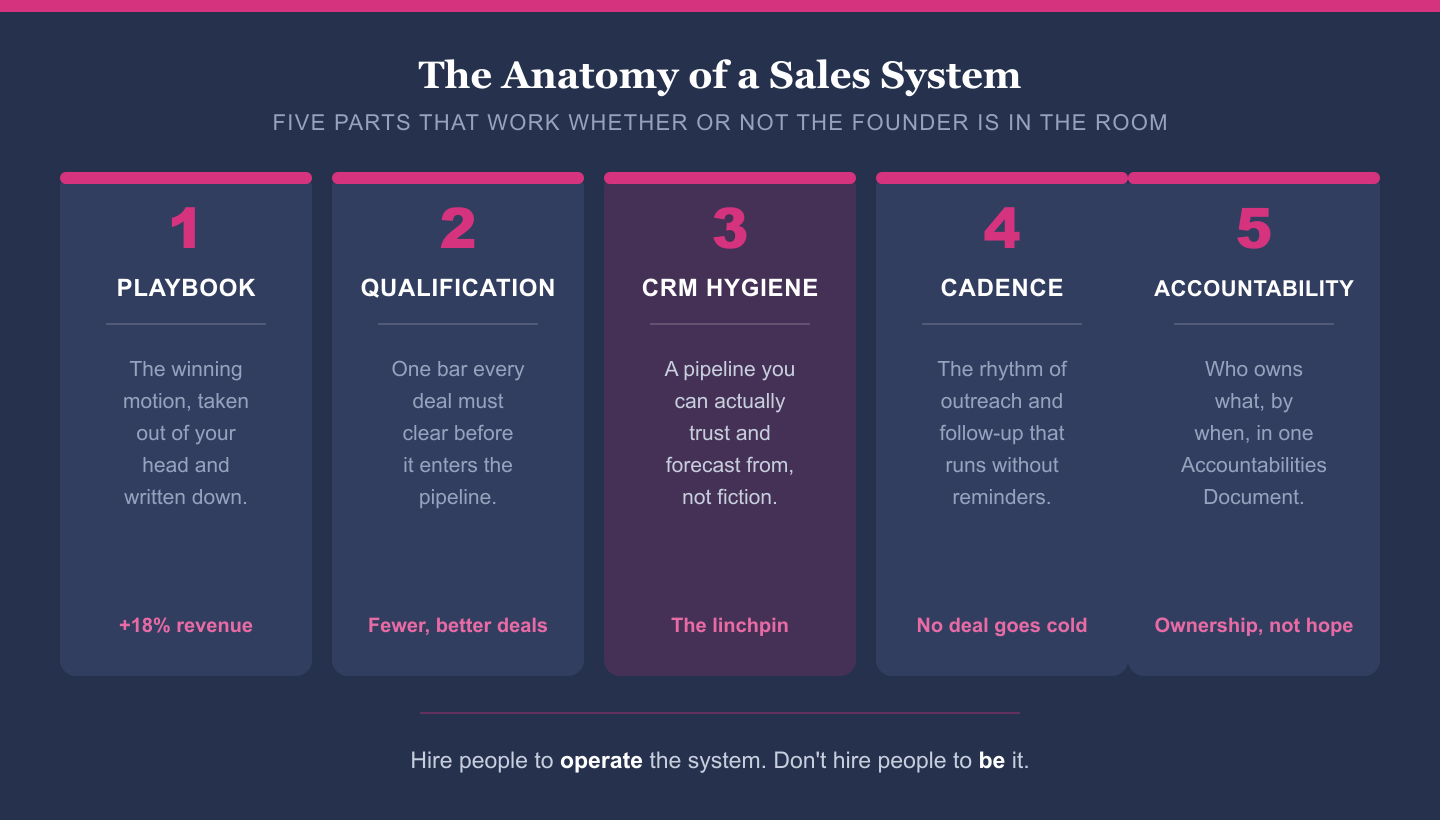
A sales system isn't a single document or a CRM you bought. It's five moving parts working together. Miss any one of them and the whole thing leaks. Here's what each part is and why it matters.
1. The Playbook: Your Winning Motion, Taken Out of Your Head
The playbook is the pattern behind your best deals, written down so someone else can run it. Who your ideal customer is and who to walk away from. The questions that surface real pain. The three objections you hear every week and the answers that work. The story that makes a prospect lean in. If it lives only in your instincts, it can't be handed off. The first job of a system is to make the invisible visible.
2. Qualification: One Bar Every Deal Must Clear
Most founder-led pipelines are full of deals that were never going to close. A qualification standard, whatever framework you like, gives every rep the same bar to clear before a deal counts as real. It does two things at once: it stops your team from wasting weeks chasing bad-fit buyers, and it makes your pipeline mean something. A qualified deal is a forecastable deal. An unqualified one is a wish.
3. CRM Hygiene: A Pipeline You Can Actually Trust
This is the part everyone skips, and it's the linchpin. Left alone, 70% of the data in a CRM goes stale every year and 91% of records are incomplete (Dun & Bradstreet). A system defines what each stage means, what has to be true to move a deal forward, and what "closed-lost" actually requires. When the CRM is clean, your Monday pipeline review takes ten minutes and tells you the truth. When it's dirty, your forecast is fiction and you don't find out until the quarter ends.
4. Cadence: The Rhythm That Runs Without Reminders
Deals don't die from a single missed step. They die from silence. A cadence is the defined rhythm of outreach and follow-up, so no prospect goes cold because a rep forgot. It's also the operating rhythm of the team: the weekly pipeline review, the deal-by-deal coaching, the one-on-ones. Reps already spend about 60% of the week on non-selling work (Salesforce). A cadence makes sure the 40% that's actually selling lands on the deals that matter.
5. Accountability: Who Owns What, By When
The last part is the one that holds the other four together. Every role gets a clear Accountabilities Document that spells out what they own, what "good" looks like, and the numbers they're responsible for. Not a job description you wrote once and filed. A living standard you coach against every week. Without it, "the system" is just a binder nobody follows. With it, expectations are explicit and performance is a conversation, not a surprise.
A playbook with no accountability is a suggestion. Accountability with no playbook is pressure with no path. You need all five parts, or you don't have a system. You have a pile of good intentions.
What Actually Changes When You Install It
Here's the part that matters to you as a founder. The value of a system isn't philosophical. It shows up in specific, measurable ways, and it shows up fast. Take the same strong hire and change nothing about them. Change only what you drop them into. This is the difference.
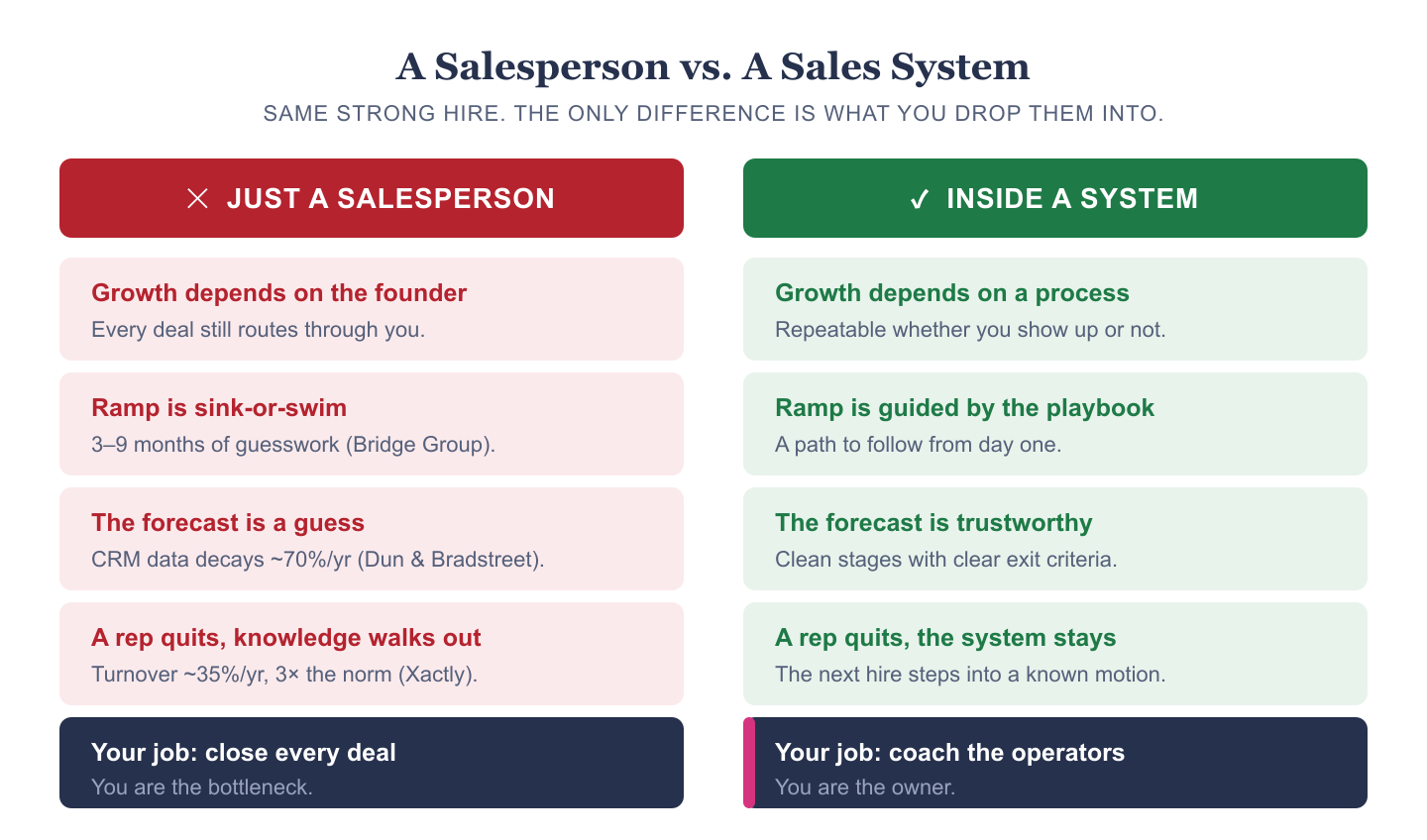
Notice what the right-hand column has in common. In every row, the company stops depending on any single person, including you. That's the whole point. A salesperson is a bet on one human's talent, energy, and tenure. A system is an asset the company owns. When a rep on a system quits, the next hire steps into a known motion and ramps against a playbook instead of guessing. The knowledge doesn't walk out the door with them.
And your own role changes in the best possible way. You go from being the person who has to close every deal to being the person who owns a machine that closes deals. That's the shift from operator to owner. It's also, not by accident, exactly what a buyer pays a premium for if you ever sell the business. A company that runs on a system is worth more than one that runs on a founder.
When a System Won't Save You (And When It Will)
I'll be straight with you, because I'd rather lose the engagement than sell you something that won't work. A sales system is not a magic trick, and there's one situation where it can't help.
If you don't yet have a repeatable win, a system has nothing to systematize. If you're pre-revenue, or you've closed a handful of deals that were all favors, one-offs, or wildly different from each other, then you haven't found your motion yet. You're still doing the founder's real job: talking to the market until you find the pattern that repeats. No playbook, no CRM, and no fractional hire can manufacture that pattern for you. That part is on you, and it should be. Nobody can outsource product-market fit.
But here's the flip side, and it's where most $1M–$10M founders actually live. If you've personally closed enough deals that you can feel a pattern, you don't have a talent problem. You have an extraction problem. The winning motion exists. It's just trapped in your head, running only when you're in the room. That is the exact moment a system pays for itself, because there's finally something real to capture and hand off. You don't need better talent. You need your winning motion turned into infrastructure a strong, ordinary hire can run.
If your sales still only work when you're the one selling, the answer was never a better hire. It's a system that makes the hire almost interchangeable.
Frequently Asked Questions
Q: Isn't hiring a great salesperson faster than building a whole system?
It feels faster, and that's the trap. A new rep takes 3 to 9 months to reach full productivity (Bridge Group), and if there's no system underneath them, that ramp is guesswork with a high chance of failure. Building the core of a system, the playbook, the qualification bar, and clean pipeline stages, takes weeks, not months, and it makes every hire after it ramp faster and cost less. The system isn't the slow path. It's what makes hiring finally work.
Q: Does a sales system mean I need expensive software?
No. The system is the process, not the tools. You can run a strong sales system on a CRM you already pay for. What matters isn't the software, it's the discipline around it: what each stage means, what has to be true to advance a deal, and the weekly rhythm that keeps the data honest. Most founders don't have a tool problem. They have a "nobody defined how we sell" problem. Fix that first, and the tools you already own start earning their keep.
Q: I'm the best salesperson in my company. Won't a system make us generic?
The opposite. A system is built from your winning motion, not a template off the internet. It captures what makes you effective and lets other people run it. You're not replacing your instincts with something generic. You're cloning your instincts into a form your team can use when you're not in the room. That's how your edge scales instead of staying locked inside one calendar.
Q: Can't I just build the system myself?
You can, and some founders do. The catch is that you're the worst-positioned person to document your own instincts, because most of what you do is unconscious, and you're already out of hours. That's the specific value of a Fractional Sales Leader: an outside operator who's built these systems many times pulls the motion out of your head, installs it, and coaches the team on it, in a fraction of the time it would take you to do it between everything else you're carrying.
Q: How is this different from just hiring a fractional VP of sales to sell for me?
A Fractional Sales Leader isn't there to be your closer. If they just sell for you, you've rebuilt the same dependency with a more expensive person. The job is to build the system and the team that runs it, so the results outlast the engagement. When we're done, you don't have a person you can't lose. You have infrastructure you own. That's the whole difference between renting revenue and building a sales engine.
Q: What if I've only closed a few deals and they were all different?
Then be honest with yourself: you may not have a repeatable motion yet, and a system can't systematize something that doesn't exist. Your job right now is to keep selling until a pattern emerges, which customers, which problem, which pitch. Once you can feel that pattern, even before it's written down, you're ready to turn it into a system. If you're not sure which side of that line you're on, that's a good first conversation to have.
Stop hiring for a system that doesn't exist yet.
If your sales still run through you, the fix isn't another rep. It's the infrastructure that lets a strong, ordinary hire close like your best. See how that gets built at louiebernstein.com, or grab 30 minutes and we'll map your winning motion together.
Schedule a 30-Minute CallAbout the Author
Louie Bernstein
Fractional Sales Leader with 50 years of sales experience helping $1M–$10M ARR companies build scalable, repeatable sales systems. Founder of MindIQ (INC 500). LinkedIn Top Voice in Sales Management, Sales Operations, and Sales Coaching.