Key Takeaways:
- Your CRM isn't lying on purpose. It's faithfully repeating back the optimistic, half-remembered, never-updated inputs you fed it. Garbage in, forecast out.
- 76% of organizations say less than half their CRM data is accurate and complete (Validity, 2025). The forecast you're betting payroll on is built on data most people don't trust.
- The three fictions that wreck a founder's forecast: a win probability nobody calculated, a close date that only ever slips, and a stage name that describes your activity instead of the buyer's decision.
- A clean pipeline isn't a fancier tool. It's stages that mean the same thing to everyone, written exit criteria, and every deal carrying an owner and a dated next step.
- The "Monday morning pipeline review" you actually want, 10 minutes instead of a full-day firefight, only becomes possible once the pipeline lives outside your head. It's a design problem, not a discipline problem.
- A Fractional Sales Leader installs the whole system in a quarter, then hands you the keys. You get what a full-time VP of Sales would build, without the full-time cost.
Open your CRM right now and look at the deals marked 70% or 80% to close this quarter. Ask one question about each one: who put that number there, and what did they base it on?
For most founder-led companies, the honest answer is "me, and a feeling."
That's the whole problem. Your CRM isn't a system of record. It's a system of hope. It takes the optimistic inputs you fed it and hands them back to you dressed up as a forecast. And you make real decisions off that number. Hiring, spending, whether you can finally take a breath this quarter.
You're not alone in this. Validity's 2025 research found that 76% of organizations say less than half of their CRM data is accurate and complete (Validity, 2025). Worse, 37% of staff admit they regularly fabricate CRM data to tell leadership what it wants to hear (Validity, 2025). The instrument you're using to predict revenue is one most people quietly don't believe.
The good news is that a forecast you can trust isn't a bigger team or a pricier tool. It's a handful of definitions, moved out of your head and onto the board. Here's what's lying to you, and what clean actually looks like.
How to Tell If Your CRM Is Lying to You
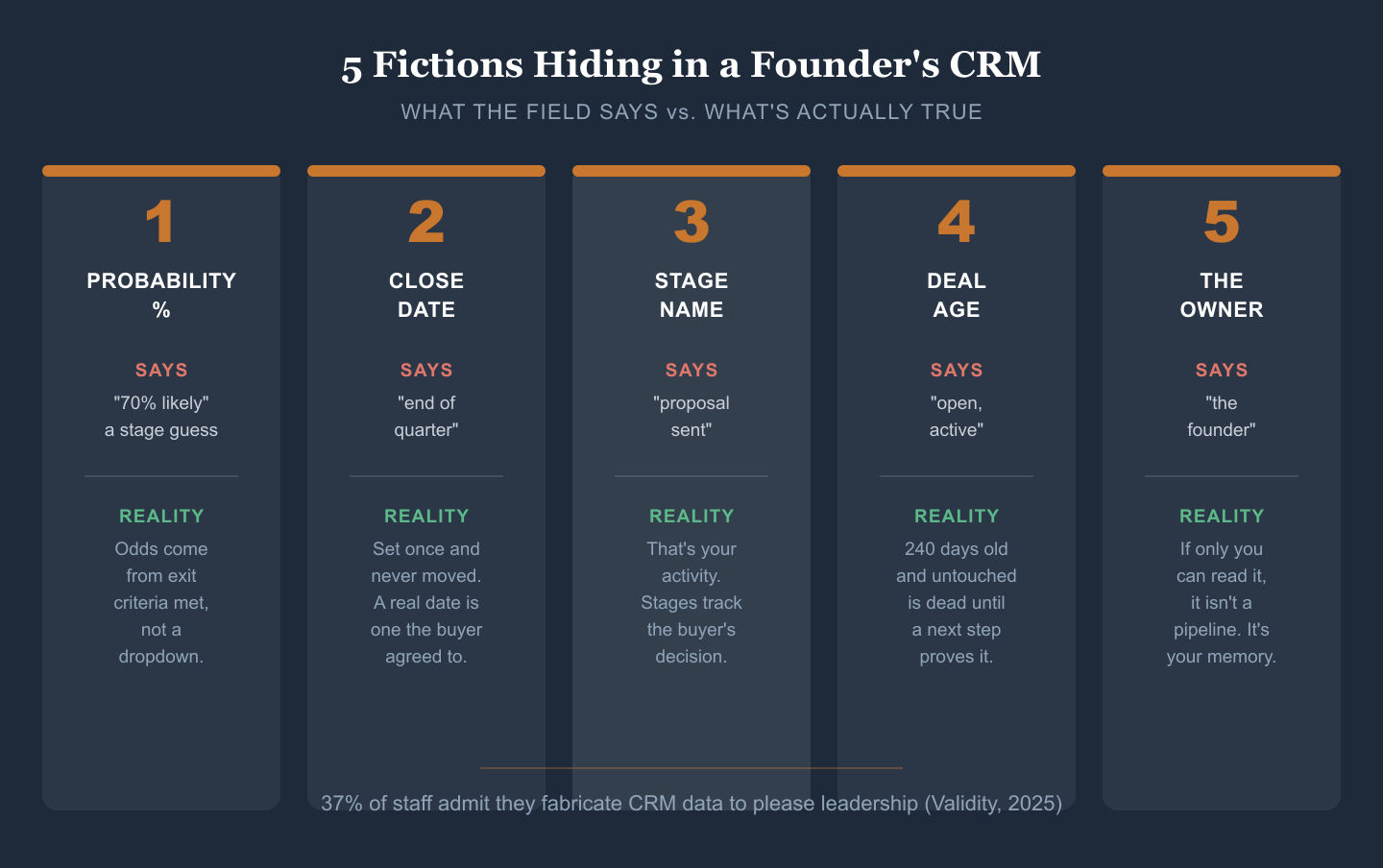
A lying CRM doesn't announce itself. It looks organized. Deals sit in stages, percentages are assigned, dates are filled in. That surface tidiness is exactly what makes it dangerous, because it feels like visibility. Here are the five fictions I find in almost every founder's pipeline.
The win probability nobody calculated
Most CRMs auto-assign a probability to each stage. A deal reaches "Proposal" and the software calls it 60%. But that number is an average of other companies' deals, not evidence about this one. A proposal sitting with someone who has no budget isn't 60% of anything. When you add up a column of made-up percentages, you don't get a forecast. You get a fiction with a decimal point on it.
The close date that only ever moves one direction
Watch your close dates for a quarter and you'll notice they never move earlier. They slip. End of March becomes end of June becomes "next quarter." A close date is only real if the buyer agreed to it. If you set it, it's a wish. And a pipeline full of wishes is why quarter-end always feels like a surprise you somehow should have seen coming.
Stages that describe you, not the buyer
"Demo done." "Proposal sent." "Followed up." Those describe your activity, and your activity tells you nothing about whether the deal closes. Naming a stage after what you did is the most common way founders fool themselves. Motion looks like progress right up until the quarter ends and none of it converted to revenue.
Deals that are "active" and haven't moved in months
Every founder's CRM has them. Open 180 or 240 days. Still parked in "Negotiation." Still counted in the forecast. B2B pipelines typically run with only 60% to 70% of CRM fields consistently populated (Clari), and deal age is the field that quietly rots first. A deal nobody has touched in two months isn't active. It's dead, and it's inflating your number every time you look at the board.
A pipeline only you can read
This is the one that traps founders. Your CRM makes sense to you because you were on every call. You know "Acme" is really stalled because their CFO left, even though the record says "Committed." That context lives in your head, not in the system. Which means the pipeline can't be reviewed by anyone else, can't be handed off, and can't survive you taking a week off. A pipeline only the founder can interpret isn't a pipeline. It's your memory with a login screen.
A CRM doesn't lie because the software is bad. It lies because it faithfully reports the optimistic guesses you put in. Fix the inputs and the lying stops.
What a Clean, Forecastable Pipeline Actually Looks Like
Clean doesn't mean expensive or complicated. Fewer than 37% of sales reps actually use their CRM in the first place (CSO Insights), so complexity is the enemy, not the goal. A forecastable pipeline at your stage comes down to four things, and none of them require new software.
Every stage means the same thing to everyone
Stages should track where the buyer is in their decision, not where you are in your effort. Have they admitted a problem worth solving? Confirmed budget, authority, and a timeline? Agreed on a path to a decision? When a stage describes the buyer's commitment, "Qualified" means the same thing whether you read it or a brand-new rep does. That shared meaning is the entire point of a stage.
Exit criteria are written, not felt
An exit criterion is the one fact that must be true before a deal is allowed to move forward. Not "I feel good about it." A written, checkable fact: budget confirmed, decision-maker identified, next meeting booked. No criteria met, the deal stays put. That single rule is what separates a qualified deal from a pleasant conversation, and it's what makes your stages trustworthy instead of decorative.
Every deal has an owner and a dated next step
This is where founder-led pipelines quietly break. Every live deal needs a named owner and a specific next action with a date attached. "Follow up sometime" is not a next step. "Call Tuesday to confirm the security review" is. When every deal carries an owner and a dated action, the pipeline tells you and your team what to do next, without anyone having to remember it. Ownership is also what lets you finally hand a deal off without it dying.
One number becomes three
Stop forecasting with a single figure. Report three. Commit is what you'd bet your own money closes this period. Best Case is the realistic upside if things break your way. Pipeline is everything qualified that's still in play. Three numbers show you the range you're actually operating in, and they make it obvious when Commit is too thin to hit target while there's still time to do something about it.
A clean pipeline answers one question at a glance: what's real, and what's just hoped-for? If yours can't, the stages and exit criteria aren't defined yet.
The 10-Minute Monday Morning Pipeline Review
Here's what founders actually want. Not a dashboard with 40 charts. A short, calm Monday review that tells them exactly where they stand before the week starts. Ten minutes, not a full-day firefight.
That review is completely achievable. But it's only possible after the stages, exit criteria, and ownership live outside your head. That's the part most people miss. The 10-minute review is a design problem, not a discipline problem. You can't run it fast until the pipeline stops depending on your memory to make sense.
Once the system exists, the agenda is short and the same every week:
- What moved forward, and did it earn the move by meeting its exit criteria?
- What's stuck, and what's the dated next step to unstick it?
- What new qualified pipeline got created? That's your earliest signal of future revenue.
- What should be killed? A dead deal you keep on the board is lying to your forecast.
Compare that to the alternative you're probably living now. Without the system, "reviewing the pipeline" means reconstructing it from memory, your inbox, and three half-trusted spreadsheet tabs. Validity found workers spend an average of 13 hours a week just hunting for basic information in the CRM (Validity, 2025). The review is slow because the data is scattered and only you can interpret it. Fix that, and the same review takes ten minutes and anyone on the team can run it.
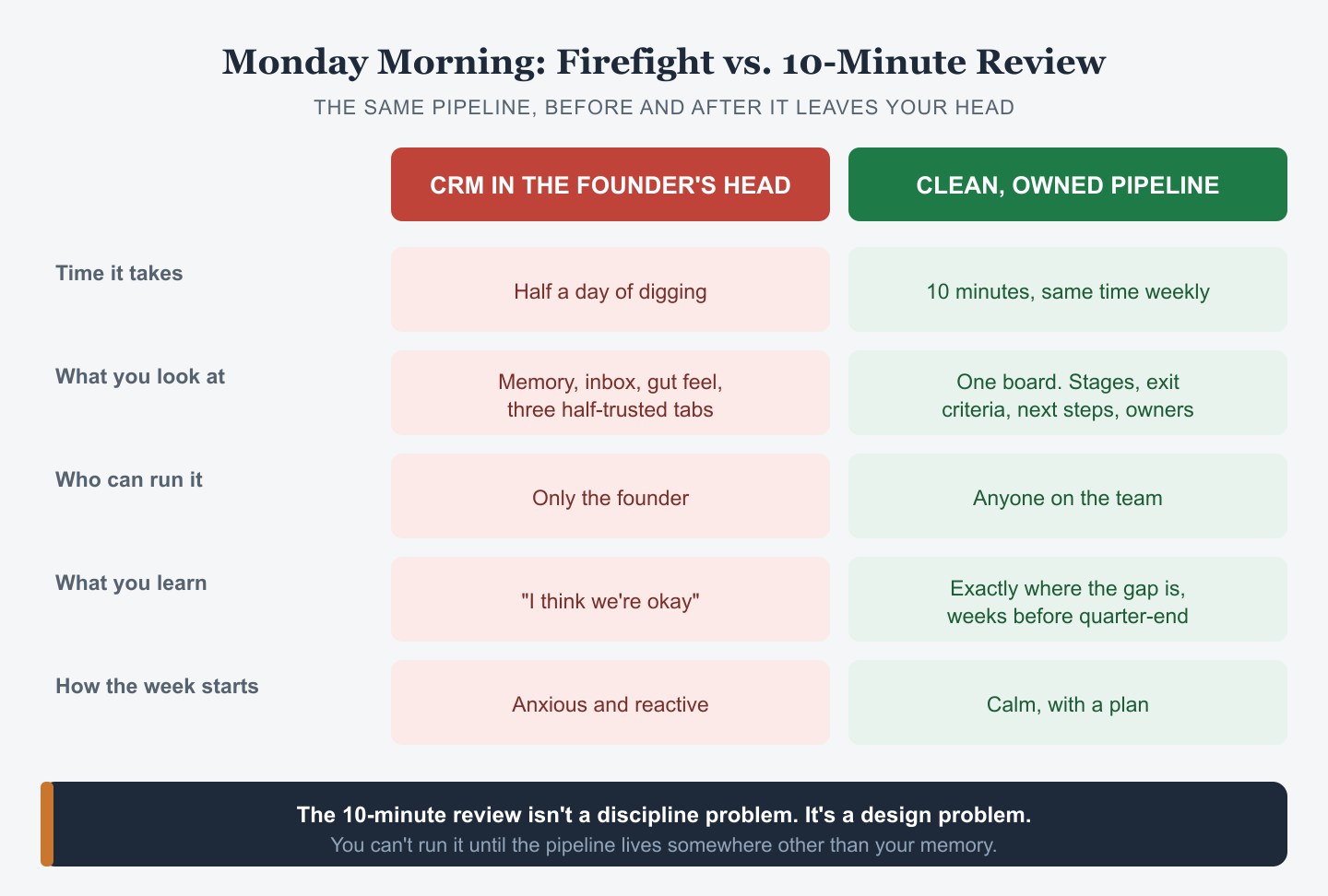
You'll know the system works the first Monday your pipeline review ends early and you actually believe the number at the bottom.
When a Clean CRM Won't Save You Yet
I'll be straight with you, because it matters. If you don't have a repeatable sales motion yet, none of this saves you. A CRM, stages, and exit criteria make a repeatable motion visible and predictable. They can't invent one. You can't systematize chaos, and instrumenting a business that doesn't yet know who it sells to or why people buy just gives you very organized confusion.
If that's you, the first job isn't forecasting. It's nailing the motion: a clear ICP, a real reason people buy, and a rough repeatable path from first conversation to close. That's the foundational work you do before you instrument anything on top of it.
But if you're already closing deals, just inconsistently and invisibly, you're the exact person this fixes. You have a motion. It's trapped in your head. The definitions above are what pull it out and turn it into something you can see, staff, hand off, and repeat without you being the single point of failure. That's the work I do with founders as a Fractional Sales Leader, and you can see how it works at louiebernstein.com.
Frequently Asked Questions
Q: Why is my sales forecast always wrong?
Because it's built on inputs nobody verified. Win probabilities the software guessed, close dates you set instead of the buyer, and stages named after your own activity. When 76% of organizations say less than half their CRM data is accurate and complete (Validity, 2025), an inaccurate forecast isn't a surprise. It's the expected output. Fix the inputs with real stage definitions and written exit criteria, and the forecast starts telling the truth.
Q: What does "exit criteria" mean in a sales pipeline?
An exit criterion is the specific, checkable fact that must be true before a deal is allowed to move to the next stage. For example, a deal can't leave "Qualified" until budget, decision-maker, and timeline are confirmed and you know how the order flows through their company. It's the gate that keeps optimism out of your pipeline. No criteria met, the deal doesn't advance, no matter how good the last call felt.
Q: How do I clean up a messy CRM without starting over?
Don't try to fix history. Draw a line. Define your stages and exit criteria first, then run every open deal through the new definitions once. Anything that doesn't meet the criteria for the stage it's sitting in either moves back or gets killed. It's uncomfortable, and it usually shrinks your pipeline on paper. That's not a loss. That's the fiction leaving. A smaller real pipeline is worth far more than a big fake one.
Q: How long should a pipeline review take?
Once the system exists, about ten minutes weekly, same time every week. If your review regularly runs long, that's a signal the data isn't clean or the pipeline still only makes sense to you. The length of your pipeline review is a pretty good measure of how much of it still lives in your head instead of on the board.
Q: Which CRM is best for a founder doing $1M to $10M?
The one your team will actually update every day. HubSpot, Pipedrive, or Close are all plenty at your stage. The tool matters far less than the stage definitions and exit criteria you put inside it. Founders who spend three months choosing a CRM and zero months defining what their stages mean have it exactly backwards. Simple and used beats powerful and ignored, every time.
Q: Can a Fractional Sales Leader really fix this without a full-time hire?
Yes, and that's the point. A Fractional Sales Leader sets up or cleans up the CRM, writes the stage definitions and exit criteria with you, builds the forecasting cadence, and runs the rhythm alongside you until it sticks. Then you own it. You get the system a full-time VP of Sales would build, without the full-time salary, and without waiting until you can afford one to finally trust your own numbers.
Your forecast should be evidence, not optimism.
If your pipeline lives in your head and your CRM only makes sense to you, let's fix that. In 30 minutes I'll show you exactly where your forecast is fiction and what a clean, 10-minute-review pipeline would look like for your business. See how I help founders build predictable revenue at louiebernstein.com.
Schedule a 30-Minute CallAbout the Author
Louie Bernstein
Fractional Sales Leader with 50 years of sales experience helping $1M–$10M ARR companies build scalable, repeatable sales systems. Founder of MindIQ (INC 500). LinkedIn Top Voice in Sales Management, Sales Operations, and Sales Coaching.