Sales management for founder-led teams
Your best rep doesn't need another pipeline review, another forecast call or another CRM reminder. They need someone who clears the road. Here's how to manage top performers so they sell more, stay longer and stop wondering why they need a manager at all.

By Louie Bernstein · Last updated
Manage top sales performers by removing obstacles, not adding coaching. Protect their selling time, cut unnecessary meetings, get stuck approvals moving, handle internal politics and keep admin off their plate. Average performers need coaching. Top performers need leverage. A sales manager's job is to build an environment where the best reps can sell at their highest level.
A top sales performer needs a manager who removes friction, not one who adds supervision. Most founders get this backwards. They promote themselves into the sales manager seat, then manage the best rep the same way they manage the newest one: same forecast call, same pipeline review, same CRM nagging. The best rep doesn't need that. The best rep needs air cover.
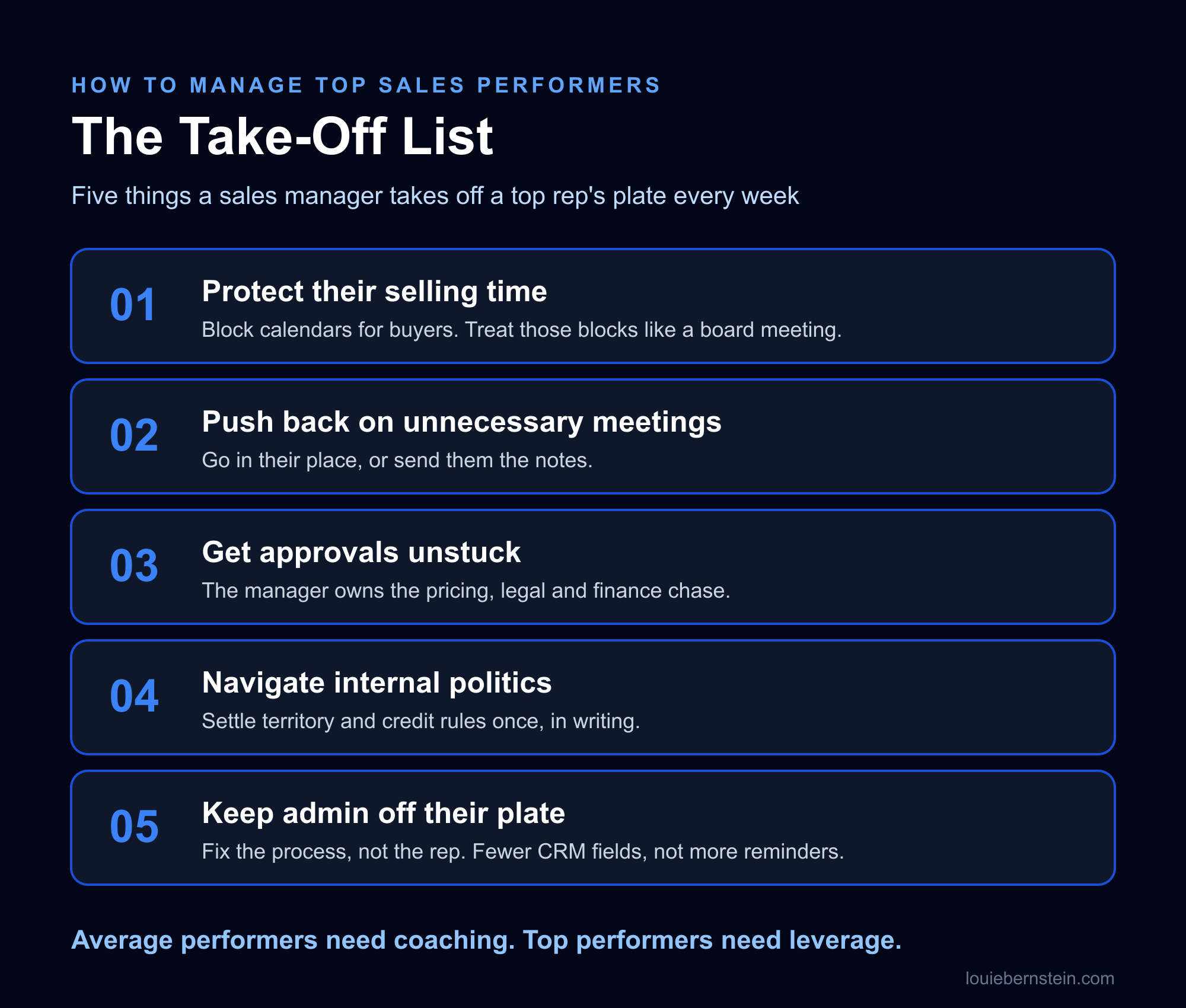
The Take-Off List is the running list of tasks, meetings and approvals a sales manager removes from a top rep's week. Every 1:1 with a top performer starts with one question: what's slowing you down that I can take off your plate? The manager writes the answer down, owns it and reports back. Here are the five things that land on most Take-Off Lists.

Selling time is the hours a rep spends talking to buyers, preparing for buyers or following up with buyers. Everything else is overhead. Reps spend just 28% of their week actually selling (Salesforce State of Sales, 2022). For your top performer, that number is the whole game. Block their calendar for prospecting and buyer calls, and treat those blocks the way you'd treat a board meeting.
What You Get: More hours in front of buyers from the rep who already converts them best.
Top performers get pulled into everything: product feedback sessions, marketing brainstorms, all-hands prep, the new hire's shadowing schedule. Each one sounds reasonable. Together they eat a day a week. Ask of every recurring meeting: does this rep need to be here, or do they just need the notes? Then go in their place, or send them the summary.
What You Get: A calendar your best rep controls, and a manager who absorbs the internal noise.
Nothing frustrates a closer more than a signed-in-principle deal stuck in pricing, legal or finance. The rep did the hard part. Now the deal is waiting on someone inside your own company. The sales manager owns that chase. Walk the discount approval to the CFO. Call legal about the redlines. Write the approval rules down so the next deal doesn't stall in the same spot.
What You Get: Deals that close on the buyer's timeline, not your internal queue.
Territory disputes, account ownership fights, credit splits, a delivery team that resents the promises sales makes. Top performers run into these first because they sell the most. Let them sell and handle the politics yourself. Settle the rule once, in writing, and stop the same argument from coming back every quarter.
What You Get: A rep who spends their energy on buyers, not on defending their own deals inside the building.
CRM updates matter. The forecast depends on them. But if your best rep spends an hour a day on data entry, fix the process, not the rep. Cut the required fields to the ones you actually use. Have a coordinator book meetings and build proposals. A CRM reminder is supervision. A shorter form is support.
What You Get: Clean data without turning your top performer into a part-time admin.

Sales managers coach the wrong people because coaching the best rep feels productive and safe. The rep is pleasant, the deals are interesting and the conversation goes well. Meanwhile, the middle of the team, the reps who would gain the most from real coaching, gets a generic weekly meeting. Coach the middle. Clear the path for the top. If your meetings are where the time goes, start by tightening how you run your weekly sales meeting.
None of this means your top performer gets no accountability. They still have a quota, still own their pipeline and still need to hit the activities in their Accountabilities Document. The difference is how you check. Inspect the evidence in a short 1:1, then spend the rest of the meeting on the Take-Off List. That's how you run sales 1:1s off the Accountabilities Document without making your best rep feel micromanaged.
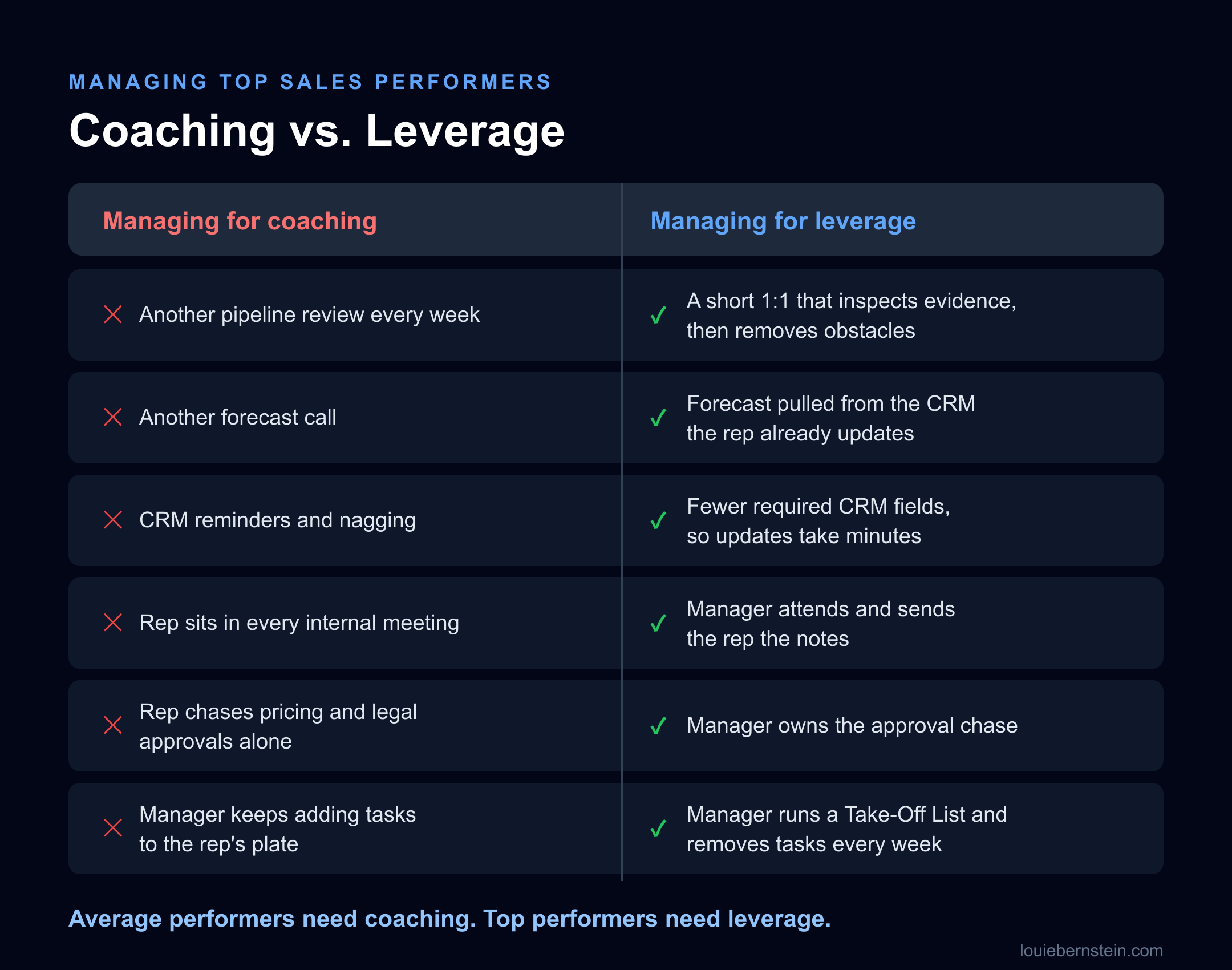
Managing for coaching tries to make the rep better at selling. Managing for leverage makes it easier for an already-great rep to sell more. Average performers need the first. Top performers need the second.

| Managing for coaching | Managing for leverage |
|---|---|
| ✕ Another pipeline review every week | ✓ A short 1:1 that inspects evidence, then removes obstacles |
| ✕ Another forecast call | ✓ Forecast pulled from the CRM the rep already updates |
| ✕ CRM reminders and nagging | ✓ Fewer required CRM fields, so updates take minutes |
| ✕ Rep sits in every internal meeting | ✓ Manager attends and sends the rep the notes |
| ✕ Rep chases pricing and legal approvals alone | ✓ Manager owns the approval chase |
| ✕ Manager keeps adding tasks to the rep's plate | ✓ Manager runs a Take-Off List and removes tasks every week |
A sales manager should split time by what each group of reps actually needs, not by who is easiest to talk to. Here's the split I use with founder-led teams.
A short weekly 1:1, a quick check of the evidence and the Take-Off List. Ask for their help shaping the playbook, then protect their calendar.
Most of your coaching hours. Ride along on calls, run daily drills, give one specific correction at a time. This is where coaching moves the number.
Check the system first. Did they get a written process, a fair territory and real onboarding? If they did and the numbers still aren't there, put a clear plan in writing with a deadline.
A manager who keeps adding to a top rep's plate eventually loses the rep. At MindIQ, the IT training company I founded in 1986 and ran for 22 years, my top salesperson walked in one day and threatened to quit. She said, "Louie, I don't know what you want from me. Every week, it's different."
That hit hard. She wasn't asking for more coaching. She was asking me to stop changing the rules. So I sat down and built our first sales process, starting with how we qualified prospects. Sales started growing faster. My team said, "Thank you. I finally know what you want and expect." The next two hires stayed for years.
People don't just quit jobs. They quit chaos and confusion. Great leaders teach, coach and inspire. Then they get out of the way.
Louie Bernstein, Fractional Sales Leader who helps B2B founders at $1M–$10M ARR escape founder-led sales.
Louie has 50 years of sales experience and has been a Fractional Sales Leader since 2017. He founded and ran MindIQ for 22 years and grew it to Inc. 500 status. Today he works 20 to 35 hours a week inside a client's sales team in renewable 12-week engagements, building the process, coaching the reps and clearing the obstacles the founder never has time to clear.
Sales managers should coach top performers lightly and support them heavily. A top rep still benefits from an outside view on a big deal or a new skill, but most of their manager's time should go to removing obstacles: protecting selling time, cutting meetings and getting approvals moving.
A sales manager should spend enough time with a top performer to run a short weekly 1:1 and work the Take-Off List, then put most coaching hours into the middle of the team. The middle performers are where coaching moves the number most.
Top sales reps want clear expectations that don't change every week, fewer internal meetings, fast approvals on pricing and contracts, a fair comp plan and a manager who handles internal politics. Mostly, they want more time to sell.
You keep top sales performers by removing chaos. Write the sales process down, keep the rules stable, pay them fairly and take tasks off their plate every week. Good reps rarely leave a manager who makes selling easier.
If the founder is the sales manager, obstacles usually pile up because the founder is busy running the company. A Fractional Sales Leader can own that work 20 to 35 hours a week, at roughly half the cost of a full-time VP of Sales, and build the process so the obstacles stop coming back.
If you're still the founder, the sales manager and the approval desk all at once, your best reps are waiting on you. Let's talk about building a team that sells without you in the way.
Talk to Louie for 30 Minutes