You stop being the accidental account manager by giving every account one named owner, writing each account's history into the CRM, and redirecting every customer request that still comes to you. Keep yourself as executive sponsor on your top 5 to 10 accounts, on a quarterly calendar. Hand off everything else over about 90 days. Customers don't need the founder on every call. They need fast, informed answers, and a founder at capacity can't give them.
Key Takeaways:
- A founder becomes the accidental account manager when every post-sale question routes to the founder by default. The fix is to route the work to a named account owner, not to disappear from the relationship.
- Keep the founder as executive sponsor on 5 to 10 strategic accounts with a quarterly check-in. Move every other account to an owner with a backup.
- Expansion is where growth hides. In SaaS Capital's 2025 survey of 1,000+ private B2B SaaS companies, those with 110–120% net revenue retention grew at a 30% median rate, versus 21% for companies at 100–110%.
- A founder-managed account is single-threaded on both ends. The median U.S. worker has been with their current employer 4.1 years (BLS, January 2026), so your customer contact will likely move on before your relationship does.
- Do this week: log every customer call, email, and text you handle for two weeks, with the account, the type of request, and the minutes it took.
You block Tuesday morning for new business. By 9:30, a customer has texted about an invoice. Another wants to "run something by you" about a feature. A third forwards a support ticket with "can you look at this?" By lunch, you've done three hours of account management and zero hours of selling.
Nobody decided you'd be the account manager. It happened one customer at a time. You closed the deal, so you're the one they know. You're the one who answers fast. So every question comes to you.
If you're at $1M to $10M ARR and still closing most of the deals yourself, this is the other half of the trap. Founder-led sales caps how much new business comes in. Founder-led account management caps what happens to the business you already won.
“You didn't choose to become the account manager. Nobody else was given the job, so the job found you.”
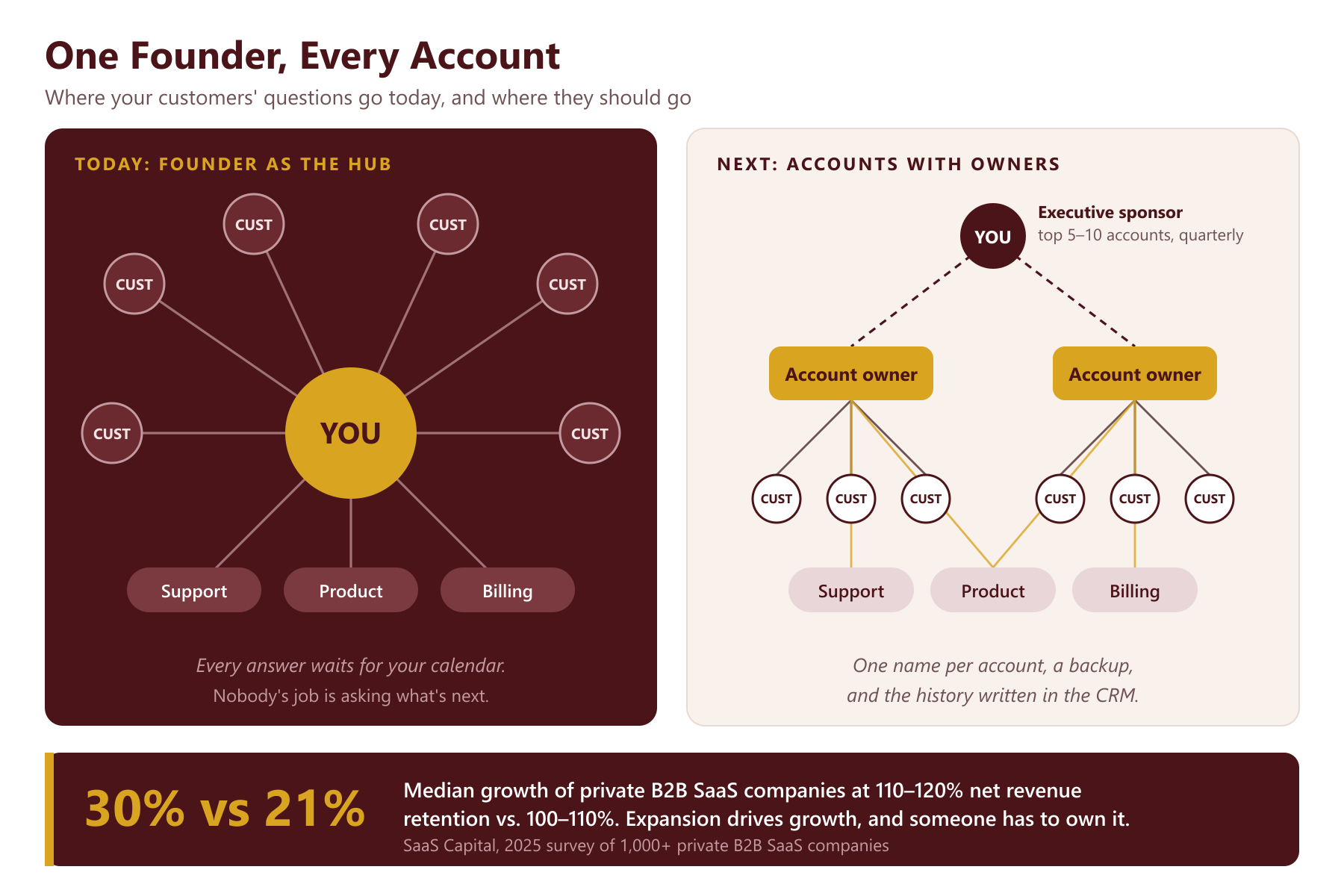
How do I know I've become the accidental account manager?
A founder has become the accidental account manager when existing customers contact the founder first for questions that someone else could answer. The clearest sign is a calendar where customer requests regularly push out prospecting, planning, or deal work. The founder is acting as the switchboard between customers and the rest of the company.
Years ago I wrote that an Account Manager is the interface between existing customers and everyone else in your company. That job exists in every company with customers. The only question is who's doing it. In most founder-led companies, the answer is the founder, and nobody wrote it down.
Five signs the account manager job landed on you
- Customers skip the process. They text or email you directly, even when a support address exists.
- Your team waits for you. Support, billing, and product questions sit until you weigh in.
- Renewals are surprises. You find out a contract is up when the customer brings it up.
- Account history lives in your head. Nobody else knows what you promised, or to whom.
- Upsells only happen when customers ask. Nobody's job is to look for the next need.
Why does being the accidental account manager cap my growth?
Being the accidental account manager caps growth because the founder's time is spent servicing accounts instead of growing them or finding new ones. A founder answering reactive questions rarely has time to ask proactive ones, so expansion revenue waits until customers bring it up themselves. Many never do.
The cost shows up in expansion, not just your calendar
Net revenue retention is the revenue you keep from last year's customers, including upgrades, minus losses. In SaaS Capital's 2025 benchmark survey of more than 1,000 private B2B SaaS companies, the median was 101%. Companies at 110–120% net revenue retention grew at a 30% median rate. Companies at 100–110% grew at 21%. Those companies at the top didn't just keep customers. Someone asked those customers what they needed next. If you want the full math, here's how net revenue retention works.
A founder-managed account is single-threaded on both ends
On your side, the account depends on one person: you. On the customer's side, it usually depends on one person too, the contact who bought from you. The median U.S. wage and salary worker has been with their current employer 4.1 years, according to the Bureau of Labor Statistics' January 2026 survey. For workers 25 to 34, the median is 3 years. When your contact leaves and nobody else at the customer knows your company, the renewal starts from zero.
Buyers now expect answers without waiting for a person
In a Gartner survey of 646 B2B buyers conducted in August and September 2025, 67% said they prefer a rep-free experience. That survey measured buying, not account management. The direction still matters for founders: customers value quick, accurate answers more than a phone call with a particular person. Waiting three days for the founder isn't a premium experience. It's a slow one.
There's also a price at exit. Buyers pay less for a business that depends on its owner, and customer relationships are usually the first thing they check. If that's on your mind, read what your company is worth if it can't run without you.
Which accounts should the founder keep, and which should they hand off?
The founder should keep an executive sponsor role on 5 to 10 strategic accounts and hand off day-to-day ownership of every account, including those 5 to 10. Executive sponsorship means a scheduled quarterly conversation about the customer's business, not answering their tickets. Everything operational goes to a named account owner.
Most founders sort accounts by how much they like the relationship. Sort by what the account needs from the company instead. Strategic accounts are your largest, your most visible references, or the ones with the biggest room to grow. They get you as sponsor. Every other account gets an owner and never needs you on a routine call.
| Kind of customer contact | Who owns it |
|---|---|
| Support tickets, how-to questions, bugs | Support, tracked in one system |
| Invoices, billing, contract paperwork | Operations or finance |
| Check-ins, renewals, upsells, "who should I talk to about..." | The named account owner |
| Feature requests and roadmap questions | Account owner collects, product decides |
| Quarterly business review for top accounts | Founder as executive sponsor, with the owner in the room |
| Escalations the owner can't resolve | Founder, brought in by the owner |
Notice the founder still shows up. Showing up on a calendar you control is leadership. Showing up whenever a customer texts is a job nobody gave you.
How do I hand off accounts without customers feeling downgraded?
Hand off accounts without customers feeling downgraded by introducing the new owner yourself, passing along the full account history, and staying visible on a fixed schedule. Customers feel downgraded when the founder vanishes and a stranger shows up asking questions they've already answered. A planned introduction with context feels like more attention, not less.
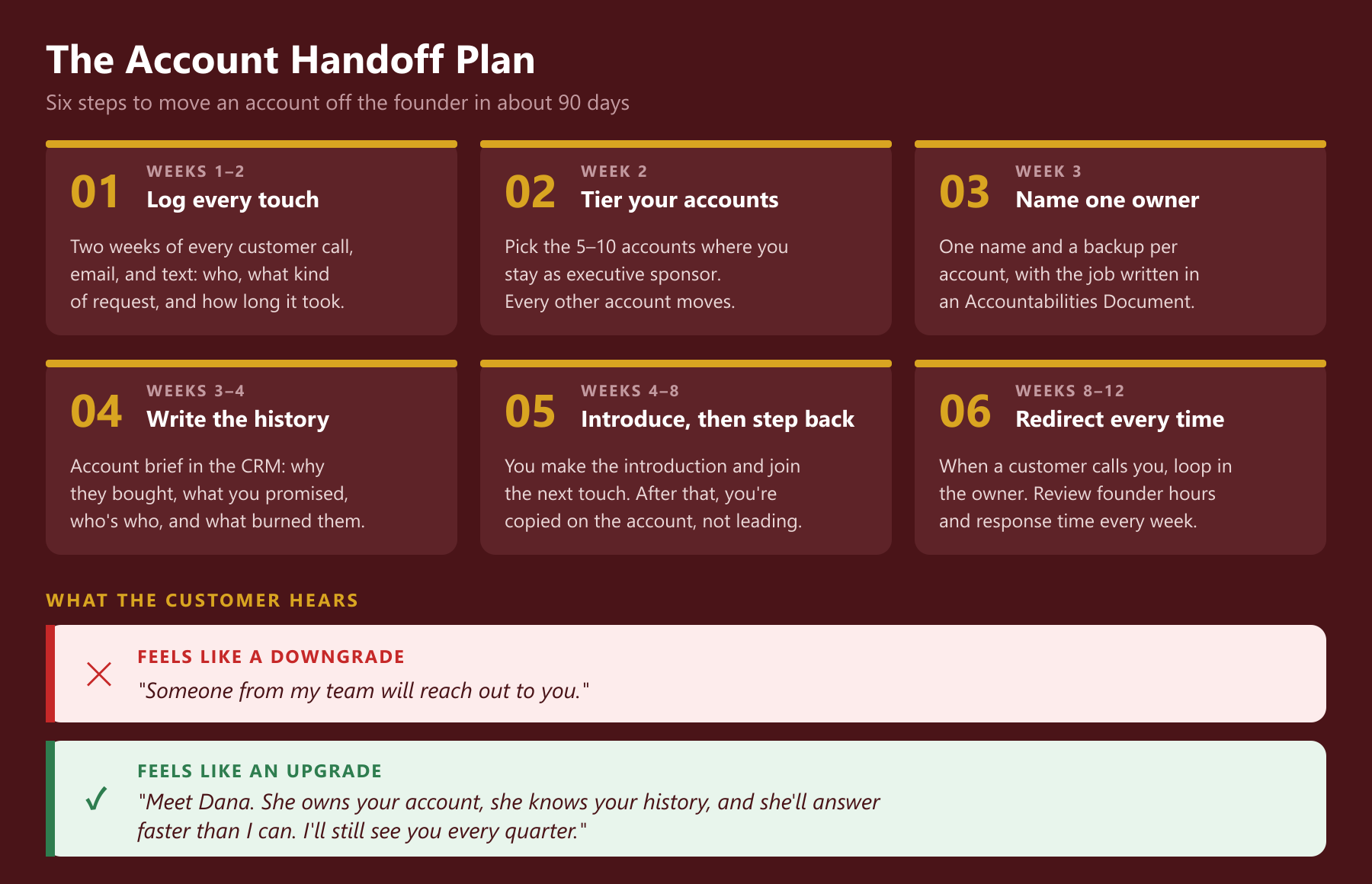
The six steps, in order
- Log every touch for two weeks. Write down each customer call, email, and text: the account, the kind of request, and the minutes. Most founders underestimate the total.
- Tier your accounts. Pick the 5 to 10 where you'll stay as executive sponsor. Every other account moves to an owner.
- Name one owner and a backup per account. Put the job in an Accountabilities Document: response times, check-in cadence, renewal prep, and expansion conversations.
- Write the history. Each account gets a one-page brief in the CRM: why they bought, what you promised, who the players are, and what went wrong before. If it isn't in the CRM, it never happened.
- Introduce, then step back. Make the introduction yourself, by call or video, and join the next touch. After that, you're copied, not leading.
- Redirect every time. When a customer contacts you directly, answer within the day with the owner copied: "Great question. Dana owns your account and will have an answer for you today."
For the introduction call itself, and the fear that your best customers only buy from you, see the related article below.
Where do founders usually get the account handoff wrong?
Founders usually get the account handoff wrong by handing off the account but continuing to answer the customer. When the founder keeps replying to texts and emails, the customer learns the owner is optional, and the handoff quietly reverses. The founder's own habits are the hardest part of the handoff to change.
What 50 years in sales has taught me about account management
Early in my IT training and consulting business, a buyer at MCI hired us for one introductory course after getting one of our postcards. On the last day, she told me the course had been a test. She had a much bigger problem in mind: networked systems at six call centers that kept crashing. We had five full-time consultants on site within a week, and that one account added $1.2 million to our top line.
That $1.2 million came from a customer we already had, not a new one. I've never forgotten it. The money in an existing account shows up when someone is close enough to hear about the next problem. A founder buried in tickets and invoices isn't close to anything. The founder is just busy.
I've also managed account management teams, and I've learned that account management and new business are different jobs with different personalities. A great account manager likes staying close, spotting the next need, and keeping promises. A great new-business rep likes the hunt. At the right company, account managers can earn as much as the new-business reps. Don't hand your accounts to your closer as a side job and expect both jobs to get done.
“Every time you answer a customer that someone else owns, you're telling the customer the owner doesn't matter.”
Other handoff mistakes I see over and over
- Starting with the worst accounts. Founders hand off the small, cranky accounts first. The new owner inherits only problems and loses confidence. Give the owner a mix.
- No written history. The owner starts cold and asks the customer to repeat everything.
- No clear job. "Take care of these accounts" isn't an assignment. Response times, check-ins, and renewal dates are.
- No end date. A handoff with no plan becomes permanent co-ownership, and co-ownership means nobody owns it.
How do I know the account handoff is working?
The account handoff is working when the founder's weekly customer hours fall, customer response time holds or improves, and the account owner is starting expansion and renewal conversations without the founder. Track those three numbers weekly for the first 90 days. If founder hours drop but response time slips, the owner needs more support, not less.
- Founder hours on customer work. Compare to your two-week log. The goal is time you can move to selling and leading.
- Response time to customer requests. It should stay the same or get faster. Customers notice slower before they notice anything else.
- Share of accounts with a named owner and a current brief. The goal is every account.
- Renewals prepared 90 days out. The owner should know each renewal date before the customer brings it up.
- Expansion conversations started by the owner. This number tells you whether the job is being done, or just covered.
Systems before people. If you don't have anyone who can own accounts yet, here's when to hire your first customer success person. If you need the system built before the hire, that's the kind of work a Fractional Sales Leader does in the first 90 days of an engagement.
Frequently Asked Questions
Q: Who should own accounts if I don't have a customer success team?
Your first account owner can be an operations person, a project or implementation lead, or a salesperson whose written job includes account management. What matters is one named person per account, a backup, and a written list of responsibilities. The title can come later.
Q: Should my first salesperson also manage existing accounts?
Only if account management is written into the job and the quota accounts for it. A new-business rep asked to cover accounts on the side will spend time on whichever job feels more urgent, which is usually the customer asking for help. Decide the split up front and measure both.
Q: What if a customer insists on talking only to me?
If an account insists on the founder, that account belongs on your executive sponsor list, and you meet with them on a quarterly schedule. Their day-to-day requests still go to the owner. Most customers who say they want the founder actually want fast answers from someone who knows their history.
Q: How long should an account handoff take?
Plan on about 90 days to move a book of accounts from the founder to an owner. Two weeks to log and tier, two weeks to name owners and write account histories, then four to eight weeks of introductions and redirects. Individual accounts can move faster once the owner has the history.
Q: Will handing off accounts hurt renewals?
A planned handoff usually protects renewals, because an owner preparing 90 days out beats a founder who remembers the date a week before. Renewals get hurt when the handoff is a surprise, when the history isn't written down, or when response times slip during the transition.
Still the one every customer calls?
Let's spend 30 minutes mapping which accounts you should keep, who should own the rest, and how to hand them off without a single customer feeling downgraded.
Schedule a 30-Minute CallAbout the Author
Louie Bernstein
Fractional Sales Leader with 50 years of sales experience helping $1M–$10M ARR companies build scalable, repeatable sales systems. Founder of MindIQ (INC 500). LinkedIn Top Voice in Sales Management, Sales Operations, and Sales Coaching.