What needs to change so my team can sell without me stepping into every deal?
Yes. Fractional Sales Leadership can help repair an underperforming sales team when the leader identifies why performance is weak and takes responsibility for the repair. For a B2B founder at $1M to $10M ARR, that means inspecting targeting, process, skills, responsibilities, and follow-through before deciding who stays. Coach a skill gap, clarify an ownership gap, and replace a rep when evidence supports a role decision after fair support.
Key Takeaways
- Fractional Sales Leadership can repair team performance by matching the action to the cause, rather than treating every missed target as a hiring problem.
- Inspect real opportunities before judging reps. Poor-fit prospects, unclear stages, and missing authority can produce the same disappointing result.
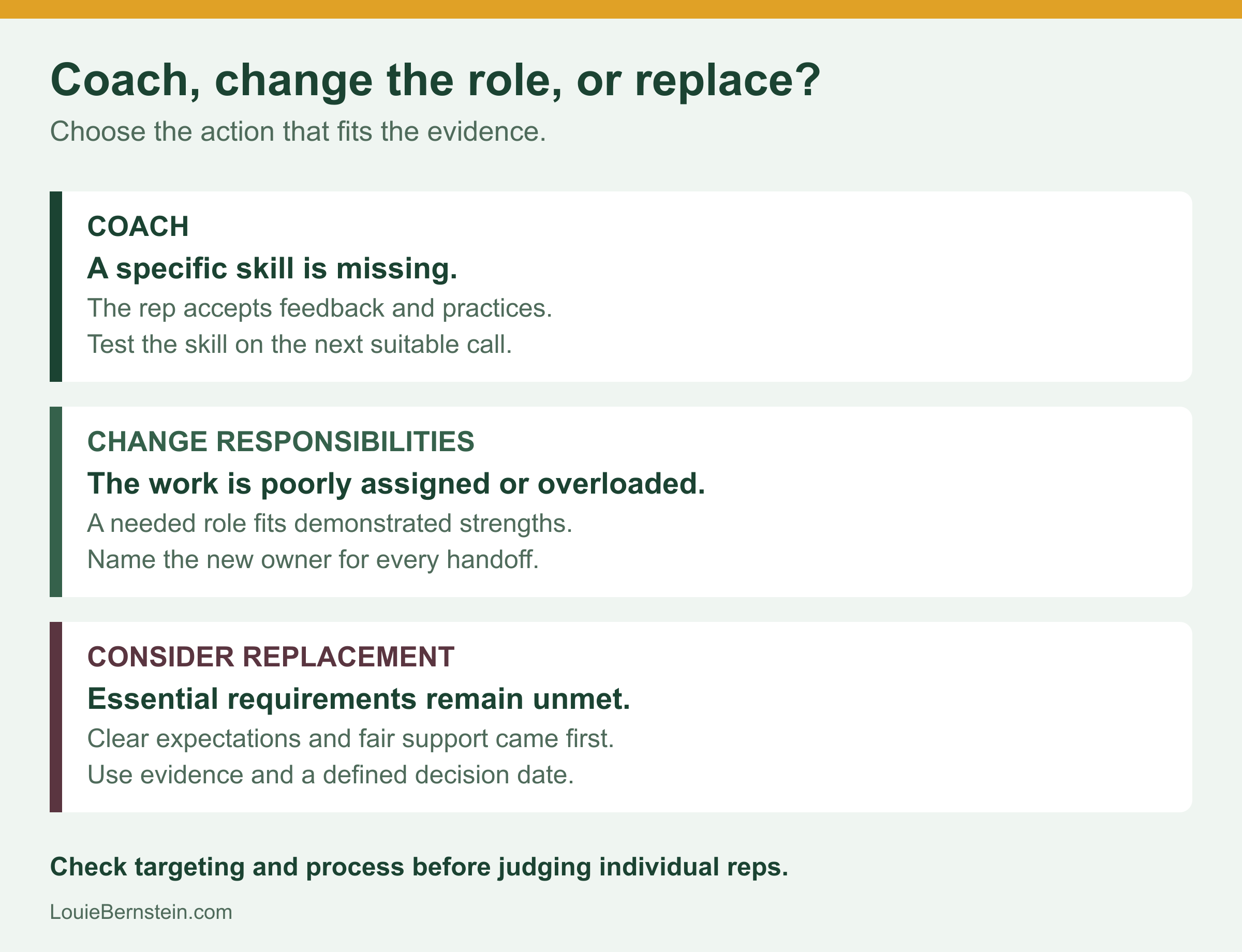
- Coach a rep who needs a specific skill and applies feedback. Change responsibilities when the work is poorly assigned. Consider replacement when the role's essential work still isn't done after clear expectations and fair support.
- Salesforce's 2026 report found that 46% of surveyed reps rarely receive feedback on sales conversations. Don't assume instruction happened just because training material exists.
- Choose one recurring failure, assign a repair owner, and inspect the next comparable opportunities. Track deal quality and founder rescue together.
Your team misses the number. You join the next call, rewrite the proposal, and get the deal moving. Everybody feels better until the next opportunity stalls.
You can keep saving individual deals and still have an underperforming team. The question is what keeps producing the need for rescue.
Before you replace the salesperson, find out what the next salesperson would inherit.
The Sales Gravy overview emphasizes leadership that manages execution, develops people, and builds a repeatable process. Here's how I'd turn that broad promise into a practical repair plan for a founder whose team is already struggling.
How do I find out why my sales team is underperforming?
Find the cause of sales underperformance by tracing recent opportunities from the first conversation to the point where progress stopped. A missed quota describes the result, not the cause. A Fractional Sales Leader should compare buyer fit, rep behavior, process rules, and available support before recommending training or a staffing change.
Inspect the same work from several angles
Start with a manageable sample of won, lost, and stalled opportunities. Include different reps and similar customer types. Review the calls, CRM entries, proposals, and buyer responses. Ask the rep to explain what happened before you tell the rep what you think.
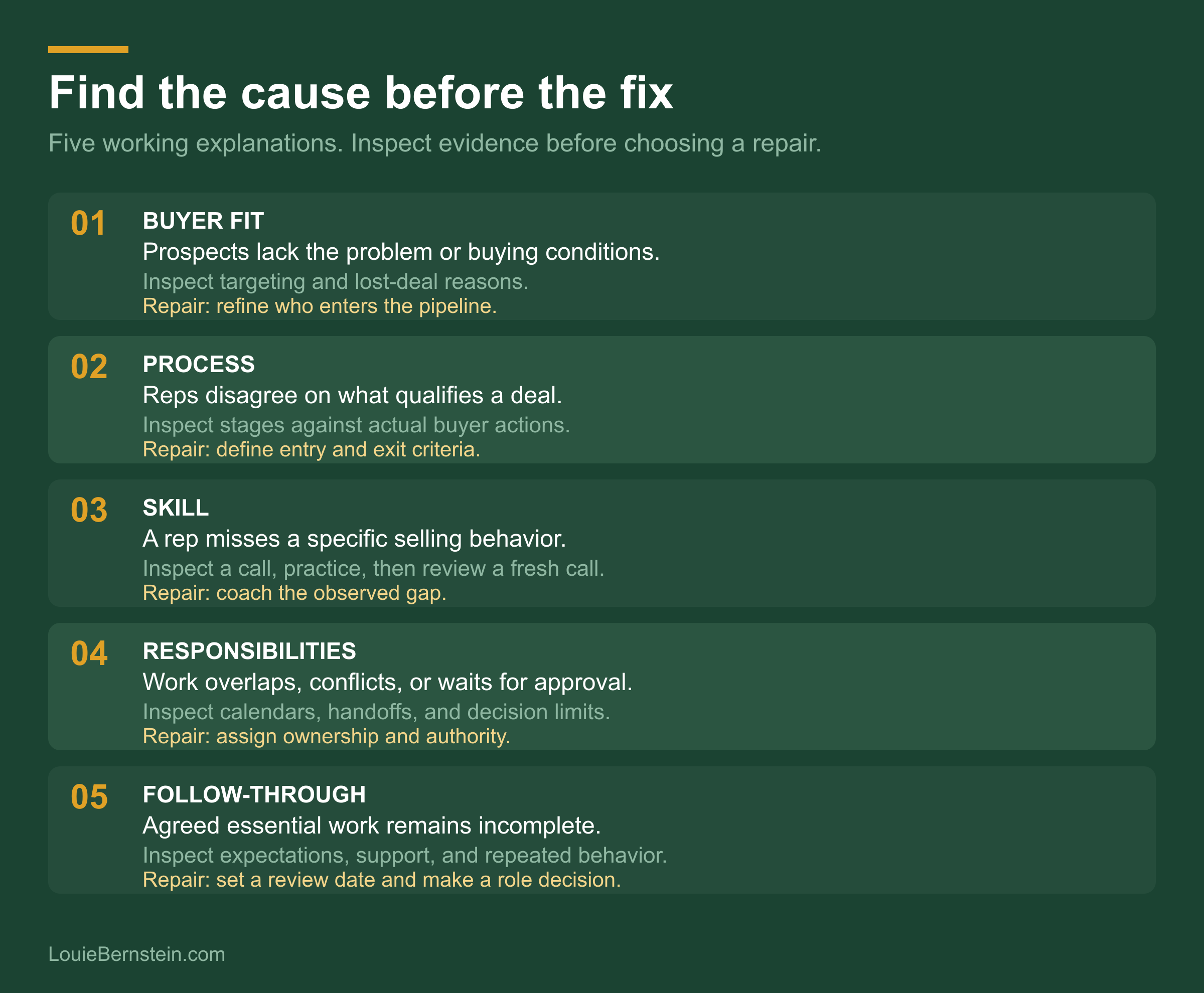
Look for five possible causes: the prospects don't fit, the process doesn't define progress, the rep lacks a skill, responsibilities conflict, or agreed work isn't getting done. These are working explanations. More than one can be true, and each needs evidence.
For example, a proposal that goes nowhere could follow weak discovery. It could also go to a buyer with no budget, or wait on a founder who hasn't approved standard terms. “Improve closing” is too broad to repair any of those problems.
Check what would disprove your first explanation
If you think the rep can't qualify, inspect whether stronger reps advance similar prospects. If everyone struggles in the same segment, look at targeting and the offer. If the rep succeeds when approval arrives promptly, inspect the approval delay before buying another sales course.
Small teams rarely provide perfect comparisons. Record differences in deal size, lead source, and founder involvement. A useful diagnosis admits uncertainty instead of turning a few calls into a verdict about someone's ability.
What should we fix before judging individual sales reps?
Fix missing standards, poor targeting, and blocked execution before drawing conclusions about individual sales reps. People need a reasonable opportunity to perform the role you hired them for. A Fractional Sales Leader should make the work clear and remove avoidable barriers while continuing to inspect each rep's effort and selling behavior.
Write down what a qualified deal looks like
Your Sales Playbook needs usable rules for customer fit, discovery, qualification, stage changes, and next steps. “Proposal sent” doesn't prove the buyer has a reason to buy. Require the buyer evidence that makes the next step appropriate.
If your company has no sales system, building a basic one belongs in the repair. Start with the questions and decisions needed for the next conversation. Don't delay coaching until someone finishes a large manual.
Give reps a job they can actually carry
A rep responsible for prospecting, demos, renewals, support tickets, and implementation may have a workload problem. Inspect the calendar and handoffs. Decide which activities belong in sales and who will handle the rest. Moving tasks without assigning their new owner only creates another problem.
Gallup reported that 49% of U.S. employees strongly agreed they knew what was expected at work in the first half of 2026 (Gallup, 2026). That's a broad workforce finding, not a sales-team benchmark. It's a useful reason to check clarity instead of assuming everyone shares your expectations.
Define approval limits too. Reps need to know which commercial decisions they can make and when to escalate. If routine proposals wait for your permission, document the boundary and assign a backup. Otherwise your calendar remains part of every sales cycle.
When should I coach a struggling salesperson?
Coach a struggling salesperson when the missing behavior is specific, the rep is willing to practice, and the role provides a fair chance to apply the skill. Coaching should connect observed work to practice and a later customer conversation. General encouragement won't tell you whether the rep can do the job.
Make the lesson small enough to check
Suppose a rep accepts “we're interested” without learning what the buyer needs to change. Review that moment. Model a follow-up question, role play several buyer answers, and have the rep try again. Then inspect the next suitable discovery call.
Salesforce's 2026 State of Sales report found that 41% of surveyed reps lacked enough opportunities to roleplay before customer calls, and 52% said traditional enablement didn't provide the skills they needed (Salesforce, p. 25). The report surveyed 4,050 sales professionals in 22 countries during August and September 2025. These findings describe reported gaps, not a guaranteed return from coaching.
What building MindIQ taught me about handing over sales
On my SCALE Framework page, I explain that I sold every deal myself for too long while building MindIQ. That experience shapes the order I teach: prove the sale, document the work, establish accountability, and then step back.
A founder's instinct isn't an onboarding plan. You may hear a weak answer and know what to ask next. Your rep needs to learn how you recognized the gap. Have the rep explain the buyer's situation and recommend the next question before you supply the answer.
If an urgent deal requires you to take over, debrief afterward. Turn the missing skill into the next practice session. Saving the deal handles today's need. Teaching the decision gives the rep a better chance on tomorrow's call.
When should I change a rep's responsibilities?
Change a rep's responsibilities when evidence shows a mismatch between the assigned work, available capacity, and demonstrated strengths. Reassignment should solve a real business need with clear ownership and measures. Moving a struggling rep into an undefined job delays the decision and leaves the original sales work uncovered.
Test whether the mismatch is real
A rep may expand existing accounts well but struggle to create new opportunities. Before changing the role, check whether the prospecting gap comes from weak targeting or missing instruction. Strong account relationships don't automatically prove the company needs a separate account-management position.
If that role is needed, describe its essential work and capacity. Agree on the accounts, renewal or expansion responsibilities, handoffs, and measures. Test the fit against actual work. Be equally clear about who will now create new pipeline.
Rewrite the agreement about the job
Use an Accountabilities Document to make the revised role concrete. Include the outcomes, required behaviors, authority, support, review dates, and escalation rules. Discuss changes openly so the rep understands what success means.
Don't reward a rep for new revenue while quietly expecting that person to spend most of the week handling service issues. Inspect whether the measures and incentives support the work you assigned. A Fractional Sales Leader needs the founder's help to resolve those competing demands.
When is replacing a sales rep the right decision?
Consider replacing a sales rep when essential role requirements remain unmet after clear expectations, appropriate resources, specific coaching, and a fair review period. Distinguish inability from repeated refusal to perform agreed work. A Fractional Sales Leader should explain the evidence and alternatives rather than promise that every person can be coached into fit.
Use a written improvement plan with a decision date
Name the gap in observable terms. “Needs a better attitude” is vague. “Doesn't complete agreed prospect follow-up despite a clear standard and available time” identifies work you can inspect. Ask the rep for missing context before settling on the explanation.
Record the required change, help provided, evidence to review, and decision date. Choose a period that allows the behavior to occur. A six-month sales cycle doesn't prevent you from reviewing discovery preparation or follow-up within weeks. One short-term booking doesn't erase repeated failures in essential work either.
Don't make the same hiring mistake twice
If performance still falls short, decide whether another needed role genuinely fits. If not, make the staffing decision through your company's established process. Don't invent a position because the conversation is uncomfortable, and don't keep moving the review date without new evidence.
Before recruiting a replacement, update the role, interview exercise, onboarding, and management routine based on what you learned. If the previous rep never had clear qualification rules, the replacement will inherit the same confusion unless someone fixes it.
How do I know the repair is working?
A sales team repair is working when the targeted behavior improves on comparable opportunities and commercial results hold up with less routine rescue. Check whether the change was actually used before judging its effect. A cleaner CRM or a quieter founder inbox alone doesn't prove the team has become more capable.
Run one repair through the next real opportunities
- Set the starting point. Record the recurring failure, comparable opportunities, and how often the founder or leader intervenes.
- Assign the repair. Name the owner, specific change, practice or support, and review date.
- Inspect fresh work. Check calls, buyer actions, and results after the change. Keep the denominator visible alongside percentages.
- Decide what happens next. Continue a useful repair, revise a weak diagnosis, or make the role decision the evidence supports.
If a new discovery standard produces fewer proposals, inspect why. Removing poor-fit opportunities may be useful. Losing good buyers because reps apply the questions mechanically needs correction. Track qualified deal movement, customer fit, and margin alongside independence.
Buy a repair plan you can inspect
My Fractional Sales Leadership engagements are 12 weeks, renewable, at $14K per month for 20 to 35 hours a week. Agree on the diagnosis, responsibilities, coverage, and review evidence at the start. The engagement length isn't a promise that every revenue problem disappears within 12 weeks.
If nobody has shown that suitable customers will buy, validate the offer first. If the team needs more daily coverage than the engagement provides, assign that coverage explicitly. Leadership can improve execution, but it can't substitute for a viable market or enough people to do the selling.
Related Reading: Can a Fractional Sales Leader Train My Existing Sales Team?
Frequently Asked Questions
Should I announce an audit as a team turnaround?
Explain the work in specific terms: understanding where deals stall and giving the team clearer support and expectations. Invite reps to identify barriers. A dramatic label can create anxiety before anyone has inspected the evidence.
Can we evaluate a new rep the same way as an experienced rep?
Use the same selling standards but account for onboarding, territory development, and time in role. A new rep's early review should emphasize learning and execution milestones. Don't compare mature accounts with an empty territory as though the starting conditions match.
What if my top seller ignores the process?
Check whether the rule improves selling or creates unnecessary work. Keep useful standards consistent, including accurate records and reliable handoffs. Strong bookings don't remove a rep's responsibility to provide information the company needs to serve customers and manage revenue.
How much access does the Fractional Sales Leader need?
Provide the access needed to inspect opportunities, coach reps, and review results within company policies. Agree on CRM permissions, call-review access, and decision authority before work begins. Missing information limits the reliability of the diagnosis.
What if I disagree with the leader's recommendation about a rep?
Ask for the observed gap, support provided, remaining uncertainty, and alternatives. Review the actual work together. The founder retains the company's staffing decision; the leader should provide a clear recommendation that can withstand questions.
Find the cause before making the next hire
If your B2B company is at $1M to $10M ARR and you're still rescuing routine deals, let's identify what needs to change. We'll distinguish the sales system, coaching, responsibility, and staffing decisions your team needs.
Schedule a 30-minute conversation or learn about Fractional Sales Leadership at LouieBernstein.com.
About the Author
Louie Bernstein is a Fractional Sales Leader with 50 years of sales experience and has served as a Fractional Sales Leader since 2017. He built MindIQ and helps B2B founders develop Sales Playbooks, clear accountabilities, and sales teams that can carry more of the work.