A 30-day trial tests the person. Founders need to test whether there's a sales system for anyone to run.
A contract-to-hire sales leader is rarely worth the risk for a founder-led B2B company that has no written sales system. A 30 to 90 day trial is shorter than most B2B sales cycles, so you end up judging activity and personality, not revenue. The bigger risk isn't the person. It's that there's nothing for any leader to run yet. Build the playbook, the CRM stages and the Accountabilities Document first, then hire the full-time leader into a working system.
Key Takeaways
- A contract-to-hire sales leader is a senior sales leader hired on a fixed contract, often 30 to 90 days (Go Fractional), with the option to convert to a full-time VP of Sales at $250K to $400K a year.
- For a founder with no written sales process, contract-to-hire tests the wrong thing. The trial tells you whether you like the person, not whether the role can succeed.
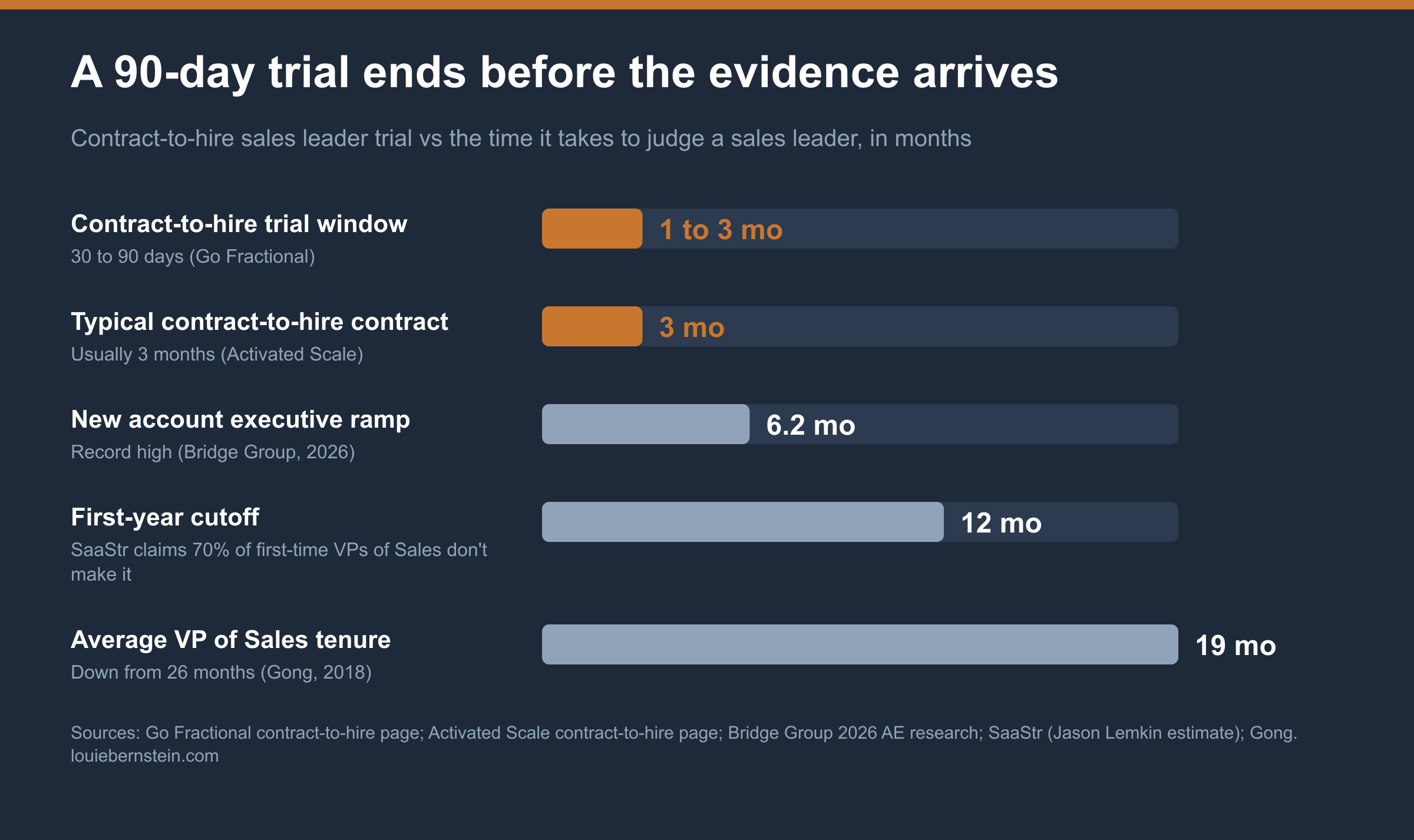
- Most trials end before the evidence arrives. A new account executive takes 6.2 months to fully ramp (Bridge Group, 2026), and a 90-day window can't show closed revenue from a long B2B sales cycle.
- First VP of Sales hires usually fail because they're hired to scale a process that doesn't exist. SaaStr's Jason Lemkin claims 70% of first-time VPs of Sales don't make it one year.
- Before you sign a contract-to-hire agreement, spend 12 weeks building the Sales Playbook, CRM stages and Accountabilities Document. Then hire the full-time leader to run what's already there.
Every founder I talk to wants the same thing from a VP of Sales hire: a way to know it will work before they bet $300K on it.
Contract-to-hire sounds like that answer. You bring a senior sales leader in on a short contract, watch them work, and only convert if you like what you see. The platforms sell it as try before you buy.
I understand the appeal. I've also watched founders hire a VP of Sales they really liked and end up back in every deal a year later. Liking the person was never the problem. The problem was what the person walked into.
A trial period can tell you if you like a sales leader. It can't tell you if there's a sales system for that leader to run.
What is a contract-to-hire sales leader?
A contract-to-hire sales leader is a senior sales executive who works for your company on a fixed-length contract, with an agreed option to convert to a full-time role at the end. The founder gets to see the leader work before committing to a full-time VP of Sales salary of $250K to $400K a year.
How a contract-to-hire trial usually works
The length varies by provider. Go Fractional describes its contract-to-hire window as typically 30 to 90 days, working as a fractional or interim executive before you decide. Activated Scale's contract-to-hire recruiting page says its contracts usually run 3 months. In both cases, the founder and the leader agree on success criteria up front, the leader works inside the business, and then both sides decide whether to make it permanent.
What the founder is really buying
The founder is buying an exit ramp. If the contract-to-hire sales leader doesn't fit, you part ways without severance or a failed full-time hire on the record. That's a real benefit. It just isn't the benefit most founders think they're getting, which is proof that the VP of Sales role will work.
Does a 30 to 90 day trial tell you if a VP of Sales will work?
Rarely. A 30 to 90 day trial is shorter than most B2B sales cycles, so a contract-to-hire VP of Sales can't show you closed revenue from deals they sourced and ran. You end up grading activity, meetings and how the person makes you feel, which tells you about fit, not results.
You judge activity, not closed revenue
Look at the time frames side by side. A new account executive takes 6.2 months to fully ramp, the longest the Bridge Group has recorded in its 2026 research. The average VP of Sales tenure is about 19 months, down from 26 (Gong's 2018 analysis). A 90-day trial ends before a new rep is halfway ramped and long before you'd know if the leader can build a team that hits its number.
You learn about the person, not the role
In 90 days you'll learn plenty about the person. Do they show up prepared? Do your reps like them? Do they push back on you when you're wrong? All useful. But none of it tells you whether the VP of Sales role can succeed in your company. If there's no written playbook, no clean pipeline and no defined accountabilities, a great leader will spend the trial building basics, and you'll grade them on a job they haven't started yet.
Why do first VP of Sales hires fail?
First VP of Sales hires usually fail because they're hired to scale a sales process that doesn't exist yet. With no written playbook, clean pipeline or defined accountabilities, the new VP spends the first year building basics while the founder and board expect growth. The gap between those two jobs is where most first VPs lose the seat.
The numbers founders should know
- SaaStr's Jason Lemkin claims 70% of first-time VPs of Sales don't make it one year. It's his estimate from years of watching SaaS companies, not a survey, but it matches what I see.
- The average VP of Sales lasts about 19 months in the seat, according to Gong's 2018 analysis.
- A full-time VP of Sales costs $250K to $400K a year before recruiting fees, equity and the months it takes to find one.
Put those together and the math is ugly. You can spend a year of executive salary and still be back closing the big deals yourself. If you're about to make that bet, run through the questions you must ask a VP of Sales before committing $250K first.
What I've seen in turnarounds
The sales leader hires I've seen work had one thing in common. They walked into something written down.
When I took over as Sales VP at a struggling company, during the worst economy in 30 years, the first thing I did was write a sales training course from real selling experience. Then we ran 20 minutes of training and role play every day. In the first year, sales went up 10% and profits went up 321%. I'd love to say that was all me. It wasn't. It was the system, repeated every single day.
And at MindIQ, I made the opposite mistake. I hired my first two salespeople without a playbook. They were smart people with nothing to follow except me, and I was too busy selling to teach them. That one was costly.
The hires that worked walked into a written playbook. The ones that failed were asked to write it while hitting a number.
What should a founder do instead of contract-to-hire?
A founder should build the sales system first, with a Fractional Sales Leader on a 12-week engagement, and then hire the full-time VP of Sales to run it. The Fractional Sales Leader writes the playbook, installs the CRM stages and the Accountabilities Document, and then helps write the VP job and interview candidates.
The 12-week build
Here's how I'd run the 12 weeks for a founder at $1M to $10M ARR who still closes most of the deals.
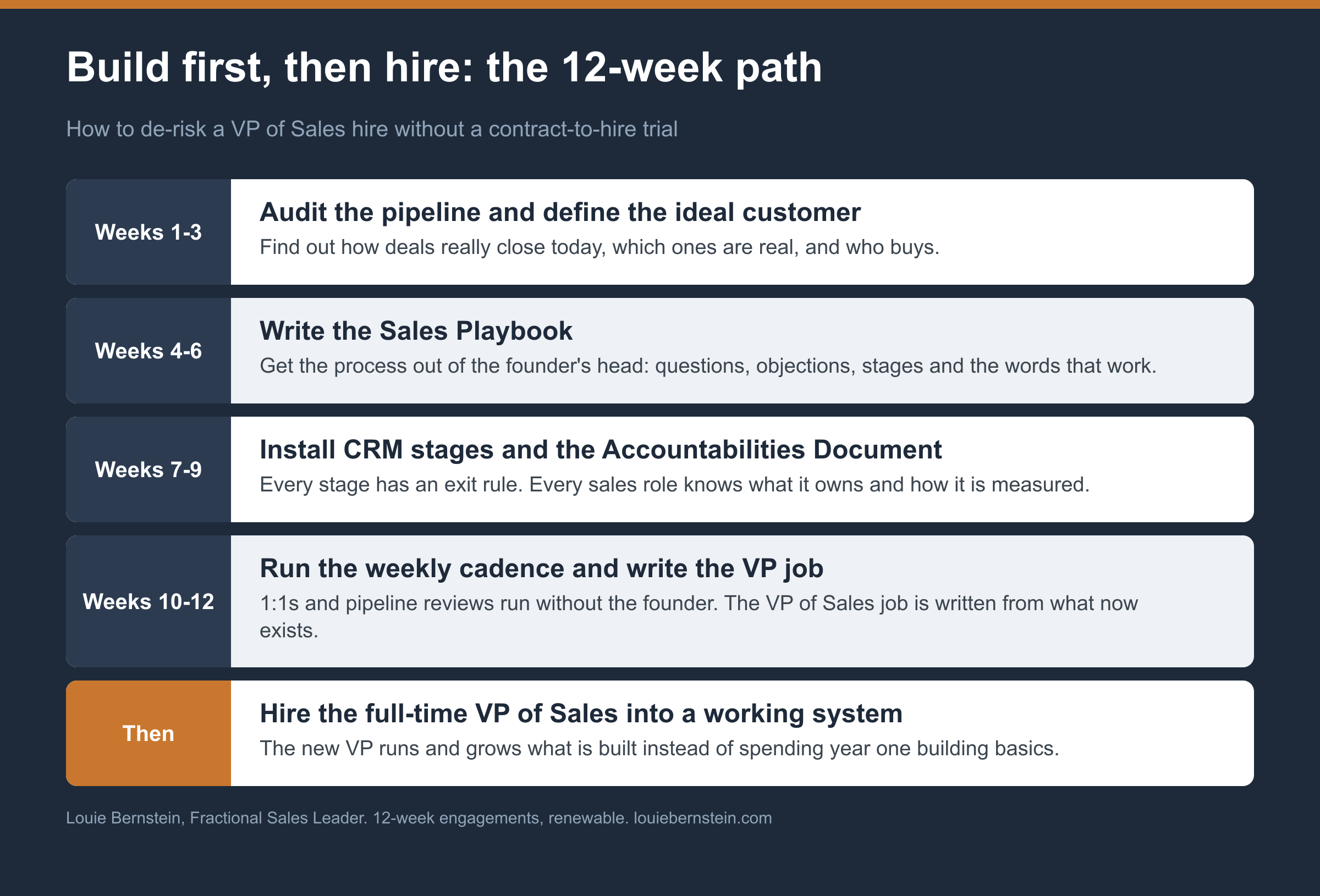
By week 12, a VP of Sales candidate can read how you sell, see the pipeline in clean stages, and know exactly what the job owns. That changes the interview. You stop asking "can this person build it?" and start asking "can this person run it and grow it?" That's a much easier question to answer in a few conversations.
Contract-to-hire first vs build the system first
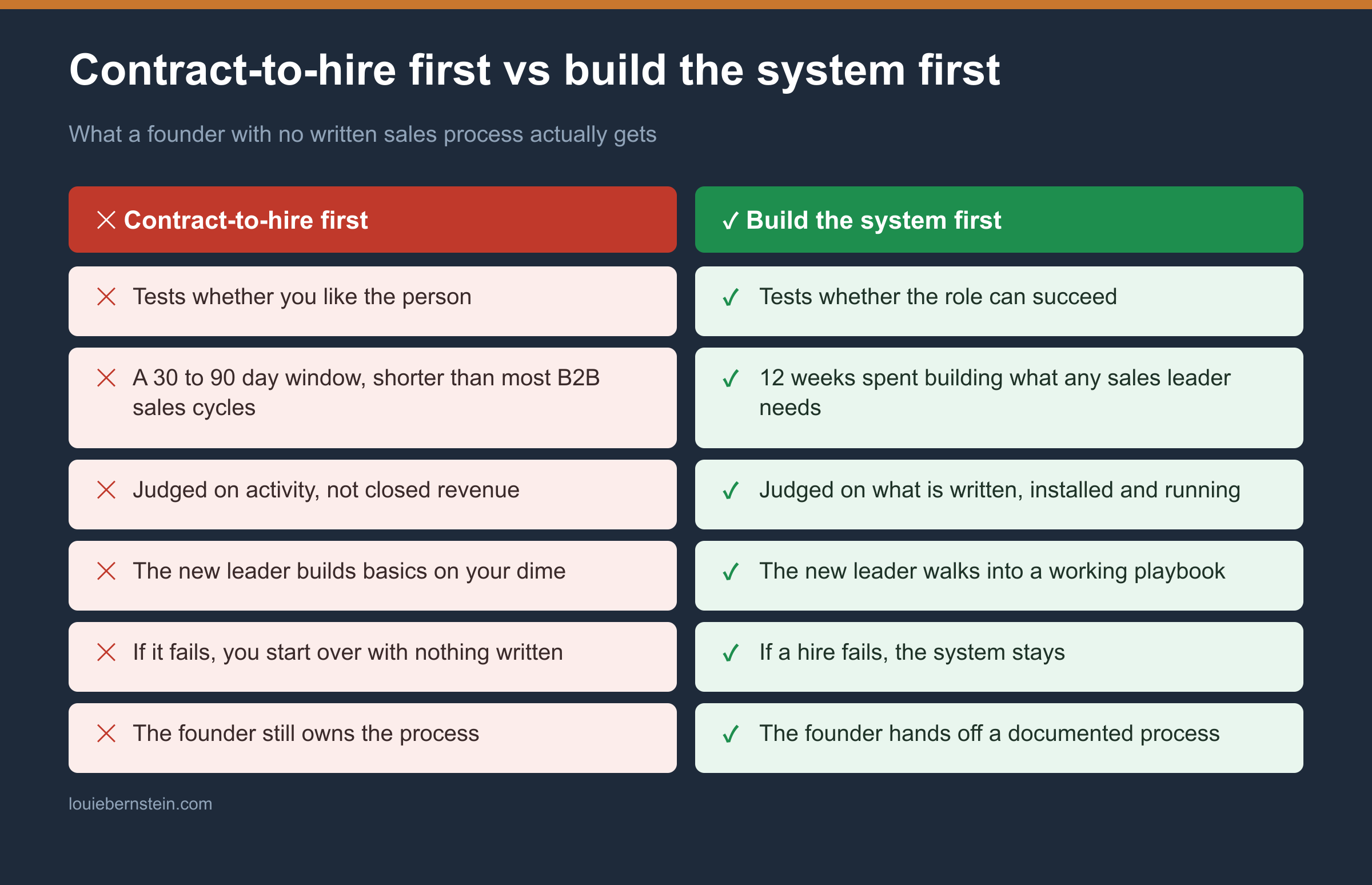
The cost comparison matters too. Other Fractional Sales Leaders run $10K to $20K a month. My fee is $14K a month for 20 to 35 hours a week, in 12-week engagements that renew. That's roughly half the cost of a full-time VP of Sales, and you keep everything that gets built. I lay out the full cost and role comparison in VP of Sales vs Fractional Sales Leader.
When does a contract-to-hire sales leader make sense?
A contract-to-hire sales leader makes sense when the playbook, CRM and quota history already exist, and you're choosing between strong candidates for a clearly defined role. In that case the trial tests what it should test: whether this person can run and grow a system that already works.
Signs you're ready for contract-to-hire
- You have a written Sales Playbook that reps other than you actually use.
- Your CRM has defined stages and the pipeline is clean enough to forecast from.
- At least a couple of reps have quota history, so you know what good looks like.
- The VP of Sales job is written down in an Accountabilities Document, with what the role owns at 30, 60 and 90 days.
If you can check all four, a 90-day trial can tell you a lot. If you can't, the trial will mostly tell you how the leader handles chaos, and you'll be paying a senior rate for them to build what should have been there on day one.
Can a Fractional Sales Leader become my full-time VP of Sales?
Sometimes, but it's a different job. A Fractional Sales Leader is hired to build the sales system, and a full-time VP of Sales is hired to run and grow it for years. The builder and the long-term operator are often different people, so decide what the role is first, then decide who fills it.
I'm 74. I'm not looking to become anyone's full-time VP of Sales, and I tell founders that on the first call. My job is to build the system, run the weekly cadence until it holds, then help you hire the person who'll run it from there. Some Fractional Sales Leaders do want to convert. That can work. Just don't let a good 12 weeks of building talk you into a full-time hire for a job the person never wanted.
Frequently Asked Questions
How much does a contract-to-hire VP of Sales cost?
During the trial, a contract-to-hire VP of Sales is usually paid a fractional or interim rate for the contract period. If you convert, you're committing to a full-time VP of Sales package of $250K to $400K a year. Budget for the full-time number, not the trial number, before you start.
What success criteria should a contract-to-hire trial have?
A contract-to-hire trial should be judged on things a leader can finish in 30 to 90 days: a written pipeline review, a documented sales process, a first draft of the playbook, and a plan for the next two quarters. Don't make closed revenue the test unless your sales cycle is shorter than the trial.
Will strong sales leaders accept a contract-to-hire offer?
Some will and some won't. Many experienced VPs of Sales won't leave a full-time job for a 90-day trial, so contract-to-hire tends to attract people who are already between roles or working fractionally. That isn't bad, but it does narrow your candidate pool.
How long before a new VP of Sales shows real results?
Plan on two to three quarters at the earliest. The new VP has to learn your buyers, fix or build the process, and hire or coach reps, and a new account executive alone takes 6.2 months to fully ramp (Bridge Group, 2026). Results come faster when the system already exists.
Can a Fractional Sales Leader help me hire the full-time VP of Sales?
Yes, and it's one of the best uses of the engagement. A Fractional Sales Leader who built your system can write the VP job, screen candidates, sit in on interviews and onboard the hire. The new VP gets a clean handoff instead of a founder's memory.
Test the system before you test the VP.
If you're a B2B founder at $1M to $10M ARR still closing most of the deals and thinking about a contract-to-hire VP of Sales, let's look at what a new leader would walk into and what needs to be built first. Learn about Fractional Sales Leadership at LouieBernstein.com.
Schedule a 30-Minute CallAbout the Author

Louie Bernstein Fractional Sales Leadership
Louie Bernstein is a Fractional Sales Leader with 50 years of sales experience and has worked as a Fractional Sales Leader since 2017. He built and ran MindIQ for 22 years. He helps B2B founders at $1M to $10M ARR build repeatable sales systems so selling doesn't depend on the founder.