How founder-led sales caps a $1M to $10M business, and how to raise the ceiling
Working harder won't grow revenue when every deal needs the founder, because revenue can only grow as far as the founder's hours go. That's the founder bottleneck. More hours buy a little more revenue and a lot more burnout. The way to raise the ceiling is to write down how you sell and teach someone else to do it.
Key Takeaways
- The founder bottleneck is a revenue ceiling set by the founder's hours: when every deal needs the founder, the company can only carry as many deals as one person can work.
- Working harder raises the ceiling a little. Going from 20 to 30 selling hours a week buys about 50% more deal capacity in the illustrative example, and it costs the founder their health.
- Deals that wait on a busy founder slip, and slipped deals close less often: 13% after a one-month slip and 8% after three months (Ebsta and Pavilion, 2025, 655,000 opportunities).
- Businesses that run without the owner list for a median 2.8x cash flow, about 20% more than owner-dependent ones at 2.4x (Fulkerson Advisors, 2026, about 39,000 US listings, asking prices).
- To raise the ceiling, count your selling hours and the founder hours each deal needs, then write down how you sell and teach one person to run deals without you.
One morning in 2008, after running MindIQ for about 20 years, I couldn't get out of bed. I lay there staring at the ceiling.
Earlier that week I'd been diagnosed with job burnout and clinical depression. I had four kids at various stages of school. I had a mortgage. Quitting wasn't an option.
I'd been running the company, and much of its selling, for two decades. Here's what I wish someone had told me sooner.
The hours aren't the real cost. The real cost is that your business can't grow past the hours you have.
If you're a founder at $1M to $10M ARR and every deal still runs through you, this article is about the ceiling you're living under, and how to raise it.
What is the founder bottleneck?
The founder bottleneck is what happens when every sale needs the founder to move forward. The founder takes the first call, answers the hard questions, sets the price and closes. Revenue can only grow as fast as one person's calendar, so the founder becomes the ceiling on the whole company's growth.
Why founders end up as the bottleneck
Nobody plans this. In the early days, the founder is the only one who can sell. That's the right call at $0. You know the product, you know the buyer, and you can make decisions on the spot.
The trouble starts when the company grows and the selling doesn't change. You hire people for product, delivery and support. Sales stays with you, because you're good at it and because nothing about how you sell is written down. I've written about how this shows up in founder-led sales.
Every deal needs you, so revenue has a ceiling
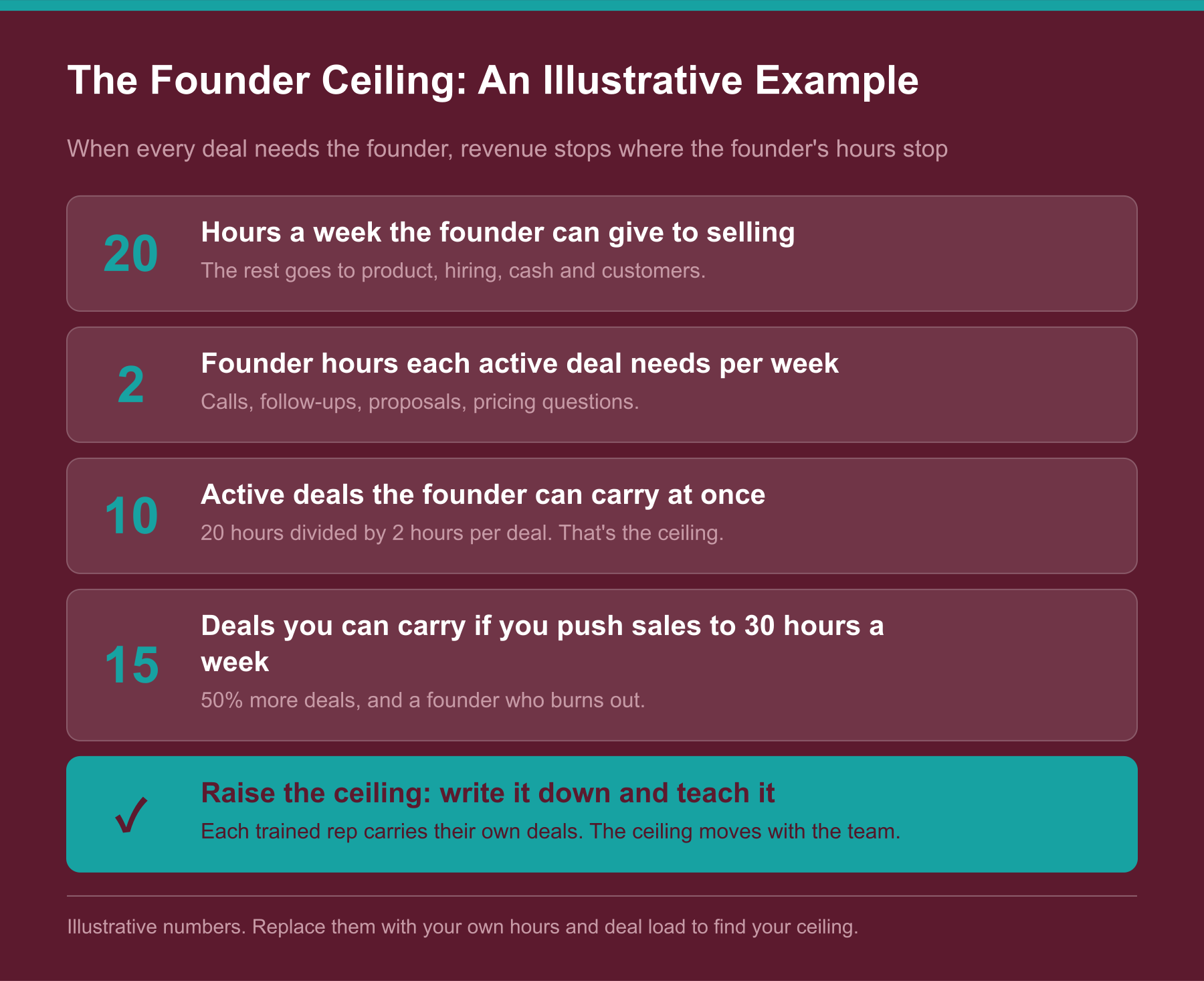
Here's the plain math. Say you can give 20 hours a week to selling. Say each active deal needs about two hours of your time a week for calls, follow-ups, proposals and pricing questions. You can carry about 10 active deals at once. That's your ceiling. These are illustrative numbers, so put in your own.
Why won't working harder grow your revenue?
Working harder won't grow revenue much because founder hours are the constraint, and hours run out. Going from 50 to 70 hours a week moves the ceiling a little, then stops. A system moves it every time you train another person. Your hours can't scale. A written, taught sales process can.
More hours buy a little, then nothing
In the example above, pushing sales from 20 to 30 hours a week gets you from 10 deals to 15. That's 50% more capacity. It sounds good until you ask where the 10 hours came from. They came from your evenings, your weekends and your family. And you can only do that trade once. There's no 60 hours a week of selling on top of running a company.
I know, because I tried. I ran MindIQ for 22 years and did a lot of the selling myself. The company grew. Then, at about year 20, I hit the wall.
Deals that wait on you slip, and slipped deals die
There's a second cost founders miss. When you're the bottleneck, deals wait for your calendar. The proposal goes out a week late. The follow-up call moves to next Thursday. Every delay costs you. Ebsta and Pavilion's 2025 B2B benchmarks, built on 655,000 opportunities, found that deals that slipped by a month closed 13% of the time. Deals that slipped by three months closed 8% of the time.
Every deal needs you. So revenue has a ceiling. And the ceiling is you.
How do you know if you're the bottleneck in your own sales?
You're the sales bottleneck if deals stall when you're out, if reps bring you every pricing question, and if you can't take a week off without checking the pipeline. Any one of those is a warning. All three mean revenue is capped by your calendar, whatever your CRM says.
The week-off test
When was the last time you took a week off and didn't check the pipeline? If the honest answer is "never," that's the clearest sign there is. A business that runs without you for a week can probably run without you for a deal. A business that can't is waiting on you all the time.
Other signs I look for
- You personally touched most of the revenue that closed last quarter.
- Your reps win a lot less often than you do on the same kinds of deals.
- Deals sit in "proposal" waiting for you to review the price.
- Your reps ask you questions you've answered many times before.
- You do your real work, the planning and hiring, after 9 p.m.
If you want to put numbers on it, use the five measures in the Founder Bottleneck Scorecard.
How do you raise the revenue ceiling?
You raise the founder-led sales ceiling by moving the selling out of your head and into a system other people can run. Write down how you sell, teach one person to run deals with it, and step off the calls. Each person who can sell without you adds a ceiling of their own.
Four steps to start this month
- Count your selling hours. Track one normal week. How many hours did you spend on sales?
- Count founder hours per deal. For your open deals, how much of your time does each one take a week?
- Find your ceiling. Divide the first number by the second. That's how many deals you can carry. Compare it with how many you need.
- Write down how you sell. Start with your best-fit customer, your discovery questions, your answers to objections and your pricing rules. That's the core of a Sales Playbook.
Then teach one person to run deals with it. Not all deals. One kind of deal, the simplest one you sell. Stay off those calls and fix what breaks.
Why this matters when you sell the company
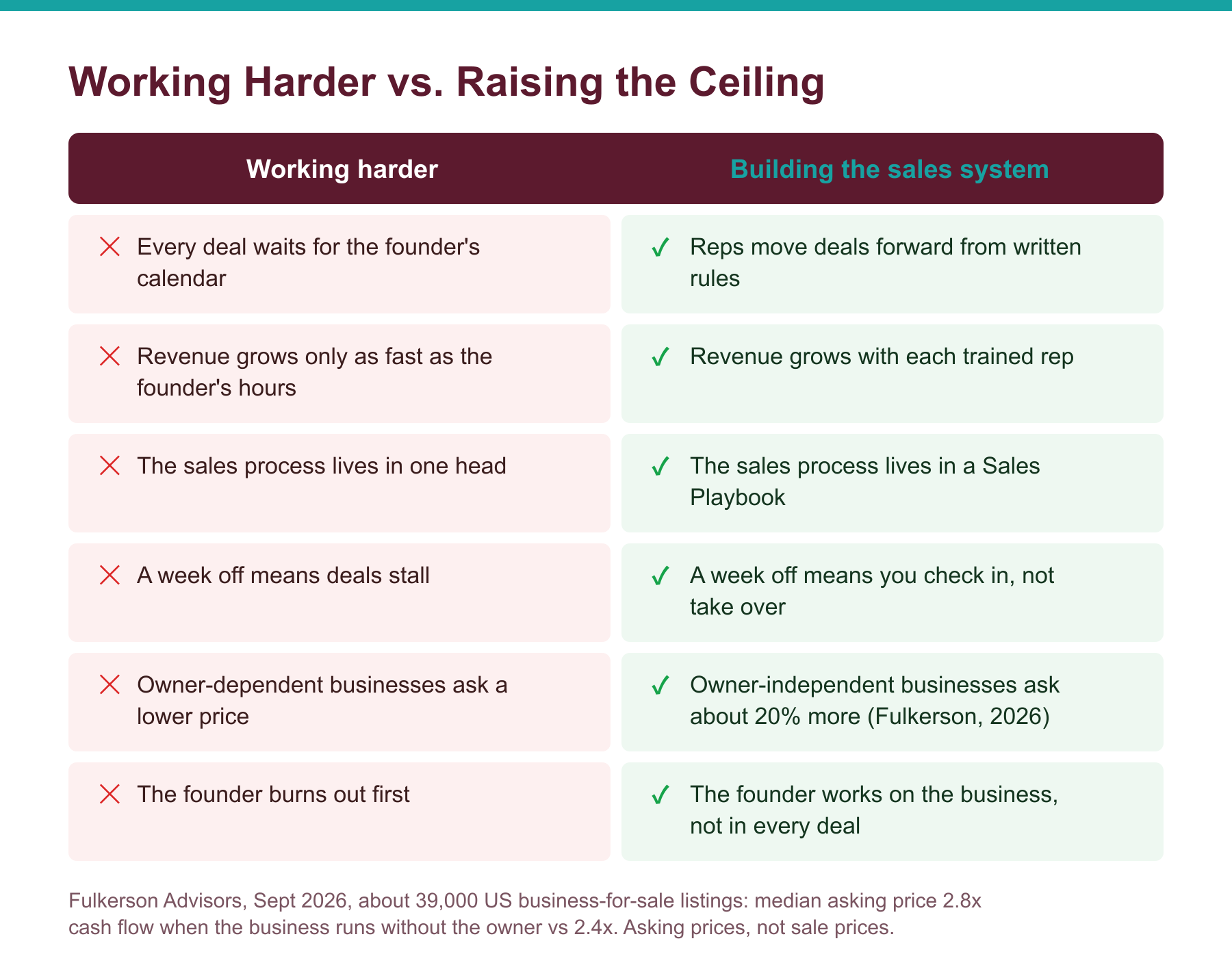
Buyers notice the founder bottleneck too. Fulkerson Advisors studied about 39,000 US business-for-sale listings in 2026. Businesses described as running without the owner had a median asking price of 2.8 times cash flow, against 2.4 times for the rest, about 20% higher. Those are asking prices, not final sale prices. But the direction is clear. A company that needs its founder to sell is worth less to the next owner.
What happens if you keep being the ceiling?
If the founder stays the sales ceiling, revenue flattens and the founder wears out. Growth stalls at whatever one person can carry. The founder can't take time off, can't plan, and can't step back. For me, it took a burnout diagnosis to stop and change how I worked. I'd like you to change sooner.
What I learned from the morning I couldn't get up
After 2008, I went looking for tools and answers. The first thing I did was write a 558-page sales training course that had been in my head for 30 years. Prospecting, objections, closing, all of it. I needed it out of my head and onto paper where other people could use it.
I believe the most generous thing you can do for your family and your team is make yourself less necessary in sales. Your family gets you back. Your team gets to grow. And the company gets a ceiling that isn't one person.
When to get help
Many founders know they're the bottleneck and still can't find the hours to fix it. Getting the sale out of the founder's head is the first thing I do as a Fractional Sales Leader. I work in 12-week engagements, 20 to 35 hours a week, at $14K a month. Other Fractional Sales Leaders run $10K to $20K a month. A full-time VP of Sales costs $250K to $400K a year, and still needs the system you haven't written yet.
Frequently Asked Questions
Is the founder bottleneck only a problem for small companies?
No. The founder bottleneck shows up at any size where the founder still closes most deals. It's most common between $1M and $10M ARR, when the company has outgrown one seller but hasn't built a sales system yet.
Should I hire a salesperson to fix the founder bottleneck?
Not first. Write down how you sell before you hire. A salesperson hired into a company with nothing written down has to guess, and the deals come back to you. Hire once a rep can run a deal from written rules.
How long does it take to stop being the sales bottleneck?
Expect months, not weeks. Writing the first draft of your sales process takes days. Getting a rep to run deals without you takes a full ramp, and the average B2B rep takes 6.2 months to ramp (Bridge Group, 2026).
What if I'm the only one customers want to talk to?
Customers want the person who can solve their problem. Early on, that's you. Bring the rep into your calls, let the rep run more of each one, and tell the customer who their contact is. Most buyers follow the person who answers quickly.
What should the founder still do in sales after handing off?
Keep the work only you can do: an executive call on a big deal, a key partnership, a pricing decision outside the written rules. Write a clear rule for when a deal comes back to you, so the exception doesn't become every deal.
Raise the ceiling.
If you're a $1M to $10M ARR B2B founder and every deal still runs through you, let's find your ceiling and the first steps to raise it. Learn about Fractional Sales Leadership at LouieBernstein.com.
Schedule a 30-Minute CallAbout the Author

Louie Bernstein Fractional Sales Leadership
Louie Bernstein is a Fractional Sales Leader with 50 years of sales experience and has worked as a Fractional Sales Leader since 2017. He built and ran MindIQ for 22 years. He helps B2B founders at $1M to $10M ARR build repeatable sales systems so selling doesn't depend on the founder.