What Weekly Time and Deal Analysis Actually Shows Whether You Are Still the Constraint?
Run a founder bandwidth audit by logging one working week, linking sales activity to individual deals, and recording which next steps wait for your decision. Separate time spent from time buyers spend waiting. Then give one recurring decision to a capable owner with clear limits. You are still the constraint when qualified deals repeatedly stop at your desk and move sooner when that dependency is removed.
Key Takeaways
- A founder bandwidth audit joins a weekly time log to a deal waiting log, then tests one suspected bottleneck.
- Measure both active founder hours and elapsed business hours waiting for a ready founder decision.
- In an illustrative week, nine of 15 active deals waiting for the founder means a 60% founder wait rate. The cause still needs investigation.
- A buyer delaying budget approval is different from your team waiting for permission to send an ordinary proposal.
- Transfer one recurring decision with an owner, a deadline, and written limits. Count progress and rework alongside the hours you recover.
You finish another full week. You joined calls, approved pricing, rewrote a proposal, and answered questions between meetings. The team stayed busy. Several buyers are still waiting.
A crowded calendar can hide two very different problems: too much useful work for the available people, or ordinary work that nobody can finish without you. Hiring before you know the difference can add another person to your approval line.
Your longest task may not be your biggest bottleneck. A ten-minute decision can hold up a deal for three days.
For a B2B founder at $1M to $10M ARR, the useful question is specific: which ready next steps would have happened sooner if someone else could act?
What should I record during a founder bandwidth audit?
Record actual time, the purpose of the work, the deal involved, and the reason your involvement was needed. A calendar alone misses quick approvals and unscheduled interruptions. Keep the log simple enough to use daily, but detailed enough to separate selling, coaching, administration, and decisions only the founder can make.
Use one row per work block
Start Monday and log through Friday, including evening work. Use rough 15-minute blocks for substantial tasks and a separate tally for brief interruptions. Record actual minutes for those interruptions rather than rounding every two-minute answer to 15 minutes. Avoid counting the same time twice.
| Field | Example entry |
|---|---|
| Time and activity | Tuesday, 25 minutes, proposal review |
| Deal and stage | Acme, proposal |
| Why me? | Only I can approve standard pricing |
| Result | Approved without changes |
| Future owner and missing support | AE, written pricing limits |
Label each block as direct selling, decisions and approvals, coaching, sales administration, or other CEO work. Add a second label: founder required, teachable, delegable now, or unnecessary. A customer call can belong in any of those categories. Attendance alone says little about value.
Capture the work your calendar misses
Microsoft’s 2025 Work Trend Index survey found that 48% of employees and 52% of leaders described their work as chaotic and fragmented. The survey covered 31,000 knowledge workers across 31 markets. Those are broad workplace findings, not founder benchmarks, but they explain why memory makes a poor time log (Microsoft, 2025).
Reconcile your notes against sent messages and CRM activity each afternoon. Mark estimates as estimates. If the week included travel or a launch, label it unusual and repeat before drawing a lasting conclusion.
How do I connect my weekly time to stalled deals?
Connect founder time to stalled deals by giving each active opportunity a named next action, an owner, and a timestamp for when the action became ready. Record the blocker and its release separately. The audit should show whether the buyer, a rep, an internal specialist, or the founder controlled the delay.
Start the clock when the request is ready
For every qualified opportunity open during the week, record the buyer-supported next step and due date. If founder approval is needed, record when the team supplied enough information to decide. A request reading “need help” is incomplete. A pricing exception with scope, margin, terms, and a recommendation is ready for review.
Measure elapsed business hours from ready request to decision. Use a consistent working-day window and report overnight or weekend exposure separately if relevant. Keep the founder’s actual handling time beside the wait. Ten minutes spent deciding and 16 business hours awaiting a decision tell different stories.
Log incomplete requests too, with a separate reason. Missing discovery evidence may be the real constraint. Use your one-page discovery standard to show what a rep must know before asking for help.
Separate internal waiting from buyer waiting
Assign one primary blocker at a time: founder approval, rep execution, missing information, specialist capacity, or buyer decision. Add a secondary cause if needed. Count a deal once in the weekly founder wait rate, even if the founder receives three requests about it.
Review all opportunities active at any point during the week, including those won or lost before Friday. Otherwise, a snapshot can leave out the deals that moved fastest. Keep a second view of the deals still blocked at week’s end.
Which numbers show whether I am still the constraint?
Look for repeated founder-controlled waiting, work that receives approval without meaningful changes, and buyer progress that depends on your availability. No single percentage proves you are the constraint. Read the time log and waiting log together, then check whether the same decision appears across several otherwise ready deals.
Calculate a small set of useful measures
- Founder wait rate: unique active deals with a ready action waiting on you during the week, divided by all unique active deals that week.
- Decision wait: median business hours from a complete request to your decision. Keep the oldest open request visible too.
- Transferable hours: time spent on work another person could own with suitable skills and authority.
- Independent progress: deals reaching a buyer-confirmed next milestone without founder intervention, divided by deals due to reach that milestone.
Use raw counts beside percentages. Three deals provide weak evidence for a hiring decision. Group comparable deals by stage, source, size, and complexity when volume allows. Founders often get unusual exceptions and warm referrals, so a simple founder-versus-rep win-rate comparison can mislead.
An illustrative week, with the math visible
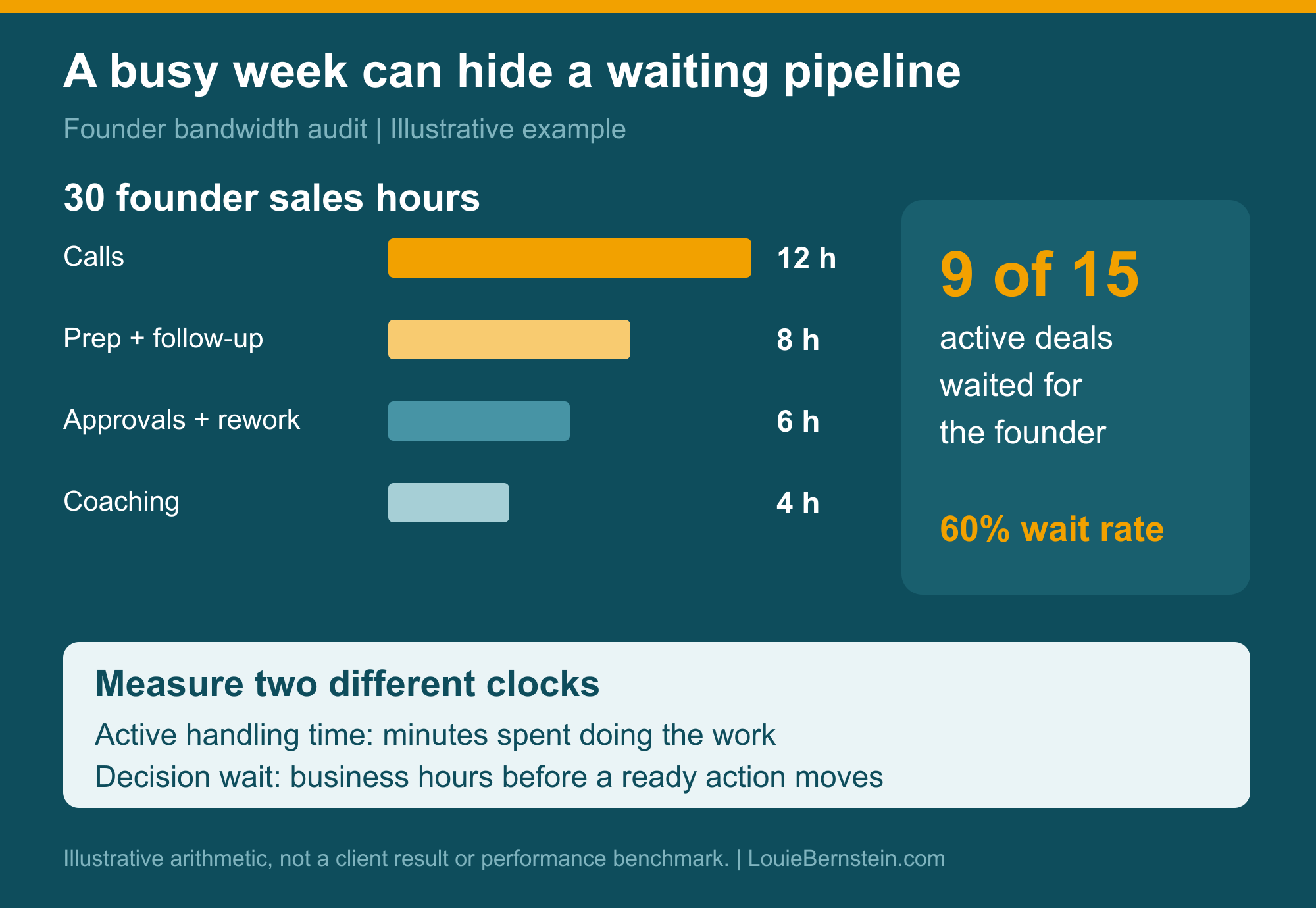
Suppose a founder logs 30 sales hours: 12 in calls, eight in preparation and follow-up, six in approvals and rework, and four in coaching. Fifteen qualified deals are active during the week. Nine encounter a ready next step waiting for founder action. Nine divided by 15 produces a 60% founder wait rate.
In this example, six hours of approvals and rework equal 20% of the founder’s sales time. That does not mean all six hours can disappear. Some exceptions need judgment. Inspect the decisions: which changed the commercial outcome, and which simply confirmed work the rep already got right?
These figures are illustrative arithmetic, not client results or recommended thresholds. The nine waiting deals are exposed pipeline, not nine lost sales. Do not multiply their full contract values into a claim about revenue lost.
How do I find the cause behind the founder bottleneck?
Find the cause by asking what prevented the next responsible person from acting: missing skill, missing authority, missing information, or insufficient capacity. Each cause needs a different response. Giving a rep permission will not repair weak discovery, and another training session will not help a rep who already knows the answer but cannot approve it.
Where founders usually get this wrong
In my guidance on discovery calls, I describe a recurring mistake from 50 years in sales: salespeople arrive ready to talk instead of ready to listen. An audit can expose the consequence. The proposal keeps returning to the founder because nobody established the buyer’s real problem.
Call that a discovery gap. Writing the proposal yourself may save today’s meeting, but the same gap will return on the next deal. Teach the rep what evidence is missing, role play the follow-up conversation, and have the rep get the answer.
If you keep doing the missing work, your audit will measure how fast you rescue deals instead of how well your team can run them.
Match the finding to the remedy
| Audit finding | First response |
|---|---|
| Routine proposals await your signature | Write approval limits and assign authority |
| Discovery notes omit business impact | Coach discovery and inspect buyer evidence |
| Ready demos wait on one engineer | Review specialist coverage and scheduling |
| Buyers cannot secure budget | Review qualification and buying process |
| Capable reps miss agreed actions | Review workload and ownership |
A founder with no formal sales system can still run the audit. Use a shared document and a deal list. Missing ownership is a finding, not a reason to delay. Put repeat decisions and evidence standards into a Sales Playbook as you identify them.
What should I change after the first weekly audit?
Change one recurring dependency after the first audit, then compare waiting, deal progress, and quality over the next two weeks. Pick work with a clear decision rule and a capable owner. Keep unusual commercial risks with the right authority while giving the team room to handle ordinary decisions without asking you again.
Run a controlled handoff
- Choose one recurring decision, such as sending proposals at standard terms.
- Name the owner and document the required buyer evidence.
- Write limits for price, scope, promises, and exceptions.
- Set the deadline and the escalation path for decisions outside those limits.
- Review completed decisions afterward instead of approving every decision beforehand.
Put ownership in an Accountabilities Document. “Help with proposals” leaves you responsible. “Send complete standard proposals within the agreed response window; escalate exceptions with a recommendation” gives someone a job they can own.
Judge progress without fooling yourself
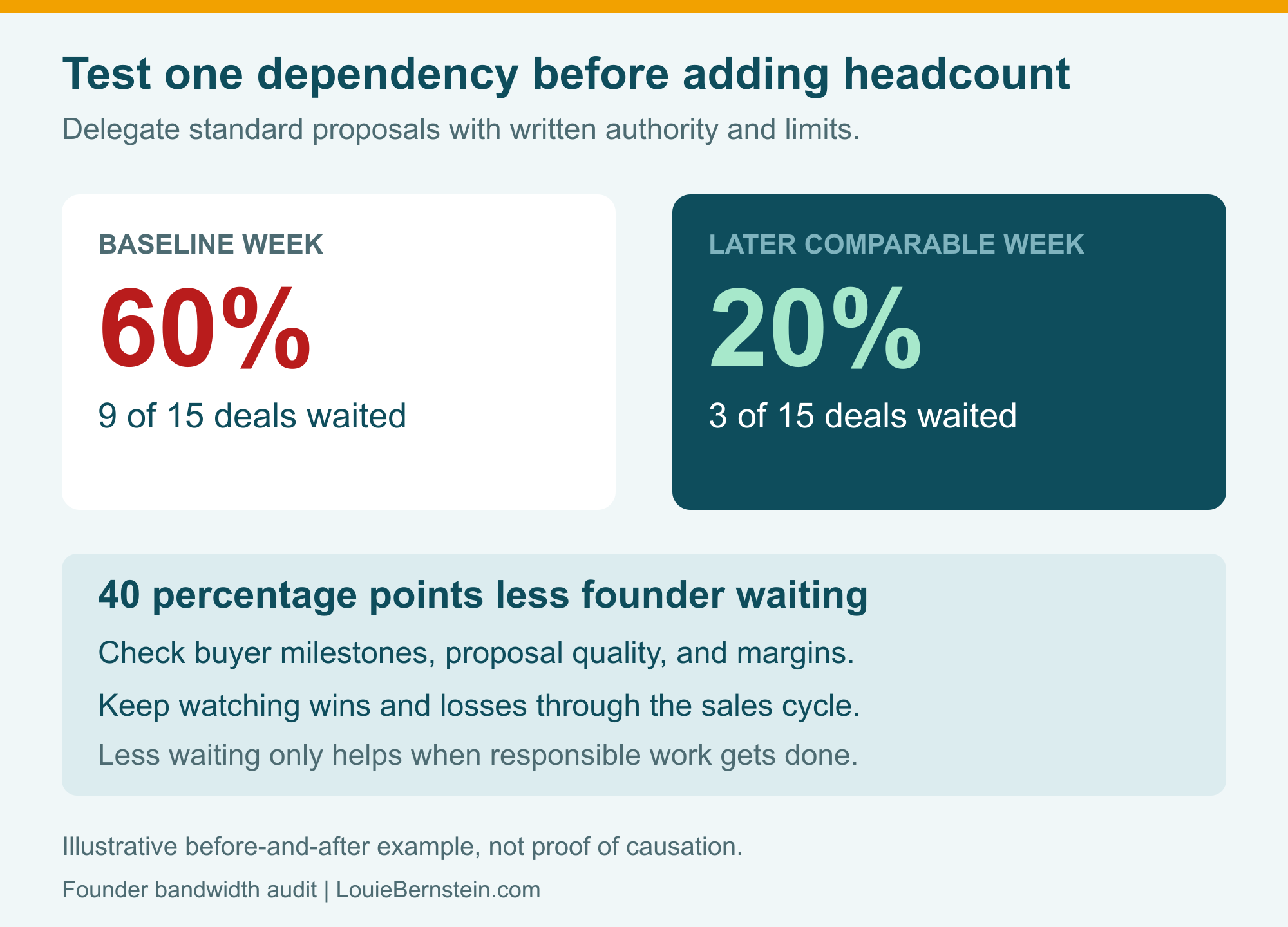
Imagine a later comparable week has 15 active deals and only three wait on the founder. The rate falls from 60% to 20%, a 40 percentage point reduction. That is encouraging only if buyer milestones, proposal quality, margins, and commitments also hold up. A quiet founder inbox can hide abandoned work.
Two weeks can reveal faster decisions; two weeks may not reveal the final effect on wins in a long sales cycle. Keep reviewing outcomes. Record changes in deal mix or staffing, and avoid treating a small before-and-after comparison as proof of causation.
If waiting simply moves to another desk, inspect the new queue. If the same decisions keep returning to you, revise the authority or teach the missing judgment. A Fractional Sales Leader can help build those standards and coach the team when the founder lacks the time to lead the change.
Frequently Asked Questions
Should my team see my time log?
Share the work patterns and decisions the team can help improve. Personal details do not belong in the review. Present the audit as a way to remove waiting and clarify ownership, so people can report blockers without treating the exercise as a search for blame.
What if my CRM timestamps are unreliable?
Start a fresh waiting log and label historical estimates. Reconstruct recent requests from messages only when the evidence is clear. An accurate week of new observations is more useful than a quarter of invented timestamps.
How should I handle confidential pricing decisions?
Keep sensitive commercial details in the approved restricted system. The audit can record a deal identifier, decision type, owner, and waiting duration without copying pricing or contract terms into a widely shared sheet.
Can I audit sales and the rest of my CEO work together?
Yes. Log the whole working week, then analyze sales dependencies separately. Keep a short list of CEO commitments displaced by sales work, with real deadlines. Otherwise, recovered sales hours can vanish into meetings without helping the business.
What if I am the only salesperson?
Use the audit to identify repeatable decisions, unnecessary work, and preparation a future hire will need. Do not pretend you can delegate selling to someone who does not exist. The immediate result may be a simpler process and a clearer hiring brief.
When should we stop keeping the detailed log?
Reduce the detail once the main dependency is understood and the new owner can handle the work reliably. Keep a weekly check on overdue decisions, buyer milestones, and exceptions. Resume the fuller log when growth or staffing changes create fresh delays.
Find the decision that keeps coming back to you
A Fractional Sales Leader can help you turn the audit into clear ownership, a usable Sales Playbook, and coaching that builds independent judgment. Learn more at LouieBernstein.com, or bring your time log and a few delayed deals to a conversation.
Schedule a 30-Minute CallAbout the Author
Louie Bernstein is a Fractional Sales Leader with 50 years of sales experience and has provided fractional sales leadership since 2017. He helps B2B founders at $1M to $10M ARR build repeatable sales systems and coach teams that can sell without depending on the founder for every decision.