What one-page template would let my AEs run discovery exactly like I do?
Get your sales team to sell without you by writing down the decisions you make during discovery, then teaching your account executives to make those decisions themselves. Give each AE a one-page template covering the buyer's problem, business impact, decision process, fit, and agreed next step. Review the evidence behind their recommendations before you join another call. Your goal is consistent judgment, not a team that copies your personality.
Key Takeaways
- A sales team can sell without the founder when AEs can explain why a deal should advance, pause, or stop.
- Build a one-page discovery template with five evidence fields and a written recommendation.
- Use actual buyer statements and confirmed facts. Mark missing information as unknown.
- Review three founder calls to capture the follow-up questions and decisions your team cannot see.
- Measure independence alongside discovery quality. Fewer founder calls mean little if reps advance poor-fit deals.
Your AE finishes a call and says, "Good meeting. They liked us. Can you join the next one?" You ask a few questions. Nobody knows what the buyer needs to change, who approves the purchase, or why anything needs to happen now.
You join, uncover the missing information, and move the deal forward. The sale survives. The AE learns that the next step after an incomplete discovery call is to get you involved.
If every unclear deal becomes your next meeting, you're teaching your team to escalate instead of investigate.
A founder at $1M to $10M ARR needs a way to teach discovery while protecting the pipeline. Start with a page that makes the rep's thinking visible.
Why do my AEs keep pulling me into discovery?
AEs pull founders into discovery when the team lacks a shared standard for what a qualified opportunity looks like. A question list tells reps what to ask, but often leaves out what to do with the answers. Founders fill that gap with experience, product knowledge, and authority the team hasn't learned to use.
Where founders usually get this wrong
In my discovery call guidance, I describe a mistake I've seen across sales teams: showing up to talk instead of listen. Handing an AE your presentation doesn't fix that mistake. A polished pitch can make an incomplete diagnosis sound convincing.
You hear "we need better reporting" and ask who uses the reports, what decisions are delayed, and what the delay costs. Your AE hears the same answer and starts showing dashboards. The difference is the follow-up decision. Capture why you stayed with the problem before discussing your product.
Also separate a skill gap from an authority gap. An AE may understand the buyer perfectly but still need approval for an unusual contract term. Write down the commercial limits. Don't treat an approval request as proof that the rep can't sell.
Capture the choices hiding inside your calls
Choose three recent founder discovery calls: one promising opportunity, one poor fit, and one uncertain deal. If recordings aren't available, reconstruct the conversations from notes. Ask the AE to identify each moment you changed direction and explain what triggered the change.
Write down the buyer's answer, your follow-up, and the decision the answer supported. "Asked about timing" isn't enough. "Asked what happens if the deadline slips because the buyer hadn't named a consequence" teaches a judgment the rep can reuse.
What belongs on a one-page discovery template?
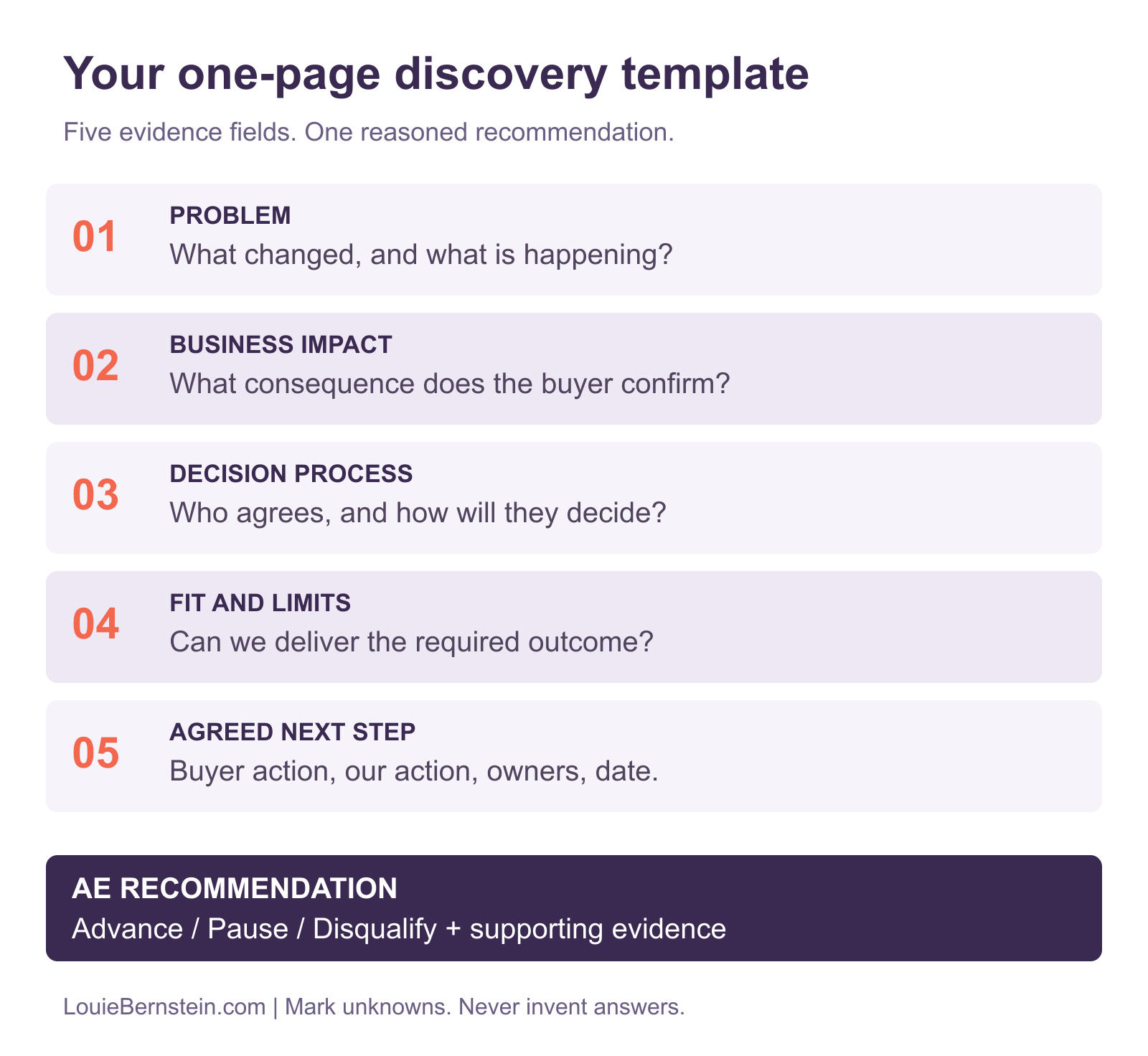
A one-page discovery template needs five evidence fields: problem, impact, decision process, fit, and next step. Add a final recommendation with the reason to advance, pause, or disqualify. Each field should pair a useful question with the evidence an AE must capture, so completing the page requires more than checking boxes.
Copy this discovery decision sheet
Put the following sheet into your CRM or a shared document. Keep answers short enough to fit on one page. Link supporting notes when needed. The page is a summary of the buyer's situation, not a transcript.
One-Page Discovery Decision Sheet
Account / AE / Call date: __________
Buyer role / Opportunity type: __________
1. Problem
Ask: What happened that made this worth discussing now?
Capture: Specific problem, recent example, and the buyer's words.
Unknown or follow-up: __________
2. Business impact
Ask: What does the problem cost in time, money, risk, or missed work?
Capture: Buyer-confirmed consequence, calculation assumptions, and priority.
Unknown or follow-up: __________
3. Decision process
Ask: Who needs to agree, and what would they need to decide?
Capture: People, approval steps, funding status, and timing reason.
Unknown or follow-up: __________
4. Fit and limits
Ask: What must a solution do, and what could prevent success?
Capture: Required outcome, delivery constraints, and any disqualifier.
Unknown or follow-up: __________
5. Agreed next step
Ask: What should we each do next to decide whether to continue?
Capture: Buyer action, our action, owners, date, and purpose.
AE recommendation: Advance / Pause / Disqualify
Evidence supporting the choice: __________
Biggest remaining uncertainty: __________
Founder help required, and why: __________
An unknown is useful information. "Budget unknown; buyer will confirm funding with finance Thursday" gives the team a plan. "Budget looks fine" gives the founder another investigation.
Adapt the fields to your buying process. A security review may matter in enterprise software. Capacity and implementation ownership may matter in services. Keep the core decisions visible instead of expanding the page into a long form nobody uses.
How do I keep the template from becoming a script?
Keep the discovery template focused on evidence rather than a fixed sequence of questions. AEs should follow the buyer's answers, ask for examples, and return to unanswered fields naturally. The standard is whether the rep understands the buying situation well enough to recommend a next step, not whether every prompt was read aloud.
Use research as a coaching clue
Gong's historical discovery research, summarized in an article originally published in 2018, analyzed 519,291 sales conversations. Gong reported an association between 11 to 14 targeted questions and stronger outcomes. The same guidance describes top performers listening for 54% of discovery calls (Gong). These are observational findings, not current universal targets or proof that a question count causes wins.
The practical lesson is to investigate and listen. Don't stop a useful buyer answer to hit the next box. Don't grade a complex conversation by a stopwatch. Review whether the AE followed a meaningful answer far enough to understand the business problem.
Show the difference between a claim and evidence
Here's an illustrative example. The buyer says eight managers each spend two hours a week rebuilding reports. That equals 16 hours of weekly work. The AE should confirm the inputs and ask what those managers cannot do while rebuilding the reports.
Sixteen hours of work is not automatically 16 hours of savings. Some reporting work may remain. Record the calculation as a buyer estimate and test whether your solution addresses the actual cause.
The follow-up might reveal that the urgent issue is a missed board deadline, not labor cost. Good discovery lets the buyer correct the rep's first interpretation. The template should preserve that correction.
What should my AEs decide before I review a deal?
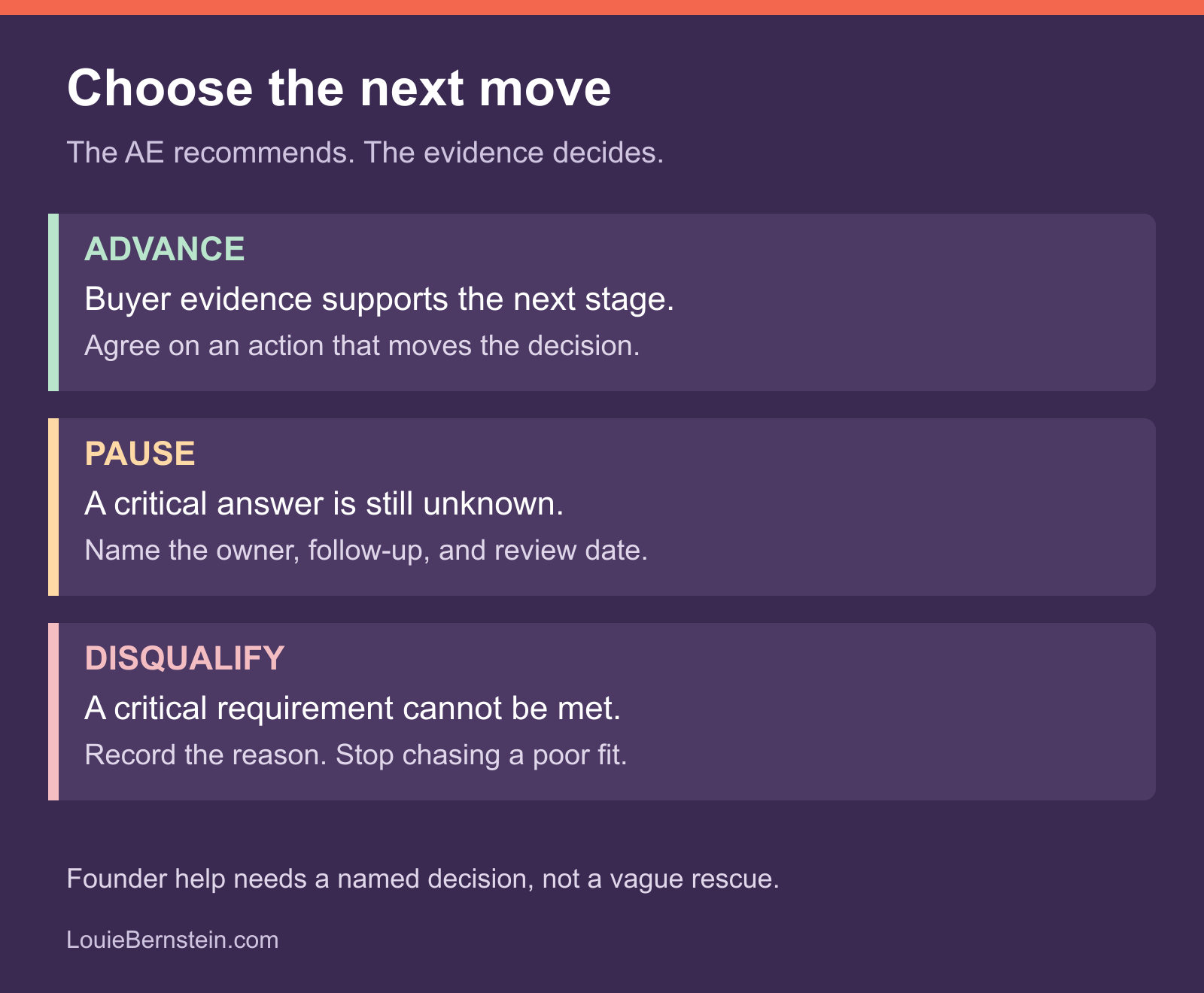
AEs should recommend whether to advance, pause, or disqualify a deal before asking for founder help. The recommendation must name the buyer evidence, the remaining uncertainty, and the next action. Requiring a reasoned choice gives the founder something to coach and prevents deal reviews from becoming a request for instructions.
Set rules for each recommendation
- Advance: The buyer has a problem you can address and agrees to a next action that tests or moves the purchase forward. Match evidence requirements to the next stage.
- Pause: Important evidence is missing. Name the missing fact, who will obtain it, and the review date. Don't move the stage just because another meeting is booked.
- Disqualify: The requirement falls outside your offer, a critical constraint cannot be met, or the buyer confirms there is no reason to pursue a purchase.
A pause needs an owner and a date. Otherwise "needs more discovery" becomes a place to store deals that should leave the active forecast. Your Sales Playbook should define the evidence needed at each stage.
Founder involvement also needs a purpose. The AE might need your approval for a contractual exception or your expertise on a novel use case. The request should say what decision you must make and what the AE has already learned.
How do I coach discovery without taking the deal back?
Coach discovery by reviewing the AE's evidence and reasoning, then having the AE handle the next buyer conversation. Pick one behavior to practice at a time. Keep the rep responsible for the recap, follow-up, and opportunity record so your coaching improves the next call rather than quietly returning ownership to you.
Run a short review with one correction
Ask the AE to explain the recommendation before you give yours. Then ask, "Which buyer statement supports that?" and "What answer would change your decision?" Those questions reveal whether the rep understands the opportunity or is defending a hopeful forecast.
Choose one missing skill. If the rep accepts vague problems, role-play asking for a recent example. If the rep avoids the decision process, practice asking how the company approved a similar purchase. Have the AE try again until the question sounds natural.
For the first review cycle, inspect five completed sheets per AE where volume allows. Five is a practical starting sample, not a validated certification standard. Look for repeated gaps before changing the template or making a hiring judgment.
Measure independence without rewarding shortcuts
Track the share of discovery calls run without you, the share of reviewed sheets with buyer-supported evidence, and progression to the next stage. Compare similar deal types. A founder's warm referral and an AE's cold outbound opportunity aren't a fair win-rate comparison.
For example, if you attended eight of ten discovery calls last month and four of ten this month, founder attendance fell from 80% to 40%. That's illustrative math, not a promised result. Check evidence quality and later outcomes before calling the change an improvement.
Use your founder sales handoff to expand independence gradually. Review the page after calls instead of joining every call by default. When a rep struggles, teach the missing decision and let the rep try again.
Frequently Asked Questions
Should every AE use the same wording?
No. AEs should meet the same evidence standard in language that sounds natural to them. Keep required facts consistent while allowing different questions and conversational styles. Copying the founder's phrasing does not guarantee the rep understands the buyer.
Can we use the template before we have a CRM?
Yes. Start with a shared document and a consistent account name. Assign ownership and keep the sheet where the team can find it. When you add a CRM, carry the evidence fields into the opportunity record instead of creating a second reporting task.
What if a buyer refuses to answer a question?
Record the information as unknown and explain why the answer matters. Offer a narrower question or a later discussion with the appropriate person. Refusal alone doesn't prove poor fit, but the team shouldn't replace missing buyer evidence with an assumption.
Can AI fill out the sheet from a call transcript?
AI can draft a summary, but the AE should verify every field against the conversation. Check numbers, speaker attribution, and commitments especially carefully. A system-generated statement about budget or authority is not evidence unless the buyer actually provided it.
What if my AE finds a better discovery question?
Add the question when the team can explain what it reveals and when to use it. Keep a version date on the template and review changes together. A useful discovery standard should improve as the team learns, rather than preserving every founder habit.
Build a team that can explain its own deals
A Fractional Sales Leader can help turn founder knowledge into a Sales Playbook, discovery standards, and coaching your team uses. Learn more at LouieBernstein.com, or bring a recent discovery example to a conversation.
Schedule a 30-Minute CallAbout the Author
Louie Bernstein is a Fractional Sales Leader with 50 years of sales experience and has provided fractional sales leadership since 2017. He helps B2B founders at $1M to $10M ARR build repeatable sales systems, coach their teams, and reduce dependence on founder-led selling.