How Do You Reset Pay, Accounts, and Authority Without Losing the Rep or Confusing the Team?
Move a sales manager back into selling by agreeing on a real seller role before announcing the change. Put compensation, account ownership, reporting lines, and the effective date in writing. Assign management duties to one named leader. Give the returning seller a workable pipeline and a fair ramp. A respectful conversation helps, but clear operating rules prevent the team from ending up with two managers.
Key Takeaways
- A return to selling works only when the company needs the seller role and the employee accepts its duties and reporting line.
- Reset pay, accounts, and authority together before announcing the move.
- The 2019 Peter Principle study examined 38,843 sales workers across 131 firms. Selling performance and management potential were different selection signals.
- Keep existing reps' opportunities protected. A returning manager doesn't automatically get their old accounts back.
- Name one management owner and remove the former manager's approval duties on the effective date.
You promoted a strong salesperson. The management work hasn't followed. Now you're considering a move back, and you don't want to lose the person who used to bring in the business.
For a founder at $1M to $10M ARR, the temptation is to solve the conversation first and work out the details later. That's backwards. The employee will hear every missing detail as a risk to their income or standing.
Don't offer someone a fresh start with an empty territory and their old management problems still attached.
When is moving a sales manager back into selling the right call?
Moving a sales manager back into selling makes sense when the employee still has credible selling ability, wants the role, and can work under the new manager. The business must also need another seller. A strong sales history alone doesn't justify creating a seat or taking productive accounts away from everyone else.
Confirm the decision before designing the handoff
Separate a role mismatch from a conduct problem. If the employee misled customers, retaliated against reps, or won't follow agreed rules, returning them to a quota doesn't resolve the issue. If they're struggling to coach but still sell well and earn buyer trust, a seller role may be worth discussing.
The foundational 2019 study by Benson, Li, and Shue covered 38,843 sales workers at 131 U.S. firms from 2005 to 2011, including 1,553 promoted into management. The researchers found firms favored sales performance in promotions over other observable characteristics that better predicted management performance. Those findings support testing for different skills. They don't establish a failure rate for returning managers to selling.
If you're still deciding whether the manager deserves more support, start with the sales manager performance decision. The plan here begins after you've established that a return to selling is a serious option.
Build a job someone can actually succeed in
Write the buyer profile, territory, quota assumptions, lead sources, and support the seller will receive. Check whether their product knowledge and selling habits are current. Six months spent managing doesn't preserve a full pipeline. Ask the prospective manager whether they can lead this person without a separate set of rules.
What should you say in the private conversation?
Tell the manager what isn't working, acknowledge your part in the promotion, and offer a specific selling role if one exists. Explain the duties, pay proposal, reporting line, and transition plan. Give the employee time to assess the offer. Don't present a demotion as a reward or promise that nobody will notice.
Own the decision without inventing a story
A practical opening might sound like this: "The management job isn't producing the coaching and forecast discipline we agreed on. I made the promotion decision, and I should have tested the management work more carefully. I want to discuss a selling role because I still see value in your customer work. Here's the job and what would change."
That's sample language, not a client story. Use the facts you can show. If the person also lacked training, authority, or a defined process, acknowledge those gaps. Don't make an employee carry all the blame for a job you never properly built.
Ask about the work, not just the title
Ask whether they want to prospect, carry a personal number, attend coaching, and report to someone who may have been their peer. Listen for willingness to do the whole seller job. "I'll sell, but the reps will still come to me" is a warning that the authority change hasn't been accepted.
Put the proposal in writing and agree on a decision date. Discuss who will hear about the move and when. Respect the employee's privacy while being honest about the reporting change. You can't guarantee retention. You can give them a clear offer and avoid a public surprise.
How should you reset compensation without creating a dispute?
Reset compensation around the new seller job and a realistic earning opportunity, with written terms and an effective date. Separate existing compensation obligations from future incentives. Model the transition before making promises. Have HR or employment counsel review the agreement, required notices, commission treatment, and role classification for the employee's jurisdiction.
Show the employee how the numbers work
Document base pay, quota, commission rates, accelerators, payment timing, and any transition guarantee. Explain what happens to management bonuses and team overrides. Work through live opportunities so both sides understand which plan applies. A new title doesn't settle when a commission is earned or who receives credit.
Employment rules vary. The California labor agency's commission worksheet asks when commissions become earned and whether advances are subject to repayment. Those are practical questions to resolve in the transition agreement. Use local review rather than assuming a title change settles existing compensation obligations.
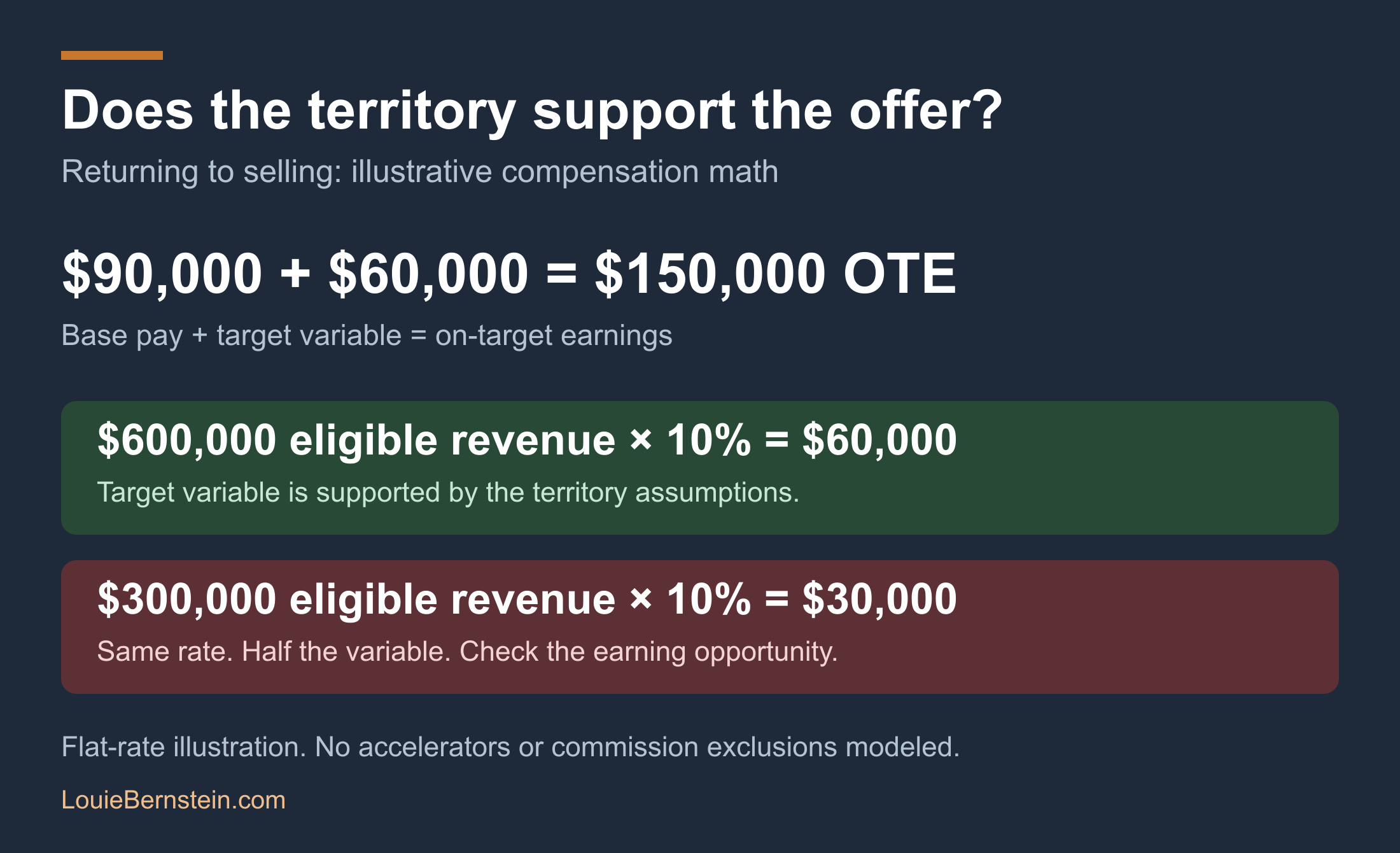
Here's illustrative math, not a pay benchmark: a $90,000 base plus $60,000 variable produces $150,000 on-target earnings. At a flat 10% commission rate on eligible new revenue, that variable requires $600,000 of credited revenue. A territory capable of only $300,000 would produce $30,000 variable under those assumptions. Calling the offer "$150,000 OTE" doesn't fix the territory.
Budget a bridge instead of hiding the shortfall
If the seller starts with little pipeline, consider a defined temporary guarantee or adjusted quota. Set its cost, duration, and end conditions before the offer. Distinguish a nonrecoverable guarantee from a recoverable draw. Don't promise a draw without explaining repayment terms and checking their validity.
Use the same discipline you would bring to designing a sales manager's compensation plan: pay for the job you need done. Once the seller role starts, ongoing management incentives can keep pulling the employee back into supervision.
How do you redistribute accounts without punishing other reps?
Assign the returning seller accounts using buyer continuity, current ownership, and realistic capacity rather than seniority. Review every affected opportunity before the effective date. Record the account owner, next customer action, and compensation treatment separately. Don't strip another rep's late-stage pipeline simply to make the returning manager's offer look attractive.
Separate account ownership from commission credit
An account can move to a different owner while previous work still receives credit under the applicable plan. Those are separate decisions. For each affected deal, write down the current stage, buyer commitments, next meeting, relationship owner, and any agreed commission split. Have the appropriate reviewer check compensation obligations.
Start with unassigned opportunities, a defined new segment, or accounts with a genuine coverage gap. If an account must move from another seller, explain the operating reason privately. Check that person's remaining earning opportunity. Saving one employee by quietly damaging another person's territory is a poor retention plan.
Preserve the customer's next step
For active buyers, arrange a short introduction with the person who already knows the account. Confirm the next action, its owner, and its due date in the CRM. The buyer needs continuity. They don't need an explanation of your internal performance discussion.
In my sales training, understanding the customer's business is a specific discipline. The homework asks managers to quiz reps on their accounts and key people. That gives you a useful handoff test: can the returning seller explain the buyer's business problem and the people involved, without the founder filling in the blanks? I've described that approach in preparing salespeople to understand the customer's business.
A familiar customer name in the CRM isn't proof that the returning seller owns a working relationship.
How do you reset authority and explain the change to the team?
Reset authority by naming one management owner and stating which decisions move to that person on the effective date. Tell the team the returning employee's role, account scope, and reporting line. Keep performance details private. Then change meeting ownership, approval permissions, and escalation routes so daily behavior matches the announcement.
Remove the second approval path
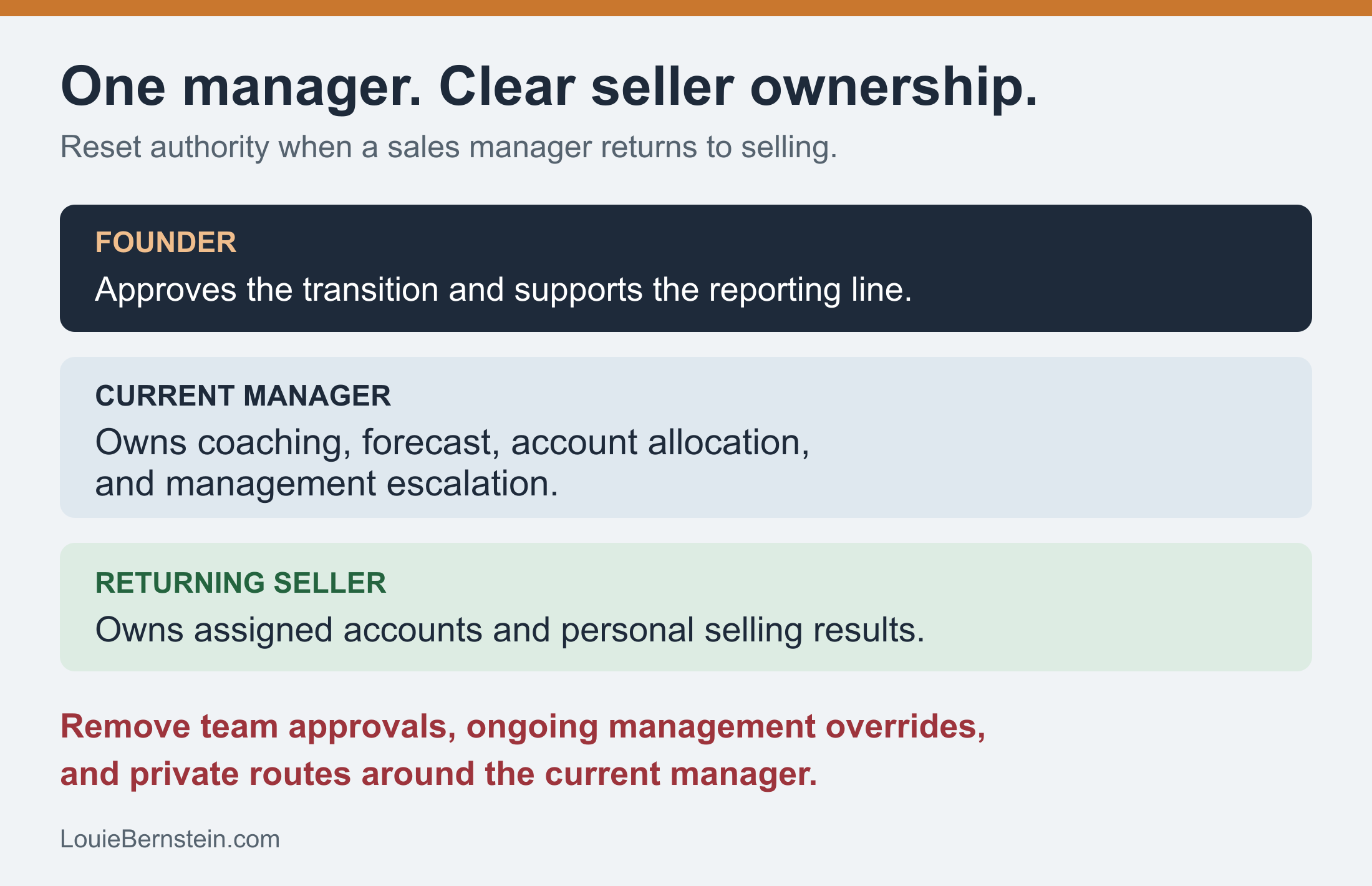
The new manager owns rep coaching, forecast calls, account allocation, and performance decisions within their assigned authority. The returning seller owns their accounts and personal selling work. Optional mentoring should happen by agreement with the manager, without approvals or unofficial performance judgments.
Your founder behavior matters. If the former manager brings you a complaint about a rep, send the issue through the current manager. If you keep taking private staffing advice and making side deals, the org chart becomes fiction. Don't ask the new manager to lead while you maintain a second chain of command.
Make the announcement specific and brief
Sample wording: "Starting Monday, Jordan will focus on enterprise selling and report to Casey. Casey owns team coaching, pipeline reviews, and account decisions. We're completing customer handoffs this week. Please bring management questions to Casey." Only use a role description the employee has actually accepted. Don't call a difficult reassignment a voluntary promotion.
Communication deserves preparation. In a 2024 Gallup analysis, disrupted employees who strongly agreed their leaders communicated effectively were 4.3 times as likely to be engaged. That's an association across U.S. employees, not proof a particular announcement saves a sales team. The useful lesson is to explain what the change means for people's work.
What should you inspect after the move?
Inspect whether the employee is doing the seller job, the current manager has real authority, and customer handoffs are complete. Set reviews against work you can observe before judging revenue. Use the sales cycle to decide when bookings become a fair test. Agree in advance what happens if the arrangement doesn't work.
Use a short transition review
As a working plan, review handoffs in the first week, prospecting and account plans after the first month, and selling progress over a full relevant cycle. These are suggested checkpoints, not research-backed recovery deadlines. Track completed buyer next steps, qualified opportunities, and whether management questions reach the right person.
Ask the returning seller and new manager separately where boundaries remain unclear. Look for informal approvals, unresolved credit disputes, or accounts nobody is following up. Fix the specific gap. Don't let a weekly check-in become another negotiation over whether the employee is still partly the manager.
Decide what success and failure mean
Success means a productive seller, a functioning manager, and clear customer ownership. If the employee rejects the reporting line or keeps undermining the manager, address that behavior directly. If the territory can't support the plan, repair the territory assumptions. Don't confuse a weak book of business with proof that the person can no longer sell.
When no one can cover management during the move, a Fractional Sales Leader can run the cadence and build the handoff. I work with founders who need clear accountabilities and a sales system before a full-time VP of Sales makes sense. The point is to leave you with a team that works without your daily rescue.
Frequently Asked Questions
Should the returning salesperson keep a manager title?
Use a title that matches the work. A senior seller title can recognize experience, but a management title without management duties confuses customers and colleagues. Define authority in writing regardless of the title.
What if the employee wants to sell but refuses the proposed pay?
Treat compensation as an unresolved offer. Check whether the territory supports the proposed earnings and whether you can afford a transition bridge. Don't announce an agreed move while important terms remain open.
Should the seller report directly to the founder?
Use the reporting line that fits the sales organization. If other sellers report to a manager, a special founder reporting line can weaken that manager. Give an exception only a clear business reason and explicit boundaries.
Should customers hear that the manager was demoted?
Customers generally need the new contact and a reliable next step. Describe the coverage change truthfully without sharing private performance details. Confirm who can make commitments and approve exceptions.
Can the returning seller apply for management again?
Yes, if the company has a real opening and the employee demonstrates the required management skills. Don't promise a date as compensation for accepting the seller role. Define the evidence needed for a future application.
Make the role change work on Monday.
If you're a $1M to $10M ARR B2B founder, let's review the seller role, account handoff, and management coverage before you announce the move. Learn about Fractional Sales Leadership at LouieBernstein.com.
Schedule a 30-Minute CallAbout the Author
Louie Bernstein is a Fractional Sales Leader since 2017 with 50 years of sales experience. He founded MindIQ and helps B2B founders at $1M to $10M ARR build repeatable sales systems, written accountabilities, and teams that sell without constant founder intervention.