Key Takeaways:
- Changing your comp plan is normal, not reckless. 97% of companies changed theirs for 2026, up from 86% the year before (Alexander Group). The question was never whether to change it. It's how.
- Teams don't quit over the new math. They quit over the ambush. Sprung on a Friday, with in-flight deals voided, a comp change reads as "the deal we made is off."
- Model the new plan against last year's real deals before anyone sees it. If a rep who performed the same now earns meaningfully less, you've designed a pay cut with extra steps.
- Give 30 to 60 days' notice, grandfather deals already in the pipeline, and explain it one-on-one before it's ever an email. 78% of leaders say reps already find comp plans hard to understand (QuotaPath).
- A comp change is the fastest way to redirect a whole team, or the fastest way to lose it. Same plan, same numbers. The rollout decides which.
Every founder I talk to about comp treats a change like defusing a bomb. I get it. But here's a number that should take some pressure off: 97% of companies changed their sales comp plan for 2026, up from 86% the year before (Alexander Group). Changing comp isn't the risk. It's routine.
The fear underneath the question is still real, though. "I want to grow sales, not have everyone quit." That's the whole thing, isn't it? Sales turnover already runs about 35%, versus 13% for other roles (HubSpot), and replacing one rep runs roughly $115,000 and takes over five months to fill an outside seat (DePaul Center for Sales Leadership). So when a founder hesitates to touch the plan, they're not being precious. They're protecting the team they've got.
But teams don't break because the math changed. They break because of how the change showed up. Reps talk to money. Change how they're paid without warning, and they hear a broken promise, not a new strategy.
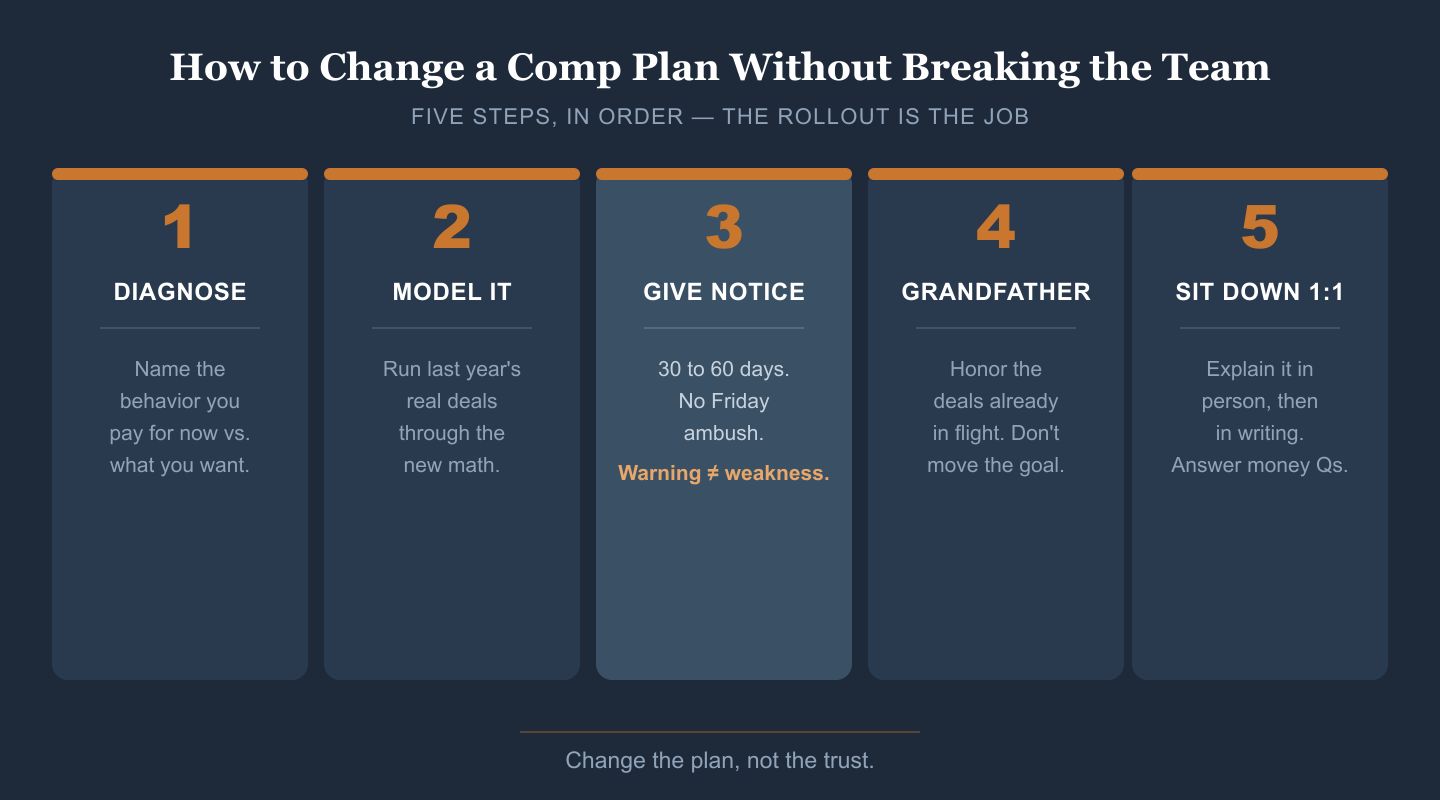
Here's the exact rollout I use, so a comp change redirects the team instead of emptying it.
Teams Don't Quit Over the Math. They Quit Over the Ambush.
The biggest mistake founders make with comp isn't the design. It's the delivery. A rep who gets told on Friday that Monday's plan is different, with no say and no warning, doesn't hear "we're optimizing incentives." They hear that the ground can move under them at any time. That's the feeling that makes good people quietly update their resumes.
The number that should worry you isn't turnover. It's the reason for it.
9% of reps eventually quit over commission errors or disputes, and 22% have at least one comp dispute a year (QuotaPath, survey of 450+ revenue leaders). Most of that isn't fraud. It's confusion and surprise. A change nobody explained becomes a dispute, and a dispute becomes a resignation. At roughly $115,000 to replace an outside rep and over five months to make the next one productive (DePaul), a botched rollout is one of the most expensive things you can do to your own P&L.
Your reps are rational. Read what they're actually reacting to.
The rep isn't being dramatic. They built a life around a number, a mortgage, a car payment, a kid's tuition. When you change how that number gets earned, mid-year, mid-deal, with no runway, you've changed the deal on them retroactively. The exact same change, delivered with notice and a straight explanation, lands as leadership. Delivered by surprise, it lands as betrayal. The plan is identical. Only the rollout is different.
A comp change is not a math problem. It's a trust transaction. You can get every number right and still lose the team if they find out the wrong way.
Before You Touch the Plan, Name the Behavior You're Buying
A comp plan is a set of instructions, and a comp change is you rewriting the instructions. So the first question isn't "what's the new number." It's "what do I want the team doing next quarter that they aren't doing now?" More new logos? Bigger deals? Less discounting? Customers who actually stay? Name it in one plain sentence before you design a single formula. If you can't finish the sentence "I'm changing this plan so my reps will ___," you're not ready to change it.
Diagnose the plan you already have
You can't fix what you haven't looked at. Pull last year's numbers and ask what the current plan actually rewarded. If reps discounted heavily, chased tiny deals, or ignored renewals, the old plan paid them to, and they were right to follow it. This is where most founders find the real culprit hiding in plain sight. I broke the usual suspects down in the comp plan mistakes that quietly kill your margin. Change comp without diagnosing the old plan and you'll just trade one accidental incentive for another.
Change one or two levers, not the whole plan at once
Don't rewrite everything in one memo. If you flip the base-to-variable split, add accelerators, raise the quota, and introduce a clawback all at the same time, no rep will understand any of it, and 78% already find comp plans hard to follow (QuotaPath). Move the one or two levers that map directly to the behavior you named. Leave the rest of the plan alone so reps can actually see what changed and why.
Model It Against Real People Before Anyone Sees It
This is the step founders skip, and it's the one that saves the team. Before the new plan ever leaves your laptop, run every current rep's last twelve months through the new math. Same deals, same performance, new formula. Now you know exactly who comes out ahead, who's flat, and who's down, before a single rep does.
The "no one worse off for the same performance" rule
Here's my hard line: no rep should earn meaningfully less for doing exactly what they did last year. If the model shows your best closer down 15% at identical performance, you haven't designed a growth plan. You've designed a pay cut with extra steps, and your best closer will do that math faster than you did. Fix it before rollout: adjust the plan, add a one-time transition bonus, or lift the base until the numbers are fair. A raise in disguise gets adopted. A cut in disguise gets argued about in your team Slack for a month.
Hunt for the perverse edge cases
Modeling also catches the accidental incentives before your reps weaponize them. Maybe the new accelerator makes it smarter to sandbag a December deal into January. Maybe a retention bonus punishes a rep for a churn they couldn't control. Your reps will find every one of these within a week of go-live. Better that you find them first, while the plan is still a spreadsheet and not a promise.
Roll It Out Like You Respect Them
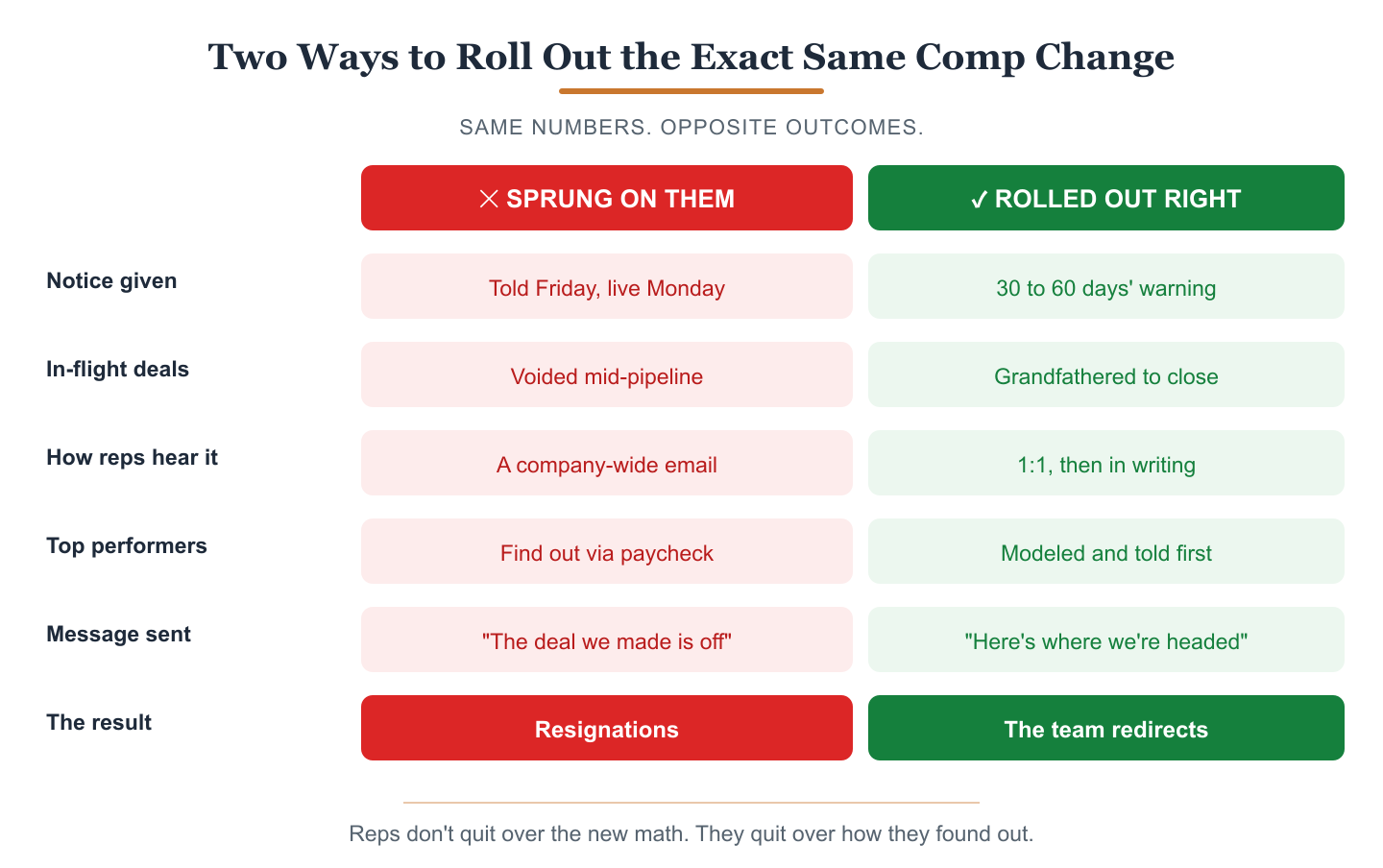
You've named the behavior, diagnosed the old plan, and modeled the new one. Now comes the part that actually decides whether the team stays: how they hear about it. Same change, two rollouts, opposite outcomes.
Give real notice
Thirty to sixty days, minimum. A comp change announced Friday for Monday is an ambush no matter how good the plan is. Notice does two things at once: it signals respect, and it gives reps time to adjust their behavior to the new targets before their paycheck depends on it. Some founders worry that advance notice looks weak or invites pushback. It doesn't. Warning is not weakness. It's the difference between a leader and a landlord.
Grandfather the deals already in flight
Any deal already in the pipeline closes under the old plan. Full stop. The rep started working that deal under one set of rules, and changing the payout after they've done the work is the fastest way to teach your team that no promise from you is safe. Grandfathering in-flight deals costs you a little in the short term and buys you an enormous amount of trust. It's the single clearest signal that this is a change, not a bait-and-switch.
Explain it in person, then in writing
The plan gets explained one-on-one, or at the very least in a live meeting where questions get answered out loud, before it's ever an email. 60% of reps take three to six months to fully understand how they earn variable pay (QuotaPath), so you don't get to assume anyone read the doc. Walk each rep through their own number on their own deals. Then put it in writing as the single source of truth. My test: if a rep can't explain their own plan back to you in their own words, you haven't finished rolling it out yet.
Notice, grandfathering, and a real conversation cost you almost nothing. Skipping them costs you your best people. That's the whole trade.
Protect Your Top Performers on Purpose
Your best rep has options. They always do. That makes them the person most likely to walk if the change feels like a demotion, and the person you can least afford to lose. So treat their rollout as its own separate task, not a line item in a group announcement.
Model their number first, and talk to them first
Before the group ever hears about the change, you should already know exactly what it does to your top two or three earners, and you should have already had a private, one-on-one conversation with each of them. Not to negotiate. To show them you ran the math on their behalf and they come out whole or ahead. A top rep who feels seen becomes your loudest advocate for the change. A top rep who feels blindsided becomes the reason three others start taking recruiter calls.
Don't cap the upside to control cost
If the new plan quietly caps commission to keep costs down, your best people will feel it on the first big deal, and they'll read it exactly right: you'd rather they coast than crush it. Growth comes from your top performers running downhill with the brakes off. If a rep earns "too much," it means they sold far more than you planned. That's a thank-you note, not a ceiling. Where the split should actually land is its own conversation, and I walk through it in how to pay your first sales rep.
If You Don't Have a Sales System Yet, a Comp Change Won't Fix It
Now let me be straight with you, because this is the part most people skip. If you're a founder still running every deal yourself, with no defined pipeline stages, no real quota, no CRM anyone trusts, and no documented process, then changing the comp plan will not move your revenue. You'd be tuning the engine on a car with no wheels.
Comp is a steering wheel. It only works when there's a system underneath it to steer, a repeatable process, clear roles, a quota built on real capacity instead of a hopeful guess, and a pipeline you can actually see. If those aren't in place yet, build them first. That's the real unlock, and it's exactly the work a Fractional Sales Leader does with $1M to $10M ARR founders who aren't ready for a full-time VP of Sales: put the system in, then use comp to point it where you want it to go.
Part of that system is making sure every rep has an Accountabilities Document, a clear statement of what they own and how their success gets measured. When the accountabilities and the comp plan agree, the comp plan simply pays for outcomes the rep already knows they're responsible for. And when that's true, a change to the plan stops feeling like a surprise and starts feeling like a natural next step. That alignment is the quiet reason some teams absorb a comp change in a week and others lose three reps over it.
Frequently Asked Questions
Q: How much notice should I give before changing a comp plan?
Thirty to sixty days at a minimum. Anything less reads as an ambush, no matter how fair the new plan is. Notice gives reps time to adjust their behavior to the new targets before their pay depends on it, and it signals respect. Pair the notice with two things: grandfather any deals already in the pipeline so they close under the old plan, and explain the change one-on-one before it ever goes out as an email. Warning is not weakness. It's what separates a change from a bait-and-switch.
Q: Should I change comp at the start of the year or mid-year?
The start of a fiscal year or quarter is cleanest, because it lines up with fresh quotas and reps expect it. But don't let the calendar trap you into keeping a broken plan for eight more months. If the current plan is actively rewarding the wrong behavior, change it mid-year, just lean harder on the safeguards: full notice, grandfather every in-flight deal, and a one-time transition bonus if anyone's number dips through no fault of their own. The timing matters less than the rollout.
Q: How do I change comp without my best rep quitting?
Model their number first, and talk to them first. Before the team hears anything, run your top performer's last twelve months through the new math so you know exactly where they land, then have a private conversation to walk them through it. The goal is to show them you did the math on their behalf and they come out whole or ahead. Never cap their upside. A top rep who feels seen defends the change to everyone else. A top rep who feels blindsided is the first one gone.
Q: What is grandfathering, and do I really have to do it?
Grandfathering means any deal already in the pipeline pays out under the plan that was in effect when the rep started working it. Yes, you really have to do it. The rep did the work under one set of rules, and changing the payout after the fact is the single fastest way to convince your whole team that no promise from you is safe. It costs a little in the short term and buys you the trust you'll need for every future change. Skip it and you'll pay far more in turnover.
Q: My reps are discounting too much. Should I just change the comp plan?
Comp is the right lever, but diagnose before you pull it. If reps discount heavily, it's almost always because a flat commission pays them the same whether the deal is full price or half price, so closing fast costs them nothing. The fix is to pay a higher rate on full-price deals and a lower one on discounted deals, so the rep shares your interest in holding price. Just make sure the rest of your system, quota, pipeline, and process, is solid first. A comp tweak on top of no system won't hold.
Q: How often should I change my comp plan?
Once a year is normal and healthy, 97% of companies changed their plan for 2026 (Alexander Group). An annual refresh lets you align pay with where the business is headed. What breaks teams is thrash: changing the plan every quarter, or every time a rep has a big month. Frequent, reactive changes teach reps that their pay is unstable, and instability drives good salespeople out. Change with intent on a predictable cadence, not in a panic.
Thinking about changing your comp plan?
Before you send that email, let's model it together. In 30 minutes I'll help you pressure-test the new plan against your real reps, so it redirects the team instead of thinning it out. See how a Fractional Sales Leader can help at louiebernstein.com.
Schedule a 30-Minute CallAbout the Author
Louie Bernstein
Fractional Sales Leader with 50 years of sales experience helping $1M–$10M ARR companies build scalable, repeatable sales systems. Founder of MindIQ (INC 500). LinkedIn Top Voice in Sales Management, Sales Operations, and Sales Coaching.