Key Takeaways:
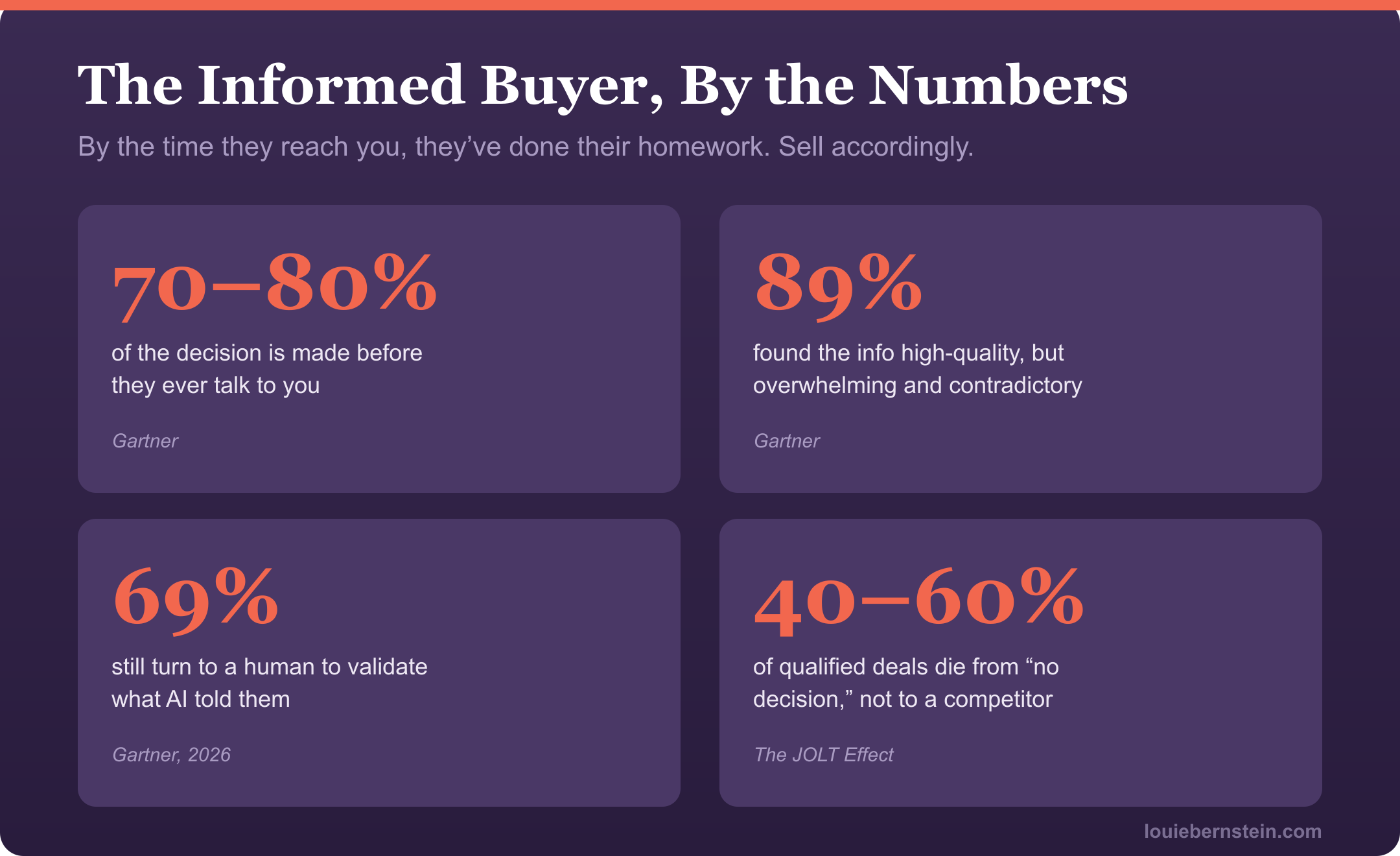
- 70–80% of the decision is made before a buyer ever talks to you (Gartner). The feature walkthrough answers questions they answered days ago.
- The informed buyer isn't ignorant, they're overwhelmed. 89% say the info they found was high-quality but overwhelming and often contradictory (Gartner).
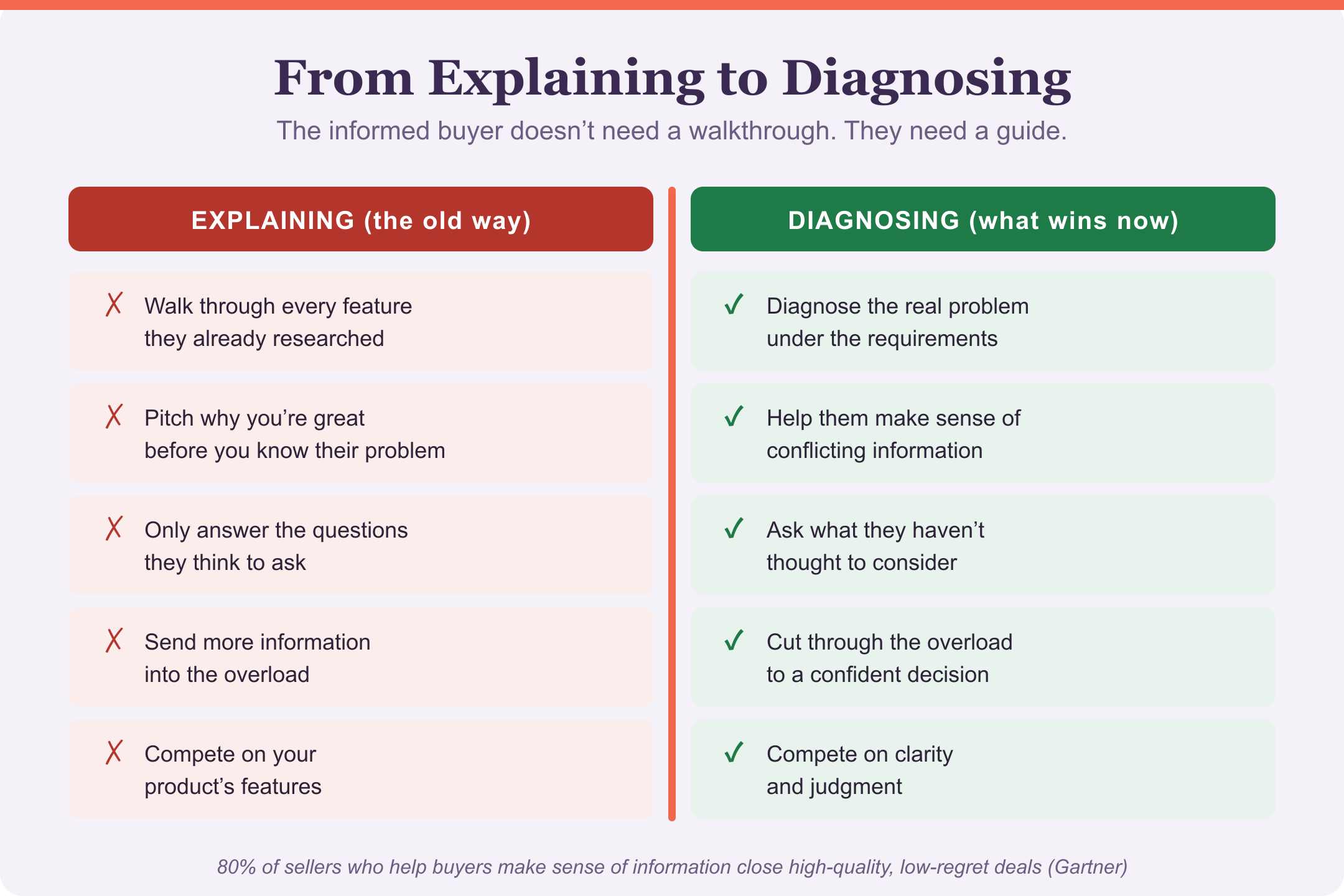
- The shift that wins now: stop explaining, start diagnosing. 80% of sellers who help buyers make sense of the noise close high-quality, low-regret deals (Gartner).
- You still matter. 69% of buyers turn to a human to validate what AI told them (Gartner). And 40–60% of deals die from "no decision," not to a competitor (The JOLT Effect). Your judgment is what breaks the tie.
- Reopen a "closed" deal with the question that surfaces a blind spot, not a pitch. Move your process upstream and run the meeting as a diagnosis.
Your prospect just booked a call. Before they clicked "confirm," they read your website, three competitor sites, a Reddit thread, four reviews, and asked ChatGPT to compare you to two alternatives. They know your pricing tiers, your weak spots, and two objections you haven't even heard yet. And you're about to open the call with, "So, let me tell you a little about what we do."
Don't. 70–80% of the buying decision now happens before a salesperson is ever involved (Gartner). By the time an informed buyer reaches you, they're roughly two-thirds of the way to a decision (6sense). The feature walkthrough, the capabilities pitch, the "here's who we are" deck, all of it answers questions they already answered without you. Reciting it doesn't inform them. It tells them you didn't do your homework on them.
So what's your job when the buyer already knows more than your pitch? It's not to inform them. It's to help them decide. That's a different skill, and most founders never make the switch. Let me show you the shift, and the specific moves that win with a buyer who's done their homework.
The Informed Buyer Has Killed the Feature Walkthrough
The walkthrough was built on an assumption that's now false: that the buyer was ignorant and you were the source. For decades that held. The rep controlled the information, so the meeting was a transfer of it. Today the buyer researched you before you knew they existed, and they've read things about you that you'd never say about yourself. When you open by explaining what you do, an informed buyer hears a subtle insult: you either didn't check who you were talking to, or you have nothing better to offer than a brochure.
It also wastes the one thing you can't get back. Buyers spend just 17% of their total buying time with suppliers, and when they're comparing several, that drops to 5% or 6% with any one rep (Gartner). That's your whole window. Burning it on a recap of things they already know is how you turn a live deal into a polite "we'll be in touch."
Meeting a Buyer Who's 70% Done Deciding
Here's what "informed" actually means, because it's not what most founders picture. The buyer has formed a preference, set their requirements, and, critically, drowned a little in the process. 89% of buyers say the information they found was high-quality, but also overwhelming and often contradictory (Gartner). That's the real person across the table: not ignorant, but overloaded and quietly unsure whether they've got it right.
And that's your opening. Even in an age of self-serve research, 69% of buyers still turn to a human to validate what AI told them (Gartner). They don't need more information. They've got too much already. They need someone credible to help them trust the decision they're about to make. That's a job AI can't do and a brochure can't do. It's the job you were actually hired for.
From Explaining to Diagnosing: The Shift That Wins Now
The move is simple to say and hard to do: stop explaining, start diagnosing. Gartner has a name for it, "sense-making," and the data behind it is striking. 80% of the sellers who use a sense-making approach close high-quality, low-regret deals (Gartner). Not just more deals, better ones, the kind that don't churn or claw back later.
Diagnosing means you help the buyer make sense of the noise. You reconcile the conflicting information they've collected, help them prioritize what actually matters for their situation, and make the trade-offs clear. You become the guide through the overload instead of another voice adding to it. It's the exact discipline of a great discovery conversation, ask before you tell, and I walk through the mechanics in how to run a discovery call with a new prospect. The difference now is the stakes: with an informed buyer, diagnosing isn't a nicety. It's the whole game.
The Questions That Reopen a Deal the Buyer Thinks Is Closed
The informed buyer often walks in with a conclusion already formed, and frequently it isn't you. Your leverage isn't a better pitch. It's the question that makes them reconsider, not by attacking their choice, but by surfacing something their research never weighed. Here are five that reopen a decision:
- "What made you rule out the alternatives?" Reveals the criteria they're actually using, and where those criteria are shaky.
- "When you modeled this, what did you assume about [the hard part]?" Tests the hidden assumptions under their confidence.
- "What happens if [the thing they're not accounting for] turns out to be true?" Introduces a risk they haven't priced in.
- "Who else has to live with this decision, and what do they need?" Surfaces the rest of the buying group and its unspoken requirements.
- "What would have to be true for this to be the wrong call?" A quiet pre-mortem that makes them stress-test their own choice.
These work because the buyer suddenly sees a gap in research they thought was complete. And that gap is exactly where deals stall. Remember, 40–60% of qualified deals die from "no decision," not to a competitor (The JOLT Effect). The buyer freezes because they're afraid of getting it wrong. The right question, followed by your genuine help thinking it through, is what un-sticks them.
"The informed buyer doesn't need you to know your product. They need you to see their decision more clearly than they can."
Why Your Sales Process Has to Move Upstream
If 70–80% of the decision is made before contact, then waiting for the inbound lead means you inherit whatever preference already formed, and it's often not for you. A sales process that starts at the demo is a process that starts too late. It has to start upstream, shaping the buyer's criteria while they're still researching. That's the whole point of getting into the consideration set early, which I covered in why buyers pick a favorite before they call you and why ChatGPT isn't recommending your company.
Downstream, the meeting itself has to change too. Kill the company-overview slide. Open with a sharp, informed question about the buyer's specific situation, something that proves you did your homework and earns you the right to be their guide. The reps who do this don't sound like salespeople. They sound like the smartest advisor in the buyer's world, which is exactly why they win.
What to Fix in Your Sales Motion This Quarter
You don't need a reinvention. You need five concrete changes you can make this quarter:
- Delete the feature-walkthrough opening. Replace it with three diagnostic questions you ask every informed buyer.
- Build a "conflicting information" cheat-sheet. List the five confusing trade-offs in your category and how you help a buyer reason through each.
- Ask "what made you rule out the alternatives?" on every deal. It's the fastest way to find the shaky criterion.
- Assume the buyer used AI. Ask what they learned, then gently correct the record wherever the model got you wrong.
- Move one activity upstream. Publicly answer the questions buyers research before they ever call you.
This is founder-led work first, because you have the judgment to know which questions actually move a buyer. A Fractional Sales Leader turns that judgment into a repeatable motion your team can run without you in the room. One honest caveat: if you haven't personally closed enough of these conversations to know which diagnostic questions land, you can't systematize it yet. Go run more of them yourself first, then hand the pattern to a team. If you're a founder between $1M and $10M in ARR, you almost certainly have that pattern in you. The work is getting it out of your head and into a motion.
Related Reading
Frequently Asked Questions
Q: How do I sell to a buyer who already knows everything about my product?
Stop trying to inform them and start helping them decide. By the time an informed buyer reaches you, 70–80% of the decision is already made (Gartner) and they're overwhelmed by conflicting information (89%, Gartner). Your job is sense-making: reconcile the noise, clarify the trade-offs, and surface the blind spots their research missed. Lead with sharp diagnostic questions about their specific situation, not a feature walkthrough. The sellers who guide buyers this way close 80% high-quality, low-regret deals (Gartner).
Q: Should I still do a product demo or walkthrough?
Yes, but not as your opener and not as a generic tour. The informed buyer already researched your features, so a full walkthrough wastes the tiny window you get, buyers spend only 17% of their time with suppliers (Gartner). Instead, diagnose their problem first, then show only the parts of your product that solve it. A demo aimed at the specific decision they're stuck on is persuasive. A demo that recites everything you do is a polite way to lose.
Q: What is "sense-making" selling?
Sense-making is Gartner's term for helping buyers evaluate, prioritize, and reconcile the flood of information they've collected so they can reach a confident decision. Instead of adding more information, you help them cut through it. Given that 89% of buyers find their research high-quality but overwhelming and contradictory (Gartner), this is exactly what they're missing. It works: 80% of sellers who use a sense-making approach close high-quality, low-regret deals (Gartner), the kind that stick instead of churning.
Q: How do I reopen a deal where the buyer already prefers a competitor?
Don't attack their choice, expose a blind spot. Ask what made them rule out the alternatives, what they assumed about the hard part of the problem, or what would have to be true for this to be the wrong call. These questions make the buyer realize their research had a gap, which is exactly where deals stall. 40–60% of qualified deals die from "no decision," not to a competitor (The JOLT Effect), so a buyer who suddenly feels unsure needs your judgment to get un-stuck, and that's your way back into the deal.
Q: Buyers say they don't want to talk to sales. Do I still matter?
More than ever, just later and differently. Buyers prefer to self-serve the research, but 69% still turn to a human to validate what AI told them before they commit (Gartner). They don't want a pitch. They want a credible person to help them trust a big, complex decision. Show up as that person, the guide who makes their choice clearer, and you're indispensable. Show up as a walking brochure and they'll rightly route around you. The value moved from information to judgment.
Q: My sales calls are still pitch-first. Where do I start?
Start by deleting your company-overview slide and writing three diagnostic questions to open every call. Build a short cheat-sheet of the confusing trade-offs in your category and how you help buyers reason through them. Assume every buyer used AI, and ask what they learned so you can correct anything the model got wrong. It's a few hours of work built on knowledge you already have. Turning it into a consistent motion your whole team runs is exactly what a Fractional Sales Leader installs.
Selling to buyers who already did their homework?
If you're a founder between $1M and $10M in ARR, I'll help you turn your instinct into a repeatable, diagnosis-first sales motion that wins the informed buyer, without hiring a full-time VP of Sales. See how it works at louiebernstein.com.
Schedule a 30-Minute CallAbout the Author
Louie Bernstein
Fractional Sales Leader with 50 years of sales experience helping $1M–$10M ARR companies build scalable, repeatable sales systems. Founder of MindIQ (INC 500). LinkedIn Top Voice in Sales Management, Sales Operations, and Sales Coaching.