Why founders should own their first 50 conversations with a new market
Cold outreach isn't dead. Irrelevant outreach is. A real reason to reach out still earns a reply, and 73% of B2B buyers say they actively avoid suppliers who send irrelevant outreach (Gartner, 2025). AI SDRs get this wrong when they automate before anyone knows what the buyer cares about. Founders should own their first 50 conversations with a new market, then automate what works.
Key Takeaways
- Cold outreach still works in B2B when it carries a real reason for that buyer. What has stopped working is sending the same irrelevant message to more people.
- 73% of B2B buyers actively avoid suppliers who send irrelevant outreach (Gartner, 632 B2B buyers surveyed in 2024, published June 2025).
- AI SDRs scale whatever message you give them. If the message hasn't been tested on real buyers, AI sends a bad message faster and to more people.
- Founders should own their first 50 conversations with a new market, to learn the reason to call, the buyer's words, who says yes and the common objections.
- Write down what the first 50 conversations taught you. That page becomes the playbook for your first rep and the brief for any AI tool you add later.
My first business job, in 1976, was IT recruiting in Chicago.
No email. No LinkedIn. No sequences. Just a phone and a reason to call.
Fifty years later, the tools look nothing alike. The thing that earns a reply hasn't changed at all.
A real reason. That's what earns a reply, in 1976 and today.
Founders, you're getting pitched AI tools that promise meetings on autopilot. I use AI every week. I love it. But I believe you can't automate the part where you earn someone's attention.
Is cold outreach dead in B2B sales?
Cold outreach isn't dead in B2B sales, but irrelevant cold outreach is. Buyers still answer a message that names a real problem they have, at a time it matters. They ignore, and then avoid, the sender of generic pitches. The difference is the reason behind the message, not the channel or the tool.
What buyers told Gartner
In a June 2025 release, Gartner reported on a survey of 632 B2B buyers taken in August and September 2024. Two findings matter here. First, 73% of B2B buyers actively avoid suppliers who send irrelevant outreach. Second, 61% prefer a rep-free buying experience overall, but buyers still prefer a seller's input when they're working out whether a product fits their company's needs.
Put those together. Buyers don't want more messages. They want the right conversation, at the point where a seller can help them decide. Gartner's own analyst put it plainly: bad prospecting actively damages relationships with potential customers.
What a real reason looks like
A real reason is specific to the buyer. You saw they opened a second location. They just hired a VP of Operations. Three companies like theirs had the same problem last quarter, and here's what fixed it. A fake reason is about you: your new feature, your funding, your "quick 15 minutes." Buyers can tell the difference in one line.
What do AI SDRs get wrong about B2B sales?
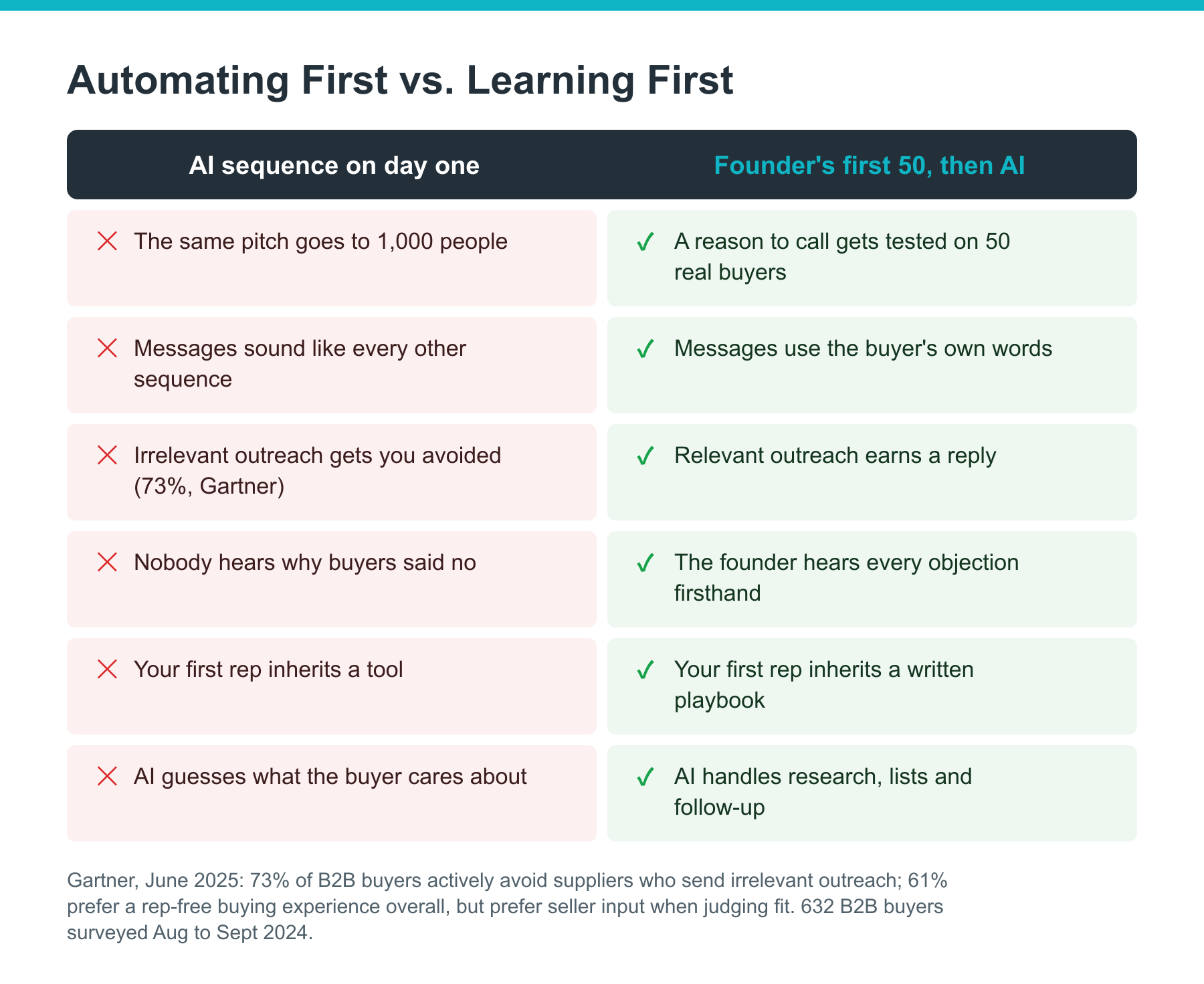
AI SDRs get B2B sales wrong when founders use them to replace learning instead of scaling it. An AI SDR sends whatever message it's given, to whatever list it's given. If nobody has tested that message on real buyers, the tool sends an unproven pitch faster and wider, and buyers learn to avoid you.
AI scales a message. It doesn't find one.
The pitch for AI SDRs is that they replace the grind of prospecting. Some of that grind is worth replacing. Research, list building, follow-up reminders and first drafts are all places AI saves real time. I use it for that kind of work every week.
What AI can't do is sit across from a buyer in a new market and hear what they actually care about. It can guess from what's been written online. But the reason a buyer replies is usually something you only learn by talking to them. I've written about the order of operations in whether to build the process or add the tools first.
The cost of getting it wrong
A bad cold call costs you one conversation. A bad automated sequence can cost you a market. If 1,000 buyers get a message that misses, and most of them start avoiding you, you've burned the same list your first rep was supposed to work. That's a hard hole to climb out of at $2M in revenue.
There's a quieter risk too. The same Gartner survey found that 69% of B2B buyers report inconsistencies between what a company's website says and what its sellers tell them. An AI tool writing its own pitches can drift from your real message fast. Buyers notice, and mixed messages make them trust you less.
Why should founders own the first 50 conversations with a new market?
Founders should own the first 50 conversations with a new market because those conversations teach you what to automate and what to hand your first rep. In 50 real conversations you learn the reason that earns a reply, the words buyers use, who says yes, and the objections you'll hear every week.
What the first 50 teach you
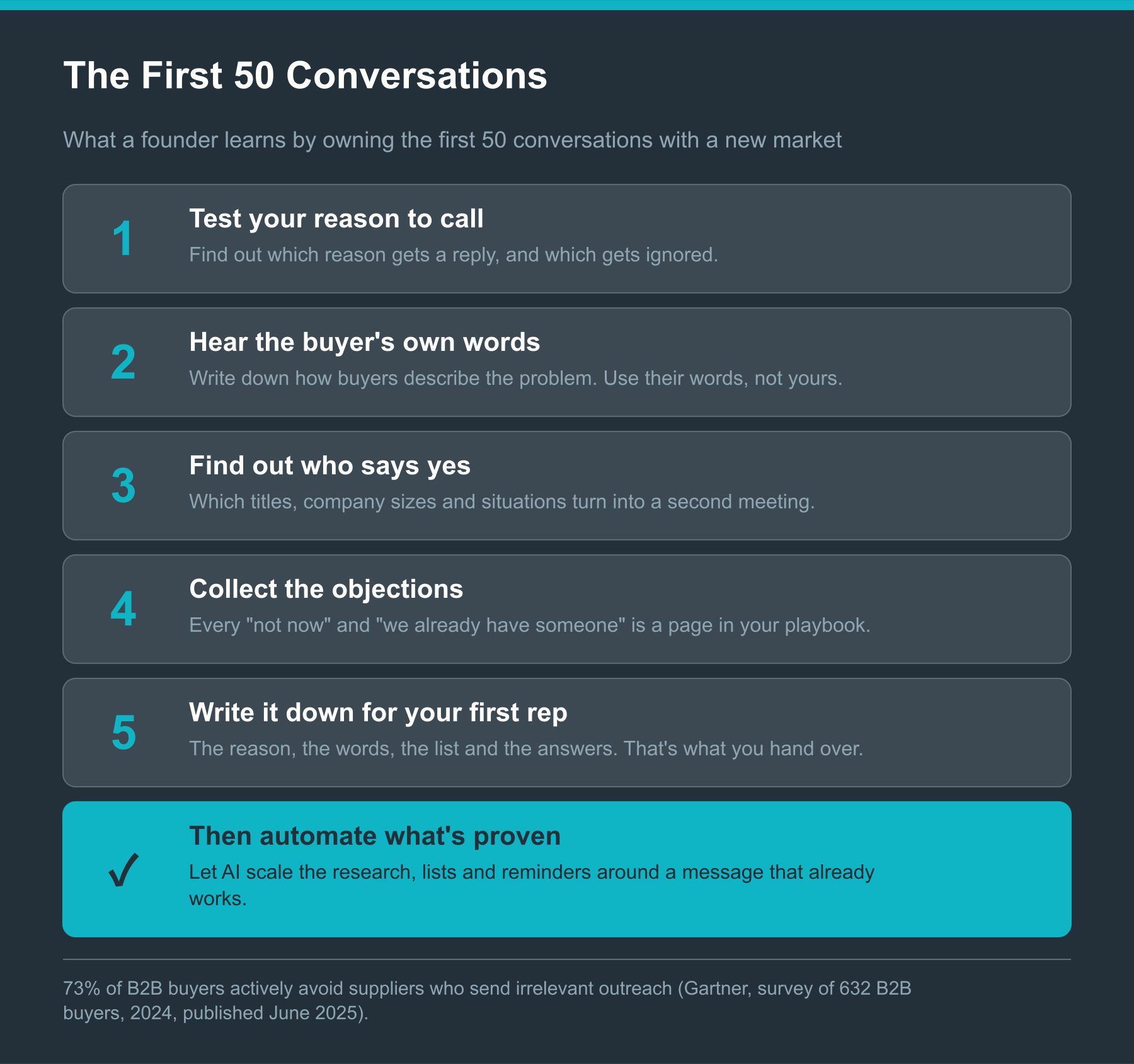
Fifty is my number, not a study. It's enough to see patterns and few enough that a founder can get through them in one to three months alongside everything else. If your market is small, 30 might do. If you sell to several kinds of buyers, plan on 50 for each.
That's what you hand your first rep
The first 50 conversations aren't only for you. They're the raw material for your first salesperson. The reason to call becomes the opening. The buyer's words become the email copy. The objections become the answer sheet. Without those 50, your first rep starts the same way your AI SDR would: guessing.
Your first 50 conversations with a new market should come from you, not a sequence.
What I learned from 50 years of reaching out to strangers
Fifty years of cold outreach taught me that the reason for the call matters more than the tool you call with. In 1976 I had a phone and a list. Today a founder has email, LinkedIn, video and AI. The buyer still answers the same question first: why should I talk to you?
Recruiting taught me the reason comes first
IT recruiting in Chicago meant calling people who weren't expecting me and didn't owe me a minute. The calls that worked had a reason the other person cared about. The calls without one ended fast. I've carried that through every sales job since, from DEC to running MindIQ for 22 years to working as a Fractional Sales Leader since 2017.
Where AI helps, and where it doesn't
I use AI every week, and I love it. AI is good at the work around a conversation: research, lists, first drafts, reminders. It isn't good at deciding what a buyer cares about. A founder learns that by asking, listening and writing down what they hear. With that work done, AI makes the next 500 messages better. Without it, AI makes them worse, faster.
When should a founder bring in AI SDRs or a first rep?
Bring in AI SDRs or a first rep once you have a message that works and it's written down. That means a reason to reach out that earns replies, a list of who says yes, and answers to the common objections. Then AI and people can scale something proven instead of guessing in public.
A simple readiness check
- You can name the reason to reach out that gets the most replies.
- You can describe your best-fit buyer in two sentences.
- You've written down the five objections you hear most and how you answer them.
- At least a handful of your first conversations turned into real deals.
If you can't check all four, the next 20 conversations are still yours. For a structured way to run them, see the 90-day outbound playbook for founders.
When to get help
Turning your first 50 conversations into a playbook a rep can run is part of what I do as a Fractional Sales Leader. I work in 12-week engagements, 20 to 35 hours a week, at $14K a month. Other Fractional Sales Leaders run $10K to $20K a month, and a full-time VP of Sales costs $250K to $400K a year.
Frequently Asked Questions
Do AI SDRs work for B2B companies at $1M to $10M ARR?
AI SDRs can help once a founder has a proven message and a clear best-fit buyer. Before that, they tend to send untested messages at scale. Use AI for research, lists and follow-up first. Hand it the outreach itself only after real buyers have replied to the message.
Is cold calling still worth it in B2B?
Yes, when the call has a real reason for that buyer. A phone call gives you something email can't: you hear the buyer's reaction in real time. For a founder learning a new market, a few good calls teach more than a thousand sent emails.
How do I find a real reason to reach out?
Look for a change at the buyer's company: a new hire, a new location, a funding round, a new regulation, a problem common in their industry. Then connect that change to a problem you solve. If you can't name a reason in one sentence, don't send the message yet.
How long do the first 50 conversations take?
Anywhere from five weeks to about three months. At three or four conversations a week, you're through 50 in about three months. At ten a week, about five weeks. Write down what you learn after each conversation, not at the end, or you'll lose the details.
Should my first sales hire be an SDR?
Usually not at $1M to $10M ARR. A full-cycle rep who prospects and closes learns more from each conversation than an SDR who only books meetings. Hire for prospecting skill, and give the rep the playbook from your first 50 conversations.
Find the reason that earns a reply.
If you're a $1M to $10M ARR B2B founder weighing AI SDRs or your first rep, let's look at what your first conversations should teach you before you automate. Learn about Fractional Sales Leadership at LouieBernstein.com.
Schedule a 30-Minute CallAbout the Author

Louie Bernstein Fractional Sales Leadership
Louie Bernstein is a Fractional Sales Leader with 50 years of sales experience and has worked as a Fractional Sales Leader since 2017. He built and ran MindIQ for 22 years. He helps B2B founders at $1M to $10M ARR build repeatable sales systems so selling doesn't depend on the founder.