Key Takeaways:
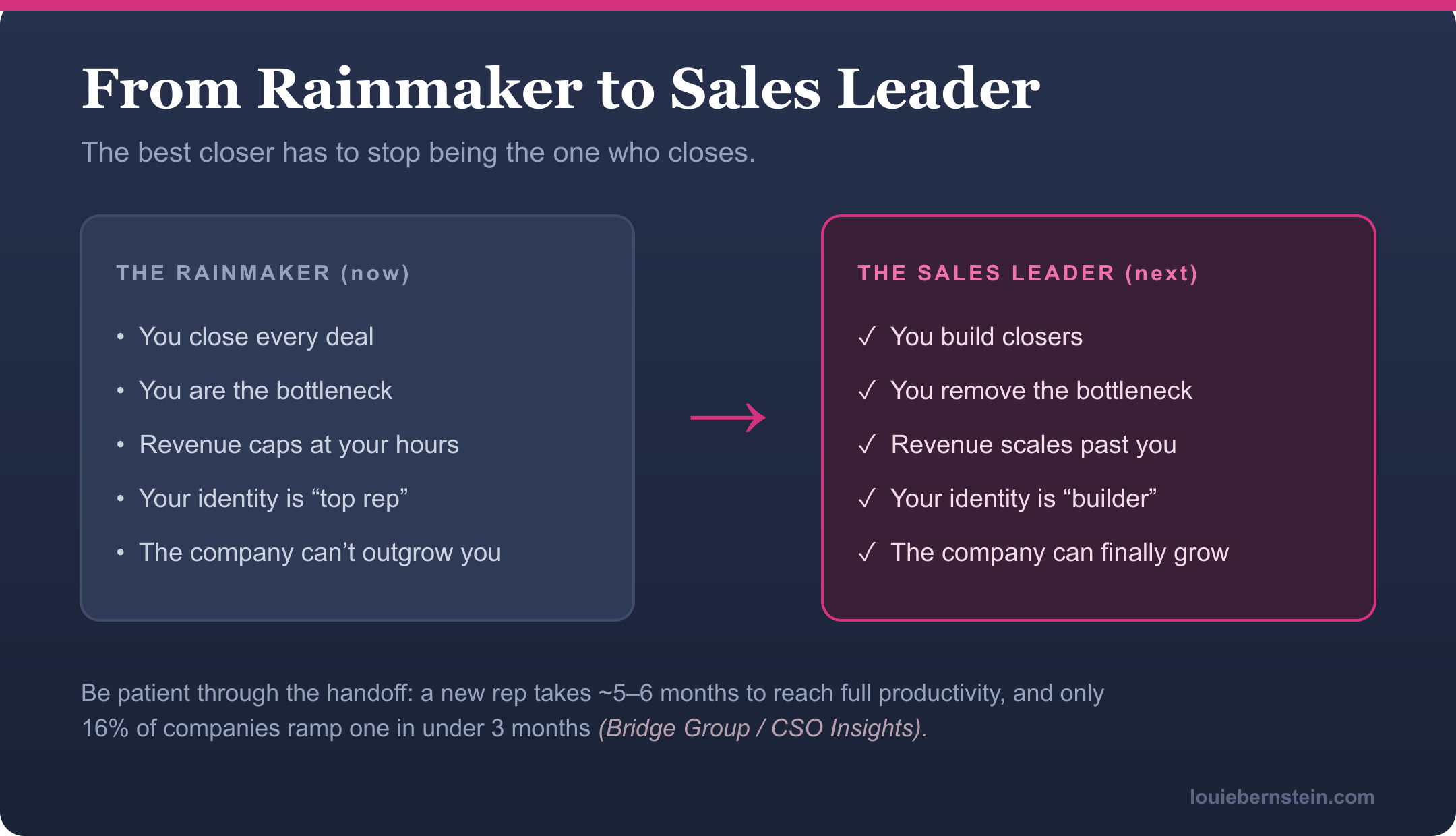
- As long as you're the rainmaker, revenue is capped at your personal capacity. The better you close, the longer you can limp along solo, and the steeper the eventual cliff.
- Letting go is hard because it's an identity problem, not a process one. Your sense of value is wrapped up in being the one who closes.
- You can't fully exit the moment you hire. A new rep takes ~5–6 months to reach full productivity (Bridge Group), and only 16% of companies ramp one in under 3 months (CSO Insights).
- Watching someone sell your product worse than you, at first, is painful but normal. The rep who's worse than you in month one can out-produce you in month twelve.
- You don't have to disappear. You have to stop blocking. Shift from top rep to sales leader: coach, don't rescue; hand over the best leads; build closers who don't need you.
You're the best salesperson in your company. You built the product, you know it cold, and nobody closes like you do. That's been your superpower since day one. And it's about to become the single biggest thing holding your company back.
Here's the uncomfortable math. As long as you're the rainmaker, your revenue is capped at your personal capacity, your hours, your energy, your calendar. The company literally cannot grow past you. And when founders finally try to hand it off, roughly 70% of first VP of Sales hires fail within 12 months (SaaStr), often because the founder can't actually let go of being the one who closes.
Letting go of being the rainmaker is the hardest part of scaling sales, and it's hard for a reason almost nobody names out loud: it isn't a process problem, it's an identity problem. Let me walk through why that is, and how to actually make the shift without tanking your revenue on the way.
Why Being the Best Closer Becomes the Bottleneck
When you're the best closer, everything routes to you. The big deals, the tricky ones, the accounts the team can't crack, they all land on your calendar, and you win them. It feels great. You're the closer, you're delivering, the numbers are moving. But every deal that requires you is a deal that can't happen without you, and slowly your calendar becomes the company's revenue ceiling.
Here's the cruel twist: the better you are, the worse this problem gets. A mediocre founder-closer is forced to build a team early, because they simply can't carry it alone. A genuinely great one can limp along solo for years, which feels like a strength but is actually just delaying the reckoning and making the eventual cliff steeper. Being excellent at closing is exactly what lets you avoid the thing you most need to do.
The Identity Trap Founders Don't See Coming
The real reason letting go is so hard has nothing to do with process. It's that your identity is fused to being the closer. "I'm the one who can sell this" isn't just a fact about your company, it's become part of who you are. Handing that off can feel like giving away the very thing that makes you valuable, and on some level, like giving away a piece of yourself.
So founders sabotage the handoff without even realizing they're doing it. They swoop in on deals the rep was handling fine. They second-guess every call. They quietly keep the best leads for themselves. Not because the rep is bad, but because fully letting go threatens the identity, and the brain protects the identity. Naming this out loud is half the battle. You can't fix a problem you keep pretending is about the rep. If you catch yourself unable to stop jumping in, read how to stop being the person who closes every deal.
Why You Can't Fully Exit the Moment You Hire
There's an equal and opposite trap waiting for the founders who do decide to let go. Having finally worked up the nerve, they expect to hand off the deals and vanish overnight. That doesn't work either, and it fails in a way that confirms their worst fear. A new rep takes roughly 5 to 6 months to reach full productivity (Bridge Group), and only 16% of companies can ramp a rep in under 3 months (CSO Insights). Disappear on day one and the rep drowns, the numbers crater, and you conclude "see, nobody can sell like me."
Letting go is a transition, not a switch you flip. You stay close during the ramp, coaching and closing alongside the rep, and then you progressively pull back as they prove they can carry it. The founders who fail at this treat it as binary, either they're doing every deal or they've vanished. The ones who succeed manage it as a gradual handoff with a real plan and a realistic timeline.
Becoming a Sales Leader Instead of the Top Rep
The shift you're actually making is from closing deals to building closers. That's a completely different job with a completely different scoreboard. As the top rep, you're measured on the deals you personally win. As a sales leader, you're measured on the team's deals, and on how well the machine runs when you're not in the room. The scoreboard change is the whole point, and it's the part founders resist most.
Be honest that this is a new skill, not an automatic upgrade. Being great at sales does not make you great at teaching sales, and conflating the two is exactly why so many companies promote their best rep into management and watch it backfire, which I covered in why promoting your top sales rep to manager fails. The good news is that sales leadership is learnable, and for a founder it's the only road past the revenue ceiling you've built with your own two hands.
The Emotional Cost of Watching Someone Else Sell Your Product
Now the part nobody warns you about. Watching someone sell your product worse than you would, especially at first, is genuinely painful. They'll fumble a question you'd have nailed in your sleep. They'll lose a deal you're certain you'd have won. They'll mangle the story you spent years perfecting. Every instinct you have will scream at you to snatch it back and just do it yourself.
"Watching a new rep sell your product worse than you do isn't a sign you hired wrong. It's a sign they're ramping, exactly like you once did."
Hold the ramp data in your mind when it hurts. That rep is 5 to 6 months from full productivity. The one who's worse than you in month one can be better than you in month twelve, not necessarily per deal, but in total, because there are more of them and they're not also running the entire company at the same time. Your job in those painful early months is to coach through the fumbles, not to rescue every deal. Every rescue teaches the rep that you'll always take over, which guarantees they never learn to close without you.
Staying Involved Without Staying the Bottleneck
Here's the resolution, and it's more freeing than founders expect: you don't have to disappear, you just have to stop blocking. Stay involved as a coach and as the closer of last resort on the genuinely strategic deals. But stop being the default that every deal routes through. That single change is the difference between staying the bottleneck and becoming the leader.
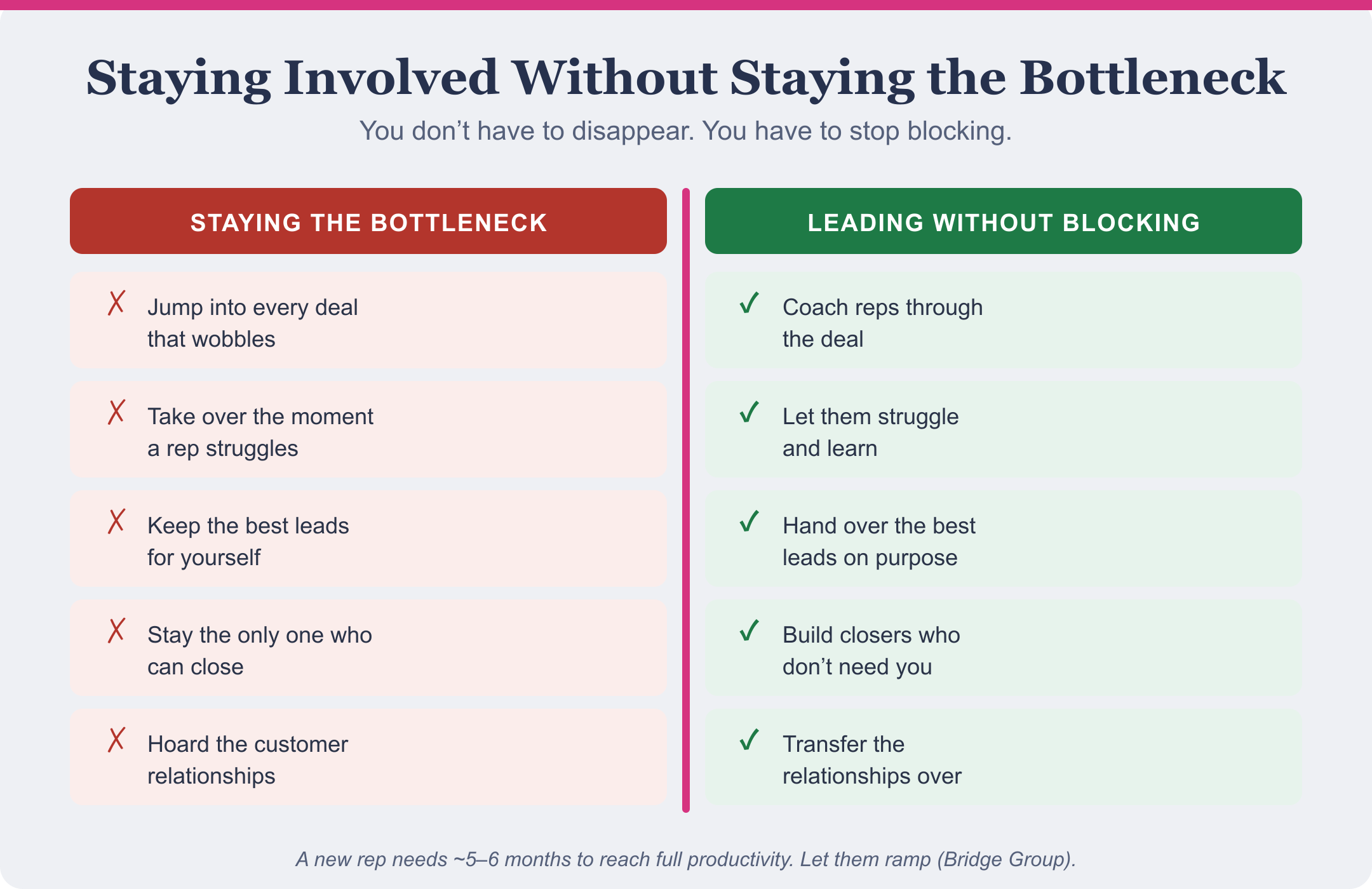
In practice that means coaching reps through deals instead of taking them over, letting them struggle a little and learn, handing over your best leads on purpose rather than hoarding them, transferring customer relationships deliberately, and reserving your personal selling for the handful of deals that genuinely need the founder in the room. This is exactly the transition I help founders make as a Fractional Sales Leader: make the identity shift from rainmaker to leader, install the coaching system, and manage the ramp so revenue keeps climbing while you step back. One honest caveat: if you're pre-product-market fit or you don't yet have a proven, repeatable motion, you should still be the rainmaker, that's your actual job right now. This piece is for founders who've proven the motion and have quietly become the ceiling. If that's you, the hardest and highest-leverage move you can make is to let go, on purpose, with a plan.
Related Reading
Frequently Asked Questions
Q: Why is letting go of sales so hard for founders?
Because it's an identity problem, not just a process one. When you're the best closer in the company, "I'm the one who can sell this" becomes part of who you are. Handing it off feels like giving away your value, so founders unconsciously sabotage the transition, swooping in on deals, second-guessing reps, keeping the best leads. The work isn't only building a system; it's separating your identity from being the rainmaker so you can let someone else carry it. Naming that is the first real step.
Q: How do I know it's time to stop being the rainmaker?
When you've become the revenue ceiling. If your growth is capped by your personal capacity, if the biggest deals can only close with you in the room, and if you've already proven a repeatable motion, then you being the rainmaker is now the bottleneck. The signal isn't that you've stopped enjoying selling; it's that the company can't grow past your calendar. If the motion is proven and you're the limiting factor, it's time to shift from closing deals to building closers.
Q: Can I just hire someone and step away from sales entirely?
No, and trying to is a common way the handoff fails. A new rep takes roughly 5 to 6 months to reach full productivity (Bridge Group), and only 16% of companies ramp a rep in under 3 months (CSO Insights). If you vanish on day one, the rep drowns and the numbers crater, which convinces you no one can sell like you. Letting go is a gradual transition: stay close during the ramp, coach and close alongside them, and pull back progressively as they prove they can carry it.
Q: My new rep sells worse than me. Did I hire the wrong person?
Probably not, at least not yet. A rep who's worse than you in their first month is usually just ramping, and the data says that ramp takes 5 to 6 months (Bridge Group). The rep who fumbles a call in month one can out-produce you in month twelve, not necessarily per deal, but in total volume, because there are more of them and they aren't also running the company. Your job during the painful early months is to coach through the mistakes, not rescue every deal. Rescuing teaches the rep they never have to learn to close on their own.
Q: How do I stay involved in sales without being the bottleneck?
Change your role from default closer to coach and closer of last resort. Coach reps through their deals instead of taking over, let them struggle enough to learn, hand over your best leads on purpose, and transfer customer relationships deliberately rather than hoarding them. Reserve your personal selling for the small number of genuinely strategic deals that truly need the founder. You stay involved and valuable, but you stop being the person every deal has to route through, which is what frees the company to grow past you.
Q: What if I'm not ready to let go yet?
Then don't, and don't feel bad about it. If you're pre-product-market fit or you haven't proven a repeatable, teachable motion, being the rainmaker is your actual job right now. Letting go too early just hands off a sale that isn't ready, which is how first sales hires fail. This transition is specifically for founders who've proven the motion and have since become the ceiling. If that's not you yet, keep selling and keep documenting what works. When the motion is proven and you're clearly the limiting factor, that's your signal to start the handoff.
Ready to stop being the ceiling?
If you're a founder between $1M and $10M in ARR, I'll help you make the shift from rainmaker to sales leader, install the coaching system, and manage the ramp so revenue keeps climbing while you step back. See how it works at louiebernstein.com.
Schedule a 30-Minute CallAbout the Author
Louie Bernstein
Fractional Sales Leader with 50 years of sales experience helping $1M–$10M ARR companies build scalable, repeatable sales systems. Founder of MindIQ (INC 500). LinkedIn Top Voice in Sales Management, Sales Operations, and Sales Coaching.