What Does 3–5x Coverage Really Mean When You Still Have Founder Involvement and Variable Cycle Lengths?
Pipeline coverage below $10M ARR works when you divide the qualified pipeline that can close this quarter by the bookings you still need. Separate short and long cycles, and identify deals that still need the founder. Then apply the share of pipeline dollars that similar deals actually booked before the deadline. A 4× CRM total can still leave you short when dates slip or founder time runs out.
- Divide open, qualified pipeline by the remaining bookings gap. Use the same dollar measure for both.
- Quarter-eligible pipeline includes the deals with a credible path through the buyer's remaining steps before quarter-end.
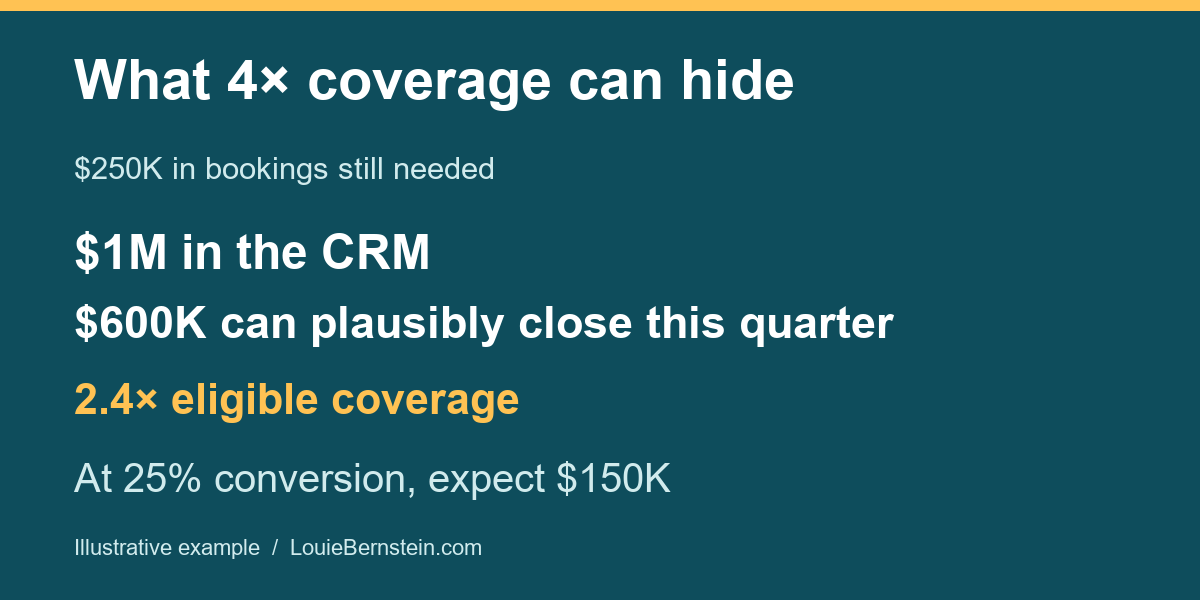
- At a 25% in-period dollar conversion rate, $600K of eligible pipeline yields $150K of expected bookings in the worked example.
- Record the specific founder action and reserve time for it before counting a founder-dependent deal toward Commit.
- Use weekly forecast snapshots to learn which dollars closed on time and which moved to another quarter.
You open your CRM on Monday. The dashboard says 4× coverage. One buyer still needs a security review. Another says their CFO signs next quarter. Two deals need you on the final call, and you have time for one.
I'd ask the rep what the buyer has done to earn each stage. A demo is a real milestone when the buyer took it and the rep qualified the deal. A close date entered because we had to fill a field tells me nothing about when the customer will buy. Apply the same standard to dates that you apply to sales stage exit criteria.
If the founder has to show up for a deal to close, put that work on the calendar before you put the deal in Commit.
How much of my pipeline can actually close this quarter?
Start with the remaining gap, then count only open deals with a buyer-supported path to signature before the deadline. Check the remaining steps and who owns them. A confirmed review with procurement tells you more than the date a rep typed into the CRM. Keep the rest visible for future quarters.
Keep the numerator and denominator on the same basis
If the quota is $400K in new annual recurring revenue booked and you've already booked $150K, the gap is $250K. Measure each opportunity in new ARR as well. A three-year contract with $100K of recurring revenue per year contributes $100K to the pipeline on that basis. Mixing total contract value with an ARR target inflates the ratio before you even get to deal timing.
Now say the CRM shows $1M in open qualified pipeline. That's 4× raw coverage. Suppose $400K cannot clear the buyer's remaining reviews in time and $600K has a plausible path. Your quarter-eligible coverage is 2.4×. If similar eligible deals booked 25% of their opening dollar value in the remaining window, you'd expect $150K from the open pipeline. That leaves $100K of the gap unexplained. This is an illustrative example. Your own data should set the rate.
Salesforce also defines pipeline coverage against the open gap to quota. Screen that numerator for buyer timing before you use it to make an operating decision. If you've already hit quota, report that you've hit quota. The coverage ratio has no denominator left.
How do I handle 30-day and 90-day sales cycles?
Group opportunities by the sales motion and how much work the buyer still has to do. A short-cycle deal can miss the quarter if legal just got involved. A deal in a longer cycle can still make it if the buyer already approved security and scheduled signature. Start with the buyer's remaining steps.
Compare time remaining with the buyer's calendar
With six weeks left, look at the last several deals that took a similar route. When did security start? How long did legal take? Could those steps run in parallel? Ask the buyer who owns each step and when they can take it. If everything has to go right to fit, that belongs in the upside conversation. When a required step cannot happen before the deadline, move the deal to the next period.
Sales velocity estimates throughput from opportunity count, average deal value, win rate and cycle length. In a simple illustration, holding the other three inputs flat, a 90-day sales motion has one-third the daily velocity of a 30-day motion. Use velocity to see which group generates bookings faster. Use buyer dates to place specific deals on the forecast. The monthly operating decision might be to prospect for more short-cycle business now and protect time for long-cycle deals in the next quarter.
How much founder involvement should I count on?
Record the founder's remaining work on each deal and confirm it fits the calendar. A founder can join for one executive conversation while the rep still owns the opportunity. When the founder has to revive a stalled deal, negotiate price and lead the close, that deal puts a different demand on the team.
Distinguish a planned assist from a founder-dependent close
Give each live deal one of three labels at the weekly review. Rep-led means the rep can run the remaining steps. Founder-assisted means the rep owns the deal and has requested a specific founder action. Founder-dependent means the deal still relies on the founder to keep the buyer moving. Record the action, the owner and the date alongside the label. If a rep needs you to explain the price, have the rep run that part of the next call with you there. That gives you both evidence of what the rep can handle.
Say two opportunities need you on a customer call next week. One buyer has set a decision meeting and asked you to address a specific commercial risk. The other buyer hasn't agreed to meet. Take the confirmed meeting. Assign the rep to get a date for the second and adjust the forecast until the buyer responds.
Look back at outcomes by type of founder involvement when you have enough examples. You'll learn whether you've built a sales motion someone else can run. The rate for founder-assisted deals describes a mix of deal selection and founder participation. Founders tend to get called into unusual deals, so a gap between conversion rates alone can't tell you the effect of joining a call.
How do I turn coverage into a three-number forecast?
Show Commit, Best Case and Pipeline separately. Commit is the open business you're prepared to call with buyer evidence. Best Case adds the upside with a specific path to close. Pipeline shows the broader qualified inventory. Label which totals are cumulative and keep the amount already booked visible beside them.
Run each deal through the same questions
- What was the last action the buyer took, and what did it confirm?
- What has to happen next, on what date, and who's responsible?
- Does the rep need the founder, and is the time actually reserved?
- If the next buyer milestone slips, which forecast category changes?
Suppose the team has $150K booked. Of the $600K in quarter-eligible open deals, $110K has evidence strong enough for Commit and another $160K could close if named milestones land. Show $110K in open Commit, $270K in cumulative open Best Case, and $600K in quarter-eligible open Pipeline. Keep the other $400K in future-period pipeline. Adding the $150K already booked yields $260K at Commit and $420K at Best Case against the $400K target. The two scenarios tell the founder exactly how much depends on upside.
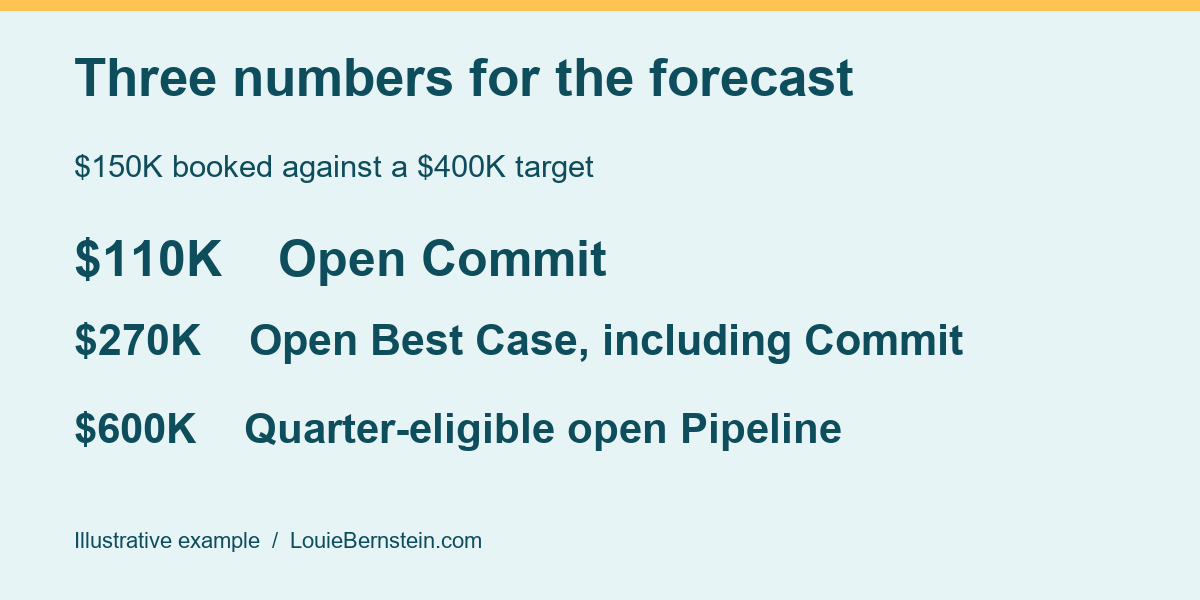
The $150K expected from the coverage example is a historical conversion check. The $110K Commit is a judgment about specific deals. The two figures answer different questions. If Commit routinely runs ahead of what comparable pipeline delivers, pull a few past snapshots and see whether the team counted deals before their buyer milestones happened. For more on the underlying math, see Pipeline Math for Founders.
What if I don't have enough history to trust the rate?
Save a weekly snapshot and use deal evidence to build a range while the data accumulates. Record each opportunity's open amount, stage, expected buyer milestone and founder role. Once the period ends, compare what you called with what booked. Keep late deals visible in the record so you can learn from them.
Measure dollars booked from the same opening group
If you took a snapshot six weeks before quarter-end, divide the dollars from that eligible group that booked by quarter-end by the group's open dollars at the snapshot. If pricing or scope changed materially, keep the change visible. New deals opened after the snapshot can generate bookings, but they belong in a separate line so you can see how much the starting pipeline delivered. Compare periods at the same point in the quarter when you can.
Start with a broad conversion range when you have only a few deals. If one large deal can swing the whole range, show that deal separately and tell the team which buyer event decides the quarter. Once you have enough similar deals, segment by cycle and founder role and check whether the split improves the forecast. You can start in a spreadsheet. One row per deal and one dated snapshot per week will teach you more than adding another probability field.
Frequently Asked Questions
Can more than 5× coverage still leave me short?
Yes. If much of the pipeline can't close by the deadline, or the eligible deals rarely convert in that window, 5× raw coverage can coexist with a shortfall. Recalculate with the eligible dollars and compare expected bookings with the remaining gap.
Do I use win rate by deal count or by dollar value?
Use a dollar-based rate for a dollar-based target, especially if deal values vary. A team can win three of four opportunities and still miss its target when the one lost deal is larger than the other three combined.
Should the founder's largest deal go in a separate line?
Show it separately when its outcome materially changes the quarter. Keep it inside the appropriate forecast total and clearly label it as included, so the team can see the dependence without counting the deal twice.
When should I change a deal's close date?
Change it when a new buyer event or a missed prerequisite changes the credible path to signature. Record the reason and preserve the previous date in your snapshot so repeated slips remain visible.
Can I count renewals or expansion in the same coverage number?
Include them only if they're part of the target you're measuring. When new business, expansion and renewals have different targets or buyer processes, track them separately before rolling up the bookings forecast.
Bring your open pipeline and the number you still need. We'll look at where the buyer is, where you're still needed and what the forecast can support.
About the Author

Louie Bernstein Fractional Sales Leadership
Louie Bernstein is a Fractional Sales Leader with 50 years of sales experience and has worked as a Fractional Sales Leader since 2017. He built and ran MindIQ for 22 years. He helps B2B founders at $1M to $10M ARR build repeatable sales systems so selling doesn't depend on the founder.