How Do You Create a Mutual Action Plan Buyers Will Actually Use?
Use a Mutual Action Plan in B2B sales when the buyer has agreed the problem is worth solving and several people must coordinate the purchase. Build the plan together around the buyer's intended result, with named owners, agreed dates, and evidence that each decision is complete. A plan earns its value through buyer participation. Sending a spreadsheet doesn't create commitment or make an uncertain deal forecastable.
Key Takeaways
- Use a Mutual Action Plan for a qualified purchase that requires coordination across people, approvals, or implementation work.
- Start with the buyer's first useful result, then work backward through the decisions needed to reach that result.
- Gartner reported in 2025 that 74% of B2B buying teams experienced unhealthy conflict, based on 632 buyers surveyed in 2024.
- Give every milestone a named owner, agreed date, completion evidence, and any dependency that could delay the work.
- Review three open opportunities this week. Ask the buyer to correct the plan and confirm the next action before treating the plan as mutual.
Your rep sends a beautiful plan. The prospect says, "Looks good." The spreadsheet goes untouched, the close date moves, and you're back on the phone trying to save the deal.
For a founder still closing most sales, another document can become another job. The useful question is whether the document helps the buyer make a decision and helps your rep run the opportunity without you.
A shared file isn't a shared commitment. Look for work the buyer has agreed to own.
What Is a Mutual Action Plan in B2B Sales?
A Mutual Action Plan is a shared record of the decisions and work a buyer and seller agree to complete toward a business outcome. For B2B founders, the plan makes responsibilities visible across the purchase. A useful plan includes buyer approvals and implementation needs, rather than stopping at the seller's signature deadline.
Separate your sales process from the buyer's work
Your sales process might say discovery, demo, proposal, negotiation. The buyer may need operations to approve the workflow, finance to release funds, and IT to review data access. Those are different kinds of progress.
Salesforce describes a Mutual Action Plan as a document shared by buyer and seller to set expectations across the sales cycle (Salesforce). The practical test is whether the buyer can use the plan to organize a purchase without translating your CRM stages.
Your pipeline stage exit criteria remain internal standards. The shared plan supplies evidence that those standards have been met. "Proposal sent" is seller activity. "Budget owner approved the business case" is a completed buyer decision.
Don't put private qualification notes, forecast probabilities, or negotiation limits in the shared document. Buyers need a useful working plan. Your internal assessment belongs in the CRM.
When Is a Mutual Action Plan Worth Using?
Use a Mutual Action Plan when a qualified buyer must coordinate multiple approvals, stakeholders, or delivery dependencies. The extra structure helps when a missed step could delay a meaningful purchase. For a simple transaction with one buyer and an immediate decision, a clear next step in an email may be enough.
Earn the right to plan before assigning work
Before introducing the plan, confirm the buyer can describe the problem, why solving the problem matters, and who needs to participate. A friendly discovery call doesn't establish those conditions. If the buyer hasn't agreed there's a reason to change, return to discovery.
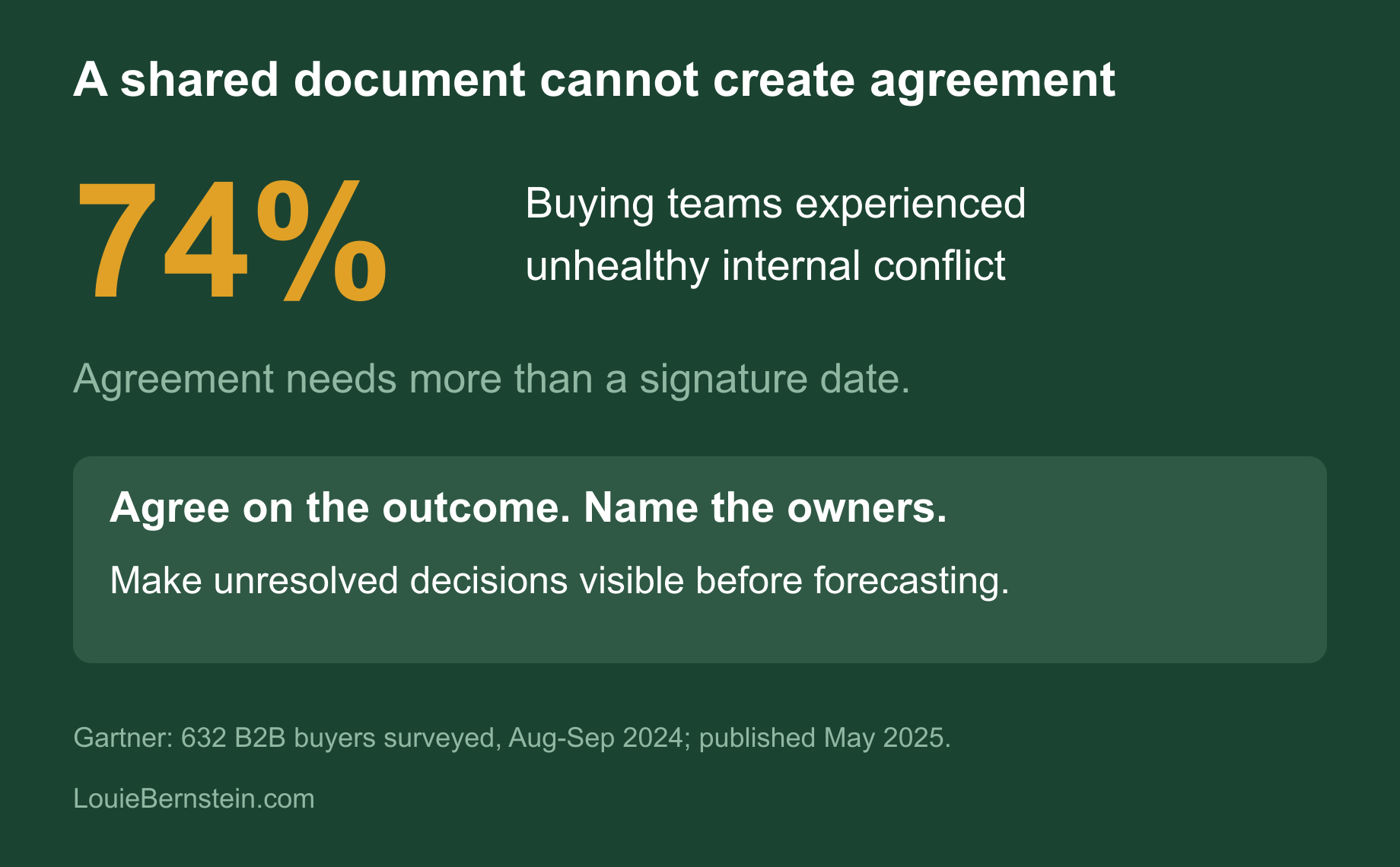
Gartner's May 2025 release reported that 74% of buying teams experienced unhealthy conflict. The research surveyed 632 B2B buyers in August and September 2024 (Gartner, 2025). Conflicting priorities won't disappear because your rep adds due dates.
The same survey found groups reaching consensus were 2.5 times more likely to report a high-quality deal. That is an association with reported deal quality, not proof that a Mutual Action Plan improves win rates. The useful lesson is to expose unresolved decisions before treating the purchase as agreed.
Ask, "Would it help to put the approvals and next steps in one place so nobody has to chase them?" If the buyer sees no benefit, find out why. The process may be simpler than you assumed, or the purchase may lack priority.
How Do You Create a Mutual Action Plan Buyers Will Use?
Create a Mutual Action Plan with the buyer during a working conversation, starting from the result the buyer needs. Agree on the decisions, owners, dates, evidence, and dependencies together. Keep the first version short enough to review in one sitting, and ask the buyer to change anything that doesn't match the real approval process.
Build the first version in five steps
- Name the business result. Ask what must work differently after the purchase and who will judge success. "Launch software" is an activity. "Operations accepts the first automated weekly report" is an observable result.
- Work backward from the required result date. Identify rollout, training, contracting, approval, and evaluation work. Ask what drives the date. Your quarter-end isn't a buyer dependency.
- Name a person for each decision. "Finance" can't confirm an action. A named budget owner can. Your contact should verify that each proposed owner has accepted the responsibility.
- Define completion evidence. Agree what will prove the milestone is finished. A scheduled security call isn't security approval. Record the actual approval or the unresolved conditions.
- Agree on the next review. Choose how updates will happen and who will maintain the shared version. Your rep can do the typing while the buyer supplies corrections and confirms commitments.
Use the buyer's existing working tools when possible. An accessible spreadsheet or document is enough to start. Requiring a new login adds work before you've shown the buyer a benefit.
In 6sense's 2025 study of nearly 4,000 B2B buyers, first seller contact occurred 61% of the way through the buying journey. Participants had purchased at least $25,000, and the median purchase was $200,000 to $300,000 (6sense, 2025). That sample isn't a benchmark for every founder's deals. It does support asking what work the buyer has already completed before imposing your sequence.
Use a small template with real completion tests
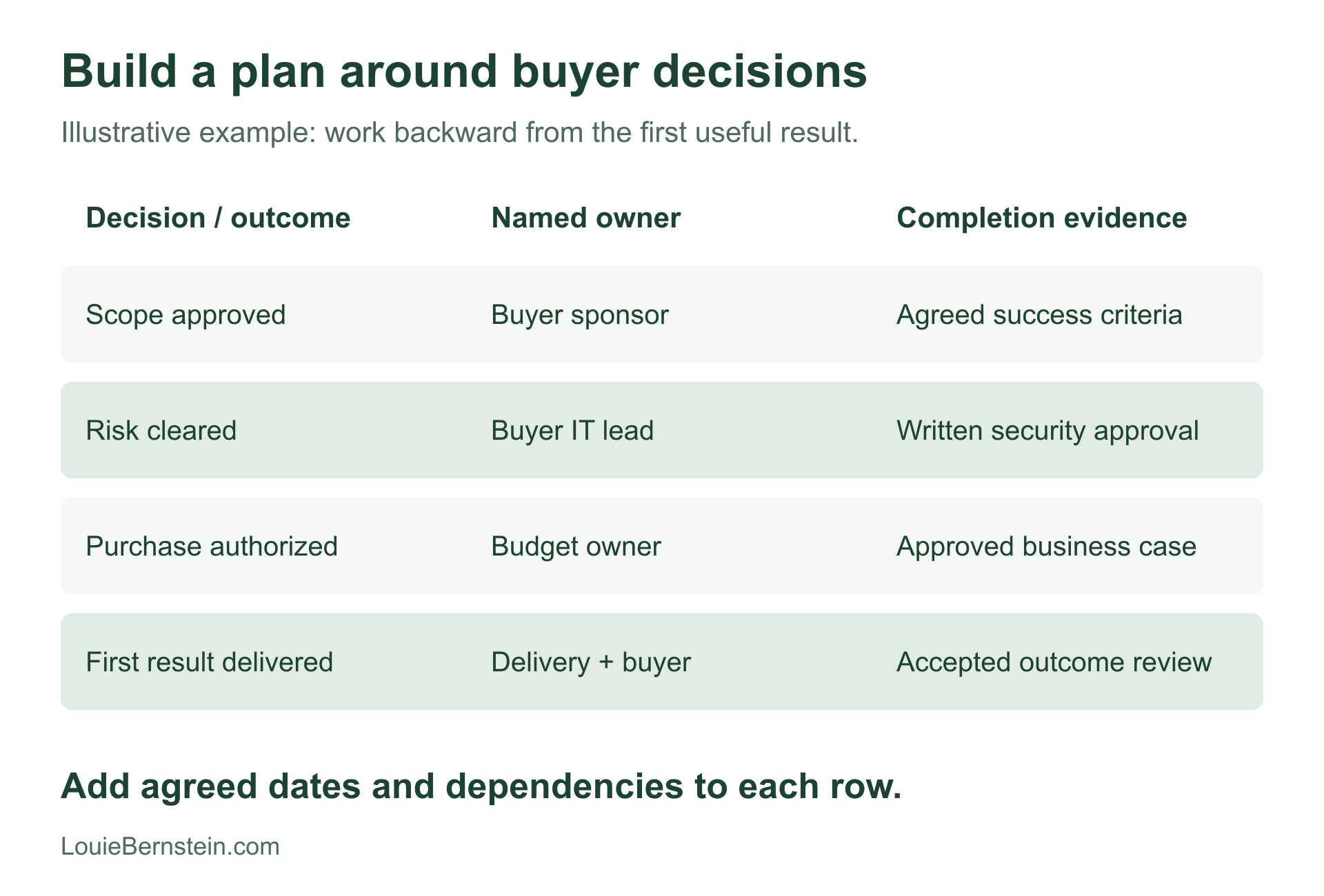
The rows below illustrate a plan, not a customer case or a required sequence. Add agreed dates and dependencies. Let the buyer remove unnecessary rows and add approvals your rep didn't know existed.
| Milestone | Owner | Completion evidence |
|---|---|---|
| Scope agreed | Buyer sponsor and seller | Success criteria accepted by affected teams |
| Risk reviewed | Buyer IT lead | Written security approval or explicit conditions |
| Purchase authorized | Budget owner | Approved business case and funding |
| First result delivered | Delivery lead and buyer | Buyer accepts the agreed outcome |
Each row should make the next conversation easier. If a row doesn't help somebody decide, approve, or deliver something, ask whether the row belongs.
How Do You Know the Buyer Has Committed?
Buyer commitment shows up when the buyer corrects the plan, confirms responsible people, supplies needed information, and completes agreed work. A polite reply or document view doesn't establish commitment. For a founder reviewing pipeline, the strongest evidence is a completed buyer action that resolves a real obstacle to the purchase.
Ask for a correction before asking for agreement
Try, "Which approval have we missed? Who needs to review this before those dates are realistic?" A buyer who changes the plan may be more engaged than a buyer who immediately agrees. Corrections tell you the document is being tested against the company's actual process.
Your champion needs support for internal conversations. Don't make your contact promise dates on behalf of legal, finance, or operations. Ask the contact to validate those dates with the people responsible, and mark unconfirmed assumptions clearly.
A buyer can participate without editing the file personally. They may confirm changes on a call or send an email. The evidence is ownership and follow-through, rather than which person last touched the spreadsheet.
Respond honestly when a milestone slips
If security review slips, ask what is missing, who can unblock the work, and how the delay affects later decisions. Update the dependency and the forecast. Don't quietly move every date forward while leaving the opportunity marked as on track.
A buyer who declines every next step may be telling you the project isn't important enough right now. Ask whether to pause. A Mutual Action Plan must allow an honest no, a change of scope, or a later decision. Otherwise the document records pressure rather than agreement.
How Can Founders Use the Plan Without Running Every Deal?
Founders can use Mutual Action Plans to coach reps on buyer evidence while leaving opportunity ownership with the rep. Review the next unresolved decision, its owner, and the evidence needed to complete it. Put the standard in your Sales Playbook so the team can repeat the method without requiring the founder to manage every milestone.
What my experience with pipeline stages changes
I've written about watching founders review pipelines full of "proposals sent" and wonder why nothing closes. The repeated mistake is treating seller effort as buyer progress. My rule for a Mutual Action Plan follows the same lesson: adding a row or sending a reminder cannot, by itself, justify advancing the deal.
In your next pipeline review, ask the rep to show the buyer's latest confirmed action. Then ask, "What will you do next?" Coach the answer. Don't take the account away and make the call yourself every time the rep gets uncomfortable.
Start with three qualified opportunities. Review what buyers actually use, remove unnecessary fields, and document the working version. Track overdue buyer milestones, unresolved approvals, and changes to expected decision dates. Those observations help you improve the process; they don't create a universal probability of closing.
If you have no defined sales process, begin with qualification, a clear next step, and buyer-based exit criteria. A shared plan can help one complex deal, but a document won't replace the sales system your team needs.
Related Reading: Why Are B2B Buyers Taking So Long to Make Decisions?
Frequently Asked Questions
Is a Mutual Action Plan legally binding?
Treat a Mutual Action Plan as a coordination document, separate from the purchase agreement. Don't put contractual promises into the plan casually. Keep commercial commitments in the documents your company uses to authorize them.
Should the buyer see every opportunity note?
No. Share the agreed work, decisions, owners, and dates. Keep internal qualification judgments, negotiation strategy, and forecast assumptions in your CRM. The shared plan should help the buyer organize the purchase.
Can a buyer use the same plan to compare vendors?
Yes. A buyer may organize multiple evaluations around the same criteria and approval process. Ask what evidence your team must supply. Don't assume that agreeing to a plan means your company has won.
Who should own the plan after the contract is signed?
The delivery or customer success lead should take responsibility for remaining supplier work, with a named buyer counterpart. Introduce both people before signing when possible, and confirm that implementation dates match available capacity.
What if the buyer won't share internal approval details?
Ask for the minimum information needed to coordinate your work, such as the next decision, expected timing, and required evidence. Respect confidential details. Keep unverified assumptions out of firm commitments and reflect uncertainty in the forecast.
Build a process your reps can run.
If you're a $1M to $10M ARR B2B founder still rescuing deals, I can help you define qualification, buyer commitments, and pipeline reviews as your Fractional Sales Leader.
About the Author
Louie Bernstein is a Fractional Sales Leader with 50 years of sales experience and has worked as a Fractional Sales Leader since 2017. He founded MindIQ, an Inc. 500 company. His work helps B2B founders build Sales Playbooks, defined sales processes, coaching habits, and teams that can sell without depending on the founder for every decision.