What Does Your Champion Need When You're Not in the Room?
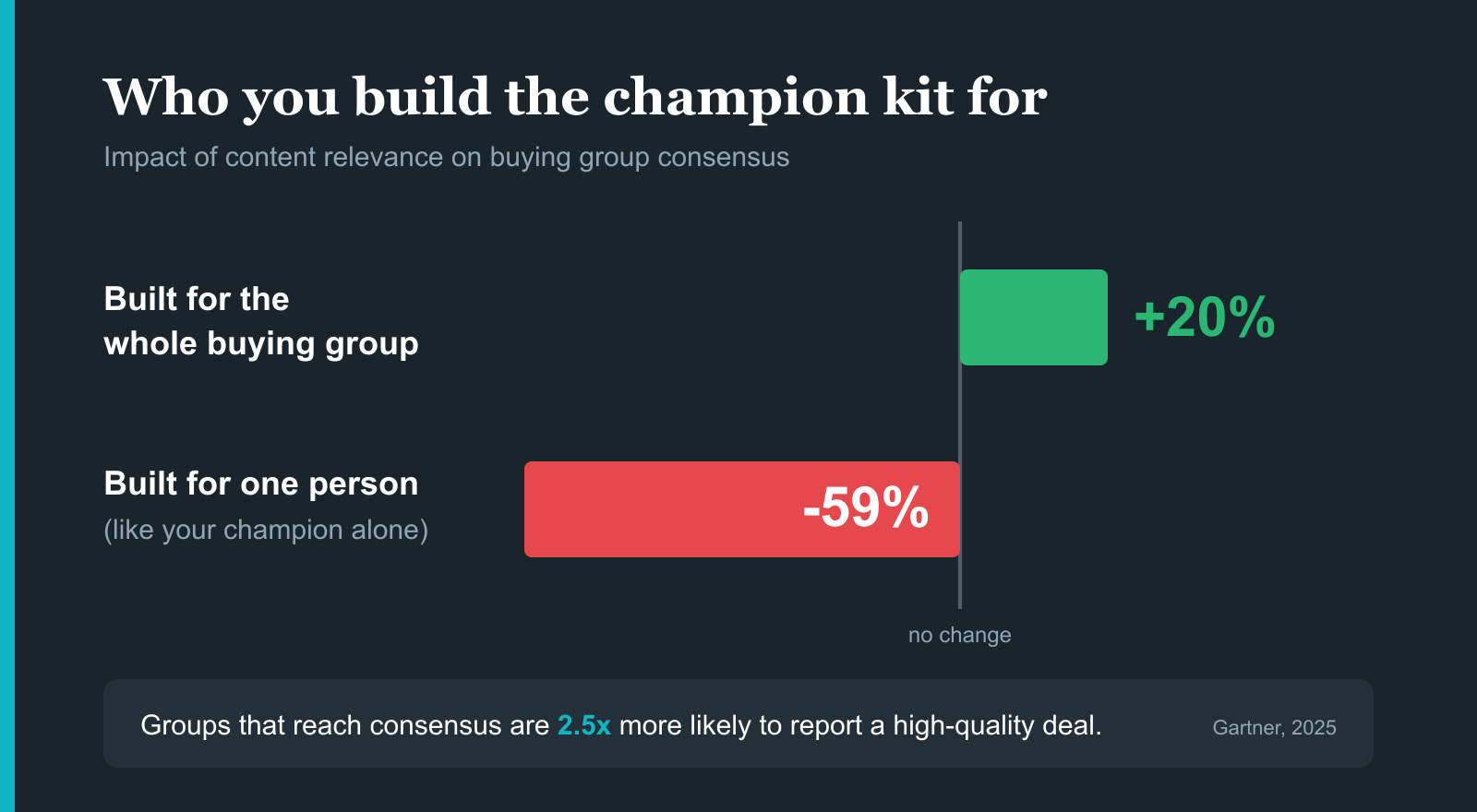
Help your champion sell internally by giving them a kit built for the whole buying group. That kit has the problem's cost in their company's numbers, answers to each function's objections, a one-page plan and a rehearsal. Gartner's 2025 research found content tailored to the group raised consensus 20%, while content tailored to individuals cut it 59%. Your champion wins the room by making everyone else comfortable.
Key Takeaways
- Your champion sells your solution in meetings you'll never attend, so give them a short, forwardable kit: the cost of the problem in their numbers, a one-page plan, and answers to each function's objections.
- Build the kit around what the whole buying group shares. Gartner (2025, 632 buyers) found group-relevant content lifted consensus 20%, while individually tailored content reduced it 59%.
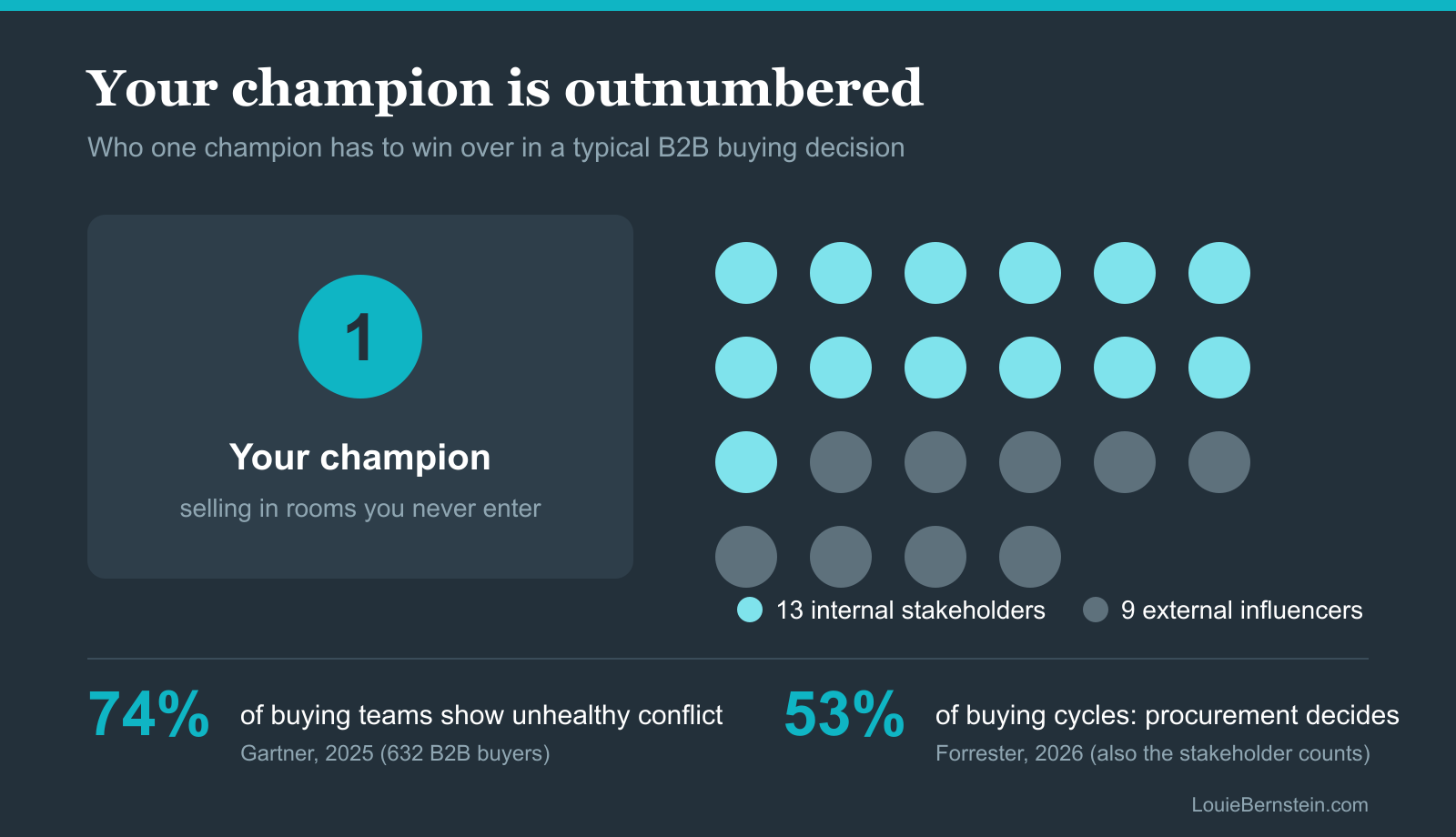
- Your champion is outnumbered. Forrester's 2026 research puts a typical decision at 13 internal stakeholders and nine external influencers, and Gartner found 74% of buying teams show unhealthy conflict.
- Test your champion before you rely on them. A real champion gives you inside information, gets you access to the approver, and does work to move the deal. A fan only says nice things.
- Before your champion's internal meeting, rehearse it with them for 20 minutes. Ask, "Who will push back, and what will they say?" Then answer each objection in writing.
You had a great call. Your champion loved the demo, nodded at every slide and said, "I'm going to take this to the team." You hang up feeling like the deal is half closed.
Two weeks later, the answer is "not this quarter." Somebody in finance asked a question your champion couldn't answer. Somebody in IT raised a risk nobody had addressed. Your champion, who isn't a salesperson, didn't have the words.
Most B2B deals are won or lost in a meeting you'll never attend. Your job is to make sure your champion walks into that meeting ready.
Founder-led sales makes this harder. Your pitch works because you're the one giving it. It rarely survives being retold by someone else. Here's what your champion needs when you're not in the room, and how to give it to them.
What Does Your Champion Need When You're Not in the Room?
Your champion needs five things to sell your solution internally: the problem stated in their company's words, its cost in their numbers, answers to the objections each function will raise, a simple plan with dates, and a way to bring you in when they're stuck. Without those, even a committed champion gets out-argued.
The five parts of a champion kit
- The problem in their words. One or two sentences your champion would actually say to their boss. Use their language from discovery.
- The cost of doing nothing. What the problem costs per year, using numbers your champion supplied and agrees with. A champion can defend their own numbers. They can't defend yours.
- Answers by function. Finance asks about payback. IT asks about security and integration. Operations asks who does the extra work. Write one short answer for each.
- A one-page plan. The steps from yes to live, with owners and dates. A plan makes the decision feel smaller and safer.
- A way to bring you in. A standing offer to join a call, answer a question by email or meet the approver. Your champion should never have to bluff.
If the deal needs finance approval, build the money side with your champion. I walk through that in how to build a business case your buyer can take to the CFO.
Why the kit has to be short
Your champion will forward the kit, paste parts of it into Slack and read from it in a budget meeting. A 20-slide deck won't get opened. One page and a few talking points will. If your champion can't explain your solution in two minutes, nobody else in their company will understand it either.
Why Do Champions Lose Deals Internally?
Champions lose deals internally because they're outnumbered and selling isn't their job. A champion has to win over finance, IT, users and leadership, each with different goals. When those people disagree, the safest choice for everyone is to do nothing, and your champion can't fix a disagreement they weren't prepared for.
Your champion is outnumbered
Forrester's State of Business Buying 2026 reports the typical buying decision now involves 13 internal stakeholders and nine external influencers, and procurement is a decision-maker in 53% of buying cycles (Forrester, 2026). Gartner's survey of 632 B2B buyers, run in August and September 2024, found buying groups ranging from five to 16 people across as many as four functions (Gartner, 2025).
If you don't know who those people are yet, start with who really makes the decision in a B2B sale. Your champion can only prepare for the people you've identified together.
Conflict is the normal state of a buying group
The same Gartner study found 74% of B2B buyer teams show unhealthy conflict during the decision, meaning members have conflicting objectives, disagree on the best course of action, or get overruled by someone outside the group. Buying groups that reach consensus are 2.5 times more likely to report a high-quality deal. Your champion's job is to get a divided group to agree.
How Do You Know You Have a Real Champion and Not Just a Fan?
You have a real champion when your contact does work to move the deal forward. A real champion shares inside information, gets you to the approver and spends their own credibility on your solution. A fan enjoys your calls and disappears when the internal pressure starts.
Three tests for a champion
- Do they share inside information? Ask, "How did your company approve the last purchase like this?" A champion tells you who signed and what slowed it down. A fan says, "I'll find out."
- Will they get you access? Ask for 20 minutes with the approver. A champion arranges it or explains exactly why not. A fan changes the subject.
- Will they do work? Ask them to correct your cost numbers or review the one-page plan. A champion sends it back with edits. A fan never opens it.
| What you see | Fan | Champion |
|---|---|---|
| Inside information | "I'll check" | Names who signs and what stalled the last deal |
| Access | Keeps you away from the approver | Sets up the approver meeting |
| Effort | Never edits your documents | Corrects your numbers and wording |
| Risk | Won't say your name in a meeting | Puts their reputation behind the decision |
| Bad news | Goes quiet | Tells you early what's going wrong |
If your contact fails all three tests, you don't have a champion yet. Keep the deal out of your committed forecast and keep looking for one.
How Do You Build a Champion Kit for the Whole Buying Group?
Build the champion kit around what the buying group shares. Gartner found content tailored to the group's shared concerns raised consensus 20%, while content tailored to individuals cut it 59%. A kit that only flatters your champion's goals gives everyone else a reason to object.
Five steps to arm your champion
- Write the shared problem first. Open the kit with the problem the whole company has, such as missed revenue, wasted hours or a compliance risk. Your champion's personal pain comes second.
- Get the numbers from your champion. Ask, "What does this cost you a year, and how did you get that number?" Use their math, even if it's lower than yours.
- Map each function's question. Ask, "Who will push back, and what will they say?" Write a two-sentence answer for each person your champion names.
- Rehearse for 20 minutes. Play the CFO. Ask the hard questions. Let your champion practice the answers before it counts.
- Debrief the same day. After the internal meeting, ask, "What questions came up that we didn't cover?" Fix the kit before the next meeting.
Make your champion look good
Gartner's 2018 research found customers who got helpful information that made the purchase easier were three times as likely to buy the bigger, more expensive option, with less regret (Gartner, 2018). Your champion is taking a personal risk by backing you. Give them material that makes them look prepared, careful and right, and they'll keep pushing when the deal gets hard.
A champion who can't answer the CFO's first question will lose your deal politely. Arm them before the meeting, not after it.
What Have 50 Years in Sales Taught Me About Champions?
One champion is never enough, and a champion is only as strong as the preparation you give them. I learned both lessons by losing the biggest deal of my early career. The same pattern shows up in founder-led companies today: the founder builds one great relationship and bets the whole deal on it.
The deal I lost when my champion left
In 1981, at DEC, I closed a $247,000 deal, the biggest of my career at the time. The next opportunity was bigger: enterprise-wide, over a million dollars. Seven months into that sales cycle, my competitor got an inside track to the decision maker, the internal politics shifted against us, and then my champion left the company.
I sat in my car in the parking lot the morning I found out, unable to move. I lost that deal. What it taught me is that a deal resting on one champion is a bet. When that person leaves or loses an internal fight, you need someone else inside who knows your case and can carry it.
Ask to be in the room, or on the phone
Here's the rule I teach every salesperson I coach. When a champion has to present my solution to the CEO or the board, I ask if I can be there, or at least listen by phone, in case there are questions they can't answer. I don't ask to take over the meeting. I ask to be the backup.
Whether you get invited depends on how your champion sees you. If you've been an educator who brings real value, your odds go up a lot. If you've been pushing for a close, they'll keep you out of the room.
How Do You Make Champion Enablement Part of Your Sales Process?
Make champion enablement a required step in your sales process on every deal. Add the champion kit to your Sales Playbook, make "kit reviewed by champion" an exit criterion before the proposal stage, and ask about the champion in every pipeline review. Then every rep does it, and the founder stops being the only one who can.
Build it into your stages
Give your pipeline stages with real exit criteria that include the champion:
- Leaving discovery: the champion has passed at least two of the three tests.
- Leaving evaluation: the champion has corrected your cost numbers and named who will push back.
- Leaving proposal: the kit is done, the rehearsal happened, and the internal meeting is on a calendar.
- Commit: you have a second contact who could carry the deal if your champion left tomorrow.
If you're still doing all the selling, start with your biggest open deal this week. Ask your champion who will push back and what they'll say. Then write the answers down. Turning that into a repeatable process your reps run without you is exactly what a Fractional Sales Leader builds for $1M to $10M ARR founders, at roughly half the cost of a full-time VP of Sales.
Related Reading
Single-Threaded Deals Die: The Multi-Threading Playbook →Frequently Asked Questions
What should I do if my champion leaves in the middle of a deal?
Reach your second contact within a day and confirm the deal still has an owner inside the company. Ask who is taking over your champion's responsibilities, and offer to brief that person. If you never built a second contact, treat the deal as early stage again and rebuild the relationship before you forecast it.
Should I present to the buying group myself instead of relying on my champion?
Offer to, but don't insist. Many companies make the decision in internal meetings vendors don't attend. Ask to join as backup or by phone. If your champion says no, prepare them well. Pushing past your champion to present can cost you their trust.
What's the difference between a champion and the economic buyer?
A champion sells your solution inside the company. The economic buyer controls the budget and approves the money. Sometimes they're the same person, especially at smaller companies. More often, your champion has to persuade the economic buyer, which is why the champion needs a kit.
How do I find a champion if nobody is stepping up?
Look for the person who feels the problem most and has the most to gain if it's fixed. Ask them, "What happens to you if this doesn't get solved this year?" Someone with a personal stake and enough influence to be heard is your best candidate. If nobody qualifies, the deal may not be real yet.
How much of the champion kit should I write myself?
Write the first draft yourself so your champion doesn't have to start from a blank page. Then hand it over and ask them to change the numbers and the wording. A kit your champion helped write is one they'll defend, and their language will sound right to their colleagues.
Get your champion ready for the meeting you won't attend.
If you're running a $1M to $10M ARR B2B company and your deals keep dying after a great demo, let's look at one together. In 30 minutes we'll review your biggest open deal and decide what your champion needs to win it. Learn about Fractional Sales Leadership at LouieBernstein.com.
Schedule a 30-Minute CallAbout the Author
Louie Bernstein is a Fractional Sales Leader with 50 years of sales experience. He's helped founders build repeatable sales systems as a Fractional Sales Leader since 2017. He founded MindIQ, an Inc. 500 company, and his work focuses on Sales Playbooks, defined sales processes, coaching, pipeline management, and helping teams sell without depending on the founder for every decision.