How Do You Find the People Who Can Approve, Block or Influence the Deal?
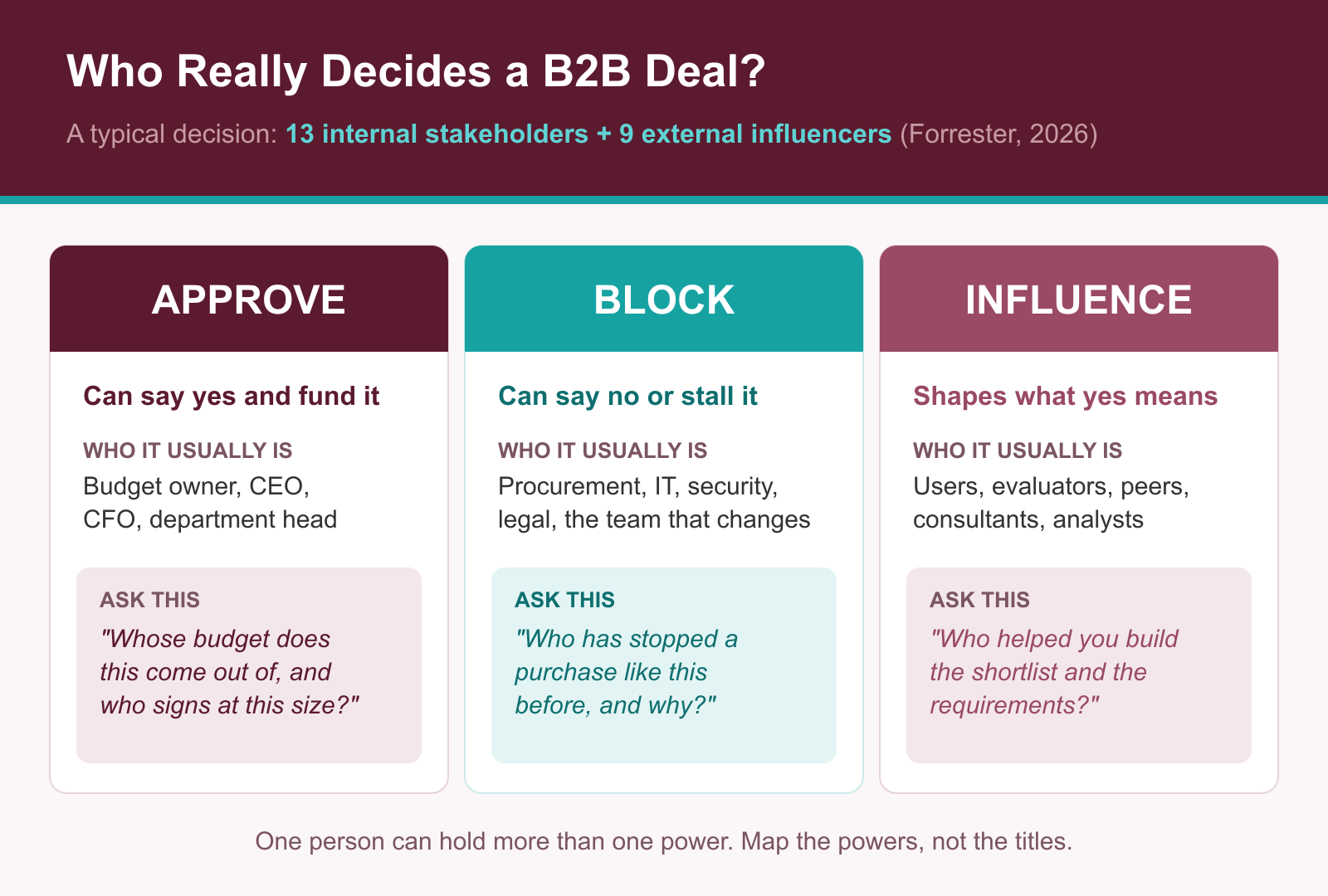
In most B2B sales, no single person makes the decision. Forrester's 2026 research puts a typical buying decision at 13 internal stakeholders and nine external influencers. Your deal is decided by three kinds of power: people who can approve and fund it, people who can block or stall it, and people who shape what a good choice looks like. Find all three by asking how the company bought something similar last time, then verify each answer.
Key Takeaways
- A B2B deal rarely has one decision maker. It's decided by three powers: approve (fund and sign), block (veto or stall), and influence (shape the requirements and the shortlist).
- Forrester's State of Business Buying 2026 reports a typical decision involves 13 internal stakeholders and nine external influencers, and procurement is a decision-maker in 53% of buying cycles.
- Titles mislead. A VP may not control the budget, and the manager who ran the evaluation may end up making the call. Map who holds each power, not who has the biggest title.
- Ask your main contact: "Walk me through the last time your company bought something like this. Who got involved, who signed, and what slowed it down?" The answer shows you the real decision path.
- Don't forecast a deal until you've confirmed who approves it, who could block it, and the date of the approval meeting.
You've spent six weeks with a VP who loves your product. Great calls. Fast email replies. They tell you, "I'm the decision maker on this." You put the deal in your forecast.
Then the VP goes quiet. When you finally reach them, you hear about a CFO review, a security questionnaire, and a procurement team that wants three quotes. None of those people were ever on a call with you.
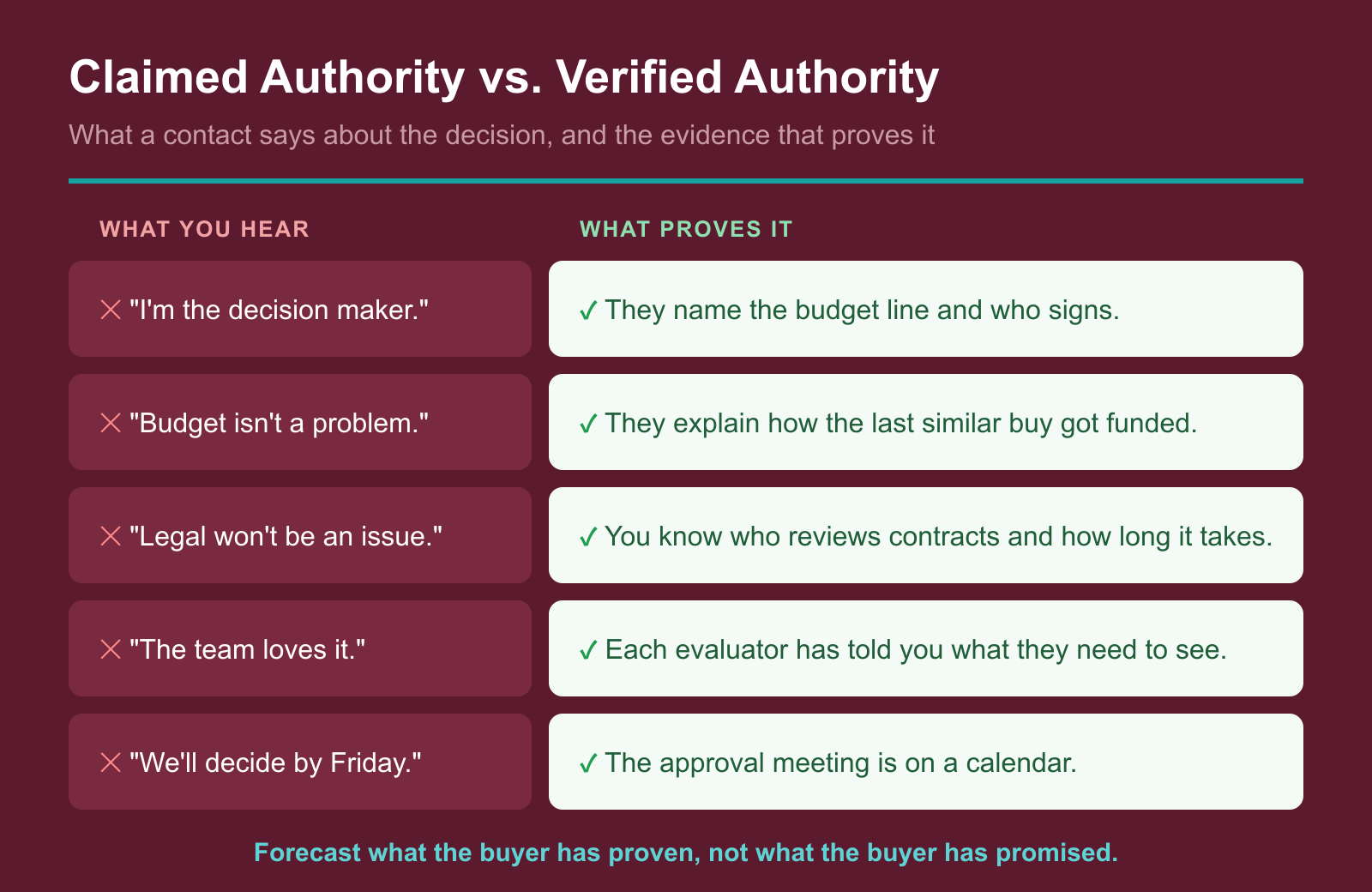
When a contact says, "I'm the decision maker," you've learned their opinion of the deal. You still have to confirm their authority.
Founder-led deals stall in the gap between a contact's opinion and their authority. Here's how to find the people who actually decide, before they find you.
Is There Really One Decision Maker in a B2B Sale?
No. In a typical B2B sale, the decision is a chain of approvals. The person you talk to most often holds one link in that chain. Finance, the users, IT, legal, procurement and outside advisors can each hold another link, and any one of them can stop the purchase.
What the research says about buying groups
Forrester's State of Business Buying 2026 found the typical buying decision involves 13 internal stakeholders and nine external influencers, and that number rises for complex or strategic purchases (Forrester, 2026). 6sense's 2025 study of nearly 4,000 B2B buyers reported buying groups that average 10 or more members. Only 52% of those respondents described themselves as the ultimate decision maker. The rest were procurement, influencers, champions and financial ratifiers (6sense, 2025).
About half the people involved in a B2B purchase aren't the one who makes the final call. If you can't tell which half your contact belongs to, you don't know where your deal stands.
Why founders get this wrong
Most founders made their first sales to other founders. One CEO talked to another CEO, and the CEO signed. That works at $20K deals with 30-person companies. As you move from $1M toward $10M ARR, you start selling bigger deals into bigger companies, and the person who loved your demo no longer has the authority to buy alone.
Who Can Approve, Block or Influence a B2B Deal?
Three groups decide a B2B deal: approvers who can say yes and fund it, blockers who can say no or stall it, and influencers who shape what "yes" means. One person can hold more than one power. Mapping powers instead of titles shows you who you still need to reach.
Approvers: the people who can say yes and fund it
An approver controls the budget or signs the contract. That's often a CFO, CEO, department head or business-unit owner. Many companies have signing limits, so the person who can approve a $25,000 purchase may not be able to approve $150,000. Your contact may be an approver for small purchases and an influencer for yours.
Blockers: the people who can say no or stall it
A blocker can stop or delay the deal without ever saying yes to anything. Procurement, IT, information security, legal and compliance are the usual ones. Forrester reports that procurement professionals are decision-makers in 53% of business buying cycles (Forrester, 2026). The team whose daily work changes after the purchase can block too, simply by telling their boss the timing is wrong. Plan for these reviews as real stages in the deal. I cover how in handling security, legal and procurement after the yes.
Influencers: the people who shape what yes means
An influencer can't sign or veto, but they write the requirements, run the evaluation and build the shortlist. That includes users, technical evaluators, and outside voices such as peers at other companies, consultants and analysts. Influencers decide which vendors get compared and on what terms, long before an approver looks at a price.
How Do You Find the People Who Can Approve the Deal?
Find the approver by asking how the company made a similar purchase before. "Are you the decision maker?" invites a yes. A question about past purchases gets you names, steps and timelines, because people describe what happened more accurately than they describe their own authority.
Ask about the last similar purchase
Use these questions in discovery, in this order:
- "Walk me through the last time your company bought something like this." Listen for who started it, who evaluated, who approved and who signed.
- "Whose budget does this come out of?" If the answer is "we'd have to find budget," the approver is someone above your contact.
- "At this price, who has to sign?" This uncovers signing limits without putting your contact on the spot.
- "What does the approver need to see to say yes?" Now you know what to build, and you've got a reason to meet them.
- "What slowed that last purchase down?" The answer usually names your future blocker.
Give the approver a reason to meet you
Approvers rarely sit through demos. They review a decision. Offer your contact a short meeting with the approver to confirm the business problem, the cost of leaving it alone and the expected return. Arm your contact with a business case they can take to the CFO so the approver hears the same numbers you discussed. If your contact won't arrange that meeting or describe how approval works, treat the deal as early stage, no matter how friendly the calls feel.
How Do You Find Blockers and Influencers Who Never Join Your Calls?
Find blockers and influencers by asking who has stopped similar purchases and who helped shape this one. Most of them never attend your calls. They review a contract, fill out a security form or advise the team privately, so you only learn their names if you ask for them directly and early.
Influencers shape the deal before you arrive
In 6sense's 2025 study, 79% of buyers said they, not the vendor, started the first conversation, and the vendor the buyer favored before first contact won roughly 80% of the time (6sense, 2025). That means influencers had already written the requirements and ranked the vendors before your first meeting. Ask, "Who helped you put together the requirements and the shortlist?" If a consultant or a peer at another company shaped it, find out what they care about, and offer a reference customer who looks like them.
Blockers tell you who they are, if you ask
Use these questions to find blockers early:
- "Has a purchase like this ever been stopped here? By whom, and why?" Past vetoes predict future ones.
- "Who reviews vendor contracts and security, and how long did that take last time?" Now you can start those reviews in parallel instead of at the end.
- "Whose job changes the most if you buy this?" That team can delay a deal just by saying the timing is bad.
- "Is anyone attached to the current way of doing things?" The status quo often has an owner.
A blocker found in week two is a task on your plan. A blocker found in week ten is a lost quarter.
What Have 50 Years in Sales Taught Me About Decision Makers?
The most expensive mistake I see is a salesperson who hears what they want to hear about authority. Founders and reps both do it. A contact describes their role, and the salesperson upgrades it in their head. The deal goes on the forecast based on authority that was never confirmed.
When "part of the team" became "the decision maker"
I once had a salesperson whose pipeline always held more deals than anyone else's on the team. He also closed the fewest. I thought he was padding his numbers to look busy. He wasn't. When I drilled into each deal, I found he'd heard a contact say, "I'm part of a team that's evaluating solutions," and recorded it as, "I'm the decision maker." He believed his own pipeline.
I started asking him the same questions on every deal. Are you talking to the person who can sign the order? Do they have budget, or can they get it? When do they want to start? Half his pipeline didn't survive those questions, and his forecast finally matched his results.
Authority can sit where you least expect it
It cuts the other way too. More than once, my ultimate decision maker turned out to be someone who started the buying cycle as just one member of the evaluation committee. If I'd ignored them because of their title, I'd have lost those deals.
And sometimes the real approver isn't in the room at all. I had a six-figure deal where every term was agreed and the CEO was set to sign on a Wednesday. That night, our contact, who really was the key decision maker for the evaluation, called to say they couldn't sign. The CEO had realized the purchase would squeeze cash flow and possibly payroll. Our contact owned the choice of vendor. The CEO owned the cash. We'd never confirmed what the CEO needed to see.
It's okay to win a sale by yourself. You don't want to lose one by yourself. On a big deal, bring your team and meet everyone who can say yes or no.
How Do You Make Decision Mapping Part of Your Sales Process?
Make decision mapping a required step for every rep on every deal. Add the approver, known blockers and key influencers to every opportunity in your CRM, and don't let a deal move forward until those fields are filled with names. A founder can install this in a week, and it immediately makes the forecast more honest.
Turn the map into exit criteria
Give your stages real exit criteria tied to the decision map:
- Leaving discovery: the approver is named, and you know how a similar purchase was approved last time.
- Leaving evaluation: influencers have told you what they need to see, and you've shown it.
- Leaving proposal: you've met or briefed the approver, and blockers' reviews are scheduled.
- Commit: the approval meeting is on a calendar, and no known blocker review is open.
Then ask one question in every pipeline review: "Who approves this, and how do you know?" If the answer is "they told me they're the decision maker," the deal hasn't been verified yet.
If you're still doing all the selling yourself, start with your three biggest open deals this week. Fill in the approver, blockers and influencers for each one. The blanks are your next calls. Building this into a repeatable Sales Playbook, with coaching so your reps run it without you, is exactly the work a Fractional Sales Leader does for $1M to $10M ARR founders who aren't ready for a full-time VP of Sales.
Related Reading
Single-Threaded Deals Die: The Multi-Threading Playbook →Frequently Asked Questions
What's the difference between a decision maker and an economic buyer?
The economic buyer controls the budget the purchase comes from. A decision maker is anyone with the power to approve the deal, which can include the economic buyer, a CEO, or a committee. In a small company they're often the same person. In a larger company, the person who chooses the vendor and the person who releases the money are frequently different people.
Is it rude to ask a prospect if they're the decision maker?
It's not rude, but it's a weak question, because most people answer yes. Ask about process instead: "Walk me through how a purchase like this gets approved here." You'll get names, steps and timing without making your contact defend their status.
What if my contact won't introduce me to the approver?
Ask what the approver will need to see, and offer something useful to bring them, such as a one-page business case or a short call to confirm the numbers. If your contact still won't help, the deal is weaker than it looks. Keep it out of your committed forecast until you know how approval will happen.
Does the CEO always make the final call at a smaller company?
No. At a 40-person company, the CEO may approve every purchase but rely completely on the operations lead's recommendation. Treat the CEO as the approver and the person they trust as a powerful influencer. Win both, because either one can stall the deal.
How many people should I be talking to in a B2B deal?
Enough to cover every power: at least one approver, the main influencer, and the people who run any review that could block you. On a $15,000 purchase that might be two people. On a six-figure deal it's usually several. The count matters less than knowing who holds each power.
Know who really decides your biggest deal.
If you're running a $1M to $10M ARR B2B company and your deals keep stalling in rooms you never get into, let's map one together. In 30 minutes we'll look at your biggest open deal and find who can approve, block or influence it. Learn about Fractional Sales Leadership at LouieBernstein.com.
Schedule a 30-Minute CallAbout the Author
Louie Bernstein is a Fractional Sales Leader with 50 years of sales experience. He's helped founders build repeatable sales systems as a Fractional Sales Leader since 2017. He founded MindIQ, an Inc. 500 company, and his work focuses on Sales Playbooks, defined sales processes, coaching, pipeline management, and helping teams sell without depending on the founder for every decision.