What Does a CFO Need to See Before Approving Your Purchase?
Build the business case with your champion, in the buyer's own numbers, on one page the champion can defend without you in the room. A CFO needs to see the cost of the problem, the full three-year cost of your solution, a conservative payback period, the risks and who owns them, and how your offer compares with doing nothing. Finance leaders check vendor math, so every input has to come from the buyer.
Key Takeaways
- A business case the CFO will approve is built from the buyer's own numbers, shows three-year total cost and a conservative payback period, and names the risks and the alternatives, including doing nothing.
- In Wynter's 2025 survey of 100 CFOs and VPs of Finance at B2B SaaS companies, 58% said they don't trust vendor ROI calculations, and 66% judge total cost of ownership over three to five years.
- Your champion presents the business case, not you. Write it with the champion, in their language, and test it with the question "What will your CFO push back on?"
- Show three cases: conservative, expected and best. If the purchase only pays back in the best case, fix the offer before finance sees it.
- Make a finance-ready business case an exit criterion for your proposal stage, so a deal can't sit in "proposal sent" without one.
Your champion loves you. The demo landed. The team agrees your product solves their problem. Then the champion says, "I need to take this to our CFO," and the deal goes quiet for three weeks.
The CFO wasn't on the demo. The CFO didn't feel the pain your champion felt. The CFO has a spreadsheet, a budget that's already spoken for, and one question: why should this money go here instead of somewhere else?
The CFO isn't buying your product. The CFO is approving your champion's judgment. Give your champion a business case worth defending.
Most founders in founder-led sales are great at selling the vision. Very few hand the buyer a document that survives a finance review. That gap costs founders deals they thought they'd already won.
What Does a CFO Need to See Before Approving a Purchase?
A CFO needs to see five things before approving a B2B purchase: what the problem costs today, what the solution costs in total, when the money comes back, what could go wrong, and why this option beats the alternatives. Finance is comparing your request against every other use of the same dollars, so a business case without those five items rarely gets approved.
The five parts of a finance-ready business case
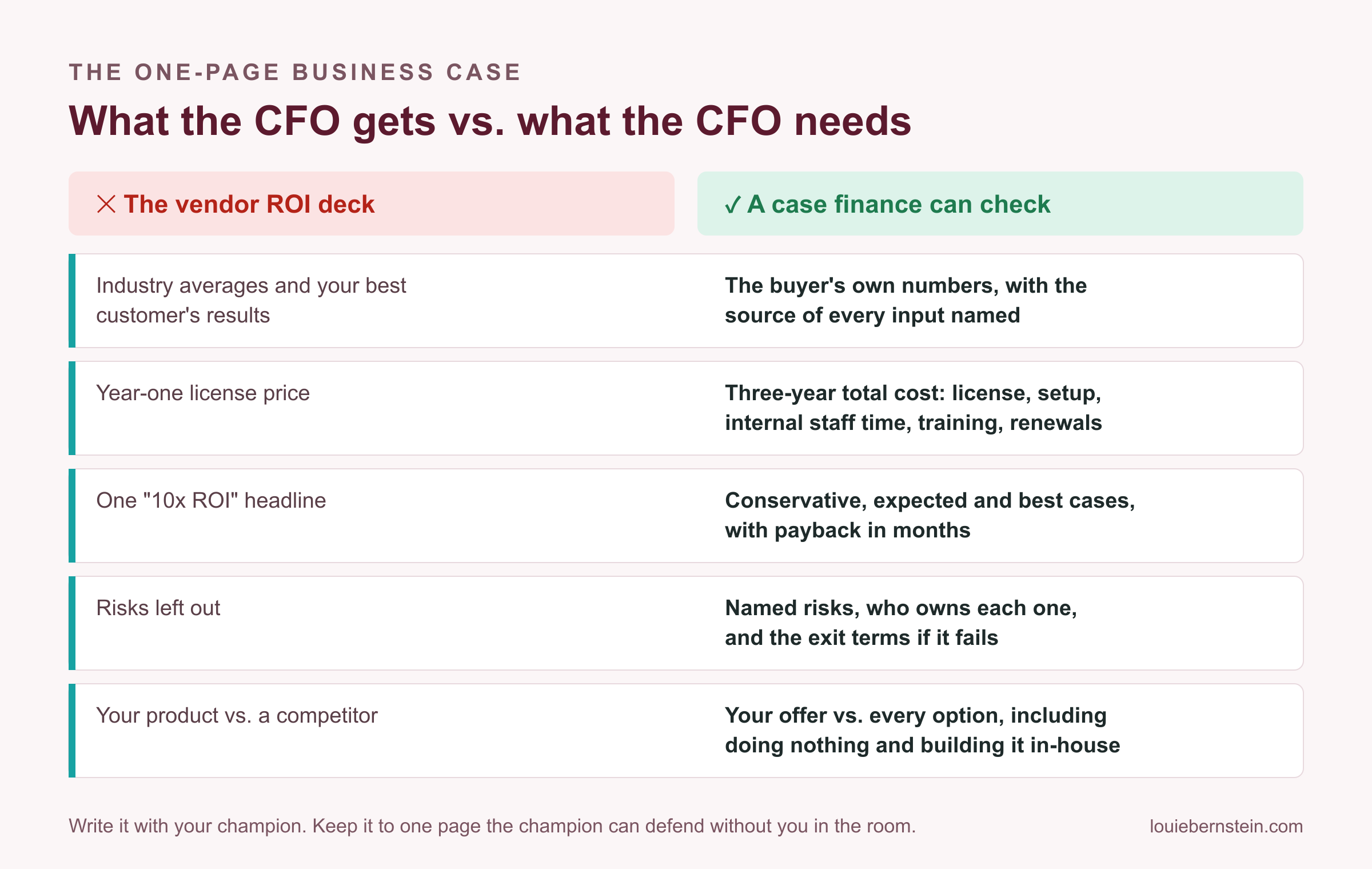
- The cost of the problem, in the buyer's numbers. Lost revenue, wasted hours, error rates, churn. Use figures the buyer gave you and name where each one came from.
- Three-year total cost. License or fees, setup, the buyer's internal staff time, training and renewal increases. The first-year price is only part of what finance will count.
- Payback in months. CFOs think in payback. "It pays for itself in 9 months" is easier to approve than "300% ROI."
- Risks and who owns them. Adoption, implementation, vendor stability, data security. Show the exit terms if it doesn't work.
- The alternatives. Your offer compared with doing nothing, building it in-house and a competitor. Doing nothing is the option the CFO will consider most seriously.
Cost gets read before ROI
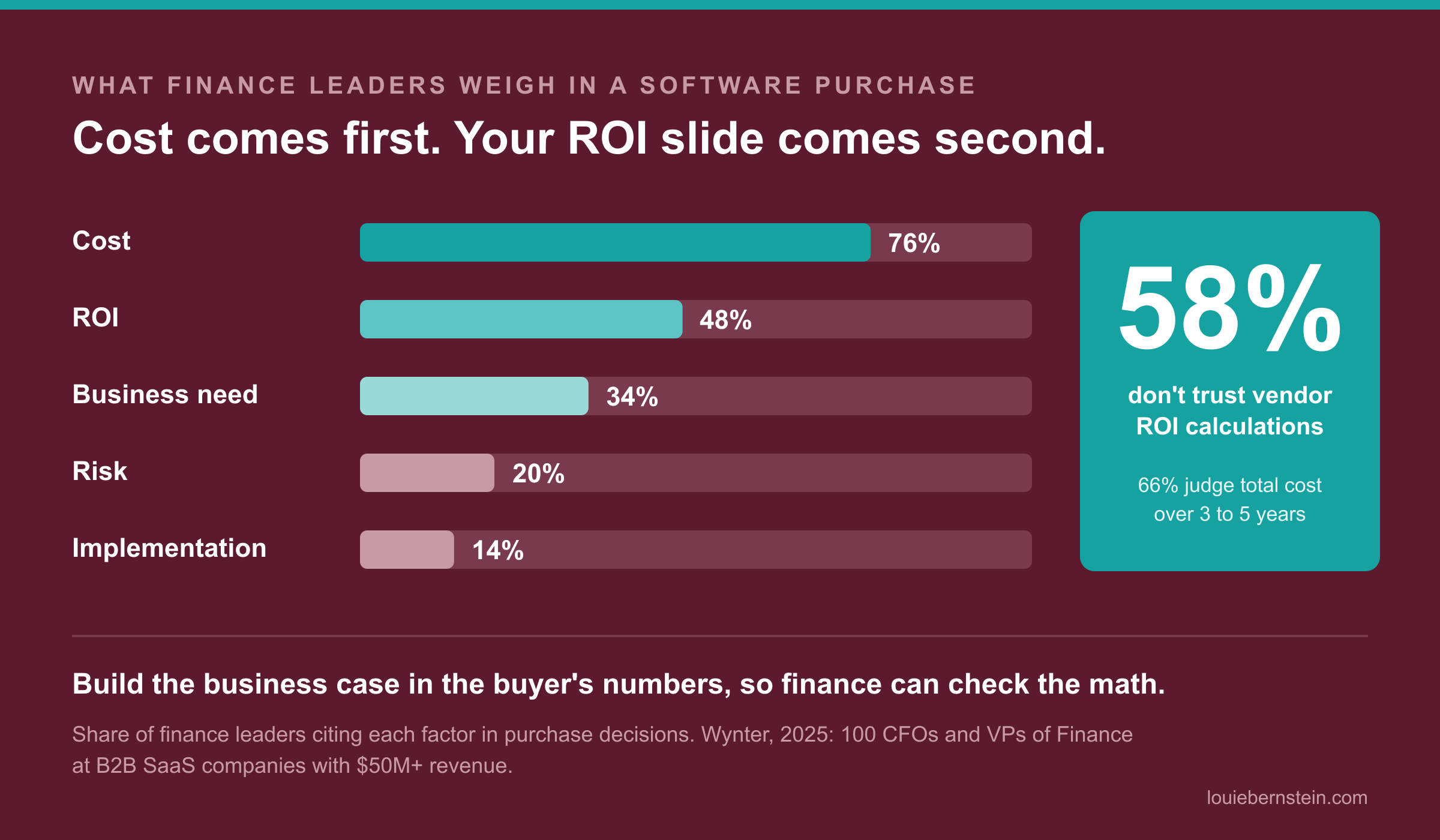
When Wynter surveyed 100 CFOs and VPs of Finance at B2B SaaS companies with $50M+ revenue in 2025, cost was the top decision factor (76%), ahead of ROI (48%), business need (34%), risk (20%) and implementation (14%) (Wynter, 2025). The same survey found only 16% of those finance leaders lead vendor selection end to end. Most show up at final approval or to negotiate.
Your buyer may be smaller than those companies, but the order of questions holds. Finance reads the total cost first, then decides whether the return justifies it.
Why Don't CFOs Trust Vendor ROI Calculators?
CFOs don't trust vendor ROI calculators because the vendor picks the inputs, and the inputs usually come from the vendor's best customer. In Wynter's 2025 survey, 58% of finance leaders said they don't trust vendor ROI calculations, and 56% build their own evaluation models. A business case only works when finance can trace and check every number.
Use the buyer's numbers, not yours
A finance leader who sees "customers save an average of 40%" asks, "Which customers? Compared to what?" A finance leader who sees "your team told us they spend 22 hours a week reconciling invoices" asks a much better question: "Is that right?" Now the conversation is about the buyer's business, not your marketing.
Get those numbers in discovery. If you didn't, go back and ask. Your champion will usually help, because your champion needs them too.
Show three cases, and lead with the conservative one
Here's a hypothetical example. First-year cost is $60,000: $42,000 in fees, $8,000 for setup and $10,000 of the buyer's internal staff time. The buyer expects to save $8,000 a month.
| Case | Monthly savings | Payback |
|---|---|---|
| Conservative (half the expected savings) | $4,000 | 15 months |
| Expected (the buyer's estimate) | $8,000 | 7.5 months |
| Best case | $10,000 | 6 months |
If the conservative case still pays back inside the buyer's planning window, you've made the CFO's job easy. If the purchase only works in the best case, fix the scope or the price before your champion walks it upstairs.
Lead with the conservative case. A CFO who catches you inflating one number will discount every other number on the page.
How Do You Build the Business Case With Your Champion?
Build the business case together with your champion, because the champion presents it to the CFO and you won't be in the room. Draft it from discovery, have the champion correct the numbers, and rehearse the CFO's likely objections. A business case the champion helped write is one the champion can defend.
Six steps, one page
- Confirm the problem and its cost. Ask, "What does this problem cost you in a year, and how did you get that number?"
- Find out how finance decides. Ask your champion how purchases this size get approved, what payback period finance expects and when the next budget review happens.
- Draft the one page. Problem, three-year cost, three cases with payback, risks, alternatives and a recommended next step.
- Hand it to the champion to correct. Let them change the numbers and the wording. Their language beats yours.
- Rehearse the pushback. Ask, "What will your CFO push back on?" Then answer each objection on the page, not in a follow-up email.
- Offer to join, don't insist. Offer to join the finance meeting if the champion wants help. If they decline, respect it.
Keep one version. In Forrester's 2024 State of Business Buying research, an average of 13 people were involved in a purchase and 86% of B2B purchases stalled during the buying process (Forrester, 2024). When different departments pass around different versions of your numbers, the purchase stalls while they argue over which one is right. If you're only talking to one person, read the multi-threading playbook first.
Where Do Founders Usually Get the CFO Business Case Wrong?
Founders usually get the CFO business case wrong by treating the champion's enthusiasm as approval and sending a deck that sells features instead of math. In 50 years of B2B sales, I've watched the same mistakes repeat: math errors, inflated numbers, no room left to negotiate and no thought about what the purchase means for the champion's career.
"Everyone agreed" isn't approval
Early in my career I worked a deal with a product manager who told me everyone was in agreement. Off he went to the signer, who happened to be the CFO. The CFO wanted better terms. I'd already given my best offer.
What I learned: always save at least two things in your proposal you can hold back for negotiation. The CFO often needs to win something in front of their own team. Give a final concession, take one back, and let them save face. If you're too upset to do that, wait 24 hours. The deal will look better the next day.
One math error can sink the deal
If you try to fool a CFO, or you simply make a math error, your deal is in serious jeopardy. Finance people find the mistake, and then they stop trusting the rest of the page. Have someone who didn't build the business case check every formula before it leaves your building.
The champion is risking their career
One question I've taught salespeople for years: "Could this decision be a career-ender if it goes badly?" Your champion is asking it whether you do or not. Answer it on the page with a phased start, clear success measures and exit terms. A smaller first purchase the CFO can approve beats a bigger one that sits in review.
There's an upside. When you've done the business math with your buyer, they're less likely to ask for a discount. If they do, you go back to the business case and show why cutting the price doesn't make sense for either of you. I wrote more about holding price in the discount trap.
How Should the Business Case Change When Budgets Are Tight?
When budgets are tight, the business case should lead with payback and the cost of doing nothing, and offer a smaller first phase. Finance leaders cutting costs approve purchases that return cash quickly. A request that pays back within the fiscal year has a better chance than one promising returns in year three.
Budgets have been tight. In a Gartner poll of 197 finance leaders taken in June 2025, 67% were cutting costs, had completed cuts or planned cuts in the second half of the year, and 37% had already paused some capital spending (Gartner, 2025). That doesn't mean nobody is buying. It means every request competes harder for the same money.
Three adjustments when money is tight
- Shorten payback. Start with the use case that returns money fastest, and expand after it proves out.
- Show the cost of doing nothing. Put a monthly number on the problem. Waiting another quarter has a price, too.
- Find budget that already exists. Ask whether your solution replaces a tool, a contractor or a planned hire. Reallocated money is easier to approve than new money.
Make it part of your sales process
If you don't have a defined sales process yet, start here. Don't let a deal move past the proposal stage until there's a finance-ready business case your champion has reviewed. Put the one-page format in your Sales Playbook so every rep builds it the same way, not just the founder.
That's the kind of system a Fractional Sales Leader puts in place: a defined process, stage exit criteria, and reps coached to sell to finance, so the founder isn't rebuilding every business case at night.
Frequently Asked Questions
Should I ask to meet the CFO directly?
Ask your champion whether a finance meeting would help, and let them arrange it. Going around the champion damages trust. If the CFO won't meet, ask the champion what payback period and format finance expects, and build the business case to match.
How long should a business case for the CFO be?
One page, with a supporting spreadsheet if finance wants to check the math. CFOs review many requests. A one-page summary with traceable numbers gets read. A 30-slide deck gets skimmed for the price.
What if the buyer won't share their numbers?
Treat it as a qualification signal. A buyer who won't tell you what the problem costs may not have a problem worth funding. Offer a range from similar customers, clearly labeled as an estimate, and ask the buyer to correct it.
Do small companies need a formal business case?
Yes, but it can be shorter. In a $5M company, the CFO may be the founder or a part-time controller. They still want the total cost, payback and risk. The format can be an email instead of a document.
Should the business case include soft benefits like morale or time saved?
Include them, but keep them out of the payback math. CFOs discount soft benefits. List them below the numbers as additional value, so the hard case stands on its own.
Stop losing deals in the CFO's office.
If you're running a $1M to $10M ARR B2B company and your deals stall once they reach finance, I can help you build a sales process your reps can run, business case included. Learn about Fractional Sales Leadership at LouieBernstein.com, or bring a stuck deal to a conversation.
Schedule a 30-Minute CallAbout the Author
Louie Bernstein is a Fractional Sales Leader with 50 years of sales experience. He's helped founders build repeatable sales systems as a Fractional Sales Leader since 2017. His work focuses on Sales Playbooks, defined sales processes, coaching, pipeline management, and helping teams sell without depending on the founder for every decision.