Calculate the cost of wrong-fit leads, wasted sales hours and stalled deals before you spend another dollar on demand.
Sales and marketing misalignment costs a B2B founder money spent attracting the wrong buyers, paid hours spent correcting the pitch, and revenue put at risk when buyers hear conflicting promises. Calculate those amounts separately using campaign records, time logs and deal notes. Add only costs that don't overlap. Keep uncertain lost revenue separate from verified spending, then fix the mismatch with the strongest evidence before increasing demand spend.
Key Takeaways
- Sales and marketing misalignment costs money through wrong-fit acquisition, wasted selling time and damaged deal confidence. Each requires a different calculation.
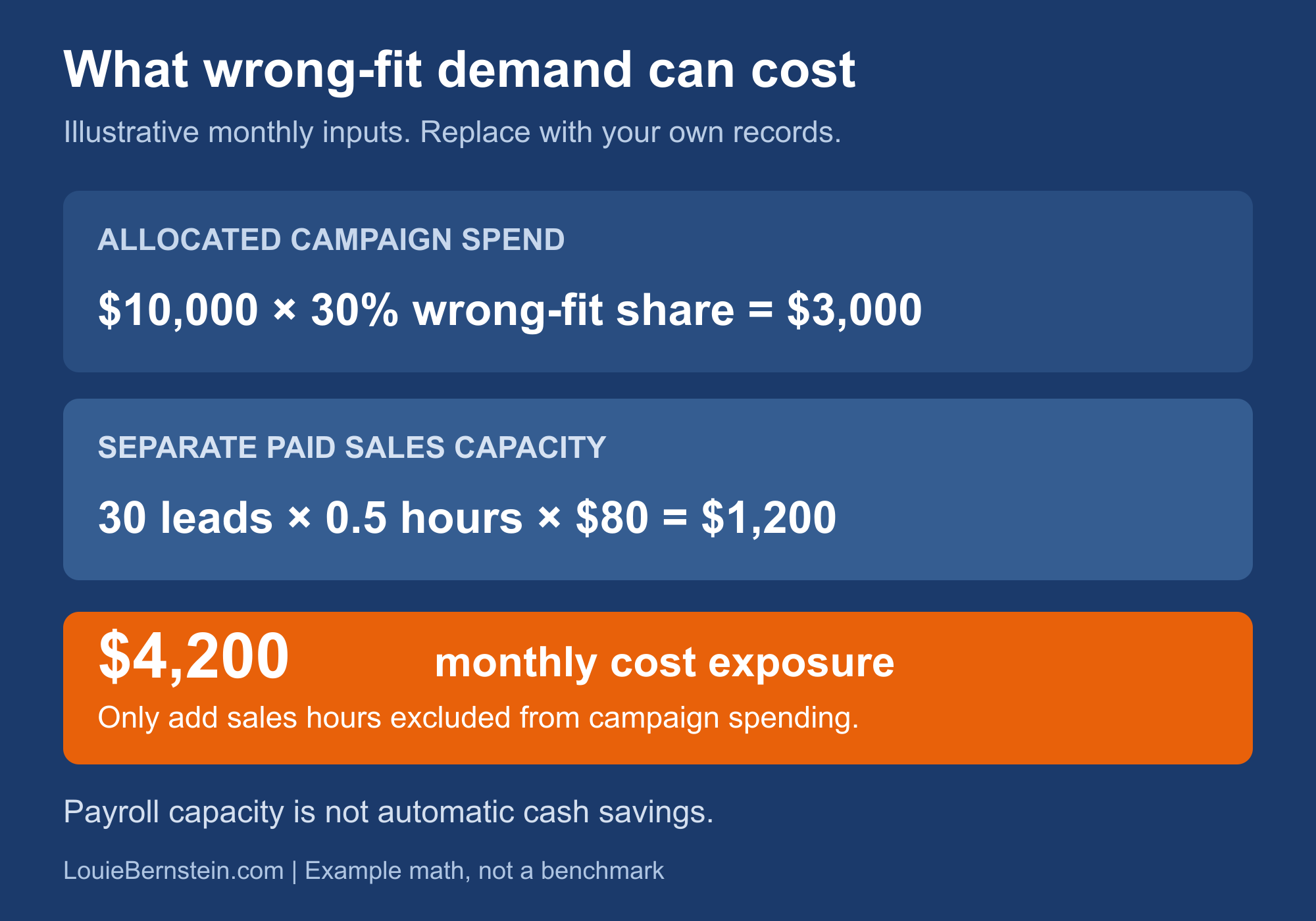
- A worked example produces $4,200 in monthly cost exposure: $3,000 in attributable campaign spend plus $1,200 in separate selling time. These are illustrative inputs, not a benchmark.
- Gartner's 2025 release found 69% of 632 B2B buyers reported inconsistent website and seller information. That percentage is not your lost-revenue rate.
- Review one month's leads, log avoidable sales work, and require buyer evidence before blaming a lost deal on conflicting messages.
- Keep delayed revenue, lost revenue and existing payroll capacity separate. A larger total isn't useful if the same dollar appears twice.
Your campaign report can look good while your sales calendar gets worse.
Meetings come in. You take the calls. Then you spend half of each call explaining that your company doesn't do what the prospect thought the ad promised. You send another proposal. You join another call. The lead count goes up. Your available selling time goes down.
For a founder at $1M to $10M ARR, that trade matters. You're still closing deals, coaching the first rep and making hiring decisions. Before you buy more attention, find out how much of your current attention turns into work you should never have needed.
A booked meeting isn't a return on investment when you spend the meeting undoing your own marketing.
Which costs should a founder count first?
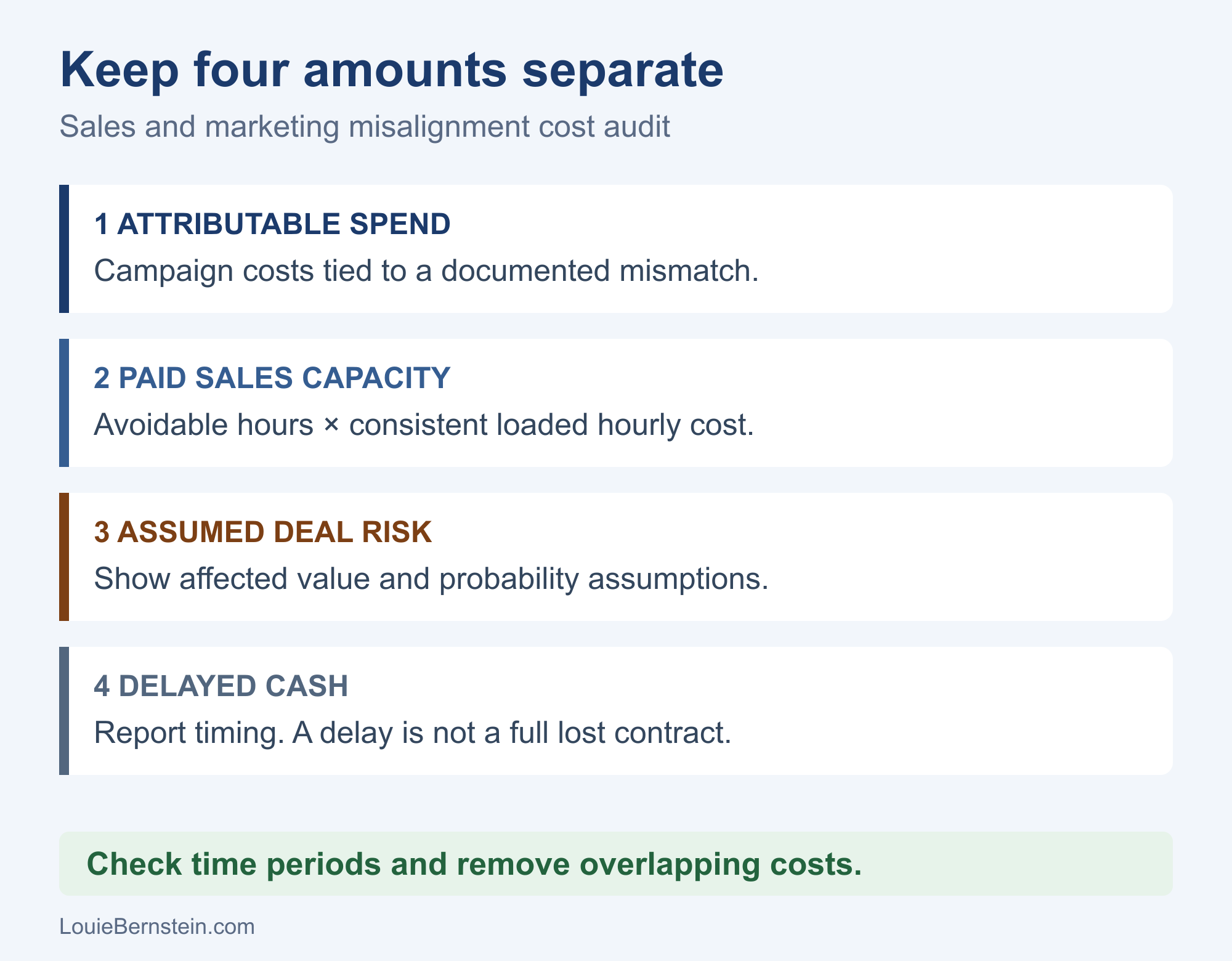
A founder should first count attributable acquisition spending and avoidable sales work, then assess deal risk separately. Spending and hours can usually be checked against records. Lost revenue requires a judgment about what would have happened without the mismatch, so a lost-deal estimate needs more evidence than a campaign invoice.
Use three separate lines
Start with one month and one campaign or lead source. Write down spending tied to the wrong audience or promise. Add sales time spent qualifying obvious misfits or correcting claims. Then make a separate list of stalled or lost opportunities where the buyer identified conflicting information.
Don't call all three lines cash savings. An agency invoice is spending. A salaried rep's wasted afternoon is paid capacity. A deal that may have closed is uncertain revenue. Those differences determine what you can actually recover.
Gartner surveyed 632 B2B buyers in August and September 2024. In its June 2025 release, 69% reported inconsistencies between a vendor's website and sellers, while 73% said they actively avoid suppliers sending irrelevant outreach (Gartner, 2025). The findings support checking your targeting and promises. They don't tell you what percentage of your revenue you've lost.
Set the boundary before calculating
A lead who wants a product you don't sell is a clear misfit. A lead who fits but needs more time isn't automatically wasted demand. Decide what makes a buyer a fit using your ideal customer profile, including the problem you solve and the conditions required for a useful sales conversation.
If you have no written qualification rules, write them before labeling last month's leads. Otherwise, sales can reject every lead after the fact and make the campaign look guilty.
How do you calculate the cost of wrong-fit leads?
Calculate wrong-fit lead cost by assigning identifiable campaign spending to buyers outside your agreed customer profile. Use direct campaign or audience costs where possible. When only blended spending is available, multiplying spend by the wrong-fit lead share gives a rough allocation, not proof that every wrong-fit lead cost the same amount.
Work one example all the way through
Suppose you spent $10,000 on a campaign that produced 100 leads. A joint review finds 30 leads outside the written profile because the ad promised a service you don't provide. The wrong-fit share is 30 divided by 100, or 30%. Allocating 30% of the campaign spending gives $3,000.
Every number in this example is illustrative. The calculation is $10,000 × 30% = $3,000 in estimated spending allocated to wrong-fit leads. Replace the inputs with your records. If platform reporting shows the exact ad set that attracted those buyers, use that cost instead of the blended allocation.
Also check the source. The 30 buyers may have come from one misleading ad while the rest came from a referral campaign. A company-wide average can hide a fix that belongs in a single headline.
Don't punish useful early interest
A buyer who fits your business but isn't ready this month belongs in a separate group. So does a good prospect who didn't answer. Poor timing and poor follow-up require different decisions from a promise your company cannot deliver.
Track the reason for rejection in plain words: wrong company size, unsupported use case, missing buying condition, or misleading claim. Review disputed records together. If nobody can establish the cause, mark it unknown rather than charging the cost to misalignment.
What are wasted sales hours worth?
Wasted sales hours are worth the avoidable time multiplied by a consistent hourly cost, with founder time reported separately when its value is estimated. Count only work caused by a targeting or messaging mismatch. Existing payroll doesn't disappear when you recover those hours, but the team gains capacity for qualified buyers.
Add time that wasn't already counted
Continue the illustrative example. The 30 wrong-fit leads each consume 30 minutes across research, calls and follow-up. That's 15 hours. At an assumed fully loaded sales cost of $80 per hour, those hours represent $1,200 in paid capacity.
The example's monthly exposure is $3,000 in allocated campaign spending plus $1,200 in separate selling time, totaling $4,200. The sales cost must be excluded from the campaign-spending input. If your $10,000 already includes those same selling hours, adding $1,200 would count them twice.
What building MindIQ taught me about founder time
I built and ran MindIQ for 22 years. I know what it means to carry the selling yourself. A founder can rescue a confusing conversation because the founder knows the whole business. The buyer gets an explanation, and the company never fixes the words that made the explanation necessary.
My advice is to record that rescue work. Put the clarification into your sales playbook, then change the message that created the confusion. Otherwise, your first salesperson inherits the same problem without your ability to talk around it.
For your own hours, show the time first. If you assign a dollar value, name the basis: replacement cost or an explicit planning assumption. Don't invent a $500 hourly rate because you want a frightening total. Ask which real task those recovered hours would make possible.
How do you value stalled deals without inflating the loss?
Value stalled deals by separating evidence of message conflict from assumptions about future wins. A buyer questioning an unsupported promise creates a specific risk worth investigating. An overdue close date alone doesn't prove misalignment. Report the affected pipeline, any scenario assumptions and delayed cash timing separately from verified spending and time.
Put the buyer's evidence beside the amount
Review the email, call notes or recording. Did the buyer say the proposal contradicted the website? Did the ad suggest implementation was included when the agreement charged extra? Did sales promise an outcome marketing never substantiated? Record the conflict and what the buyer did next.
Use a short win-loss review to test the explanation. If the buyer chose a competitor on price and never raised the message, you don't have evidence to charge the loss to misalignment.
Show scenarios as scenarios
Suppose one affected opportunity has a $24,000 annual contract value. If you assume the mismatch reduced its win probability by 10 percentage points, the scenario is $2,400 in expected annual contract value at risk. The 10-point change is an assumption, not an observed result or a promise of recoverable revenue.
Keep that $2,400 outside the $4,200 monthly operating-cost example. The amounts use different time periods and different levels of certainty. Contract value also isn't profit. Use your actual contribution margin if the decision requires a profit comparison.
A deal delayed for a month may still close at full value. Report the expected billing or collection delay according to its terms. Don't label the entire annual contract lost because a signature moved from November to December.
How should you use the calculation before buying more demand?
Use the calculation to choose one documented mismatch to fix before expanding the campaign that carries it. Compare the likely recoverable spending and capacity with the cost of the repair. Review comparable lead cohorts after the change, allowing for your sales cycle, and keep uncertain revenue upside outside the base case.
Run a small audit you can repeat
- Pull one month's records. Keep source, campaign spend, fit status, rejection reason and sales time together. Mark missing data rather than filling gaps with guesses.
- Review the causes. Sales and marketing check the rejected leads and message complaints together. Separate targeting, unsupported promises, ordinary objections and poor follow-up.
- Calculate separate amounts. Show attributable spend, paid capacity, founder hours and affected pipeline. State the period and assumptions beside each.
- Fix the strongest case. Change the ad, qualification step or proposal language tied to the clearest avoidable cost. Give one person ownership and a due date.
- Compare the next cohort. Track wrong-fit share, sales hours per qualified meeting and buyer-reported contradictions. Note changes in source mix or spending that could explain the result.
Fewer leads can be a good outcome if your team spends more time with buyers you can help. Check qualified opportunities and eventual wins before declaring success. A smaller inbox alone doesn't prove the fix worked.
Keep the repair alive
I think founders should understand the cost before they approve another campaign. A Fractional Sales Leader can help define qualification, audit the disputed deals and make sure the same promises reach the website, playbook and sales call. The useful result is a sales system your team can run without you correcting every conversation.
You can start with a spreadsheet. If you don't have reliable lead or time records, log them going forward and publish an honest partial estimate. An incomplete number with clear boundaries beats a confident total built from guesses.
Before you buy more demand, find out how much demand your team can serve without you repairing the pitch.
How Do You Align Sales and Marketing in a Small B2B Company? Use the weekly loop to keep the cost from coming back.
Frequently Asked Questions
Q: Should I multiply one month's cost by 12?
Only as an annualized scenario, with the assumption that volume, spending and behavior stay the same. Seasonal campaigns and a single bad month can make that projection misleading. Show the measured month first.
Q: Should brand marketing be counted as wasted spend?
Brand spending isn't wasted merely because it doesn't produce an immediate sales lead. Assess whether the audience fits and the claims are accurate. Don't apply a short-term lead test to spending intended to build future awareness.
Q: Can I use customer acquisition cost to diagnose the problem?
Customer acquisition cost can flag worsening efficiency, but it doesn't identify the cause. Changes in channel mix, hiring or sales cycle can also raise it. Check rejected-lead reasons and message conflicts before blaming misalignment.
Q: What if my agency won't share campaign costs?
Request spending by campaign and separate media costs from agency fees. Without that breakdown, report only the portion you can support and list the missing amount. A blended invoice limits the accuracy of your diagnosis.
Q: Should I include discounts used to rescue a confused buyer?
Include a documented incremental concession in a separate line when the buyer evidence ties it to the mismatch. Don't also count the same deal as a full lost sale. Use consistent contract periods when comparing the concession with revenue.
Put a number on the sales work you shouldn't need
If you're still correcting the pitch on every call, let's review where the confusion starts and what your team needs to handle it without you.
Schedule a 30-Minute CallAbout the Author
Louie Bernstein is a Fractional Sales Leader with 50 years of sales experience and has worked as a Fractional Sales Leader since 2017. He built and ran MindIQ for 22 years. He helps B2B founders at $1M to $10M ARR build repeatable sales systems so selling doesn't depend on the founder.