The one-week loop that stops mixed messages, protects customer trust and works with as few as two people
To align sales and marketing in a small B2B company, run one short weekly loop. On Monday, whoever sells writes down what buyers said. By Wednesday, whoever markets fixes one message to match. On Friday, both people meet for 30 minutes and agree on what changes next week. You don't need two departments. You need one buyer, one promise, and one set of words that both people use.
Key Takeaways
- A small B2B company aligns sales and marketing by running a one-week loop: buyer notes on Monday, one message fix by Wednesday, and a 30-minute review on Friday.
- In a Gartner survey of 632 B2B buyers (2024 fieldwork, released 2025), 69% said a vendor's website and its sellers gave them inconsistent information.
- 6sense's 2026 study of 4,611 B2B buyers found the vendor a buyer favored before talking to a seller won 82% of the time, so your marketing does much of your selling before the first call.
- Write and sign a one-page agreement this week: who you sell to, who you don't, the problem you solve, and the words both people will use.
- Sales and marketing alignment works with two people, even when one of them is the founder and the other is a part-time contractor.
Here's a fight I've heard more times than I can count.
Sales says, "The leads from marketing are terrible." Marketing says, "How would you know? You never call them." Sales says, "Because they're terrible!"
Big companies have that fight across two floors. In a $1M to $10M ARR company, the fight happens between the founder and a contractor, or inside the founder's own head. The website says one thing. The founder says another on the call. The proposal says a third. The buyer notices all three.
When buyers hear two stories from one company, they don't pick the better story. They pick neither.
What Does Sales and Marketing Alignment Mean in a Small Company?
Sales and marketing alignment in a small company means the website, the emails, the posts and the sales calls all describe the same buyer, the same problem and the same result. The size of the team doesn't matter. A buyer judges your company by what they read before the call and what they hear on it.
Alignment is a shared set of words
At a big company, alignment means service level agreements, lead scoring and a handoff meeting. You don't need any of that. You need three things written down where both people can see them:
- One buyer. The title, company size and trigger that make someone a fit. Also who you don't sell to.
- One promise. The problem you solve and the result the buyer gets, in the buyer's own words.
- One next step. What every piece of marketing asks a buyer to do, and what sales does when they do it.
If you can't write those three lines yet, start there. A loop can't fix a message nobody has written. My ICP checklist walks through the first line.
Two people are enough
Most founders at this stage have one person who sells (often the founder) and one person who markets (often a freelancer, an agency or a part-timer). That's a full alignment team. The loop below takes about an hour a week in total.
Why Do Mixed Messages Cost a Small B2B Company So Much?
Mixed messages cost a small B2B company deals because buyers now form their opinion before they ever talk to you. When your website and your sales call disagree, buyers lose trust at the exact moment you need it. A big brand can survive that. A small company with a short list of prospects can't.
Buyers notice the gap
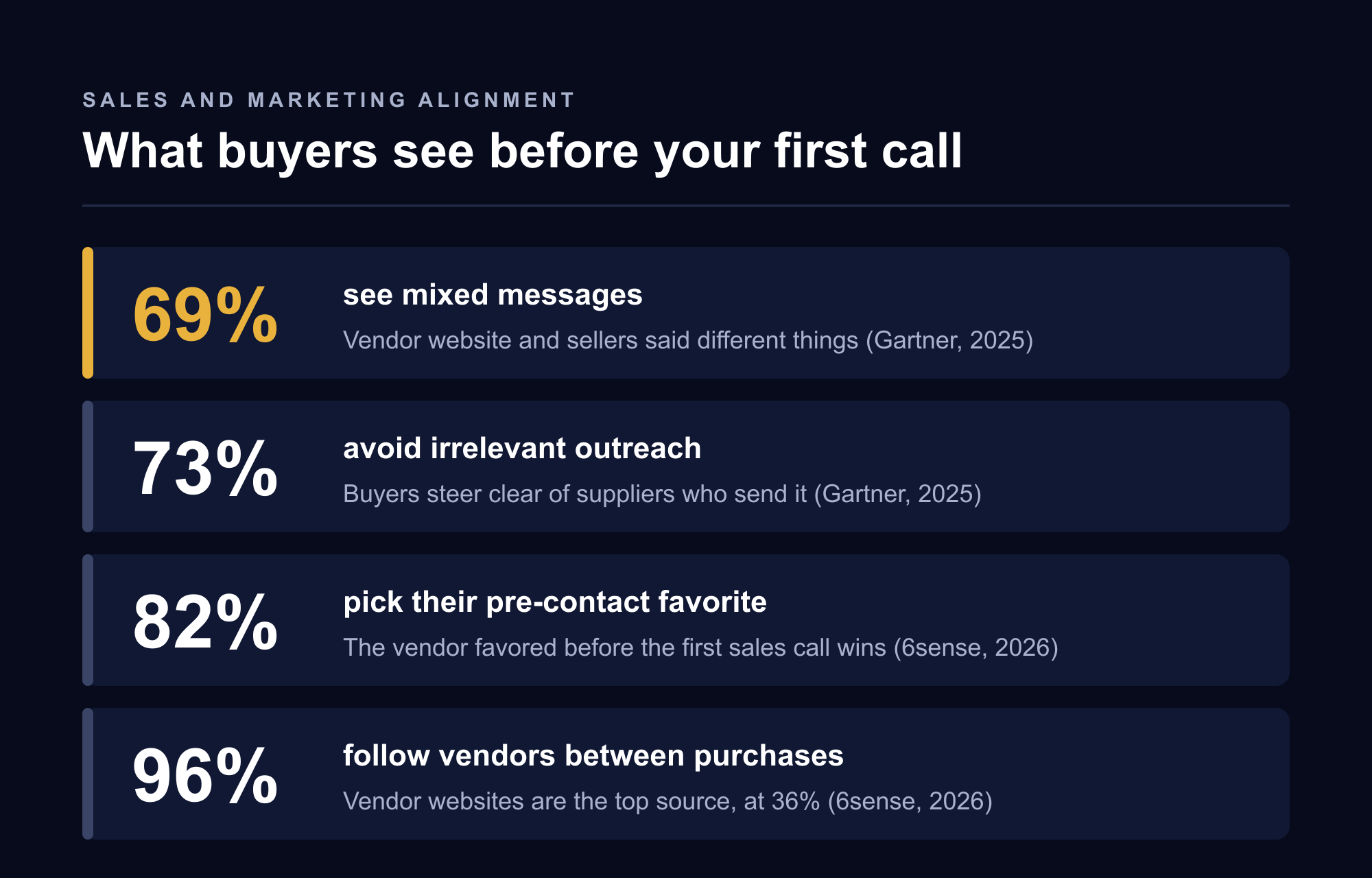
In a Gartner survey of 632 B2B buyers, run in August and September 2024 and released in June 2025, 69% said they saw inconsistencies between a vendor's website and what its sellers told them. The same survey found 73% avoid suppliers who send irrelevant outreach (Gartner, 2025). Irrelevant outreach is what happens when marketing writes for a buyer that sales doesn't sell to.
Your marketing sells before you do
6sense surveyed 4,611 recent B2B buyers for its 2026 Global B2B Buyer Experience Report. Buyers spent about 60% of an average 10.3-month buying cycle before contacting a seller. The vendor they favored before that first contact won 82% of the time. And 96% kept up with vendors between purchases, most often through vendor websites (6sense, 2026).
6sense sells software to marketing and sales teams, so read its numbers as vendor research. Still, the direction matches what Gartner found. Your website, posts and emails make the first sales pitch. If that pitch doesn't match yours, you start the call behind.
What Is the One-Week Sales and Marketing Alignment Loop?
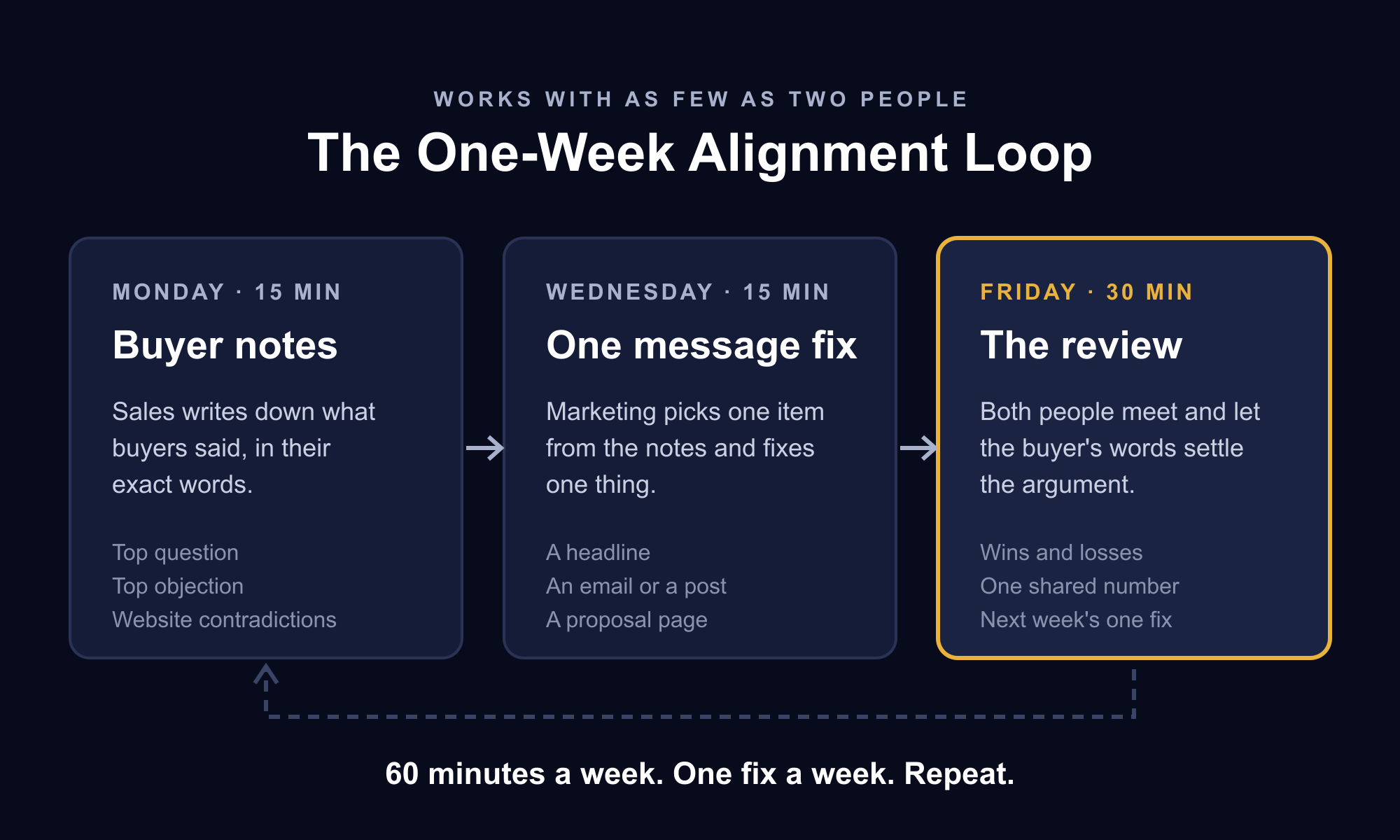
The one-week sales and marketing alignment loop is three short steps that repeat every week: capture what buyers said, fix one message, and review the results together. The loop works because it is small. One change a week is 50 changes a year, and every change comes from a real buyer.
Run the loop in three steps
- Monday: buyer notes (15 minutes). The person who sells writes down what buyers said last week. Use their exact words. Note the top question, the top objection, and any phrase a buyer used to describe their problem. Note anything a buyer said that contradicts your website.
- Wednesday: one message fix (15 minutes). The person who markets picks one item from the notes and fixes one thing. A headline, an email, a post, a proposal page. One item only. Small fixes ship. Big rewrites sit on a list and die.
- Friday: the review (30 minutes). Both people meet. Review wins and losses, the top objection, what the market responded to, and next week's one fix. Agree up front that the data decides, not the loudest voice.
The times are my suggestion, not a benchmark. Keep the total near an hour. If the loop takes half a day, a busy founder will skip it by week three.
Bring evidence to Friday
Friday works best with real deals on the table. A short win-loss analysis tells both people why buyers said yes or no, in the buyer's words. That beats opinions from either side.
Let the buyer settle the argument. Bring their words to the meeting, not your opinions.
What Should Sales and Marketing Agree On Before the Loop Starts?
Sales and marketing should agree on a one-page alignment sheet before the first loop: the ideal customer, the problem, the promise, what counts as a lead and the words both people use. Write the sheet once, sign it, and update it on Fridays. Without the sheet, each weekly fix pulls in a different direction.
Sign the ideal customer profile
I tell founders to have both people sign the ideal customer profile. Yes, sign it. A signature turns "I think we sell to mid-size firms" into "we agreed we sell to 50 to 500 employee firms with this problem." When a lead comes in that doesn't fit, nobody argues. You check the sheet.
Define a lead in buyer actions
Write what a buyer has to do to become a lead and what they have to do to get a sales call. Use actions, like a reply, a pricing question or a booked meeting, rather than scores. When marketing and sales use the same definitions, "the leads are terrible" turns into a question you can answer with facts.
Keep a shared word list
List the five to ten phrases buyers use to describe the problem. Use them on the website and on the call. Then list the words you'll stop using, like internal product names buyers never say. Your sales playbook is the right home for both lists, so a future salesperson inherits them.
Where Do Founders Usually Get Sales and Marketing Alignment Wrong?
Founders usually get sales and marketing alignment wrong by treating it as a one-time project instead of a weekly habit. They run a branding workshop, rewrite the website, and stop. Six months later, the founder's pitch has moved on and the website hasn't. The gap reopens, and buyers see it first.
What I'd do differently at MindIQ
I built and ran a bootstrapped company, MindIQ, for 22 years. If I could go back, I'd start a weekly sales and marketing meeting in year one. I wish I had done it from the start. The idea is simple: a fixed time each week where sales tells marketing what buyers said, and marketing shows sales what it plans to say next. That meeting catches a mixed message before buyers do.
Mistakes I see in small companies
- The founder keeps the real pitch in their head. The marketer writes from an old brief, so the website describes the company the founder ran two years ago.
- Marketing gets measured on leads, sales on closed deals. Each side wins its own scoreboard while the company loses. Pick one shared number, like qualified meetings from fit buyers.
- Nobody tells marketing about losses. Founders celebrate wins. Losses hold the lessons, and they never reach the person writing the message.
- The agency gets a kickoff call and nothing else. An outside marketer can't fix a message they never hear about. Put them in the Friday review.
| Without the weekly loop | With the weekly loop |
|---|---|
| ✕ The website describes an old pitch | ✓ One message gets fixed every week |
| ✕ "The leads are terrible" with no proof | ✓ Both sides judge leads by a signed definition |
| ✕ Objections stay in the founder's head | ✓ Objections reach the marketer by Monday |
| ✕ Separate scoreboards for each side | ✓ One shared number reviewed on Friday |
| ✕ Outreach goes to buyers you don't serve | ✓ Outreach goes only to the signed ICP |
| ✕ A new salesperson learns a different story | ✓ A new salesperson inherits one word list |
When Should a Founder Get Outside Help With Sales and Marketing Alignment?
A founder should get outside help with sales and marketing alignment when the founder is the only person who knows the real pitch and has no time to write it down. The loop depends on someone capturing buyer words every week. If the founder is too busy selling to do that, the loop stalls.
A Fractional Sales Leader can run the loop for you while you keep selling. That person documents the buyer, the promise and the lead definitions, sits in the Friday review with your marketer, and builds the habit into your playbook. Most fractional sales leaders charge $10K to $20K a month. My fee is $14K a month for 20 to 35 hours a week, in renewable 12-week engagements. A full-time VP of Sales costs $250K to $400K a year, so a fractional leader runs roughly half the cost.
If you're earlier than that, start alone. Write the one-page sheet this week. Hold the first Friday review with your marketer next week. If you want to see how the message reaches buyers before the call, read about building a demand engine before you hire a marketer.
Frequently Asked Questions
Q: Who should run the weekly sales and marketing meeting?
The person who sells should run the Friday review, because that person brings the buyer's words. In most small companies that's the founder. Keep a simple agenda: wins, losses, top objection, what got a response, and next week's one fix.
Q: What number should sales and marketing share?
Share one number that both sides affect, such as qualified sales meetings from buyers who fit your ICP. Leads alone reward volume. Closed revenue alone moves too slowly to guide a weekly fix. Qualified meetings sit in the middle.
Q: How long before sales and marketing alignment shows results?
Expect the first visible change in about a month: fewer wrong-fit leads and fewer buyer questions about things your website should answer. Revenue results take longer and depend on your sales cycle. Give the loop at least 12 weeks before you judge it.
Q: Should I include my marketing agency in the loop?
Yes. Invite your agency or freelancer to the Friday review and send them the Monday notes. An outside marketer can only write what they hear. Thirty minutes a week costs far less than a campaign built on an old message.
Q: What if I'm the only person doing both sales and marketing?
Run the loop with yourself and put it on your calendar. Write buyer notes on Monday, change one message on Wednesday, and review the week on Friday. The written notes keep your message honest and give your first hire a record to learn from.
Get your sales and marketing telling one story
If your website, your posts and your sales calls don't match, buyers notice before you do. Let's look at where the story splits and set up your first weekly loop.
Schedule a 30-Minute CallAbout the Author
Louie Bernstein is a Fractional Sales Leader with 50 years of sales experience and has worked as a Fractional Sales Leader since 2017. He built and ran MindIQ for 22 years and now helps B2B founders at $1M to $10M ARR move out of founder-led sales with a repeatable sales system.