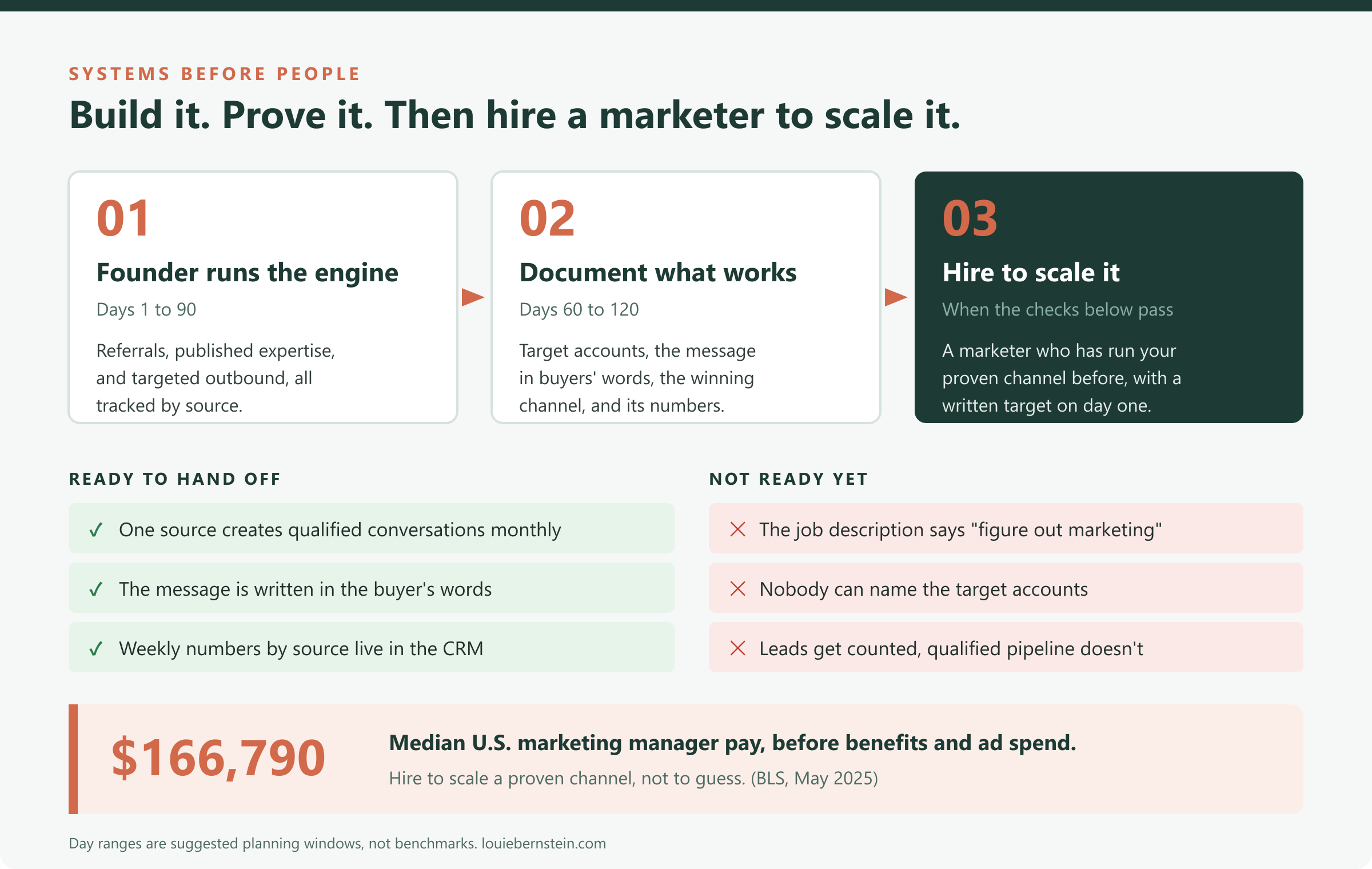
Build the demand engine yourself, then hire a marketer to scale what already works. For 90 days, run three small sources at once: referrals, published expertise, and targeted outbound. Track which source creates qualified conversations with right-fit buyers. A marketer can amplify a proven message and channel. If you hire a marketer to find the message, you're paying a median of $166,790 a year (BLS, May 2025) for someone to guess.
Key Takeaways:
- A founder at $1M to $10M ARR should build and run a small demand engine before hiring a marketer. Hire the marketer to scale a proven channel, not to discover one.
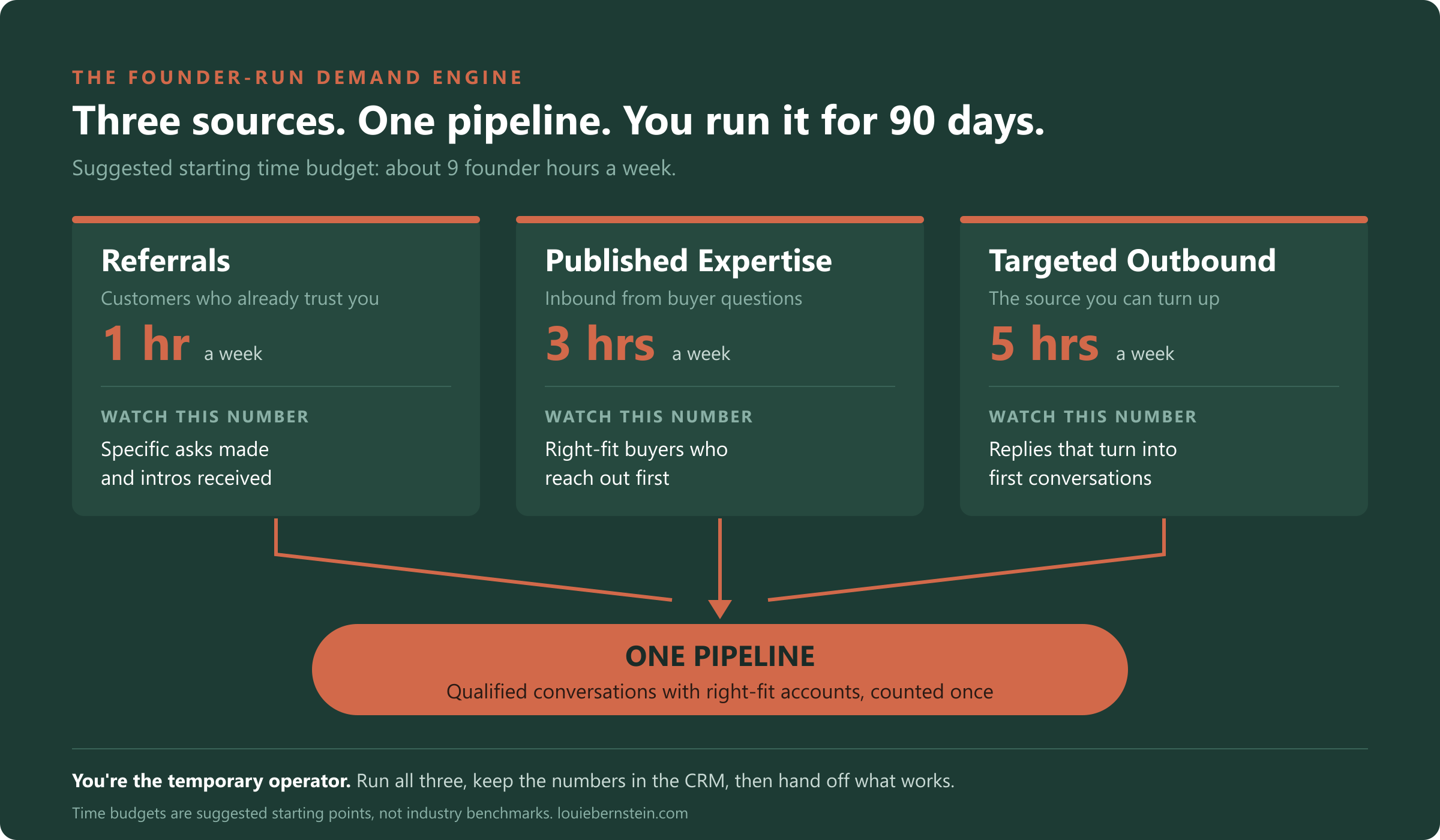
- A founder-run demand engine has three sources feeding one pipeline: referrals, published expertise that brings inbound, and targeted outbound. About 9 hours a week is a workable starting budget.
- Buyers contact sellers at about 61% of the way through their buying journey, and the winning vendor is on the Day One shortlist 95% of the time (6sense, 2025). Demand work has to reach buyers before the first call.
- Measure qualified conversations with right-fit accounts by source, not leads, clicks, or followers. Put the weekly numbers in the CRM from day one.
- This week, write down your 50 best-fit target accounts and the three questions every good prospect asks you on a first call. Those two lists become the base of the demand engine.
You close most of the deals. The pipeline comes in waves. A good month of referrals, then a quiet month, then a scramble. So you start thinking the fix is a marketing hire.
I understand why. You're tired of being the only source of new business. But I've watched a lot of founders hire their first marketer into a company where nobody could say who the ideal buyer was, what message worked, or which channel produced real deals. The marketer does what any smart person does with no direction. They get busy. Newsletter, website refresh, social calendar, a trade show booth. Six months later there's more activity and about the same pipeline.
The problem isn't the marketer. The problem is that the engine didn't exist yet. You can't hand off a system nobody built.
Hire a marketer to scale what works. Don't hire a marketer to find out what works.
What is a demand engine, and why build it before hiring a marketer?
A demand engine is a small, repeatable set of activities that creates qualified sales conversations every week, with the results tracked by source. A founder should build the demand engine before hiring a marketer because the founder holds the buyer knowledge the engine runs on. Without that knowledge written down, a marketing hire starts from zero.
A marketer amplifies a message. A marketer can't discover it for you.
You know things no new hire knows. You know which customers renewed without a fight, which objection shows up on every call, and which three words make a buyer lean forward. That knowledge came from hundreds of sales conversations. A marketer can't get it from a kickoff meeting.
When the message is proven, a good marketer turns it into more reach, better timing, and a steady rhythm. When the message isn't proven, the same marketer is running experiments with your payroll.
The math on a first marketing hire
The median U.S. marketing manager earned $166,790 in May 2025 (BLS). That's before benefits, tools, and ad spend. A $3M ARR company might pay less for a hands-on marketing generalist. But the salary isn't the biggest cost. The biggest cost is the months spent finding a message you could have handed over on day one.
Why does demand work have to reach buyers before the first sales call?
Demand work has to reach buyers early because most B2B buyers pick a favorite vendor before they talk to anyone. In 6sense's 2025 study of nearly 4,000 B2B buyers, first contact with sellers came about 61% of the way through the buying journey. The winning vendor was on the Day One shortlist 95% of the time (6sense, 2025).
The 6sense study also found the pre-contact favorite still wins about four out of five deals. So for a founder, the question isn't "How do I get more meetings?" The question is "How do right-fit buyers hear about me before they build their shortlist?"
Buyers also want to do more of this work alone. In a Gartner survey of 646 B2B buyers conducted in August and September 2025, 67% said they prefer a rep-free experience, and 45% said they used AI during a recent purchase (Gartner, 2026). Your expertise has to be findable, by people and by AI tools, while the buyer is still researching.
If buyers don't know you exist before they build the shortlist, your best sales call won't get scheduled.
What are the three parts of a founder-run demand engine?
A founder-run demand engine has three parts: referrals from people who already trust you, published expertise that brings buyers to you, and targeted outbound you can turn up when the pipeline gets thin. Each source covers a weakness in the other two. Referrals convert well but don't scale. Inbound compounds slowly. Outbound is the one you control this quarter.
| Source | Starting time | Strength | Weakness |
|---|---|---|---|
| Referrals | 1 hr/week | High trust, short sales cycles | Limited by your network |
| Published expertise | 3 hrs/week | Reaches buyers before first contact | Slow to start |
| Targeted outbound | 5 hrs/week | You control the volume | Stops the day you stop |
The time budgets are my suggested starting points, not industry benchmarks. Adjust them once you see which source produces.
Referrals: ask on a schedule, not by luck
Put a referral ask on the calendar after every customer win, renewal, or rescue. Make the ask specific. "Who do you know running a 20-person sales team at a logistics company?" gets names. "Know anyone who might need us?" gets a polite nod. I cover the full approach in The Referral Engine Founders Never Build on Purpose.
Published expertise: answer your sales-call questions in public
Write down the three questions every good prospect asks on a first call. Answer one each week in a LinkedIn post, a short article, or a newsletter. You're not trying to become a content creator. You're putting your sales conversations where buyers can find them before they call. More on that in Turning Your Founder Expertise Into Inbound.
Targeted outbound: small list, relevant message
Pick 50 accounts that look like your best customers. Reach out with something that matters to them, not a pitch. Relevance isn't optional. In Gartner's survey of 632 B2B buyers, conducted August through September 2024, 73% said they actively avoid suppliers who send irrelevant outreach (Gartner, 2025). A founder who knows the problem cold writes a better first message than any template.
What should a founder measure in the first 90 days of a demand engine?
A founder should measure qualified conversations with right-fit accounts, broken out by source, every week for 90 days. Leads, followers, and open rates are activity, not demand. The goal of the first 90 days is to find out which source produces real buying conversations for the hours you put in, so you know what to hand off.
Track four numbers in the CRM. If it isn't in the CRM, it never happened.
- First conversations by source. A real two-way conversation with someone at a target account.
- Qualified opportunities by source. Use a written rule: a problem you solve, an account you can serve, and an agreed next step.
- Founder hours by source. A rough weekly log is enough.
- Buyer language. The exact words prospects use to describe the problem. The best marketing copy you'll ever get comes out of these notes.
Expect uneven results. Outbound usually shows signs first because you control the volume. Published expertise often takes months to produce a buyer who reaches out on their own. Don't kill a source at week four because it's slow. Kill it at day 90 if it still hasn't produced a qualified conversation with a right-fit account.
Where do founders usually get demand generation wrong?
Founders usually get demand generation wrong by hiring for the gap instead of building the system first, and by betting on one channel. Both mistakes come from the same place. The founder wants pipeline to stop depending on them, so they reach for a person or a tactic before they know what works.
What 50 years in sales has taught me about channels
Founders love to argue about which channel is dead. Cold calling is dead. Email is dead. Direct mail is definitely dead. I once landed a deal that eventually grew to $1.2 million because a postcard ended up on the right person's desk. I'm not telling you to go buy postcards. I'm telling you the channel matters less than being visible to the right buyer, with the right message, more than once.
That's why I push founders to run three sources instead of one. The source you'd bet on is rarely the one that works best. You only find out by running them side by side and counting.
What I see when I audit sales and marketing
The pattern I see over and over in fractional engagements is the same one I see with sales hires. The founder hires a good person into chaos and expects the person to create order. Salespeople don't quit companies, they quit chaos. Marketers are no different. Give a new marketer a written target list, a proven message, and a channel with real numbers, and you've given them a job they can win.
Watch the budget math too. Outbound with a dedicated rep is hard to justify when your average deal is small. From what I've seen, if your product sells for under about $30,000 in ARR, run the numbers carefully before you pay someone to prospect all day. The founder-run engine lets you test the math before you commit to the payroll.
When is the demand engine ready to hand off to a marketer?
The demand engine is ready to hand off when at least one source reliably produces qualified conversations, the message is written down in the buyer's words, and the weekly numbers live in the CRM. At that point, a marketer inherits a working system with a clear target. Before that point, a marketer inherits your guesswork.
Write the Demand Playbook before you write the job description
Put what you learned in one document, the demand chapter of your Sales Playbook. Include the target account list, the buyer problems in their own words, the winning source and its numbers, and what didn't work. That last part saves a new marketer months of repeating your failed tests.
Hire a doer for the proven channel, not a VP
Your first marketing hire should usually be someone who has already run the channel that's working for you. If published expertise is producing, hire a content marketer who can write. If outbound is producing, hire someone who can build lists and run sequences. A VP of Marketing with nothing to scale ends up building a department around a guess.
Give that person an Accountabilities Document with a target number of qualified conversations, not a vague mandate to "grow awareness." Then keep a weekly review on the calendar so sales and marketing count pipeline the same way.
This is where a Fractional Sales Leader earns their keep. I help founders build the sales system, the qualification rules, and the CRM discipline the demand engine depends on, so the first marketing hire walks into order instead of chaos.
Related ReadingWhen Inbound Dries Up: Why 100% Inbound Always Stalls →
Frequently Asked Questions
Q: Should I hire a marketing agency instead of a marketer?
An agency has the same problem as a new hire if you haven't proven the message. Agencies are good at executing a defined channel. Hand an agency your Demand Playbook and a qualified-conversation target, and it can help. Hand it a blank page, and you'll pay for the agency's guesses.
Q: I don't have 9 hours a week. What should I cut?
Start with the source closest to revenue. For most founders at $1M to $10M ARR, that's referrals plus a small outbound list, about 3 to 4 hours a week. Add published expertise once those two are running. Some demand work every week beats a big plan you drop in a month.
Q: Can AI tools replace a first marketing hire?
AI tools can speed up drafting, research, and list building. AI tools can't tell you which buyer problem is worth leading with. That judgment comes from your sales conversations. Use AI to produce more of a proven message, not to pick the message.
Q: What if none of the three sources works after 90 days?
If no source produces qualified conversations after 90 days of steady effort, the problem is usually upstream of marketing. Check your ideal customer profile and your message first. A marketing hire won't fix a target market that doesn't feel the problem you solve.
Q: Should my first hire be a marketer or a salesperson?
Hire for the bottleneck. If you have more qualified conversations than you can handle, you need sales capacity. If your calendar has room but the pipeline is thin, you need demand, and the proven channel tells you what kind of marketer to hire. Either way, build the system first.
Build the engine before you hire the people.
If your pipeline still depends on your memory and your network, let's build a system someone else can run. Learn how Fractional Sales Leadership can get you there before the next hire.
Schedule a 30-Minute CallAbout the Author
Louie Bernstein
Louie Bernstein is a Fractional Sales Leader with 50 years of sales experience. He founded and ran MindIQ for 22 years, earning a place on the INC 500. He helps founders build sales systems their teams can run.