How Does Remaining the Closer Quietly Destroy Both Company Value and Your Personal Take-Home?
The founder tax is the personal financial cost of making yourself essential to every important sale. Founder dependency can restrict cash available for owner distributions and weaken the earnings or payment terms a buyer will accept. There isn't a universal $300,000 bill. Calculate annual owner cash and eventual sale proceeds separately, subtract the full cost of replacing your sales work, and distinguish money received from money you might receive later.
Key Takeaways
- The founder tax can reduce personal take-home when sales depend on your availability and the business cannot fund a profitable handoff.
- Salary pays you for work. Distributions reward ownership. Recovered founder hours are neither a bank deposit nor automatic profit.
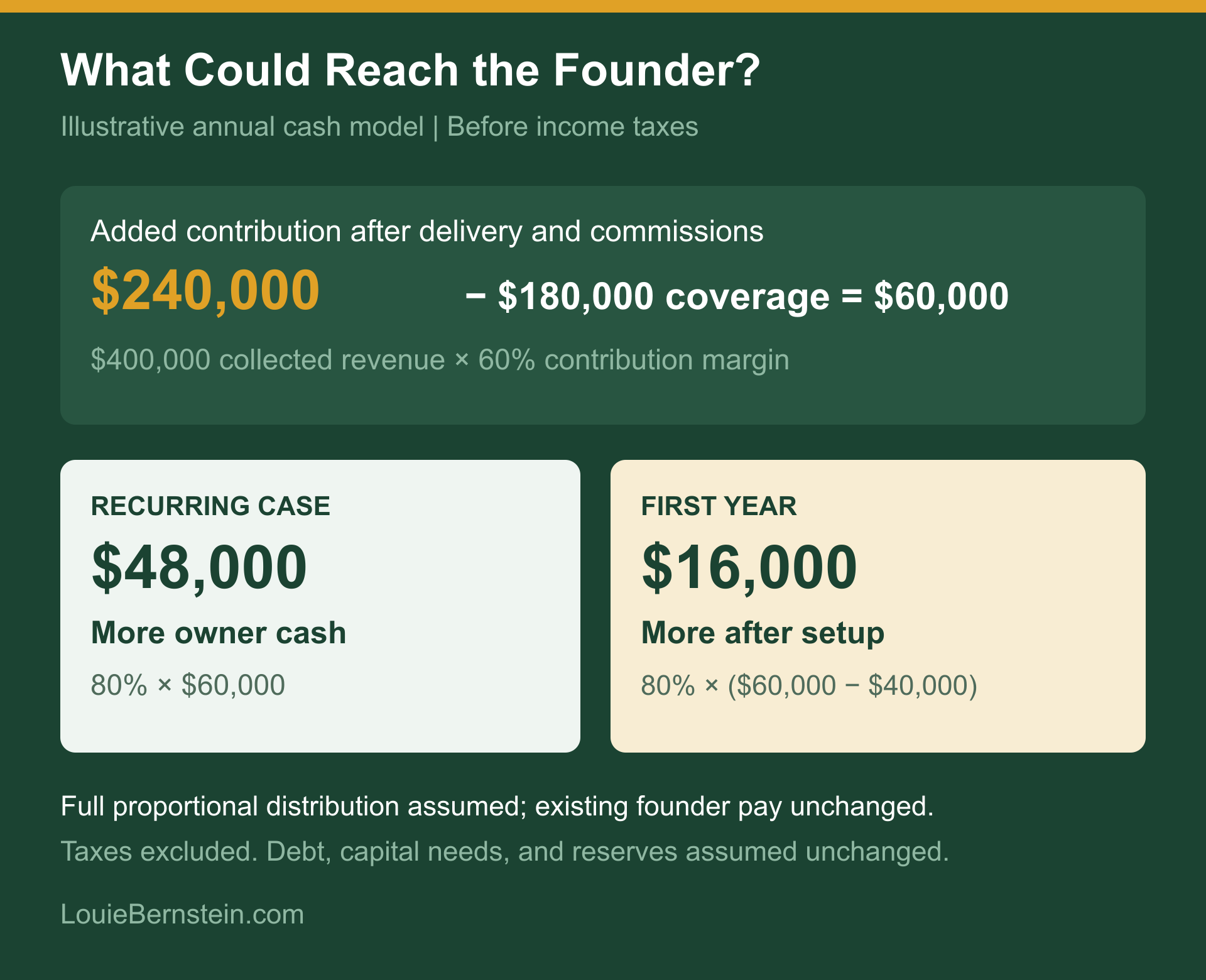
- In the illustrative annual model, $240,000 of additional contribution minus $180,000 of recurring sales coverage creates $60,000 before income taxes and setup costs.
- A founder owning 80% receives $48,000 of that recurring improvement only if all $60,000 is distributed proportionately, before income taxes.
- Build separate annual cash and exit worksheets. Keep conditional payments, replacement costs, and ownership visible.
You close another good quarter. Revenue goes up. Your personal bank balance barely moves.
For a B2B founder at $1M to $10M ARR, the missing money may be tied up in payroll, delivery, debt payments, or the reserves needed to survive the next uneven quarter. A signed contract doesn't settle those bills immediately.
Then you think about selling. The buyer asks who will close the business after you leave. Suddenly your strongest skill becomes a negotiation about how long you must stay.
Your company can pay you well for being indispensable and still leave you with less freedom to take money out or walk away.
Why Doesn't More Revenue Mean More Personal Take-Home?
More revenue doesn't guarantee more personal take-home because the company must fund delivery, operating costs, debt, investment, and reserves before distributing cash. For a founder who remains the main closer, growth can increase those demands while selling capacity stays limited to one calendar. Separate compensation for your work from returns on your ownership.
Keep three different numbers apart
Your salary or other working compensation pays for the jobs you perform. Owner distributions move available cash to owners. The value of your shares is a potential future outcome. Adding all three into one annual “founder tax” produces an impressive number with no clear meaning.
Profit isn't automatically distributable cash either. Customers may not have paid. Debt principal uses cash without being an operating expense. Equipment purchases and working capital can absorb money that looks available on an income statement.
For planning, start with cash generated after normal operating costs and existing founder compensation. Deduct required debt principal, capital spending, taxes, and a defensible reserve. Then consider ownership rights and distribution restrictions. Use finance's records, not ARR divided by twelve.
Find the financial consequence of the dependence
Founder dependency matters when qualified demand exceeds your capacity, cash collections become uneven, or essential CEO decisions keep getting postponed. But a crowded calendar alone doesn't prove a dollar loss. Identify what changed in cash generation and what could realistically improve.
The broader annual cost of founder-led sales includes concessions and extra work. This calculation asks a narrower question: after the company pays its bills, how much could actually reach you?
How Do You Calculate the Annual Founder Tax Honestly?
Calculate the annual founder tax by comparing owner cash under the current sales model with owner cash under a funded, realistic handoff. Charge the alternative for recurring coverage, setup, and any disruption. For a B2B founder, the useful result is the difference after those costs, rather than the value assigned to recovered hours.
Start with an illustrative cash baseline
Assume a company generates $500,000 in annual operating cash after existing founder pay but before income taxes. It needs $100,000 for debt principal, $50,000 for capital spending, and $100,000 in retained operating reserves. That leaves $250,000 potentially available for distributions before income taxes.
Assume an 80% founder interest, identical distribution rights, and full proportional distribution of available cash. The founder's share is $200,000 before income taxes, in addition to unchanged working compensation. These assumptions describe a teaching example, not a client result or a recommended payout policy.
Charge the handoff for its real costs
Now assume the team collects $400,000 of additional revenue during the year. After incremental delivery costs and commissions, a 60% contribution margin leaves $240,000. Additional recurring sales coverage costs $180,000, excluding the commissions already deducted. The net recurring improvement is $60,000 before income taxes.
Available cash becomes $310,000 if debt, capital needs, and reserves stay unchanged. The founder's 80% share becomes $248,000, an increase of $48,000. A separate $40,000 setup expense reduces first-year available cash to $270,000 and the founder's share to $216,000. The first-year increase is only $16,000 before income taxes.
The $180,000 is a hypothetical combined coverage budget, not Louie's fee or a compensation benchmark. Include every added role, payroll burden, tool, and ongoing management cost in your own version. Contracted bookings don't qualify as collected revenue.
Test the downside before you spend
If the extra contribution reaches only $120,000, the same $180,000 coverage cost reduces available cash by $60,000. The founder's share falls from $200,000 to $152,000 before setup and income taxes. Hiring can reduce current take-home while buying capacity. That may be worthwhile, but call the tradeoff what it is.
Keep incremental contribution, collections, and working capital consistent. Income taxes, financing restrictions, and changed reserve needs would reduce or alter these payouts. Have your accountant turn the planning model into an actual distribution decision.
How Can Founder Dependency Reduce Eventual Sale Proceeds?
Founder dependency can reduce eventual sale proceeds when a buyer must fund replacement work, doubts future earnings, or makes payment conditional on results after closing. The effect isn't a standard percentage discount. For a founder considering an exit, separate the company's negotiated value from equity proceeds and the cash personally received.
A buyer still has to pay for your work
A buyer evaluating managed earnings can't assume your essential selling work disappears for free. BizBuySell's compensation guide explains that underpaid owner labor can inflate reported earnings; normalization accounts for the market cost of the work. Don't add back your entire salary while keeping all the revenue your labor produces.
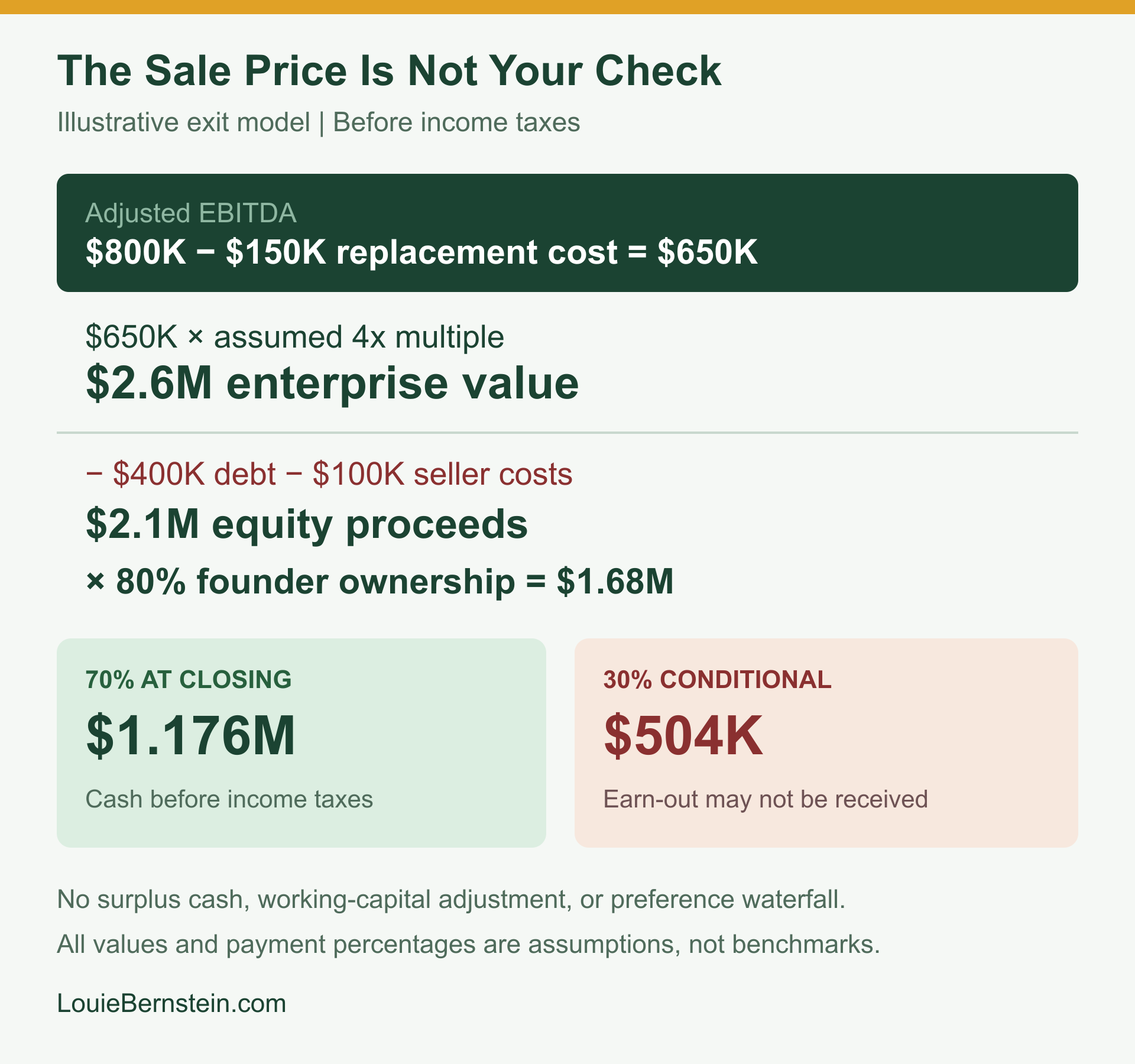
Consider a separate illustrative exit model. Reported EBITDA is $800,000. Assume review identifies $150,000 of additional annual replacement expense beyond compensation already recorded. Adjusted EBITDA becomes $650,000. At an assumed 4x multiple, enterprise value is $2.6 million. The multiple and replacement expense are assumptions, not market benchmarks.
Subtract $400,000 of debt and $100,000 of seller transaction costs, with no surplus cash or working-capital adjustment. Equity proceeds before income taxes are $2.1 million. At 80% ownership with no preference waterfall, the founder's share is $1.68 million. The $2.6 million headline was never the founder's personal check.
Payment timing can matter as much as price
Assume 70% of the founder's $1.68 million is paid at closing and 30% is a conditional earn-out. Cash at closing is $1.176 million before income taxes. Another $504,000 is contingent. It may be earned, partly earned, or never received.
BDC defines an earn-out as payment earned only when specified conditions are met. A seller note is different: it is a financing obligation, although collection still carries risk. Neither belongs in the same column as cash already received.
Owner reliance is one of the purchase-price factors in BDC's acquisition guidance. A buyer might respond through price, transition obligations, or payment terms. Don't turn that general risk into an invented universal valuation penalty.
What Sales Changes Can Improve the Money You Keep?
Sales changes can improve the money you keep when the team produces reliable contribution after the full cost of selling and delivery. Start by transferring repeatable decisions, then test whether the new approach holds up without founder rescue. For B2B founders, fewer calls on the calendar matter only alongside healthy commercial results.
What building my own company taught me
I've written about doing this to myself while bootstrapping my company: knowing the product and closing the important business can become the very thing holding growth back. The lesson isn't to disappear. It's to transfer the reasons behind your decisions so another person can make them.
When a rep asks you to join a call, ask what decision the buyer needs to make and what the rep recommends. Review the reasoning. Practice the difficult conversation. Put the useful lesson in the Sales Playbook. Taking over may win today's deal while leaving tomorrow's deal equally dependent on you.
Make the economics part of the handoff
- Choose one repeatable customer segment and define what a qualified opportunity looks like.
- Document discovery, pricing boundaries, sales stages, and evidence required to advance.
- Use an Accountabilities Document to assign deal decisions and exception approvals.
- Coach the rep through live opportunities while the rep keeps ownership.
- Review collections, contribution, coverage spending, and founder intervention together.
Track comparable opportunities over a period that fits your sales cycle. A handful of easy wins doesn't prove the system can replace your involvement. Keep difficult losses in the record and distinguish routine accounts from strategic situations where founder involvement remains useful.
What Should You Measure Before Expecting a Bigger Payout?
Measure collected contribution, full sales coverage costs, and sustained independence before expecting a bigger owner payout. A founder's reduced workload doesn't establish improved distributable cash or a higher sale price. Use a monthly cash review for current decisions and a separate record of transferable sales performance for a future buyer.
Review a small set of useful numbers
Review cash collected from new business, direct fulfillment and commission costs, incremental coverage spending, and setup spending. Compare the result with your baseline. Then ask finance what debt service, taxes, capital needs, and reserves leave available to owners.
Beside those financial numbers, track the share of comparable opportunities requiring founder rescue and the reasons for intervention. Record whether the rep handled qualification, negotiation, and the next step. A buyer needs evidence that sales decisions and customer relationships can survive a handoff.
Make a funded decision, not a freedom promise
If the handoff doesn't cover its cost yet, decide how much cash and time you're willing to invest before reviewing it again. Set checkpoints around your sales cycle and cash runway. Avoid promising yourself a higher distribution before the contribution exists.
A Fractional Sales Leader can help document the process, coach the team, and establish accountability when leadership is missing. Include that expense in the plan. The goal is a company that can earn without needing your personal close every time, with financial results you can verify.
Frequently Asked Questions
Is the founder tax an actual tax?
No. Founder tax is a business metaphor for the financial consequences of founder dependency. It isn't a government levy, tax deduction, or standard accounting line. The dollar figures here are illustrative scenarios.
What if I own 100% of the company?
You receive the full distribution if ownership rights and company restrictions allow it. You still have to fund operating obligations and taxes. Sole ownership doesn't turn all company revenue or reported profit into personal spending money.
What if investors have preferred shares?
A simple ownership percentage may not describe your exit proceeds. Liquidation preferences, option exercises, participation rights, and other terms can change the allocation. Model the actual capitalization and deal terms with your advisers.
Should I cut my salary to fund the sales handoff?
A smaller salary doesn't prove the business became more profitable. It shifts funding onto you. Evaluate household needs, appropriate compensation, and company runway with your accountant before choosing how to finance the transition.
Should I add annual cash improvements to an exit-value increase?
Keep the two calculations separate unless you're building a dated, consistent financial model. An exit valuation may already reflect future earnings improvements. Adding those future earnings again can double count the same benefit.
Can an unprofitable company use this approach?
Yes, but focus first on contribution and runway rather than owner distributions. If the company cannot fund the transition, narrow the work and test one repeatable sales activity before committing to a larger fixed cost.
Build sales independence you can afford
Bring your sales workload and the numbers behind it. We'll discuss where Fractional Sales Leadership could help you build a repeatable process and coach the team. Learn about my approach at LouieBernstein.com.
Schedule a 30-Minute ConversationAbout the Author
Louie Bernstein is a Fractional Sales Leader with 50 years of sales experience and has worked as a Fractional Sales Leader since 2017. He helps B2B founders at $1M to $10M ARR build repeatable sales systems and teams that can sell without the founder in every conversation.
Subscribe to The Sunday Starter for practical sales leadership advice.