Can a Smart Non-Salesperson Actually Run a Qualified Conversation Using Only Your Materials?
The transfer test is a practice exercise: give a capable non-salesperson your sales materials and ask them to run a qualification conversation without your help. Run the test before hiring to find the questions, decision rules, and next steps that still live in your head. A successful exercise shows that basic sales judgment can travel through your materials. It doesn't prove that the participant can sell or that your next hire will succeed.
Key Takeaways
- The transfer test checks whether someone can use your sales materials to qualify a buyer without the founder supplying missing instructions.
- Use a capable colleague outside sales, a simulated buyer, and the same materials you would give a new hire.
- Try a 45-minute session: 15 minutes to review, 20 minutes to role play, and 10 minutes to document the decision. These are suggested exercise limits, not research benchmarks.
- Score six observable outcomes, including buyer fit, business impact, and an appropriate next step. Record every founder rescue.
- A failed exercise identifies a documentation or training question. A successful exercise is one readiness check, not permission to skip hiring diligence or onboarding.
You have a deck. You've recorded a few calls. There's a folder named Sales Playbook. You feel ready to hand sales to somebody else.
Before you hire, hand that folder to someone who doesn't already know how you sell. Ask them to use it. Watch where they stop.
A sales document isn't finished when you understand it. It's useful when somebody else can make the right decision with it.
For a B2B founder at $1M to $10M ARR, the expensive surprise is discovering after the hire that your sales process was mostly your memory. The transfer test gives you a cheaper place to find that out.
What Should a Non-Salesperson Be Able to Do?
A capable non-salesperson should be able to use your materials to identify buyer fit, explore a business problem, and choose a sensible next step in a simulated call. The participant doesn't need to close a deal. The exercise tests whether your instructions support basic decisions without requiring the founder to translate them.
Test a narrow conversation
Pick one buyer type, one use case, and one stage. Start with an early qualification conversation for an offering you've already sold. Don't ask an operations colleague to negotiate a complex contract or explain every technical detail.
A qualified conversation should leave a usable record: who the buyer is, what problem matters, what the problem affects, how the company might decide, and what should happen next. Unknowns belong in the record too. "We haven't confirmed funding" is useful. "Budget looks fine" without evidence isn't.
Your definition of a qualified deal should tell the participant which evidence matters at this stage. Don't demand final purchasing authority on an introductory call if your normal process establishes it later. Do expect the participant to recognize the gap.
Choose someone who won't fill in every blank
An operations manager, customer success colleague, or project manager can be a good participant if they listen carefully and ask clear questions. Choose someone who understands ordinary business conversations but hasn't memorized your sales calls.
Your most experienced salesperson may pass by supplying years of personal judgment. Your cofounder may pass because you've discussed every deal together. Neither result tells you much about the materials. The useful participant needs the written instructions enough to expose their weaknesses.
What Materials Should You Hand Over?
Hand over the smallest complete set of materials a new hire would need for the selected conversation: buyer fit, questions, decision rules, relevant proof, and next-step instructions. Use the actual files and access paths. A special explanation from the founder changes the exercise from testing the materials to testing the explanation.
Build a working packet
Give the participant a short starting page with links to five things:
- Buyer fit. Who you help, the relevant buying trigger, and clear reasons to decline or pause.
- Conversation guide. An opening, discovery questions, and follow-up prompts that connect answers to business consequences.
- Decision rules. What qualifies a next meeting, what requires more information, and what calls for an expert.
- Proof and boundaries. A relevant example, approved product claims, and limits on pricing or implementation promises.
- Record and next step. Required CRM fields, a completed example, and the appropriate invitation or follow-up.
Your Sales Playbook can hold these items. The participant shouldn't need to search through a pile of obsolete decks to find the current version. If an instruction says "use judgment," explain what facts should guide that judgment.
For example, "ask about urgency" is weak. A more useful instruction is: "Ask what happens if the problem continues through next quarter. If the buyer describes no consequence and no reason to act, record timing as unconfirmed. Don't assume enthusiasm creates urgency."
Keep the buyer scenario separate
Give the person playing the buyer a private scenario. Include a real business problem, a consequence, an incomplete buying plan, and one limit the seller must respect. The participant gets a normal meeting brief, not the buyer's hidden answers.
Use a plausible variation on a deal you've handled, with identifying details removed. The buyer should reveal information when asked reasonable questions. Don't reward guessing, and don't make the buyer volunteer everything just to help the participant pass.
How Do You Run the Transfer Test Without Rescuing It?
Run the transfer test as an observed role play with a fixed scope, a separate buyer, and a silent founder. Let the participant use the materials throughout the exercise. Record where the conversation breaks and what information was missing before offering coaching. Otherwise, the founder's help can hide the exact problem you're trying to find.
Use a 45-minute starting format
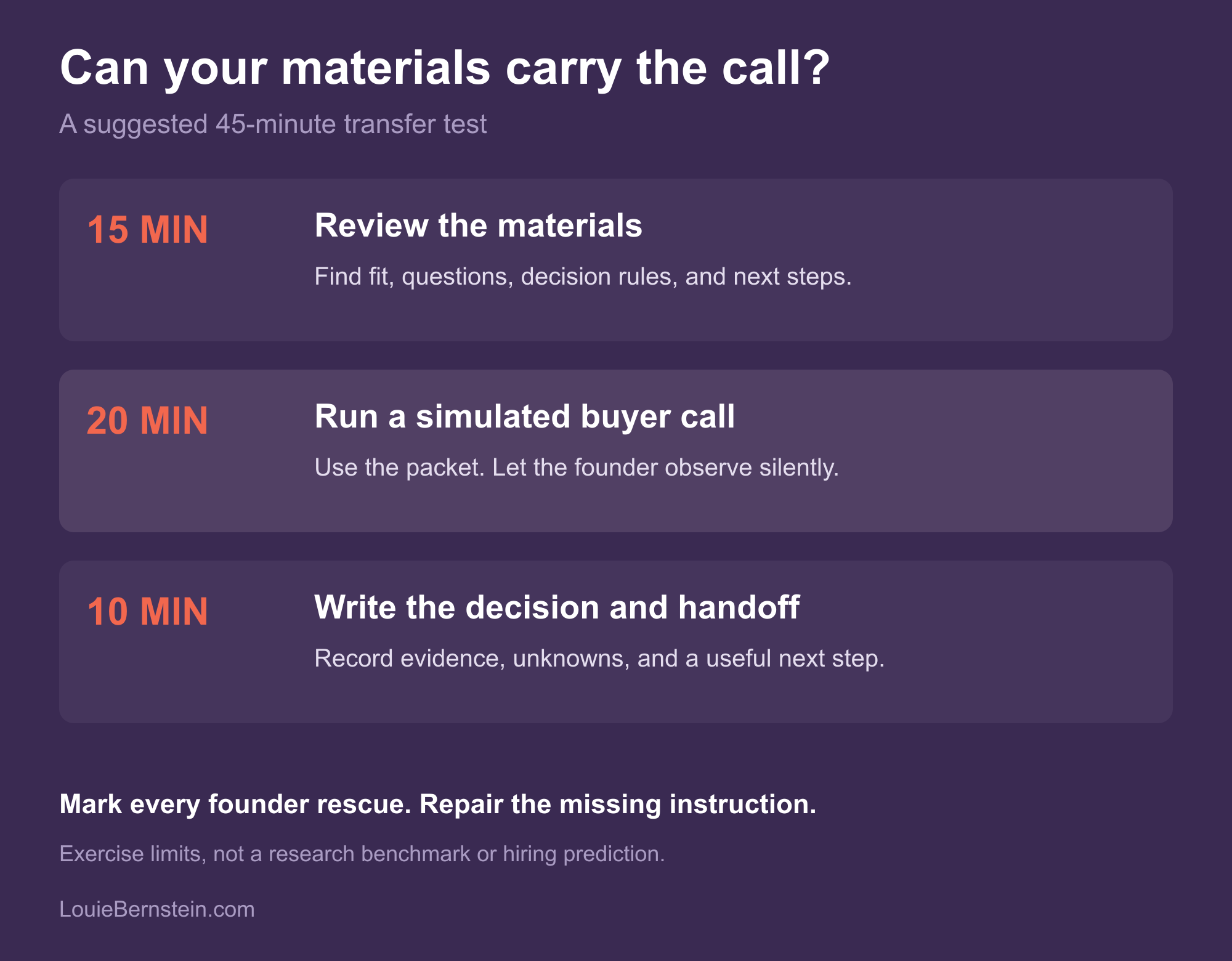
I recommend a simple first session: 15 minutes to review the packet, 20 minutes for the conversation, and 10 minutes to write the CRM note and proposed follow-up. Those limits are a practical starting point, not a validated assessment or a promise about how fast a new hire should learn.
Tell the participant: "We're checking my instructions. Use the materials, ask the buyer questions, and mark anything you can't resolve." Permit notes and searching. You're testing usable guidance, not memory.
The founder observes while another colleague plays the buyer. When you feel the urge to interrupt, write down what you wanted to say. That sentence may belong in the playbook. If the exercise truly can't continue, supply the missing information, mark the intervention, and continue to collect evidence.
Make the next step part of the test
Don't stop when the call ends. Ask the participant to complete the normal record and draft the buyer's follow-up. A pleasant conversation can still produce a useless handoff if the next person can't tell what was learned.
The note should separate buyer statements from seller assumptions. "The buyer said manual reporting takes two days each month" is evidence. "They'll buy quickly" is an interpretation that needs support. Ask the participant to explain the proposed next step using the written criteria.
Afterward, ask three questions: Where did you look? What did you expect to find? What did you have to invent? Those answers help distinguish an absent rule from a rule buried under an unhelpful heading.
What Counts as a Pass or a Failure?
A useful pass means the participant reaches the appropriate decision, supports it with buyer evidence, and records a next step using the materials without founder rescue. Judge observable outcomes against criteria set before the role play. Don't award a pass for confidence, a polished pitch, or booking a meeting the buyer doesn't need.
Check six outcomes
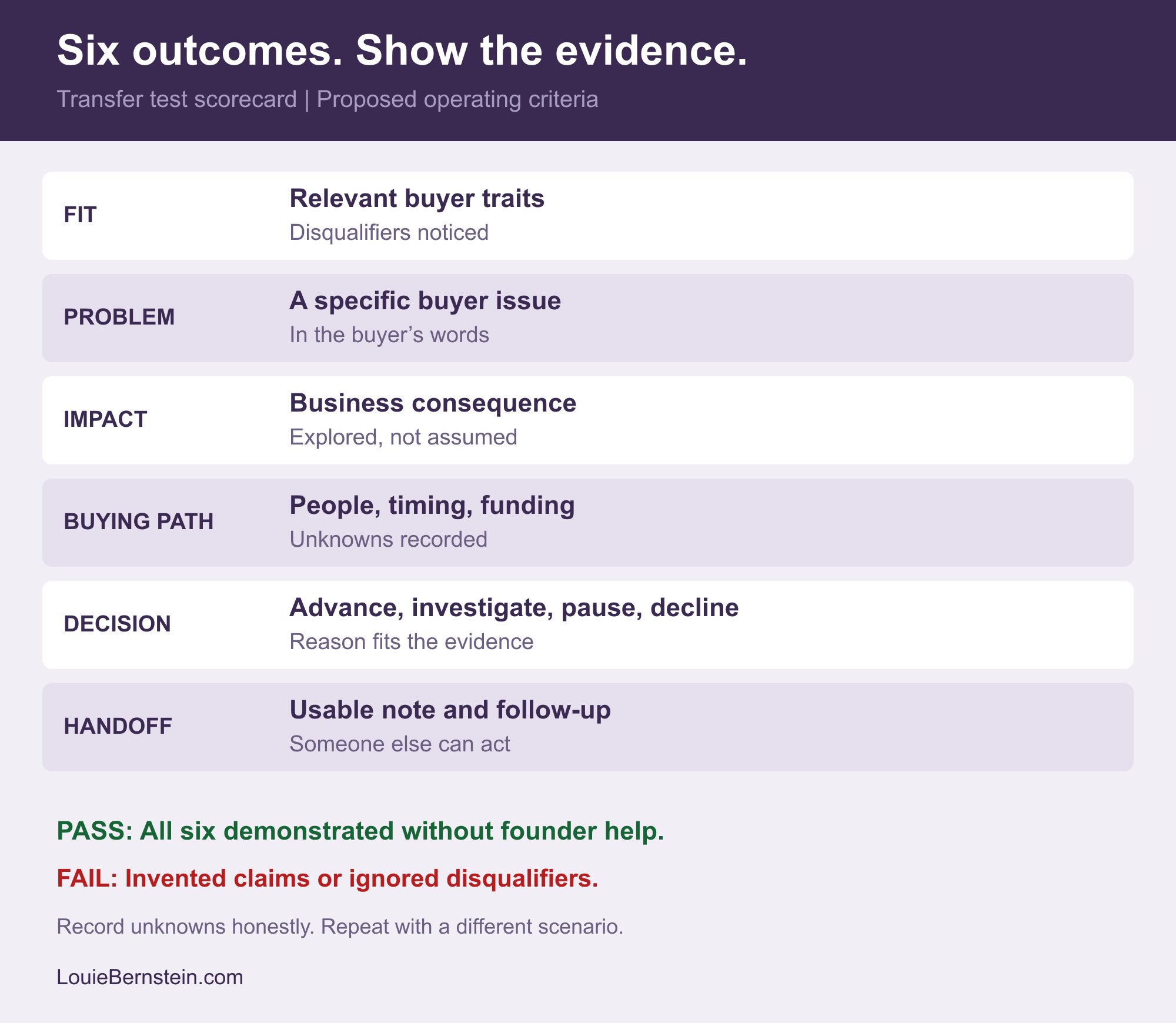
For this exercise, use six checks. These are proposed operating criteria, not an industry certification:
- Fit: Did the participant establish the relevant buyer characteristics and notice disqualifiers?
- Problem: Did the buyer describe a specific issue in their own words?
- Impact: Did the participant explore the business consequence instead of accepting a vague complaint?
- Buying path: Did the participant identify what is known and unknown about people, timing, and funding?
- Decision: Did the participant advance, investigate, pause, or decline for a supported reason?
- Handoff: Could another person act on the note and follow-up without asking the founder to reconstruct the call?
Mark each check as demonstrated, missing, or completed with founder help. Record an example beside the result. A total score alone can hide a serious failure: five good outcomes don't excuse an invented product promise.
For a basic readiness pass, require all six outcomes without founder help, allowing explicitly recorded unknowns where the scenario doesn't provide an answer. Treat fabricated claims and ignored disqualifiers as failures. Then repeat with a different scenario that should lead to a different decision.
Require a reason to stop
Include a poor-fit scenario in the repeat. If every path in your guide ends with "book a demo," the materials teach activity rather than qualification. A participant who politely declines an unsuitable opportunity may demonstrate better judgment than one who schedules another call.
Don't turn one awkward pause into a verdict on the person. If the participant finds the correct instruction but struggles to ask a follow-up, coaching may be the answer. If no instruction exists, revise the materials. Both problems can appear in the same exercise.
What Should You Fix Before You Hire?
Fix the missing decision rules and unusable instructions before asking a new salesperson to execute your process. Retest the revised materials with a fresh scenario and, when possible, a different participant. A better second performance from the same person can reflect remembered coaching rather than a clearer Sales Playbook.
Where founders usually get this wrong
My work as a Fractional Sales Leader centers on building a system the team can run. The founder's ability to rescue a conversation can hide whether that system exists. For this test, count the rescue as information about the handoff, even when the advice itself is excellent.
When a founder says, "I would have known to ask about implementation," my question is simple: where would the new hire learn to ask? Write the trigger, the question, and the consequence of the answer. Don't add another paragraph about how important discovery is.
Put recurring responsibilities into the role's Accountabilities Document. Put call decisions in the playbook. Put product knowledge into training. Sorting the repair keeps the founder from trying to solve every weakness with a longer script.
Keep the hiring decision broader than the test
The cost of a weak handoff deserves attention. The Bridge Group's 2026 survey of 158 B2B companies reported average AE ramp time of 6.2 months and 48% of reps at quota (Bridge Group, 2026). Those are survey findings, not predictions for your first hire, and they don't establish that a transfer test improves attainment.
The exercise also doesn't prove demand, generate pipeline, validate compensation, or replace a manager. If you've never repeatedly sold the offering to a defined buyer, you may need to establish the sales motion first. You can't transfer a process you haven't worked out.
Once the materials work, evaluate candidates for listening, learning, prospecting, and the actual responsibilities of the role. Keep training and call coaching in the onboarding plan. Your goal is to stop making a paid hire discover every undocumented decision the hard way.
Related Reading: What Are the 5 Most Common Ways the First Sales Hire Fails?
Frequently Asked Questions
Is the transfer test an established sales certification?
No. The transfer test described here is a practical exercise for checking your materials. The proposed timing and pass criteria are operating suggestions, not validated predictors of sales performance. Use the findings to improve the handoff, not to claim that a hire is guaranteed to succeed.
Can I use AI as the buyer?
You can use AI for an extra practice round, but a human buyer role player gives you a better opportunity to observe realistic hesitation and follow-up. Keep the hidden buyer facts separate from the seller's instructions. Don't put confidential customer details into an unapproved tool.
Should I pay an outside participant?
Agree on compensation before asking an outside person to spend time on the exercise. A colleague participating during normal work is usually simpler. Don't present unpaid process design as a job interview, and don't turn a documentation check into live selling for your company.
What if my sale needs a technical expert?
Include a clear escalation path in the materials. The participant should recognize the technical question, avoid inventing an answer, and arrange the right expert conversation. Knowing when to bring in expertise is part of a usable process.
Can recordings replace written instructions?
Recordings can show tone and follow-up, but they shouldn't be the only way to find a decision rule. Add brief notes explaining why the seller asked a question and what changed afterward. A new hire needs to understand the choice, not just imitate the words.
When should I rerun the transfer test?
Rerun the exercise after meaningful changes to your buyer, offering, qualification rules, or sales handoff. Keep the scenario and materials version with the results so you know what was tested. Routine copy edits don't require rebuilding the whole exercise.
Can Your Team Use What You Know?
If every qualification call still needs you, the next step may be making your sales judgment teachable. As a Fractional Sales Leader, I help founders build Sales Playbooks, define responsibilities, and coach teams to run the process.
Schedule a conversation or learn more at LouieBernstein.com.
About the Author
Louie Bernstein is a Fractional Sales Leader since 2017, with 50 years of sales experience. He helps B2B founders at $1M to $10M ARR build repeatable sales systems and teams that can operate without the founder on every call.