Most revenue plateaus are a sales infrastructure problem, not a marketing problem
B2B revenue usually plateaus between $1M and $10M because the business has grown as far as the founder's way of selling can carry it. More leads poured into the same founder-run sales system get the same result. Break the plateau by fixing how you sell first: a written process, stages defined by buyer actions, a weekly pipeline review and a second seller. Then add leads.
Key Takeaways
- Most B2B revenue plateaus between $1M and $10M come from a sales system that one person carries. The marketing usually isn't the cause.
- A revenue plateau is a sign that the way the company sells has peaked. It isn't a sign that the company has peaked.
- Companies with a defined sales process, at least three hours a month of pipeline management per rep, and trained managers showed 28% higher revenue growth (Vantage Point and Sales Management Association, HBR, 2015, 62 B2B companies).
- Winning new customers is getting harder: the average new-logo win rate was 19% in 2025, down a relative 10% from 2024 (Ebsta and Pavilion, 655,000 opportunities).
- Before you spend more on marketing, check six signs. If three or more fit, fix the sales infrastructure first, then add leads.
I've been in sales since 1976. In five decades, the most common thing I've seen isn't failure.
It's the plateau.
There's just something about getting past that $1 million mark. The founders I meet at a plateau aren't lazy. Most of them are the hardest-working person in the building. That's the trap. The business has grown exactly as far as one person can carry it.
A plateau isn't a sign you've peaked. It's a sign the way you sell has.
If you're a couple of steps behind me and your number hasn't moved in a year, here's what I'd tell you over coffee.
Why does B2B revenue plateau between $1M and $10M?
B2B revenue plateaus between $1M and $10M because the sales system that got the company to its first million was built around the founder. The founder sells, decides and closes. That works until the founder's hours run out. After that, revenue flattens no matter how many leads come in.
What got you here was you
Getting to $1M is a founder's sprint. You know the buyer, you know the product, and you make every decision in the room. No written process needed. Your energy is the process.
Past a certain point, that same strength holds you back. Every deal needs your time. Every price needs your approval. Every new rep needs you on the call. The company can only carry as many deals as you can, and that number stops growing long before your market does. I've covered the founder's side of that limit in why working harder won't grow revenue.
Why the plateau shows up at different numbers
Some founders hit it at $1.5M. Others push to $4M or $6M before it bites. The number depends on your deal size, your sales cycle and how many hours you can give to selling. The cause is the same. The plateau arrives when the work of selling outgrows the people who know how to do it.
Is a revenue plateau a marketing problem or a sales problem?
Most revenue plateaus between $1M and $10M are sales infrastructure problems wearing a marketing costume. Founders see flat revenue and buy more leads. But new leads poured into the same system get the same result. If the founder still runs every deal, more leads mean more waiting, not more wins.
More leads, same system, same number
Here's the pattern I see. Revenue goes flat. The founder decides the problem is lead volume, hires an agency or a marketer, and doubles the leads. For a few weeks the calendar fills up. Then the founder is back to the same 10 or so deals they can actually work, and the rest go cold.
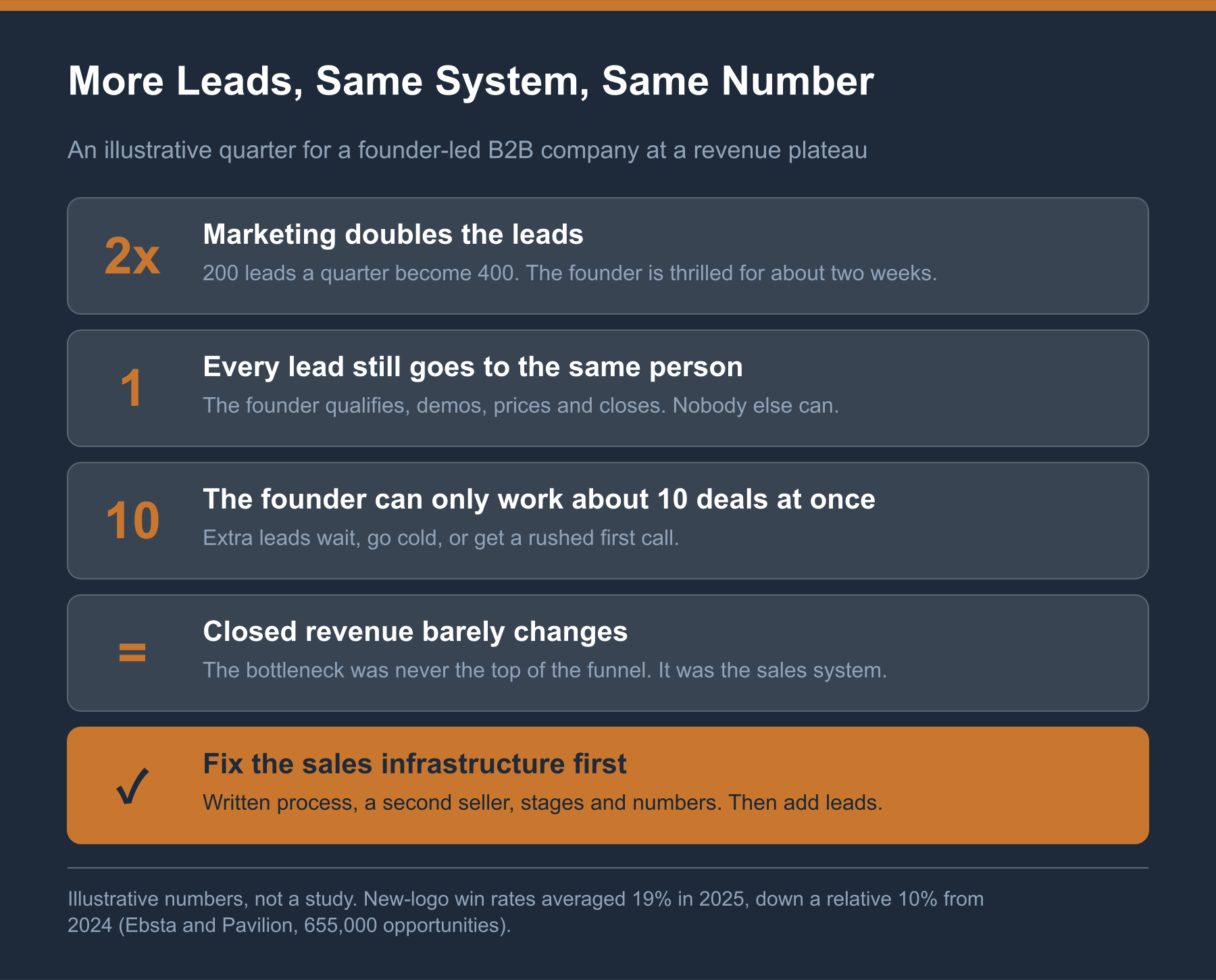
Those are illustrative numbers, not a study. But I've watched some version of that quarter play out more times than I can count.
Buyers are harder to win than they were
There's another reason more leads don't fix it. Winning a new customer is getting harder. Ebsta and Pavilion's 2025 B2B benchmarks, built on 655,000 opportunities across 387 companies, put the average new-logo win rate at 19%, down a relative 10% from 2024. When fewer deals close, the way you work each deal matters more than how many you start.
How do you know your plateau is a sales infrastructure problem?
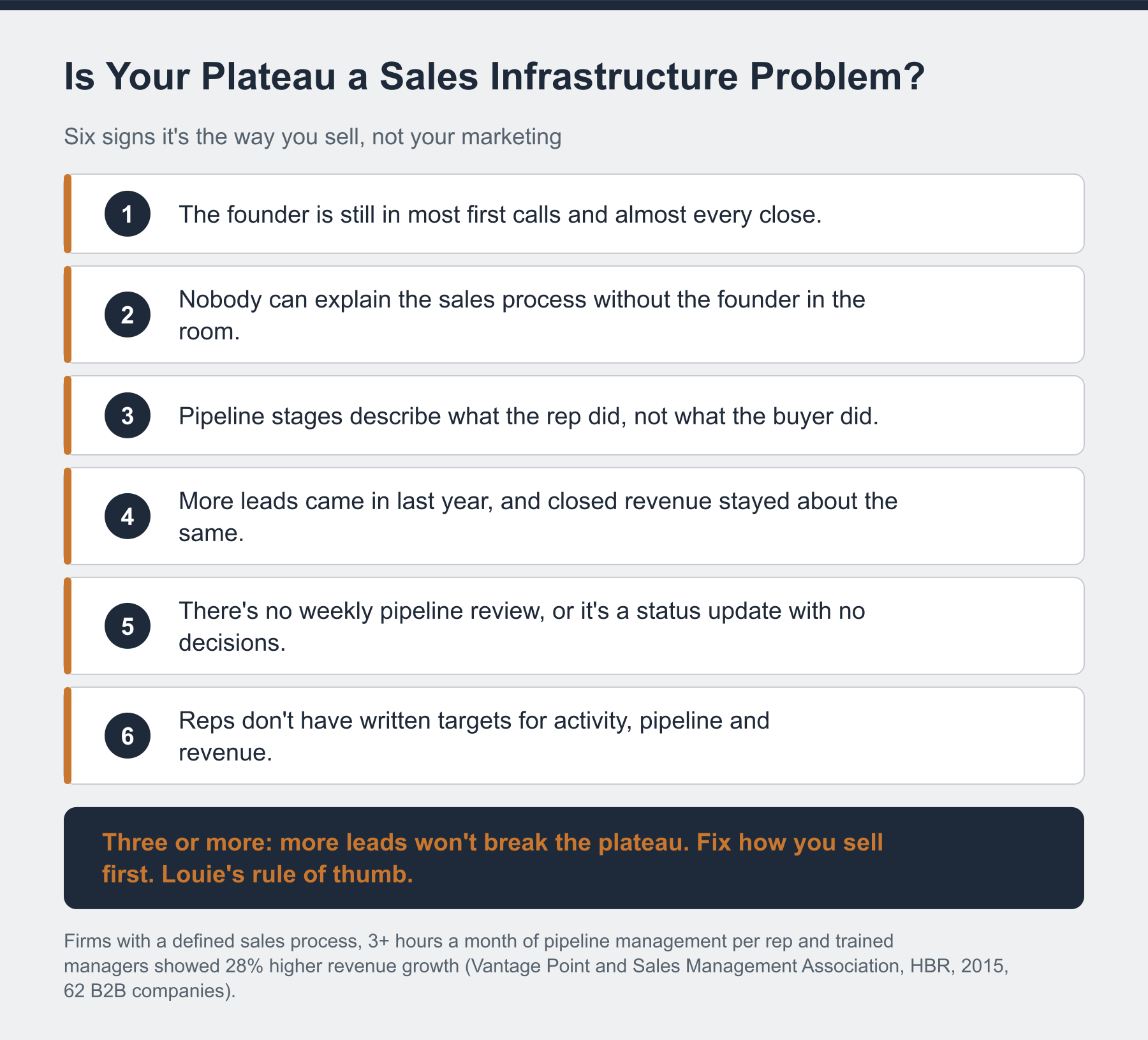
Your revenue plateau is a sales infrastructure problem if the founder is in most deals, the sales process isn't written down, and more leads haven't moved closed revenue. Check the six signs below. Three or more means the next dollar should go into how you sell, not into marketing.
What I look for first
When I sit down with a founder at a plateau, I ask one question before anything else: walk me through the last deal you won, from the first call to the signature. Then I ask who else in the company could have done each step. If the answer is "nobody" for most of the steps, I already know where the plateau comes from.
The "three or more" cutoff is my rule of thumb, not a study. I use it because one sign can be a rough quarter. Three signs is a pattern.
What does sales infrastructure mean for a $1M to $10M company?
Sales infrastructure for a $1M to $10M company means the written parts of selling that let someone other than the founder win deals: a documented sales process, pipeline stages defined by buyer actions, a weekly pipeline review, written targets for each seller, and a Sales Playbook. It doesn't mean expensive software.
The five pieces
- A written sales process. The steps your won deals had in common, from first contact to signed contract.
- Stages defined by what the buyer does. "Buyer confirmed budget and a decision date" is a stage. "Sent proposal" is rep activity.
- A weekly pipeline review. Thirty to sixty minutes, deal by deal, with decisions, not status updates.
- Written targets. Activity, pipeline and revenue numbers for each seller, in an Accountabilities Document.
- A Sales Playbook. Your best-fit customer, your questions, your answers to objections and your pricing rules.
What the research says
In 2015, Vantage Point Performance and the Sales Management Association studied 62 B2B companies and published the findings in Harvard Business Review. Companies that defined a formal sales process, spent at least three hours a month per rep managing the pipeline, and trained their managers to do it showed 28% higher revenue growth. Most of those companies were larger than yours. I think the lesson carries even further down, because a small company has nobody to cover for missing infrastructure.
How do you break a revenue plateau?
Break a B2B revenue plateau by building the sales infrastructure before buying more leads. Write down how you sell, define stages by buyer actions, start a weekly pipeline review, then add a second seller who can run deals from the written process. Add marketing spend once the system can absorb more leads.
The order matters
Founders tend to do this backwards. They hire a rep, then buy leads, then try to write the process when things go wrong. I'd flip it. Write first. Then hire. Then feed the system. A rep hired into a written process has something to follow. A rep hired into chaos copies you badly and leaves.
What to do this week
- Pull the last 10 deals you won. Write down the steps every one of them shared.
- Mark each step you did yourself. Those marks are where the plateau lives.
- Pick the one step you could hand off soonest, and write one page on how you do it.
- Put a 45-minute pipeline review on the calendar for the same time every week.
None of that costs money. All of it moves you closer to a company that can sell more than one person can carry.
How long it takes
The first draft of a written sales process takes days if you work from deals you've already won. A new rep takes longer. Bridge Group's 2026 report on 158 B2B companies puts average ramp at 6.2 months. Plan for two or three quarters between starting the work and seeing the plateau break. That's slower than buying leads. It also works.
When to get help
Building sales infrastructure is the first thing I do as a Fractional Sales Leader. I work in 12-week engagements, 20 to 35 hours a week, at $14K a month. Other Fractional Sales Leaders run $10K to $20K a month. A full-time VP of Sales costs $250K to $400K a year. At a plateau, you need someone to build the system before you need someone to run a big team.
Frequently Asked Questions
How long is too long to stay at the same revenue?
If revenue has been flat for three or four quarters while you've added leads or people, treat it as a plateau. A single flat quarter can be timing. A flat year almost always means the way you sell has hit its limit.
Should I raise prices to get past a plateau?
Raising prices can lift revenue without more deals, and many founders underprice. But a price increase doesn't fix a founder-run sales system. If every deal still needs you, you'll plateau again at a higher number.
Is hiring more salespeople the answer?
Not until the sales process is written down. Reps hired into an undocumented process have to guess, and they lose deals the founder would have won. Write the process first, then hire one rep, then a second once the first is ramping.
Can a plateau be a market problem instead?
Yes, sometimes. If you're winning most deals you work but can't find enough buyers, the market may be small or your positioning may be off. If you're losing deals you should win, or leads are going cold, look at sales first.
Do I need a CRM to break a plateau?
You need somewhere to track deals, and a CRM is the usual tool. But a CRM set up before the process is written just stores guesses. Define the stages by buyer actions first, then build the CRM to match.
Find out what's holding your number.
If you're a $1M to $10M ARR B2B founder and revenue has gone flat, let's look at whether it's your marketing or the way you sell. Learn about Fractional Sales Leadership at LouieBernstein.com.
Schedule a 30-Minute CallAbout the Author

Louie Bernstein Fractional Sales Leadership
Louie Bernstein is a Fractional Sales Leader with 50 years of sales experience and has worked as a Fractional Sales Leader since 2017. He built and ran MindIQ for 22 years. He helps B2B founders at $1M to $10M ARR build repeatable sales systems so selling doesn't depend on the founder.