How Can You Tell Whether Your Growth Is Actually Profitable?
Yes. Revenue growth can hide a bad sales model for years, because a rising top line rewards discounting, unpaid founder selling, and replacing customers who leave. To tell whether your growth is profitable, check five numbers every quarter: average discount, new CAC ratio with your own time included, gross revenue retention, burn multiple, and the share of new revenue you personally close. If those get worse while revenue climbs, the growth is being subsidized.
Key Takeaways
- Revenue growth can hide a bad sales model when discounts, unpriced founder hours, and churn replacement pay for the growth instead of a repeatable sales process.
- In 2024, the median B2B SaaS company spent $2.00 in sales and marketing to win $1.00 of new-customer ARR, up 14% in one year (Benchmarkit 2025 report).
- For an average S&P 1500 company, a 1% price cut lowers operating profit by about 8% if volume holds (McKinsey, 2003), so routine discounting shrinks profit faster than it grows revenue.
- A burn multiple (net cash burned divided by net new ARR) above 2x is "suspect" on David Sacks's scale, no matter how fast revenue is growing.
- This quarter, calculate the five Profitable Growth Test numbers and compare each one with the same quarter last year.
- If the founder personally closes more than half of new revenue, the growth rate measures the founder's effort, not the company's sales model.
Every founder I talk to can tell me last year's growth rate. Very few can tell me what that growth cost.
Revenue is the loudest number in a $1M to $10M ARR company. It's on the board slide. It's in the investor update. It's the number the team cheers when it goes up. But revenue doesn't care how you got it. A deal won at 25% off counts the same as a deal at full price. A deal you closed yourself at 10 p.m. counts the same as one your rep closed. A new customer who replaced one who quit shows up as a sale, even though the company just ran in place.
Revenue tells you that you sold. It doesn't tell you whether selling makes you money, or whether anyone but you can do it.
That's how a bad sales model hides. Not behind falling revenue. Behind rising revenue.
Can Revenue Growth Really Hide a Bad Sales Model?
Yes, revenue growth can hide a bad sales model, because revenue counts every dollar the same way no matter what it cost to win. A B2B company can grow 40% a year while paying for that growth with discounts, unpriced founder hours, and constant customer replacement. I call these the three subsidies.
The discount subsidy
Discounts are the fastest way to make revenue grow and profit shrink at the same time. McKinsey's analysis of the average S&P 1500 income statement found a 1% price drop cuts operating profit by about 8% if volume stays flat, and volume would have to rise 18.7% just to offset a 5% price cut (McKinsey, 2003). That study looked at large public companies, not $5M software firms, but the direction holds. Every dollar of discount comes straight out of gross profit.
Watch what happens at month-end. A deal is slipping, so somebody offers 15% to get it signed. Revenue goes up. The forecast looks good. Next month, the buyer's colleague hears about it and wants the same deal. Now the discount is the price.
The founder subsidy
The founder subsidy is the selling time the founder gives the company for free. Twenty hours a week of founder selling never shows up on the P&L, so customer acquisition cost looks lower than it really is. When you add your hours back in, the cost of a new customer can jump. I walk through that math in what it really costs to acquire a B2B customer.
The churn subsidy
The churn subsidy is new revenue spent replacing customers who left. In the Benchmarkit 2025 SaaS benchmark report, covering 2024 data, median gross revenue retention fell to 88% and median net revenue retention sat at 101% (Benchmarkit, 2025). A company with 80% gross retention has to replace one-fifth of its customer revenue every year before it grows a single dollar. If you want to go deeper on the retention side, read net revenue retention explained.
How Can You Tell Whether Your Growth Is Actually Profitable?
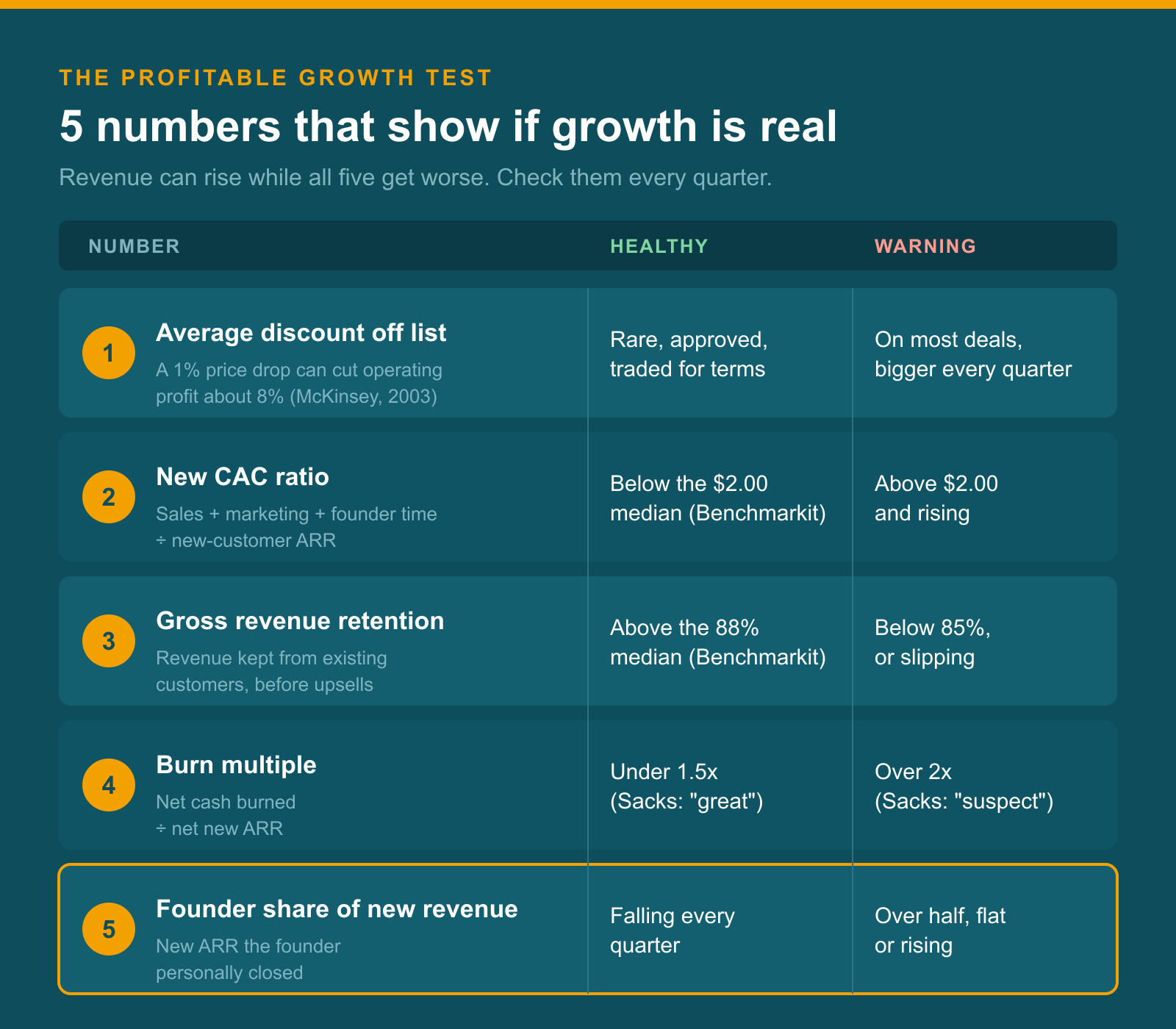
You can tell whether your growth is actually profitable by checking five numbers each quarter: average discount off list, new CAC ratio with founder time included, gross revenue retention, burn multiple, and founder share of new revenue. Profitable growth holds or improves these numbers as revenue rises. Subsidized growth makes them worse.
Most companies in the $1M to $10M ARR range aren't profitable on the income statement yet, and that's fine. "Profitable growth" here means each new dollar of revenue earns back what it cost to win, on a timeline you can afford, without depending on the founder.
How to calculate the five numbers
- Average discount off list: total list price of deals closed this quarter, minus what customers actually agreed to pay, divided by total list price.
- New CAC ratio: sales and marketing spend plus founder selling hours (priced at a realistic hourly rate), divided by new-customer ARR won in the same period. The Benchmarkit 2025 median was $2.00 per $1.00 of new ARR.
- Gross revenue retention: recurring revenue you kept from last year's customers, before any upsells, divided by what those customers paid a year ago. It can't go above 100%.
- Burn multiple: net cash burned divided by net new ARR. David Sacks's scale calls under 1x amazing, 1x to 1.5x great, 1.5x to 2x good, 2x to 3x suspect, and above 3x bad (David Sacks, Craft Ventures, 2020).
- Founder share of new revenue: new ARR from deals the founder personally ran or closed, divided by all new ARR.
Compare against yourself before you compare against benchmarks
The trend in your own five numbers matters more than any benchmark. A new CAC ratio of $1.80 is below the median, but if it was $1.10 a year ago, something broke. Put the last four quarters side by side. If revenue went up and three of the five numbers got worse, your growth is being subsidized. Benchmarks like Benchmarkit's come from SaaS companies, so if you sell services or hardware, use gross margin per customer and repeat-purchase rate in place of the SaaS retention figures.
What Does Subsidized Growth Look Like Next to Healthy Growth?
Subsidized growth and healthy growth can produce the exact same revenue line. In the illustrative example below, two B2B companies both grow from $2.5M to $3.5M ARR in one year. Company A burns $0.8M to do it. Company B burns $2.5M, because discounts, churn, and founder dependence quietly ate the difference.
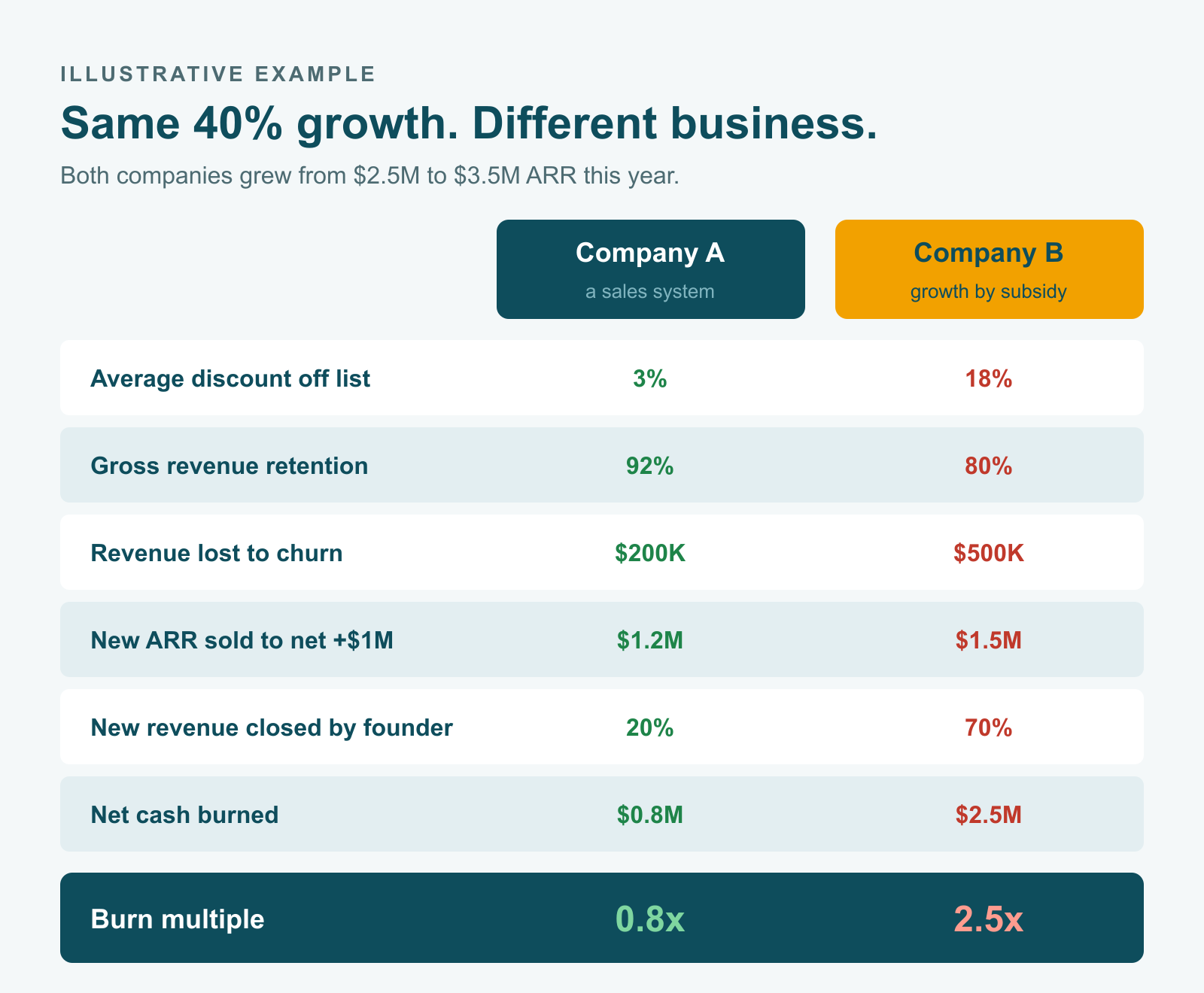
These numbers are made up to show the method, not a benchmark. Here's what they show:
- Company B had to sell more to grow the same. At 80% gross retention, Company B lost $500,000 of existing revenue, so it needed $1.5M of new ARR to net $1M. Company A needed $1.2M.
- Company B paid more for every deal. An 18% average discount means each customer pays less for the same cost of delivery and the same cost to sell.
- Company B's growth lives in the founder's calendar. The founder closed 70% of new revenue. If the founder gets sick, burns out, or spends a quarter fundraising, the growth stops.
- The burn multiple tells the story. Company A's 0.8x is "amazing" on Sacks's scale. Company B's 2.5x is "suspect."
Company B doesn't have a growth problem. It has a sales model problem, and growth is paying the bill.
A board looking only at revenue would call these two companies equal. A buyer doing due diligence wouldn't. Neither would a bank.
Why Doesn't Fast Growth Prove Your Sales Model Works?
Fast growth doesn't prove your sales model works because growth measures demand and effort, not repeatability. A sales model works when someone other than the founder can win the right customers, at a price that makes money, again and again. Most founders find out which one they have when market conditions change.
What 50 years in sales has taught me
In 2002, my company, MindIQ, made the Inc. 500 list of the fastest-growing private companies in America. We also got through three recessions, and one of them taught me the difference between revenue and a business.
Sales had slowed. I'd already cut expenses to the bone. I wanted to borrow money to keep going, and my mentor told me: "Cash does not fix a cash flow problem." So we put everything on the table to bring in cash. Discounts. Cash discounts. Shorter contracts. It worked, and we got through.
Here's the part that matters for you. Those discounts were a survival decision, made on purpose, for a defined period, and I knew exactly what we were giving up. That's very different from what I see in a lot of growing companies today, where discounting isn't a decision anymore. It's just how deals close. That's when discounting stops being a tactic and becomes the sales model.
Where founders usually get this wrong
When I audit a sales team, the revenue line almost never shows the problem. The problem shows up in the deal-level detail: discounts nobody approved, deals that only close when the founder joins the last call, and customers who never fit the ideal customer profile and leave in year one. Founders usually see the first symptom and miss the pattern, because the growth rate keeps telling them things are fine.
I ask founders one question before they chase the next deal: "Do I want a deal or a customer?" A deal adds to this quarter's revenue. A customer who fits, pays a fair price, and stays adds to the value of the company. Bad sales models are built one "deal" at a time.
What Should You Fix First If Growth Is Hiding a Bad Sales Model?
Fix the founder subsidy first, because founder dependence caps your growth and hides the other two subsidies. Once your sales process runs without you, discount habits and bad-fit customers become visible and fixable. Start by measuring all five numbers, then put rules and a written process in place so the team can sell without you.
- Measure the five numbers for the last four quarters. Use whatever data you have. A rough number with a trend beats no number.
- Make every discount a trade. No discount without something in return, such as a longer term, payment up front, or a case study. Require approval above a set percentage.
- Write down your ideal customer profile. Many retention problems start in the sales process, when the team signs customers who were never a good fit.
- Document how you sell. Put your discovery questions, qualification rules, pricing rules, and hand-offs into a Sales Playbook so someone other than you can run a deal.
- Track founder share of new revenue every month. The goal is a number that falls every quarter while revenue keeps rising.
How long it takes to see the numbers move
Discount rules can change your average discount within one quarter. Retention and founder share move more slowly, because they depend on which customers you sign and how fast the team can sell without you. Plan on two to four quarters before the full picture improves, and keep reporting the five numbers next to revenue the whole time.
Frequently Asked Questions
Is it bad for a B2B company to grow while losing money?
Growing while losing money isn't bad by itself, as long as each new customer earns back what it cost to win and the burn multiple stays reasonable. Losing money becomes dangerous when discounts, churn, or founder dependence are the reasons for the loss, because more growth then makes the losses bigger.
How is the Profitable Growth Test different from the Rule of 40?
The Rule of 40 adds your growth rate and profit margin and asks whether the total reaches 40%. It's a company-level score investors use. The five Profitable Growth Test numbers explain why your score is what it is, and they point to the specific sales problem a founder can fix.
Should I stop discounting completely?
No, you don't need to stop discounting completely. Make every discount a trade for something you value, such as a longer contract, upfront payment, or a referenceable logo, and require approval above a set limit. A discount given to get something is a negotiation. A discount given to get a signature is a price cut.
How do I measure founder share of new revenue if my CRM doesn't track it?
Add one required field to every closed deal in your CRM: "Who ran this deal?" For past deals, go through last year's wins with your team and tag each one. It takes an afternoon, and it's often the most revealing number in the whole test.
My company isn't SaaS. Do these five numbers still apply?
Yes, with adjustments. Average discount, founder share of new revenue, and fully loaded customer acquisition cost apply to any B2B company. Swap gross revenue retention for repeat-purchase rate or customer retention, and use gross profit per customer in place of ARR when you calculate your cost ratios.
When should I bring in a Fractional Sales Leader?
Bring in a Fractional Sales Leader when the founder still closes most new revenue and the company isn't ready for a full-time VP of Sales at $250,000 to $400,000 a year. A Fractional Sales Leader costs roughly half as much, builds the process and the measurement, and hands the selling to the team.
Find out what your growth is really costing you.
If your $1M to $10M ARR B2B company is growing but still depends on you to close most deals, Fractional Sales Leadership can help you measure what's real, build the Sales Playbook, and hand the selling to a team that doesn't need you in every deal. Learn more at LouieBernstein.com.
Schedule a 30-Minute CallAbout the Author
Louie Bernstein is a Fractional Sales Leader and founder of MindIQ, an Inc. 500 company. He brings 50 years of sales experience and has been a Fractional Sales Leader since 2017, helping B2B founders build Sales Playbooks, defined sales processes, and teams that can sell without constant founder involvement.