What 22 years of founder-led sales at MindIQ taught me about handing off the sale
Your sales reps keep failing because everything they need to win lives in your head. You know who to call, what to say first, which questions matter, and when to walk away. The rep gets a demo and a price sheet and has to guess the rest. Before you hire again, write down how you sell so a good salesperson can do it without you.
Key Takeaways
- When a founder goes through two or three good sales reps in a row, the usual cause is a sale that only exists in the founder's head.
- A founder's job in sales is to write down what the founder does, so a good salesperson can do it without the founder.
- Only 48% of B2B reps hit quota, and the average rep takes 6.2 months to ramp (Bridge Group, 2026, 158 companies). A rep with nothing written down starts behind those averages.
- Before you let the next rep go, check five things: a written best-fit customer, written answers to objections, written pricing rules, stages defined by buyer actions, and written success numbers.
- This week, write down the one thing your reps keep getting wrong that you have never put on paper. That page is the start of your Sales Playbook.
In 1986 I started MindIQ. For a long time, I was the best salesperson in the company.
That was the problem.
Every time I hired someone to sell, I expected them to sell like me. They couldn't. Not because they were bad. Because everything they needed to know lived in my head.
Someone can sell it. They just can't read your mind.
If you're a founder at $1M to $10M ARR, you've gone through two or three reps, and you're starting to believe "nobody can sell this but me," I think you're wrong. Here's what took me 22 years to learn, so you can learn it faster.
Why do your sales reps keep failing when you can close the same deals?
Sales reps keep failing at deals the founder can close because the founder sells with knowledge the rep never received. The founder knows the buyer, the product, the price limits, and the warning signs from years of practice. None of it is written down, so each new rep starts from zero and guesses.
The founder's advantage is invisible to the founder
You don't think of what you know as knowledge. It feels like common sense. You hear a prospect say "we're just looking" and you know whether to push or walk. You know which industries buy fast and which ones waste three months. You know the one question that tells you a deal is real.
A new rep doesn't know any of that. So the rep calls the wrong companies, asks the wrong questions, and discounts when you would have held firm. Then the deals slip, and you conclude the rep can't sell.
The Rep Failure Loop
I've watched this pattern play out the same way for decades. It's a loop, and founders run it two or three times before they see it.
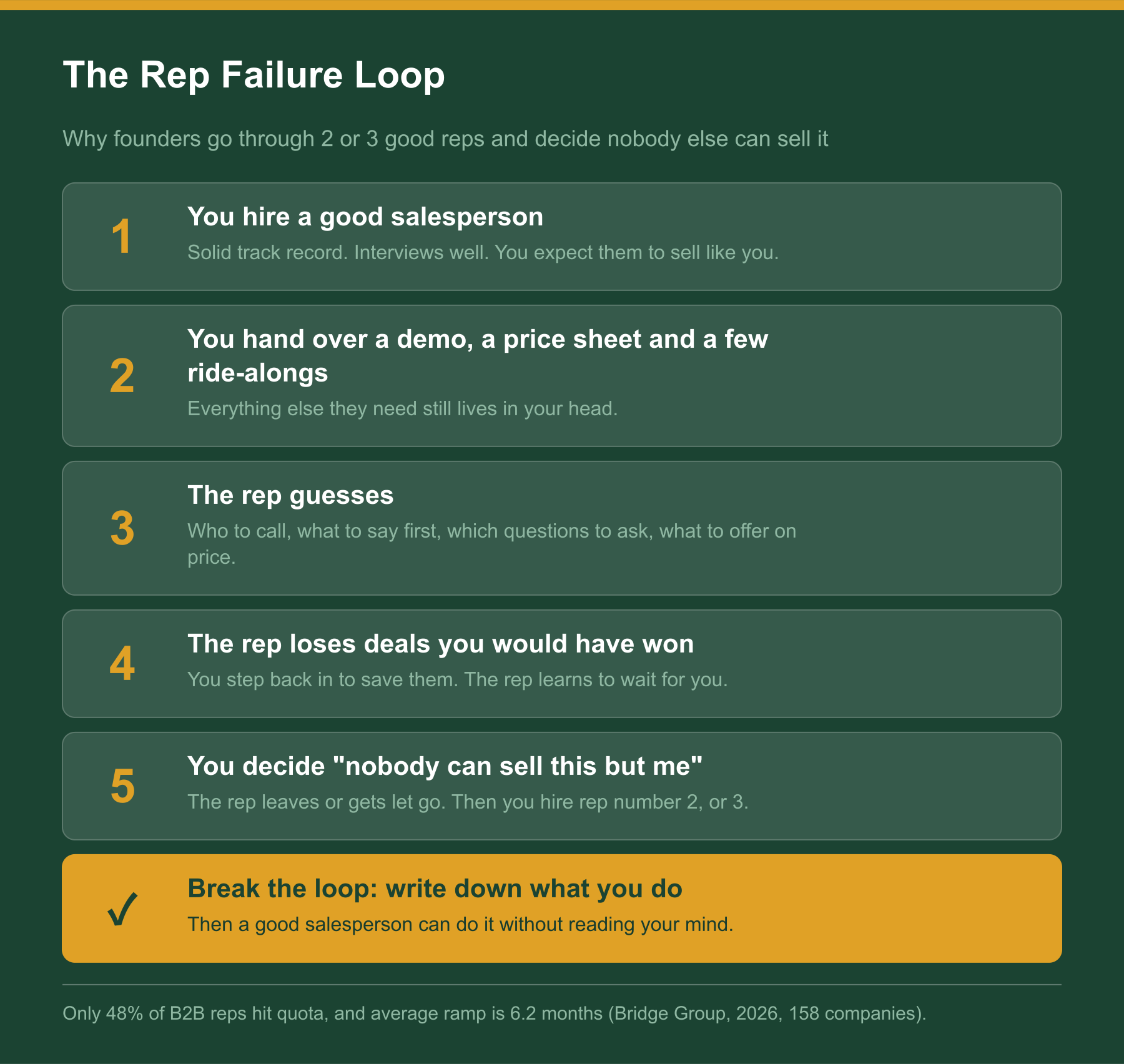
Step four is where the damage compounds. Every time you jump in to save a deal, the rep learns to wait for you. You get busier, the rep gets less practice, and the next quarter looks worse than the last one.
Is it the rep or the system?
Whether a sales rep failed or the system failed comes down to what the rep was given in writing. If the rep had a written customer profile, objection answers, pricing rules, and clear goals, and still missed, it may be the rep. If the rep had none of those, you tested the rep's ability to guess.
Five questions to answer before you let the next rep go
Some reps really are the wrong hire. I've had to let salespeople go. But I'd want to know the answer to these five questions first, because they tell you whether the next rep will run into the same wall.
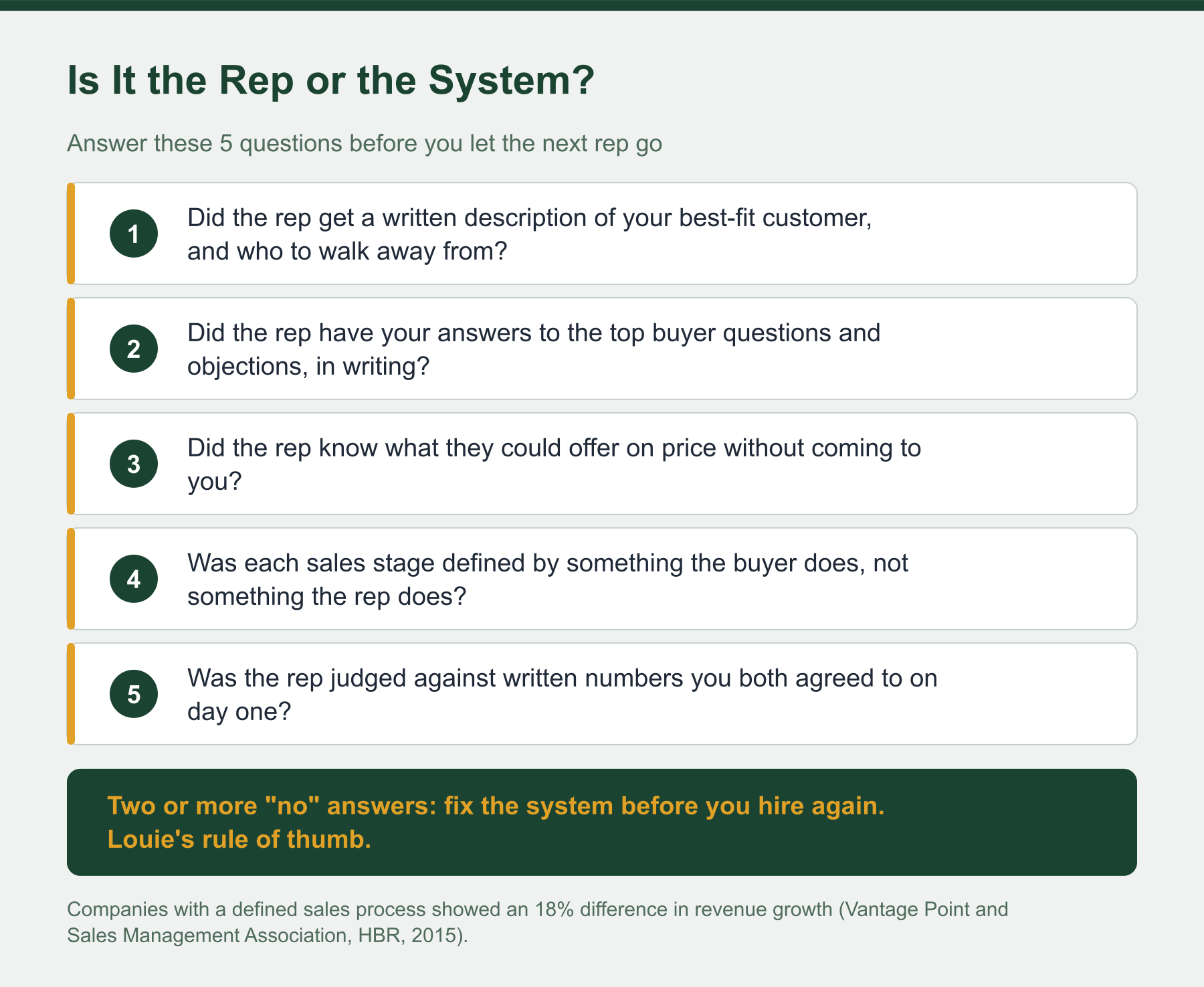
Two or more "no" answers is my rule of thumb, not a study. In my experience, a rep who got two or more of those "no" answers never had a fair shot. I've written more about this in why first sales hires fail.
What the research says about a defined process
In 2015, Vantage Point Performance and the Sales Management Association studied 62 B2B companies and published the results in Harvard Business Review. Companies with a defined, formal sales process showed an 18% difference in revenue growth over companies without one. The study is old and the companies were mostly large. I think the gap matters even more in a small company, where there's no sales manager to cover for a missing process.
What did 22 years of founder-led sales at MindIQ teach me?
Twenty-two years at MindIQ taught me that a founder's job in sales is to make the sale repeatable, not to find a rep as good as the founder. I spent too long hunting for a salesperson who could do what I did. I should have spent that time writing down what I did.
What I got wrong
I founded MindIQ in 1986 because I thought there was a better way to deliver IT training. Before that I was a recruiter, starting in 1976, and then sold tech at DEC. So when I started the company, I was the one who knew how to sell it. The company made the Inc. 500 list, and for a long time most of the selling ran through me.
When I hired salespeople, I hired good ones. I'd take them on a few calls, show them the product, and send them out. Then I'd watch them struggle with buyers I could have closed. My conclusion was always about the person. Wrong fit. Not hungry enough. Not technical enough.
My job wasn't finding someone as good as me. My job was writing down what I did, so a good salesperson could do it without me.
What I did about it
It took me years, and a hard stretch of burnout around 2008, before I finally sat down and got it out of my head. I wrote a 558-page sales training course that had been in my head for 30 years. How to prospect. How to handle objections. How to close. You don't need 558 pages. But you need more than zero.
Since 2017 I've worked as a Fractional Sales Leader, and I see the same thing in almost every founder I sit down with. Brilliant at selling. Nothing written down. Two or three reps behind them who "didn't work out."
What should you write down before you hire your next rep?
Before hiring the next sales rep, write down five things: who your best-fit customer is, how you open a first conversation, the questions you ask and why, your answers to the top objections, and what the rep can offer on price. Those five pages cover most of what a rep guesses at today.
Start with the thing reps keep getting wrong
Don't start with a blank document titled "Sales Playbook." Start with the mistake you've watched every rep make. Maybe they chase companies that are too small. Maybe they demo too early. Maybe they cave on price the first time a buyer pushes back. Whatever it is, you know the right answer. Write it down in a page.
Then do the next one. In a few weeks you'll have the core of a Sales Playbook built from real problems, not theory.
The five pages a rep needs from you
- Your best-fit customer. Industry, size, the problem they have, and the signs that tell you to walk away.
- Your opening. How you start a first call or email, in your own words, and why it works.
- Your questions. The questions you ask on discovery calls and what each answer tells you.
- Your answers. The top objections and buyer questions, answered the way you'd answer them.
- Your pricing rules. What the rep can offer alone, the discount limit, and when a deal comes back to you.
Write down what success looks like
Reps also fail because nobody told them what winning looks like at month one, month three and month six. Put it in an Accountabilities Document: the activity numbers, the meetings, the pipeline, and the revenue you expect by when. Then you're judging the rep against something you both agreed to, not against your memory of how fast you used to close.
How long should a new rep get before you decide it isn't working?
A new B2B sales rep needs a full ramp period before you judge results, and the average ramp is now 6.2 months (Bridge Group, 2026). Judge activity and early pipeline in the first 90 days. Judge closed revenue after that. Most founders judge revenue in month two and end up firing the rep too early.
The numbers are tougher than founders expect
The 2026 Bridge Group report on 158 B2B companies puts average ramp at 6.2 months, the highest in the study's history. Only 48% of reps hit quota, down from 51% in 2024. Those are reps at companies with real sales leadership. A rep at a company where the whole sale lives in the founder's head starts behind those averages.
What to watch in the first 90 days
- Is the rep doing the activity you agreed on, every week?
- Are first meetings turning into second meetings?
- Is the rep asking you fewer questions each week?
That last one matters most. Every question a rep brings you is a page missing from your playbook. Write the answer down, and the next rep never has to ask.
When to get help
Many founders know all of this and still can't find the hours, because they're busy closing deals. Getting the sale out of the founder's head is where I start as a Fractional Sales Leader. I work in 12-week engagements, 20 to 35 hours a week, at $14K a month. Other Fractional Sales Leaders run $10K to $20K a month. A full-time VP of Sales costs $250K to $400K a year, and you'd be hiring one before the system they need exists.
Frequently Asked Questions
How do I know if I hired a bad sales rep or set them up to fail?
Look at what the rep got in writing. If the rep had a written customer profile, objection answers, pricing rules and agreed goals, and still missed on activity, it's likely the rep. If the rep had none of those, the rep never had a fair test.
Should I hire a rep who sells like me?
No. Hire a rep who follows a process well and is coachable. Founders sell with a title, authority and product depth no rep has. A rep who tries to copy your style without those advantages will struggle. Give the rep a written process to follow instead.
How much do I need to write down before hiring?
Start with five short pages: best-fit customer, opening, discovery questions, objection answers and pricing rules. That's enough for a good rep to start. Add a page every time the rep asks you a question you've answered before.
What if my product is too complex for anyone else to sell?
A complex product needs more writing, not a founder on every call. Write down how you explain it, which buyers get it fastest, and the questions that trip people up. If a buyer can understand your product, a trained rep can learn to explain it.
Should I stay on sales calls with a new rep?
Ride along for the first few calls, then step off. Have the rep run the call while you watch and stay quiet. Every time you take over, the rep learns to wait for you. Debrief after the call and write down what you would have done differently.
Get the sale out of your head.
If you're a $1M to $10M ARR B2B founder and you've been through two or three reps, let's look at what the next one would need on paper to win. Learn about Fractional Sales Leadership at LouieBernstein.com.
Schedule a 30-Minute CallAbout the Author

Louie Bernstein Fractional Sales Leadership
Louie Bernstein is a Fractional Sales Leader with 50 years of sales experience and has worked as a Fractional Sales Leader since 2017. He built and ran MindIQ for 22 years. He helps B2B founders at $1M to $10M ARR build repeatable sales systems so selling doesn't depend on the founder.