Key Takeaways:
- Yes, founders still need to sell. 69% of buyers turn to a human to validate what AI told them before they commit (Gartner). They're not avoiding humans, they're avoiding useless ones.
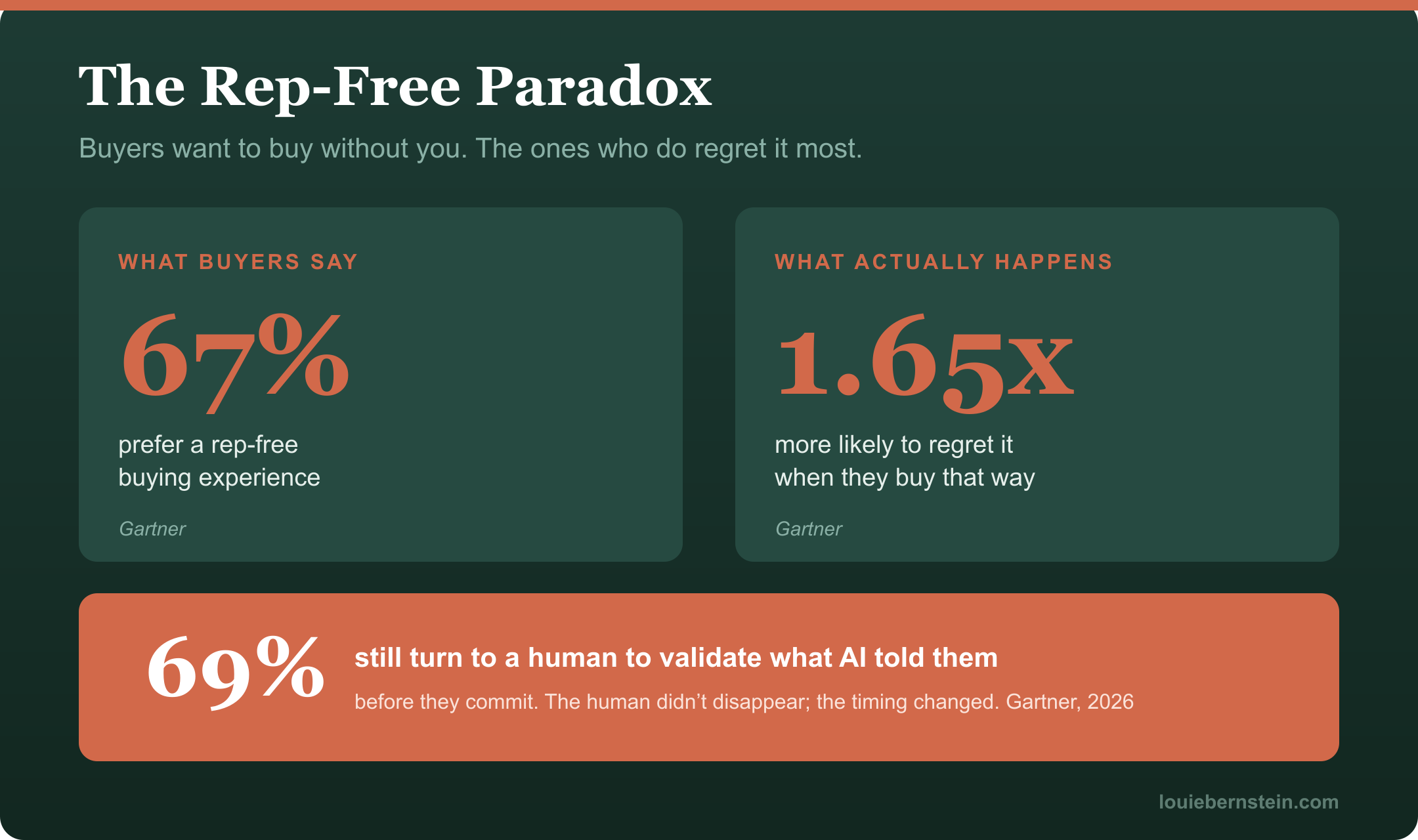
- The paradox that settles it: 67% of buyers want a rep-free experience, but they're 1.65x more likely to regret buying that way (Gartner). They want to go it alone, then wish they hadn't.
- When information was scarce, the rep's value was information. Now info is infinite and contradictory, so what's scarce is trust and judgment. That's your value now.
- The founder has an unfair advantage: you're both the best source of the point of view that gets you shortlisted and the best person to answer an informed buyer's hardest questions.
- Winning takes a system, not hustle: content upstream to get shortlisted, a diagnosis-first conversation in the middle, and enablement that de-risks the decision. That's what a Fractional Sales Leader installs.
Every founder I talk to lately asks some version of the same quiet question. "If buyers research everything through AI before they ever contact me, do I even need to sell anymore? Can't I just build great content, put up a checkout button, and get out of the way?" It's a fair question, and the honest answer is no. But your job did change, and if you don't change with it, you'll lose deals to people who did.
Here's the paradox that settles it. 67% of B2B buyers say they'd prefer to buy with no sales rep involved at all (Gartner). Sounds like the death of selling. Except the buyers who actually buy that way are 1.65 times more likely to regret the purchase (Gartner). They want to go it alone. Then they wish they hadn't. That gap, between what buyers say they want and what actually serves them, is where your job now lives.
So the real question isn't whether founders still need to sell. It's what selling even means when the buyer shows up already educated. Let me walk through why your value went up, not down, and how to build a sales motion that assumes an AI-researched buyer instead of pretending it's still 2015.
The Myth That AI Buyers Don't Want to Talk to Anyone
The myth is that modern buyers want zero human contact. The reality is that they want zero bad human contact. Nobody wants a rep who wastes their time reciting a brochure they already read three days ago. But that's not the same as not wanting help. Those two things get conflated constantly, and founders draw exactly the wrong conclusion from it.
The data is clear. Even as buyers say they'd prefer to self-serve, 69% still turn to a human to validate what AI told them before they commit (Gartner). They're not avoiding humans. They're avoiding useless ones. Show up as someone who genuinely makes their decision easier and they'll happily make time for you. Show up as a talking version of your website and they'll route around you, exactly as they should.
Why Trust and Judgment Got More Valuable, Not Less
Think about what a salesperson was actually for. When information was scarce, the rep's value was information. They knew the product, the market, the comparisons, and you didn't, so you talked to them. That entire premise is gone. Information is now infinite, free, and often contradictory. 89% of buyers say the information they found was high-quality but overwhelming and often contradictory (Gartner).
So the scarcity flipped. What's rare now isn't information. It's trust and judgment: someone who can look at the ten "right" answers a buyer collected and tell them which one is right for their situation. That's precisely what the 1.65x regret gap measures. Buyers who go it alone end up with more information and less confidence, and confidence is the thing that actually lets them act. Your value was never really the data. Now that's obvious.
The Founder's Unfair Advantage With an Informed Buyer
Here's where founders specifically win, and it's worth sitting with. An informed buyer walks in with hard, specific questions, the kind that come from having already researched the whole category. Who answers those best? Not a junior SDR reading a script. The founder, who knows the problem cold and has the scars to prove it. Your depth is exactly what the AI-educated buyer is missing and quietly craving.
You also carry the point of view that got you onto the shortlist in the first place, which I covered in why buyers pick a favorite before they call you and why ChatGPT isn't recommending your company. The founder is both the best content source and the best closer, in one person. That's an unfair advantage a competitor running a $400K VP and a call-center SDR team simply can't match at your stage.
"AI made every buyer an expert on the surface. That's exactly why they need someone with real depth underneath. At your stage, that's you."
Where Self-Serve Ends and the Human Conversation Begins
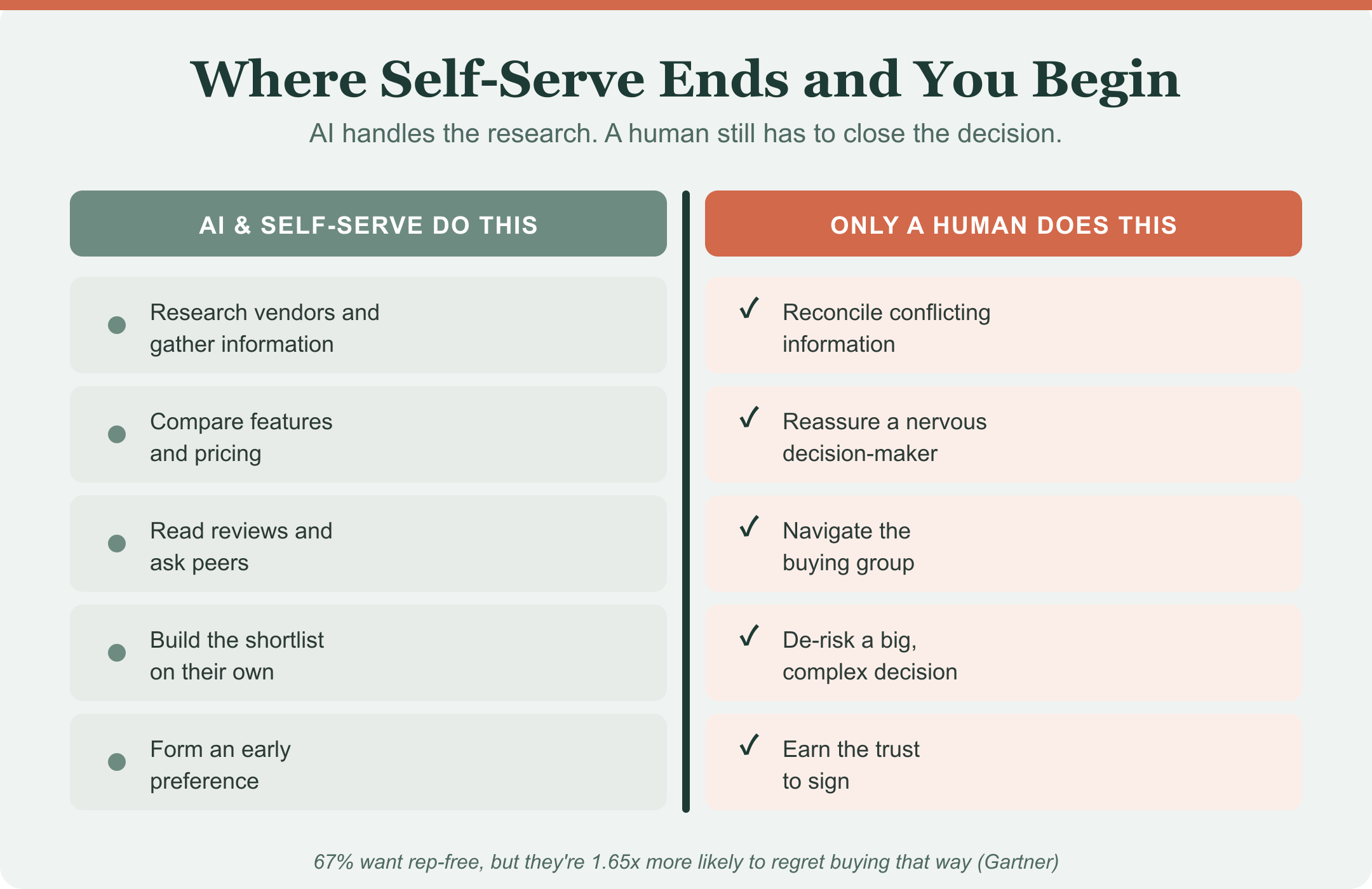
Draw the line clearly, because the whole strategy depends on it. Self-serve and AI are genuinely great at some things: researching vendors, comparing features and pricing, reading reviews, and building a shortlist. Let them. Encourage it, even. Fighting the self-serve phase is a losing battle and a waste of your energy.
But there's a hard line where self-serve stops working. AI can't reconcile genuinely conflicting information for a specific situation, reassure a nervous decision-maker, navigate the politics of a buying group, de-risk a big irreversible decision, or earn the trust it takes to sign. That's the human half, and it's the half that actually closes. Your job isn't to compete with the self-serve phase. It's to be unmissable at the handoff, the exact moment research turns into a decision.
Building a Sales Motion That Assumes an Educated Buyer
Once you accept that the buyer arrives educated, you redesign the motion around it:
- Assume they've researched. Open every conversation as if they already know your features, because they do. Skip to their problem.
- Feed the self-serve phase deliberately. Publish the content and proof that shape their criteria and get you shortlisted while they're still researching.
- Make the human moment count. When they do talk to you, diagnose instead of pitch, the shift I broke down in how to sell to an informed buyer.
- Design for the buying group and the freeze. Give them the materials to sell your solution internally and the confidence not to default to "no decision."
Notice this isn't more selling. It's selling at the right moments: upstream to get shortlisted, and at the decision to close. The middle, the part AI does well, you deliberately let go of. That focus is what makes a small founder-led team punch above its weight.
The System That Turns AI-Researched Leads Into Closed Deals
Pull it together and you have a system, not just hustle. The founder who wins in the AI-buyer era runs three connected plays: content and proof upstream that get you into the consideration set, a diagnosis-first conversation in the middle that adds judgment instead of information, and enablement downstream that de-risks the decision and helps the buyer sell it internally. Each play feeds the next.
You can absolutely build this. The place founders stall is trying to build it while also being the one closing every deal, running the company, and answering support tickets at midnight. That's the exact gap a Fractional Sales Leader fills: installing the system so an AI-researched lead becomes a closed deal predictably, without betting the runway on a $400K VP of Sales. One honest caveat, though: if you don't yet have a repeatable motion or real proof that you win, no system saves you. You'll just systematize noise. Go close more deals yourself first. But if you're a founder between $1M and $10M in ARR, you have the raw material. The buyers already changed how they buy. Your only real choice is whether you change how you sell.
Related Reading
Frequently Asked Questions
Q: If buyers research everything with AI, do founders still need to sell?
Yes, but the job changed. Buyers now self-serve the research, but 69% still turn to a human to validate what AI told them before they commit (Gartner), and buyers who go fully rep-free are 1.65x more likely to regret the purchase (Gartner). Selling is no longer about delivering information, the buyer already has too much. It's about trust and judgment: helping them make sense of what they found and giving them the confidence to decide. That human moment is more valuable now, not less.
Q: Why do so many buyers say they prefer no sales rep?
Because most of their experiences with reps were bad, someone reciting a brochure they'd already read and wasting their time. 67% of buyers say they'd prefer a rep-free experience (Gartner). But that's a vote against useless selling, not against help. The proof is that the same rep-free buyers are 1.65x more likely to regret the purchase. They want autonomy in the research and a trusted human at the decision. Give them a genuinely useful conversation and the "I don't want to talk to sales" resistance disappears fast.
Q: What's the founder's advantage over just hiring a sales team?
Depth and point of view. An informed buyer arrives with hard, specific questions, and the founder can answer them cold in a way a junior rep reading a script never will. You're also the source of the distinctive take that gets you shortlisted in the first place. So at the $1M–$10M ARR stage, the founder is uniquely both the best content source and the best closer, in one person. That's an edge a competitor with a $400K VP and a call-center SDR team can't buy. The trick is turning your instinct into a system before you scale.
Q: Where should AI and self-serve stop and a human take over?
Let AI and self-serve own the research: comparing vendors, reading reviews, building a shortlist, forming an early preference. Don't fight it. The human takes over at the handoff from research to decision, reconciling conflicting information, reassuring a nervous decision-maker, navigating the buying group, de-risking a big commitment, and earning the trust to sign. Those are the things AI can't do and where deals are actually won or lost. Your job is to be unmissable at that moment, not to compete with the parts machines handle well.
Q: How do I build a sales motion for an AI-educated buyer?
Three connected plays. Upstream, publish the content and proof that shape the buyer's criteria and get you shortlisted while they research. In the conversation, assume they already know your features and diagnose their problem instead of pitching. Downstream, give them what they need to de-risk the decision and sell it internally to their buying group. It's not more selling, it's selling at the right moments and deliberately letting AI handle the middle. That focus is what lets a small founder-led team win against bigger, slower competitors.
Q: Is it ever too early to build this system?
Yes. If you're pre-product-market fit or you haven't personally closed enough deals to know your repeatable winning motion, building a system just scales noise. Go win more deals yourself first and learn the pattern. But once you're between $1M and $10M in ARR with a motion that works, formalizing it into an upstream-to-close system is one of the highest-leverage moves you can make, and it's exactly what a Fractional Sales Leader is built to install without the cost of a full-time VP.
The buyers changed. Has your selling?
If you're a founder between $1M and $10M in ARR, I'll help you turn your instinct into a system that gets you shortlisted upstream and closes the AI-researched buyer downstream, without a full-time VP of Sales. See how it works at louiebernstein.com.
Schedule a 30-Minute CallAbout the Author
Louie Bernstein
Fractional Sales Leader with 50 years of sales experience helping $1M–$10M ARR companies build scalable, repeatable sales systems. Founder of MindIQ (INC 500). LinkedIn Top Voice in Sales Management, Sales Operations, and Sales Coaching.