Buyers pay for revenue that keeps coming after you leave. A sales system that lives in your head doesn't transfer.
A documented sales process supports a higher valuation because it lowers the buyer's risk. Buyers pay for future revenue, and a written playbook, clean CRM history, a forecast that holds and reps who close without the founder make that revenue believable. If every big deal runs through you, a buyer sees key-person risk and prices it in with a lower price, an earn-out or a holdback. Start building the proof 12 to 24 months before you sell.
Key Takeaways
- A documented sales process supports a higher business valuation and better terms because it lowers the buyer's risk that revenue drops when the founder leaves.
- US small businesses whose listings say they run without the owner ask about 20% more per dollar of cash flow, 2.8 times versus 2.4 times (Fulkerson Advisors, about 39,000 listings, September 2026). Those are asking prices, not sale prices.
- In due diligence, buyers look at customer concentration, win rates and sales cycle over time, forecast accuracy, rep tenure and ramp, and how many deals the founder personally closed.
- Key-person risk in sales is the risk that revenue falls when one person leaves, usually the founder. Buyers often answer it with earn-outs, holdbacks or a lower price.
- Write down the Sales Playbook, the ICP, pipeline stages with exit criteria, comp plans, an Accountabilities Document for each role and the forecast method, then run them for several quarters before a sale.
Most founders think about valuation in terms of revenue and profit. Those matter. But a buyer is also asking a quieter question: what happens to this revenue when the founder walks out the door?
Chief Outsiders put it well in a September 2026 piece on exit-ready growth: at exit, buyers "judge what they believe can happen next." Sales Gravy goes further, calling a missing documented sales process a red flag that hurts valuation going into an acquisition or funding round.
If the honest answer is "the revenue depends on me," you've already started negotiating against yourself.
A buyer can't buy your instincts. A buyer can buy a sales system that already works without you.
Does a documented sales process raise my company's valuation?
A documented sales process raises your company's value by lowering the buyer's risk, and lower risk supports a better price and better terms. Buyers pay for future revenue. A sales process that runs without the founder makes that future revenue believable, so the buyer has less reason to discount it, hold some back or tie it to an earn-out.
The cleanest recent data I found comes from asking prices, not closed deals. Fulkerson Advisors read about 39,000 US business-for-sale listings in September 2026. Listings that said the business runs without its owner asked a median of 2.8 times cash flow. Listings where the owner works in the business asked 2.4 times. Compared within the same cash-flow band and industry, that's about 20% more per dollar of cash flow.
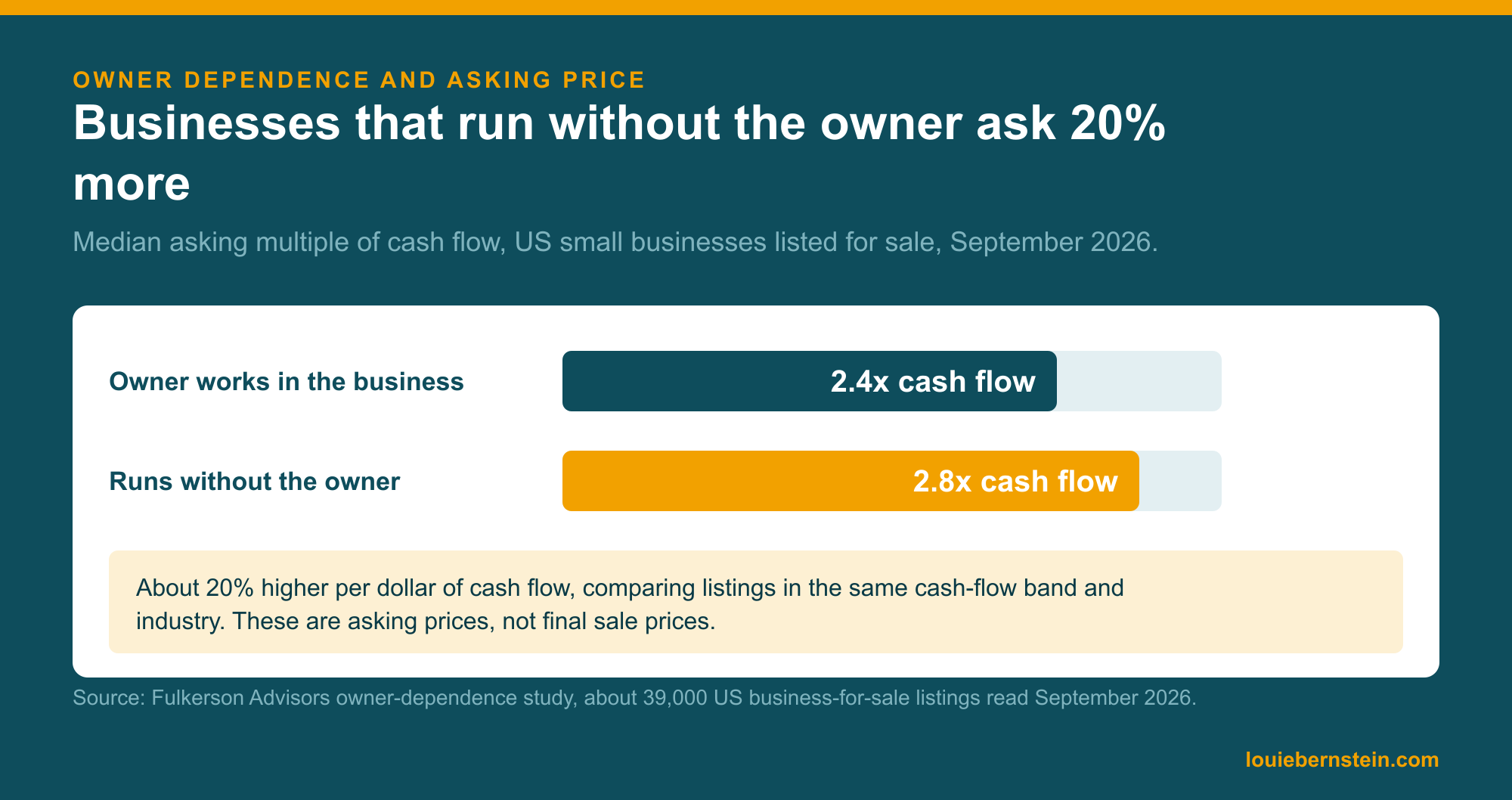
Two cautions. Those are asking prices, and the study says so plainly. And 81% of the listings didn't say what the owner does at all. So treat the 20% as a direction, not a promise. The direction matches what I've seen for decades: the less the business depends on one person, the more a buyer will pay for it. I go deeper on the overall discount in what's my company worth if it can't run without me.
What do buyers look at in a sales team during due diligence?
In due diligence, buyers look at customer concentration, win rates and sales cycle length over time, forecast accuracy, rep tenure and ramp time, and how many deals the founder personally closed. Each one answers the same question: will the revenue keep coming after the sale? Founder-closed deals and a forecast built on gut feel are the two that worry buyers most.
- Customer concentration. How much revenue comes from your top few customers, and who owns those relationships.
- Win rates and sales cycle over time. Whether they're stable, improving or slipping, by quarter.
- Forecast accuracy. How close each quarter's forecast came to what actually closed.
- Rep tenure and ramp. How long reps stay, and how long new reps take to reach quota.
- Founder-closed deals. What share of new revenue the founder personally closed.
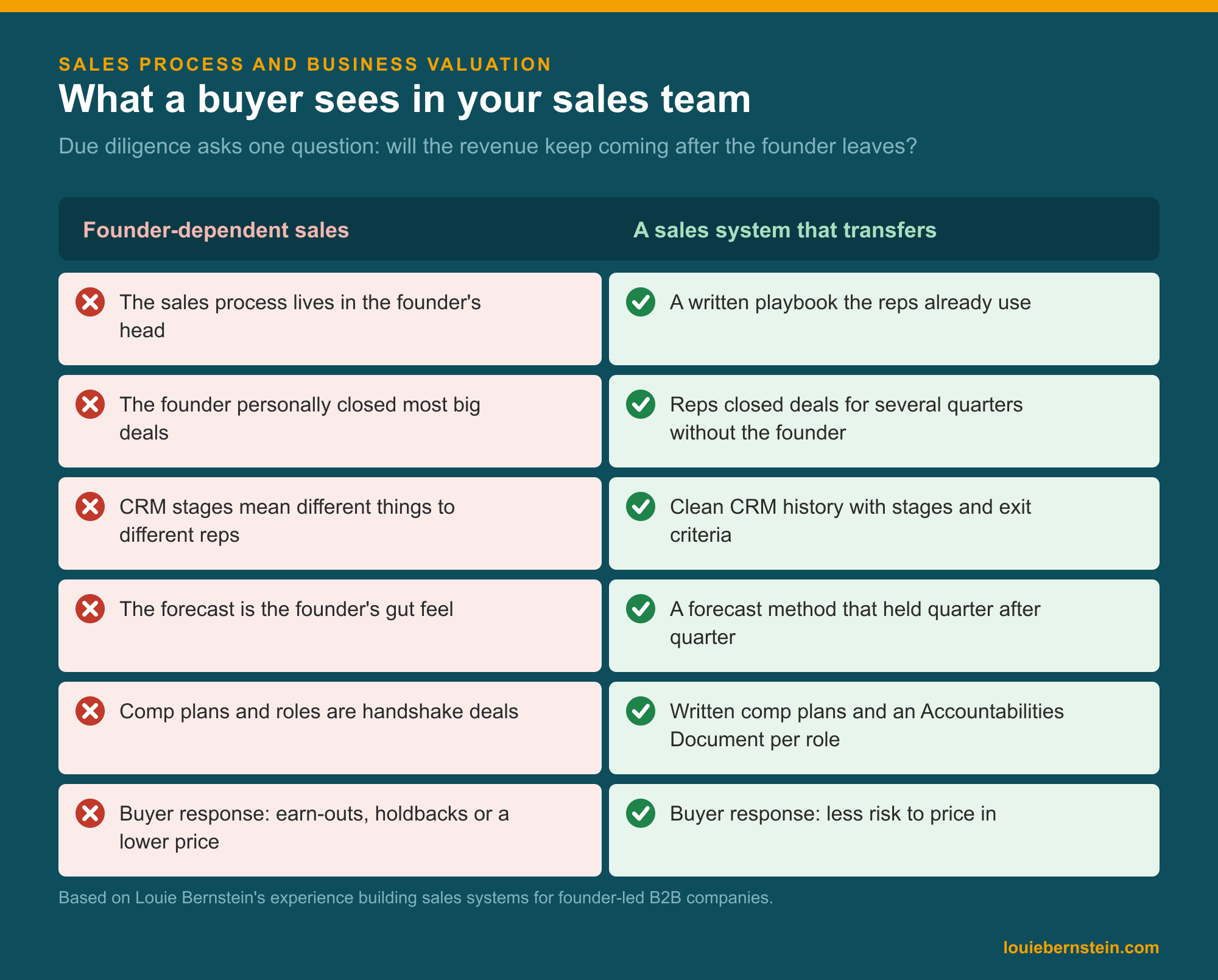
Notice that none of those are about how good the founder is at selling. A brilliant founder-closer can actually make the numbers look worse to a buyer, because the win rate goes with the founder.
What is key-person risk in sales?
Key-person risk in sales is the risk that revenue drops when one person leaves the business, and in a founder-led company that person is usually the founder. Buyers often answer key-person risk with earn-outs, holdbacks or a lower price. Each one shifts the risk of your departure back onto you.
An earn-out ties part of the price to results after the sale. A holdback keeps part of the payment in reserve for a period. Both can be fair tools. But if the reason for them is that the buyer doesn't believe sales will continue without you, you're the one carrying the risk you could have removed.
Before you think about selling, measure how much the business depends on you. My founder bottleneck scorecard gives you five numbers to check, starting with how much of your closed revenue you personally touched.
What I've seen in turnarounds
When I stepped in as Sales VP at a struggling learning company, during the worst economy in 30 years, there was no shortage of selling talent. What was missing was a system anyone could follow. So I wrote down how we sold and taught it every day, 20 minutes a day.
In the first year, sales went up 10% and profits went up 321%. The people didn't change much. What changed was that the way we sold no longer lived in one or two heads. That's exactly what a buyer wants to see: results that come from the system, not from a hero.
If the revenue comes from the system, it transfers. If it comes from you, it walks out the door with you.
What should be written down before I sell my company?
Before selling your company, write down the Sales Playbook, the ideal customer profile, pipeline stages with exit criteria, comp plans, an Accountabilities Document for each sales role and the forecast method. Then run them long enough to produce a track record. Documents alone prove intent. Several quarters of results prove the system works.
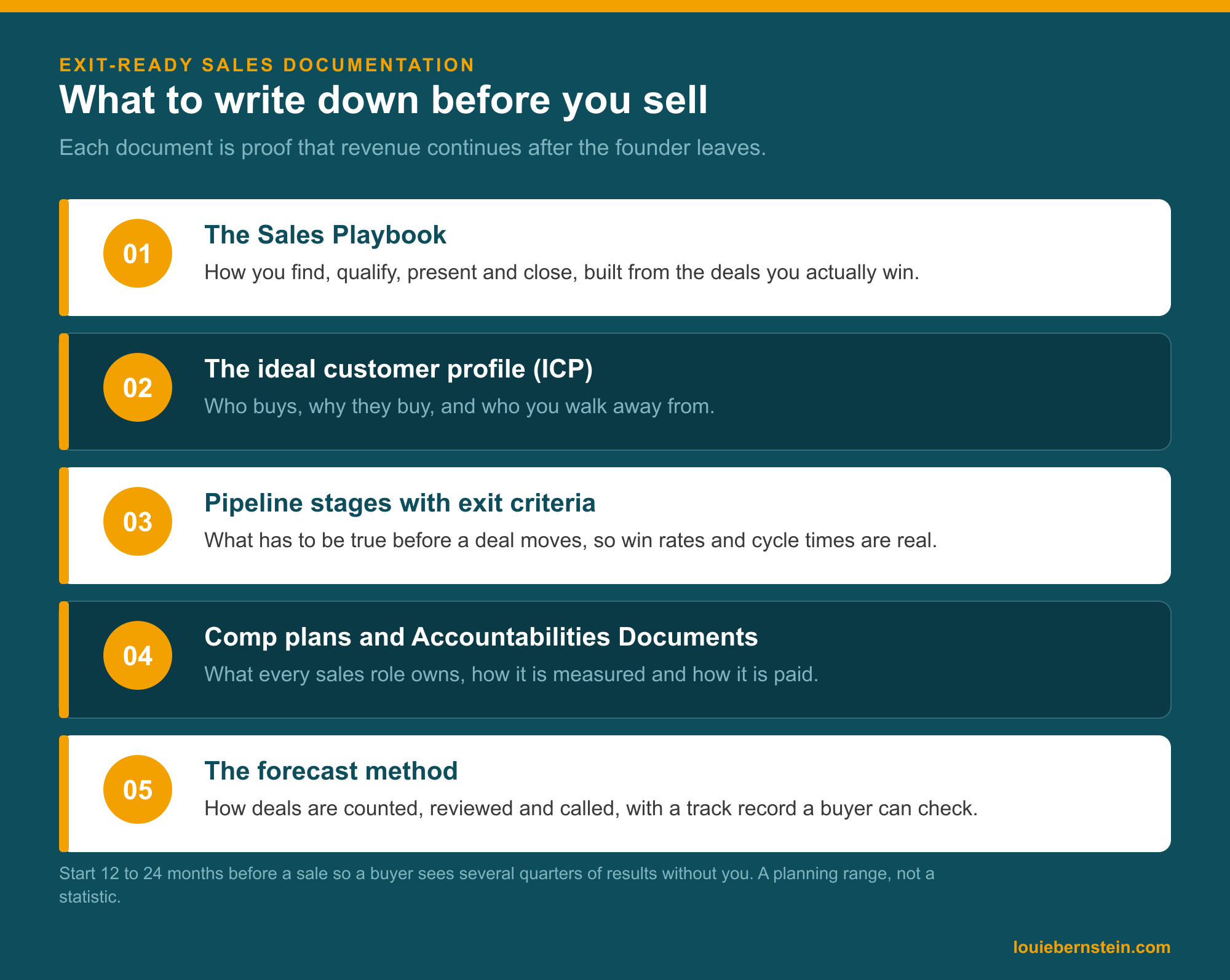
The playbook is the center of it. If you don't have one yet, start with what a sales playbook is and what goes in it. A buyer will ask to see it, and they'll ask your reps about it too. If the reps have never opened it, the buyer will notice.
How long before a sale should I fix founder-dependent sales?
Plan to fix founder-dependent sales at least 12 to 24 months before a sale. That's a planning range, not a statistic. It gives you time to build the system and then show a buyer several quarters of results with you out of the deals. A playbook written the month before diligence proves very little.
- First 3 months: build the system. Playbook, stages, exit criteria, Accountabilities Documents, weekly 1:1s and a pipeline review.
- Months 4 to 12: step out of closing, one segment at a time. Let reps close mid-size deals while you coach.
- Months 12 to 24: build the track record. Several quarters of forecasts that held, and deals closed without you.
If you're two or three years from a sale, you have time. If you're six months out, you can still start, but expect the buyer to see a system that's new rather than proven.
Can a fractional sales leader help me prepare for an exit?
Yes. A Fractional Sales Leader can build the sales system, run it for several quarters, and hand it to a team that can show results to a buyer. That's the same work a buyer would otherwise discount you for not having done, delivered at roughly half the cost of a full-time VP of Sales.
My engagements run 12 weeks, renewable, at $14K a month for 20 to 35 hours a week. Most clients renew for 6 to 12 months total, which lines up well with the time a buyer wants to see results. Other fractional sales leaders generally run $10K to $20K a month. A full-time VP of Sales costs $250K to $400K a year.
If you already have a private equity partner or expect one, the work looks a little different. I describe that version in fractional sales leadership for private equity.
Frequently Asked Questions
Will a buyer actually read my sales playbook?
A serious buyer will at least ask for it, and many will talk to your reps about how they sell. The document matters less than the proof that reps use it. A playbook that matches how the team actually sells, backed by CRM history, is what reduces the buyer's worry.
What if I'm not planning to sell for five years?
Build the sales system anyway. The same system that makes a business easier to sell also makes it easier to grow, because the founder stops being the ceiling on revenue. When you do decide to sell, you'll have years of results instead of a few months.
Does customer concentration affect valuation as much as founder dependence?
Both matter, and they often show up together. When the founder personally owns the relationships with the top few customers, a buyer sees two risks at once. Moving those relationships to account owners on your team lowers both.
Can I stay on after the sale to reduce key-person risk?
You can, and buyers often ask founders to stay for a transition period. But staying on usually comes with an earn-out or other terms tied to your performance. A sales system that already runs without you gives you more freedom to choose how long you stay.
Is CRM data really part of due diligence?
Yes. Buyers often look at win rates, sales cycle length and forecast accuracy by quarter, and they get those from your CRM. If stages mean different things to different reps, the numbers won't hold up under questioning. Clean CRM history is part of what you're selling.
Build the sales system a buyer will pay for.
If you're a B2B founder at $1M to $10M ARR and you might sell in the next two to five years, let's look at how much of your revenue still depends on you and what it takes to change that. Learn about Fractional Sales Leadership at LouieBernstein.com.
Schedule a 30-Minute CallAbout the Author

Louie Bernstein Fractional Sales Leadership
Louie Bernstein is a Fractional Sales Leader with 50 years of sales experience and has worked as a Fractional Sales Leader since 2017. He built and ran MindIQ for 22 years. He helps B2B founders at $1M to $10M ARR build repeatable sales systems so selling doesn't depend on the founder.