How Do You Stop the Same Pattern From Repeating With the Next Person?
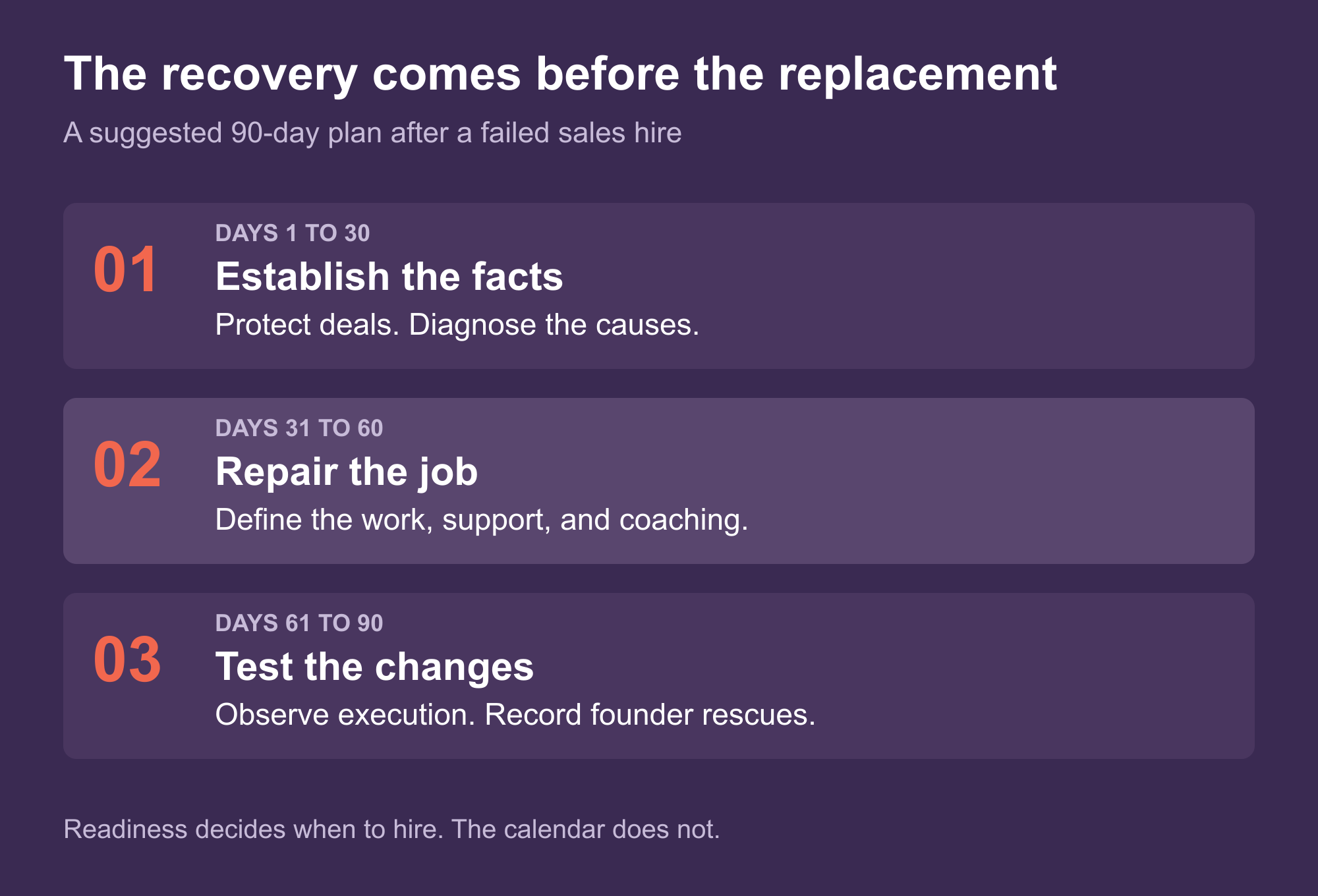
After a failed sales hire, spend the first 90 days protecting active deals, finding the causes of failure, and testing the repairs before you replace the person. Use days 1 to 30 to establish facts, days 31 to 60 to rebuild the role and sales process, and days 61 to 90 to test execution without founder rescue. Treat the timeline as a working plan, not a guarantee that you're ready to hire.
Key Takeaways
- Use the first 90 days after a failed sales hire to diagnose and repair the job before putting another person in the seat.
- Give every active opportunity a named owner and a buyer-confirmed next step before you restart recruiting.
- Separate evidence about the salesperson from evidence about lead quality, role design, onboarding, and management.
- Gallup found that only 46% of U.S. employees strongly agreed they knew what was expected at work in 2024. Clear expectations deserve a check before you blame ability.
- Reopen hiring when the repaired process works in practice, the job matches your resources, and someone has time to coach the next hire.
The salesperson is gone. You're back on the calls. A recruiter wants to know whether to reopen the search.
I understand the temptation to say yes. You hired because your calendar was already full. Now you've got the same calendar and a pipeline you don't quite trust.
Before you replace the salesperson, write down what the next person will walk into that the last person didn't have.
For a B2B founder at $1M to $10M ARR, that's the recovery question. A better interview won't repair an undefined sales job. A better playbook won't repair a rep who refuses to use one. You need to know which problem you're solving.
What Should You Do in the First Week After the Hire Fails?
In the first week after a failed sales hire, protect customer conversations and preserve the evidence you'll need to diagnose the failure. Assign temporary ownership of active deals, confirm outstanding commitments, and save the relevant sales records through your normal company process. Revenue continuity comes before rewriting the job advertisement.
Take over the promises, then the pipeline
Review open proposals, scheduled meetings, pricing exceptions, implementation promises, and unanswered buyer questions. Tell each active prospect who owns the relationship now. Keep the explanation brief. Buyers need continuity, not your account of a personnel decision.
Check the next action with the buyer. A CRM task saying "follow up Friday" isn't proof that the buyer agreed to another conversation. Record what the buyer confirmed, who must participate, and the date. Mark uncertain opportunities honestly instead of carrying the previous forecast forward.
Save the job description, hiring notes, agreed goals, onboarding plan, call recordings, coaching notes, and relevant CRM history. Use company-authorized records. Preserve the original version before editing the sales process, or you'll lose the distinction between what existed then and what you've fixed now.
Put a limit on the founder's temporary return
Name an interim sales owner, even if that's you. Reserve specific time for buyer follow-up and a separate block for rebuilding the sales operation. Otherwise every urgent deal will consume the time you meant to spend preventing the next failure.
Write a short recovery brief: affected opportunities, immediate commitments, available selling capacity, and decisions postponed until the diagnosis is finished. You don't need a committee. You need a record that survives the next busy week.
How Do You Find What Actually Went Wrong by Day 30?
By day 30, build an evidence-based explanation of the failed sales hire across the person, the role, the selling conditions, and management. Compare what you expected with what the rep could actually access and do. Label unsupported conclusions as unknown. A missed quota identifies an outcome, but doesn't establish the cause.
Reconstruct the job the person really had
Was the rep hired to close qualified inbound opportunities, then asked to build outbound from an empty list? Did the quota assume a mature territory? Did the candidate's past employer provide brand recognition, sales engineering, or lead flow your company doesn't have?
Check the same questions against actual deals. Review available wins, losses, and stalled opportunities with comparable buyers and sources. A founder's warm referral and a rep's cold outbound opportunity aren't a fair comparison. Keep differences visible.
For each suspected cause, write the evidence and a competing explanation. "Rep skipped discovery" can be checked against calls. "Bad attitude" is too vague. "No pipeline" needs a closer look at prospecting activity, target quality, messages, and the time available to do the work.
Check your side of the agreement
In 2024, only 46% of U.S. employees strongly agreed they knew what was expected at work, according to Gallup. That's a broad workplace finding, not a sales-hire failure rate. It supports a practical question: Were the expectations clear enough to coach and assess?
Ask whether weekly coaching happened, whether feedback named observable behavior, and whether the rep had a working example to follow. Missing support doesn't excuse every performance problem. It does change what you can reasonably conclude about the failure.
Finish the month with a short cause statement and a repair owner. For example: "We hired for closing, assigned prospecting, and never assessed outbound ability. Rewrite the role and test prospecting before the next offer." That's a useful conclusion because somebody can act on it.
What Should You Rebuild Between Days 31 and 60?
Between days 31 and 60, repair the specific conditions that contributed to the failed sales hire: the role, sales instructions, lead plan, or coaching routine. Give each repair an owner and a usable deliverable. Replacing every tool at once makes learning harder and takes time away from selling.
Define a job your company can support
Write an Accountabilities Document that names the outcomes, required behaviors, available support, decision authority, and review cadence. State who generates leads. State who handles technical questions. State when the founder joins a call and what the salesperson must prepare first.
Turn the diagnosis into a stage-fit hiring scorecard. If outbound creation was the missing skill, test it. If discovery was weak, score discovery. Don't solve an outbound problem by hiring a more polished presenter.
Check the capacity math too. Illustrative example: a $600,000 annual new-business target at $30,000 per deal requires 20 wins. At an assumed 20% win rate on qualified opportunities, the plan requires 100 qualified opportunities annually. Those are planning assumptions, not market benchmarks. Can your lead sources and selling capacity support them?
Write instructions at the point of failure
If deals stalled after discovery, define the evidence required before a proposal and show a useful follow-up email. If buyers were poorly qualified, clarify fit and disqualification. If calls went well but records were useless, provide a completed CRM example.
Keep the repair small enough to use during a real selling week. A rep should find the right question, example, or decision rule without calling you. Schedule the coaching session and identify who will review calls before the next hire starts.
What 50 years in sales has taught me
I've written about the founder's "mini-me" hiring mistake: expecting another salesperson to improvise with the product knowledge and credibility you earned by building the business. The practical lesson is to examine every founder rescue. What did you know, ask, or decide that the rep couldn't?
Some rescues reveal a skill the rep needed. Others expose a decision rule you never taught. Write down the difference. Your next salesperson needs a way to make sound decisions while you're doing the founder's job.
How Do You Test the Repairs Between Days 61 and 90?
Between days 61 and 90, test whether someone can use the repaired materials and whether the new management routine actually happens. Start with simulated conversations, then observe appropriate live work when a qualified team member is available. Record founder interventions. A clean document alone doesn't prove a usable sales process.
Test the system before testing another employee
Use the transfer test to expose missing instructions. Give a capable colleague a narrow simulated qualification conversation and the materials a new hire would receive. Watch where the colleague needs help. The exercise checks the materials, not whether the colleague should become your salesperson.
For candidates, use job-relevant exercises that test skills you need on entry. OPM describes work samples as tasks that mirror the job and cautions against testing skills you intend to teach after hiring. Don't expect candidates to know your private product details before onboarding.
Track behavior with a denominator
Measure qualified conversations, buyer-confirmed next steps, stage progression, record quality, and founder interventions. Keep the opportunity source and stage alongside the count. Illustrative example: six confirmed next steps from eight eligible calls is 75%. It isn't a reliable benchmark from eight calls, but the two missing next steps deserve review.
Keep reviewing your own management commitments too. Did the call review happen? Was feedback specific? Was the missing instruction corrected? If nobody follows the coaching schedule while the seat is empty, putting a new employee in it won't create management time.
When Should You Start Hiring Again?
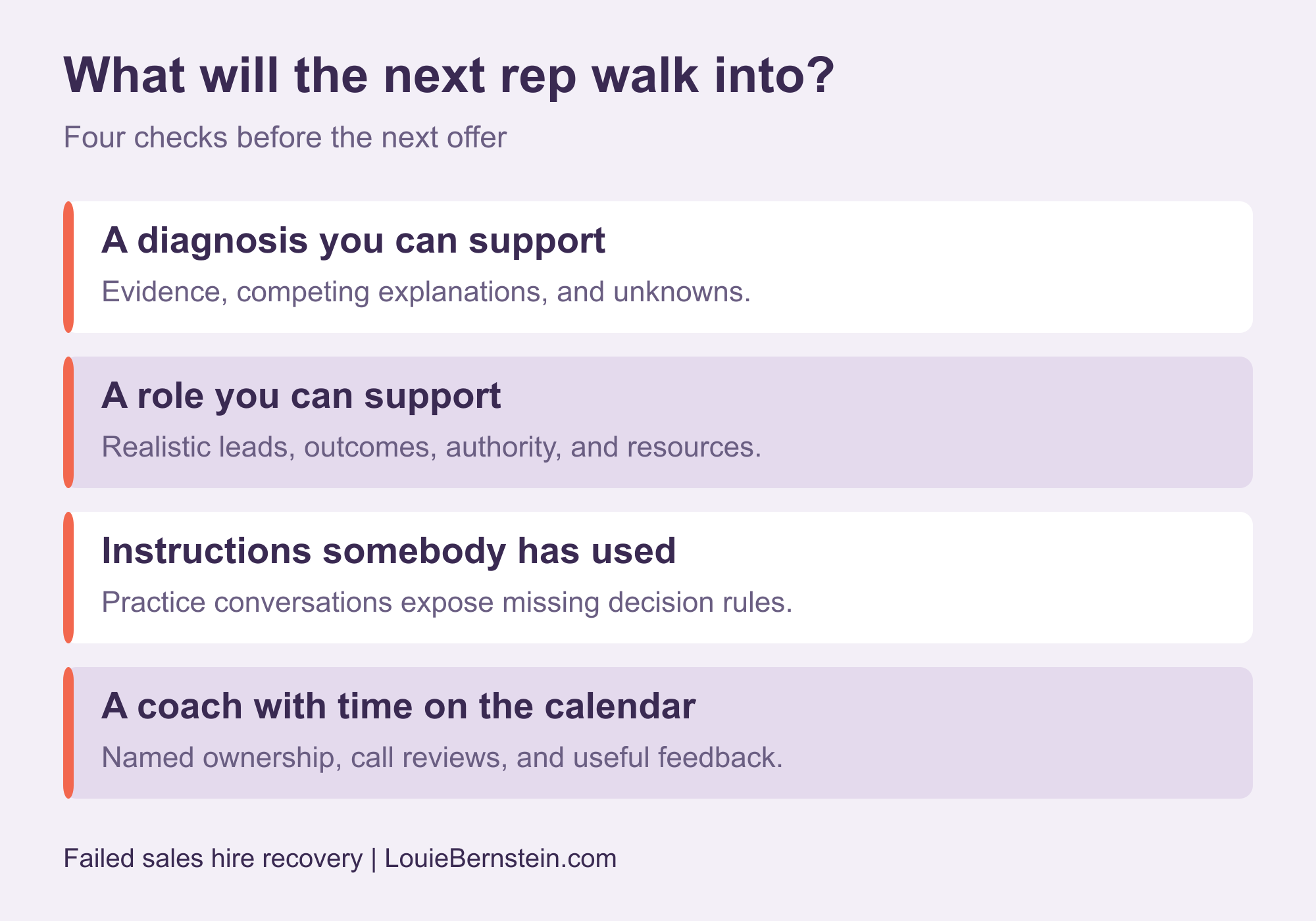
Start hiring again when you can explain the previous failure with evidence, show the repairs in use, and support the next hire with realistic work and named management. You can source candidates while repairs continue. Make the offer depend on readiness rather than the arrival of day 90 or an impressive resume.
Use a hiring decision you can defend
Before approving the offer, answer four questions:
- What did we learn about the previous failure, and what remains unknown?
- What has changed in the role, resources, or sales process?
- What exercise showed that the candidate can do the work we need now?
- Who will coach the hire, and when is the first review?
Use the same core interview questions and scoring standards across candidates. That's a defining feature of structured interviews in OPM's guidance. Consistency makes evidence easier to compare than a series of pleasant, unrelated conversations.
If the sales cycle is longer than 90 days, assess early execution without pretending closed revenue has matured. If you still haven't proven demand or a repeatable founder-led sale, stay involved and learn. No rep can promise a reliable process for an offer buyers haven't shown they'll purchase.
A Fractional Sales Leader can own the diagnosis, repair work, and coaching when the founder lacks capacity. My engagements run 12 weeks, renewable. The useful outcome is a better sales operation and an honest hiring decision, including a decision to wait.
Related Reading
Frequently Asked Questions
Should I ask the former rep for feedback?
Yes, if an appropriate conversation is possible. Ask which expectations, resources, and decisions were unclear. Treat the answers as one source to compare with records, rather than a final verdict on either person.
Should I tell candidates the previous hire failed?
Explain that the role didn't work as expected and describe the changes you've made. Keep individual personnel details private. Candidates need an honest picture of the work and support they'll receive.
Do I need a new CRM after a failed hire?
Change the CRM only if a specific limitation prevents the process you need. Undefined stages and unreviewed records usually need clearer rules and management before they need different software.
What if the rep is still employed?
Separate the person's performance review from the business recovery plan. Set clear expectations, provide the agreed support, and follow your company's employment process. Don't use a generic 90-day article as a dismissal rule.
How should I explain the reset to investors?
Report the effect on the forecast, the interim sales owner, the causes supported by evidence, and the repairs underway. State the hiring conditions and review date. Avoid promising that a replacement will immediately recover the revenue gap.
Give the next hire a better job to walk into.
If you're still closing most deals at $1M to $10M ARR, I'll help you find what broke, build the missing sales instructions, and put coaching on the calendar. Learn about my work at LouieBernstein.com.
About the Author
Louie Bernstein is a Fractional Sales Leader with 50 years of sales experience and has provided Fractional Sales Leadership since 2017. He helps B2B founders build repeatable sales systems and reduce dependence on founder-led selling.