Marketing can fill a pipeline. It can't fix a sales process nobody has written down.
For most founder-led B2B companies between $1M and $10M ARR, hire the fractional sales leader first. A fractional CMO brings more leads. A Fractional Sales Leader fixes what happens to those leads after they arrive. If your deals stall, nobody agrees on what a qualified lead is, and you still close every big deal yourself, more leads only show you the leak faster. Fix the sales system, prove it holds for a quarter, then add marketing to feed it.
Key Takeaways
- Founder-led B2B companies at $1M to $10M ARR should usually hire a Fractional Sales Leader before a fractional CMO, because more leads can't fix deals that stall after they come in.
- Marketing is the real problem only when your sales process already converts at a steady rate and you simply don't have enough qualified conversations.
- Sales is the real problem when leads stall mid-pipeline, sales and marketing argue about what counts as qualified, and the founder still closes every big deal.
- The average new-logo win rate in B2B fell to 19% in 2025 (Ebsta and Pavilion, 655,000 opportunities). Every point you add there pays off on every lead marketing will ever send you.
- Before you add a fractional CMO, check three signals: the forecast held for a full quarter, reps close without you, and the team can handle more qualified leads.
- If you hire both at once, name one person who owns the pipeline number from first touch to close. Shared ownership means nobody owns it.
"We need more leads." I hear some version of that from founders all the time.
So I ask two questions. How many leads came in last quarter? How many of those turned into proposals? More often than not, the founder can't answer either one.
The founder feels the pipeline is thin, so the founder buys more pipeline. But the problem usually isn't the top of the funnel. It's everything below it.
More leads poured into a sales process with no stages, no qualification and no follow-up don't fix anything. They just show you the leak faster.
Should I hire a fractional CMO or a fractional sales leader first?
A founder-led B2B company under $10M ARR should usually hire a Fractional Sales Leader before a fractional CMO. If the deals you already have close slowly or not at all, more leads won't change that. A fractional CMO grows the top of the pipeline. A Fractional Sales Leader makes the rest of the pipeline convert.
Think about the math. If your win rate is low and erratic, every lead marketing buys you is worth less than it should be. If you fix the win rate first, every lead marketing sends you later is worth more. Same marketing budget. Better return.
That's my bias, and I'll own it. I'm a Fractional Sales Leader. But firms that sell fractional CMOs see the same seam. Chief Outsiders, whose core business is the fractional CMO, launched fractional sales executives in 2023 and called the pair a "one-two punch." I agree you eventually need both. The question is which punch you throw first.
What I learned about great products and no selling system
My first computer sales job was at Digital Equipment Corporation in 1981. DEC had some of the best-engineered products in the world. Our founder, Ken Olsen, believed that if you gave enough engineering handbooks to enough engineers, the products would sell themselves.
For a while, they did. Then the market changed, buyers stopped being engineers, and the handbooks stopped working. Sales fell. Layoffs came. Great material in the market wasn't a substitute for a way to sell.
How do I know marketing is my real problem?
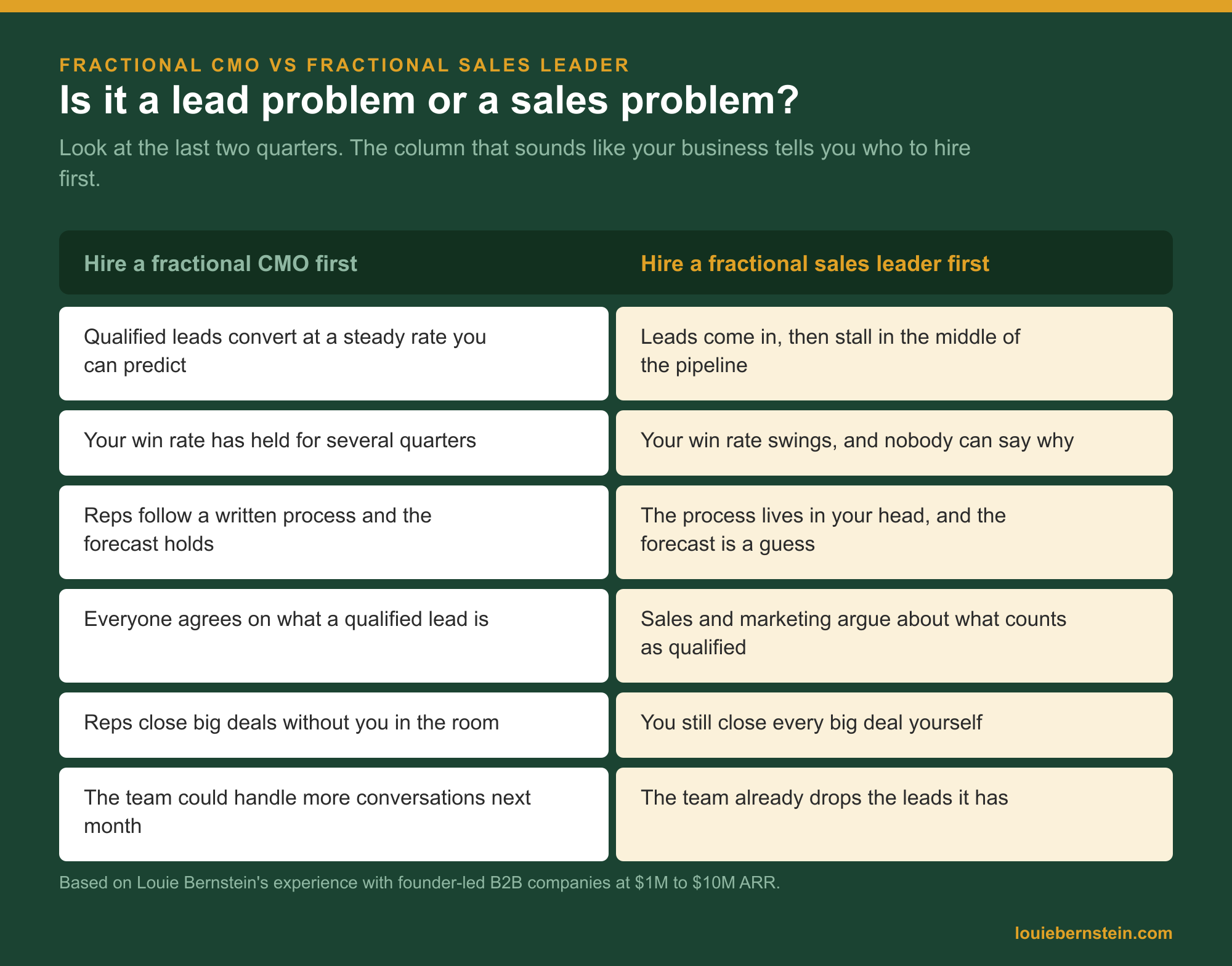
Marketing is your real problem when your sales process already converts at a steady rate and you simply don't have enough qualified conversations. Your win rate holds quarter after quarter, reps follow a written process, and the team could handle more meetings next month. That's a lead problem, and a fractional CMO is the right first hire.
Those companies exist. I've met a few. They usually have a founder who wrote the sales process down early, a rep or two who close without help, and a forecast that lands within reason. What they lack is reach. If that's you, go hire marketing.
If you aren't ready for a marketer yet but need more conversations, there's a middle path. I lay out a founder-run version in building a demand engine before you hire a marketer.
How do I know sales is my real problem?
Sales is your real problem when leads come in but stall, nobody agrees on what a qualified lead is, and you still close every big deal yourself. Those three symptoms mean the system that turns a lead into revenue is missing or lives only in the founder's head. A fractional CMO can't build that system. A Fractional Sales Leader can.
Look at the middle of your pipeline. Deals that sit in "proposal sent" for two months. Deals nobody has touched in three weeks. Deals the rep calls "warm" that the buyer has quietly abandoned. That's where revenue leaks, and new leads fall right into the same holes.
The benchmarks are sobering. Ebsta and Pavilion's 2025 GTM Benchmarks, which analyzed 655,000 B2B opportunities, put the average new-logo win rate at 19%, down 10% from the year before. Their data also shows win rates dropping as deals slip: 18% for a deal that slips a week, 8% at three months. A thin pipeline isn't the only thing that hurts. A slow, sloppy one hurts too.
The qualified-lead argument is a sales problem
When sales and marketing argue about lead quality, founders usually blame marketing. In my experience the real issue is that nobody wrote down what "qualified" means. That's a sales leadership job. You define the buyer, the pain, the budget signal and the next step that proves interest. I walk through how to do that without a marketing team in MQL vs. SQL without a marketing team.
What does a fractional sales leader do that a fractional CMO doesn't?
A Fractional Sales Leader writes the sales playbook, sets pipeline stages and exit criteria, coaches reps in weekly 1:1s, runs the pipeline review and gets the founder out of closing. A fractional CMO owns positioning, messaging, campaigns and lead flow. The CMO's work ends when a lead becomes a conversation. The sales leader's work starts there.
- The playbook. How your company sells, written down from the deals you actually win, so a new rep can follow it on day one.
- Pipeline stages with exit criteria. What has to be true before a deal moves forward, so the forecast means something.
- Rep coaching and accountability. Weekly 1:1s, call reviews and an Accountabilities Document for every sales role.
- Getting the founder out of closing. A plan that moves deals off your desk one segment at a time.
A good fractional CMO is worth every dollar when there's a working sales system to feed. Without one, the CMO spends half the engagement explaining why the leads didn't close.
Where founders usually get this wrong
Here's the pattern I've watched play out more than once. The founder feels growth slowing and hires an agency or a fractional CMO. Leads start coming in. The founder is still the only one who can really close, so the founder calls back the best leads when there's time. Many wait days. Some never get a call.
A few months later the founder looks at the spend, sees little new revenue, and decides marketing doesn't work. The agency gets fired. The real problem, a sales process nobody wrote down, is still sitting there. And now the founder is skeptical of marketing too, which makes the next hire harder.
Can I hire a fractional CMO and a fractional sales leader at the same time?
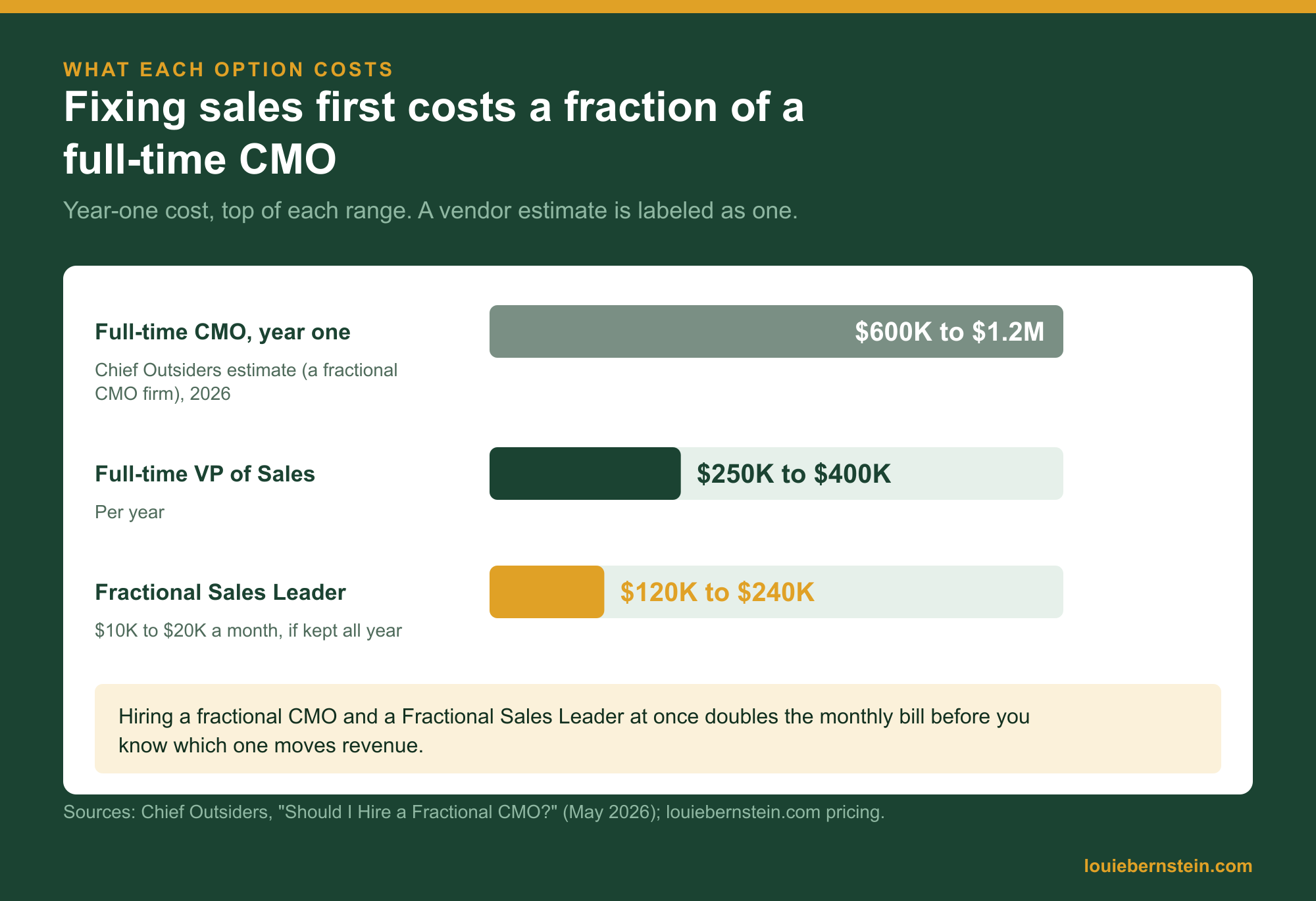
You can hire a fractional CMO and a Fractional Sales Leader at the same time, but it's expensive and it blurs accountability. You pay two senior people before you know which one moves revenue. If you do it, make one person own the pipeline number from first touch to closed deal, and give the other a clear supporting role.
The cost adds up fast. Fractional Sales Leaders generally run $10K to $20K a month. Add a fractional CMO and you've doubled the monthly bill. For comparison, Chief Outsiders estimates a full-time CMO can cost $600,000 to $1.2 million in year one. That's a vendor estimate from a firm that sells the fractional alternative, so read it that way. A full-time VP of Sales runs $250K to $400K a year.
Misalignment is common even when both seats are filled. In Chief Outsiders' own survey of mid-market companies, nearly one-third of C-suite executives reported misalignment between their sales and marketing teams. Getting it right matters: Forrester's research on the economics of alignment found that companies with strong alignment across sales, marketing and product grew revenue 19% faster and were 15% more profitable (Forrester, 2018). If you run both at once, I'd start with a weekly loop like the one in how to align sales and marketing in a small B2B company.
When should I add marketing after fixing sales?
Add a fractional CMO when three signals are true: reps follow the sales process without being chased, the forecast held for a full quarter, and the team can handle more qualified leads than it gets. When all three hold, every new lead lands in a system that converts. Before that, marketing money mostly pays for leads you'll waste.
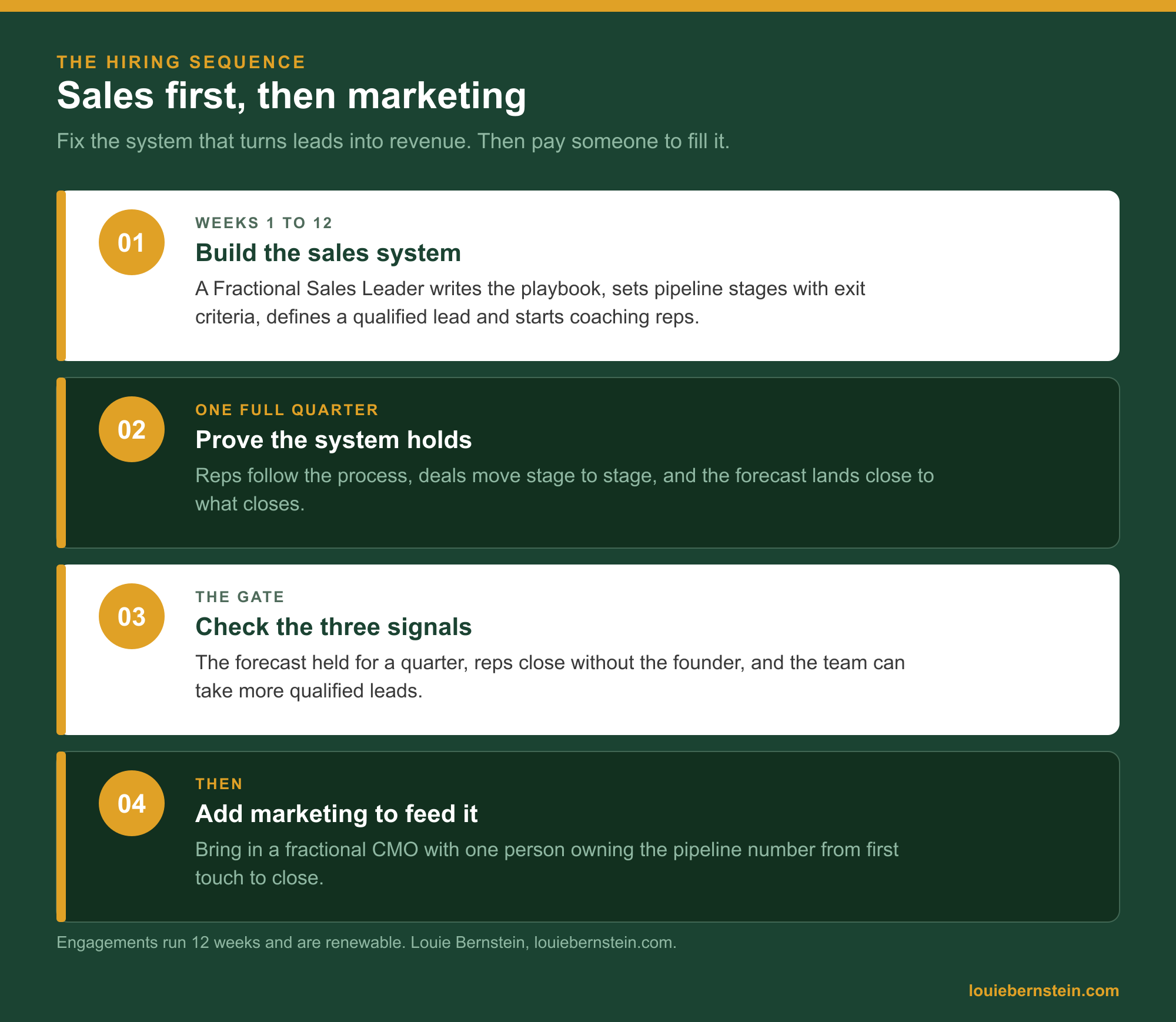
My engagements run 12 weeks, renewable, at $14K a month for 20 to 35 hours a week. Most fractional clients renew for 6 to 12 months total. The first 12 weeks build the system. The next quarter proves it. That's usually the right moment to bring in marketing, and by then you'll know exactly what kind of lead you want more of.
The three-signal gate before you hire marketing
- The forecast held. For one full quarter, what you called closed was close to what actually closed.
- Reps close without you. At least some mid-size deals closed this quarter with the founder out of the room.
- There's room for more. Reps have calendar space and follow up on every qualified lead within a day.
Frequently Asked Questions
Do I need a fractional CMO if I'm still doing founder-led sales?
Usually not yet. If you still close most deals yourself, the bottleneck is your time, not your lead flow. A fractional CMO would send you more leads you can't follow up on. Build a sales process someone else can run first, then add marketing.
Is a fractional CMO cheaper than a full-time CMO?
Yes, by a wide margin. Chief Outsiders, which sells fractional CMOs, estimates a full-time CMO at $600,000 to $1.2 million in year one including salary, bonus, benefits, search fees and onboarding. A fractional CMO costs a fraction of that, though the right first hire still depends on whether your problem is leads or conversion.
Should a fractional CMO or a fractional sales leader own the pipeline number?
One of them has to own it from first touch to closed deal. In a founder-led company with a broken sales process, I'd give it to the sales leader, because most of the leak is after the first meeting. Splitting ownership between two part-time executives means nobody is accountable.
What if I can only afford one senior hire this year?
Pick the one that fixes your biggest leak. If qualified leads already convert well, hire marketing. If deals stall and you close everything yourself, hire a Fractional Sales Leader. Most founders I meet at $1M to $10M ARR are in the second group.
Can a Fractional Sales Leader help with lead generation too?
Yes, within limits. A Fractional Sales Leader can set up outbound prospecting, referral asks and a definition of the ideal customer, which already produces more conversations. What the sales leader won't do is run brand, content and paid campaigns. That's when a CMO earns the fee.
Fix the sales system before you buy more leads.
If you're a B2B founder at $1M to $10M ARR and you can't tell whether you have a lead problem or a sales problem, let's look at your pipeline together and find where the revenue is leaking. Learn about Fractional Sales Leadership at LouieBernstein.com.
Schedule a 30-Minute CallAbout the Author

Louie Bernstein Fractional Sales Leadership
Louie Bernstein is a Fractional Sales Leader with 50 years of sales experience and has worked as a Fractional Sales Leader since 2017. He built and ran MindIQ for 22 years. He helps B2B founders at $1M to $10M ARR build repeatable sales systems so selling doesn't depend on the founder.