I bootstrapped MindIQ for 22 years. Here's how to build a sales team without outside money.
A bootstrapped B2B company can build a sales team without outside money, but it has to build in the right order: write down how you sell, define the job, prove your cash can cover a new rep's ramp, then hire. Fractional Sales Leadership fits bootstrapped companies because a Fractional Sales Leader builds that system at roughly half the cost of a full-time VP of Sales, on a 12-week renewable engagement instead of a full-time bet.
Key Takeaways
- A bootstrapped B2B company can build a sales team from cash flow if it builds the sales system before it hires the salespeople.
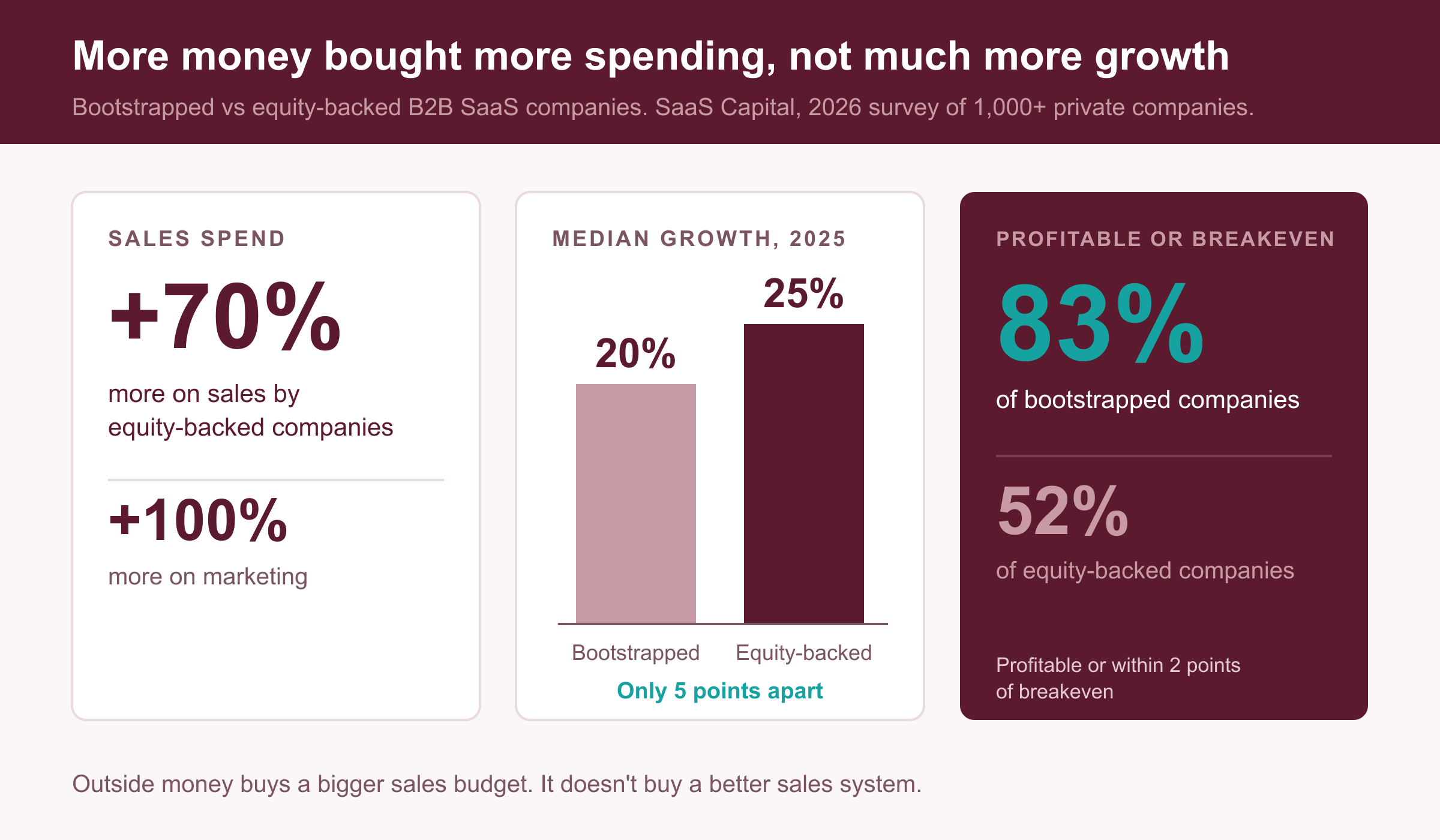
- Outside money buys spending more than growth. Equity-backed SaaS companies spend 70% more on sales than bootstrapped ones, yet grew at a median 25% in 2025 against 20% for bootstrapped companies (SaaS Capital, 1,000+ companies).
- A new account executive takes 6.2 months to ramp (Bridge Group, 2026). A bootstrapped founder should have that much of a rep's pay in the bank before the hire, not in the forecast.
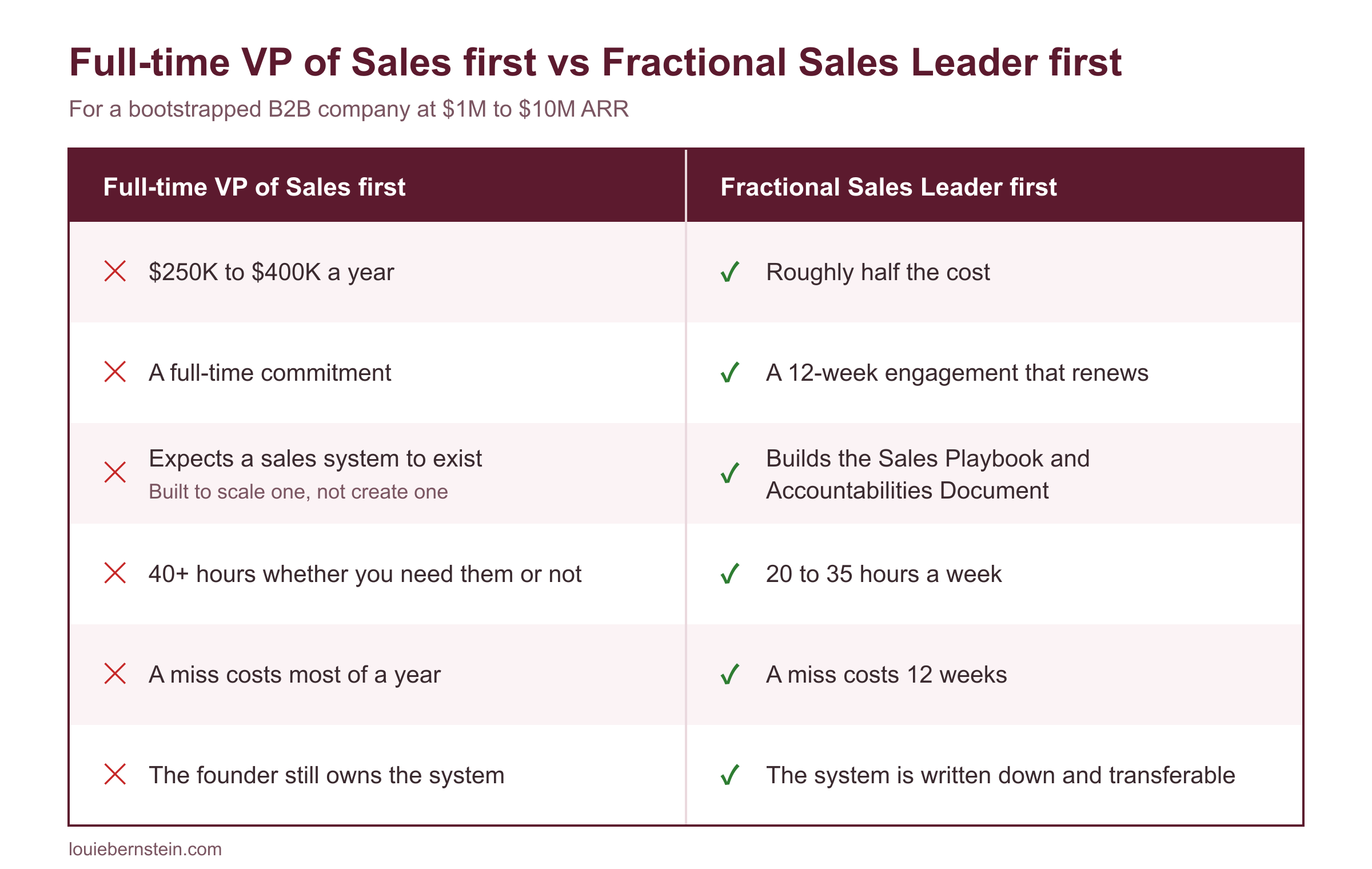
- For most bootstrapped companies between $1M and $10M ARR, a full-time VP of Sales at $250K to $400K a year is too big a bet too early. A Fractional Sales Leader builds the system first at roughly half the cost.
- Before your next sales hire, write a one-page Sales Playbook and an Accountabilities Document for the role. If you can't write them, you aren't ready to hire.
I ran MindIQ for 22 years without a dollar of venture money.
We made the Inc. 500 in 2002. We got through multiple recessions. And for a long stretch of those 22 years, I was the best salesperson we had. I was proud of that. It was also the problem.
When you bootstrap, every salesperson you hire is paid out of the money your customers already sent you. There's no investor check to cover a bad hire. So you either get sales hiring right, or you go back to doing it all yourself, usually at 55 hours a week. I know. I did that for years.
Bootstrapped founders don't need more money to build a sales team. They need a better order of operations.
Can a bootstrapped B2B company build a sales team without outside money?
Yes. A bootstrapped B2B company can build a sales team without outside money, and the data says it gives up less growth than founders fear. Bootstrapped companies grow a bit slower than funded ones, but they spend far less to do it, and most of them are profitable while they grow.
What the 2026 numbers say about bootstrapped growth
SaaS Capital's 15th annual survey of more than 1,000 private B2B SaaS companies (2026) found:
- Bootstrapped companies grew at a median 20% in 2025. Equity-backed companies grew at 25%.
- Equity-backed companies spend 70% more on sales and 100% more on marketing than bootstrapped companies.
- 83% of bootstrapped companies are profitable or within two points of breakeven. Only 52% of equity-backed companies are.
Read that again. Funded companies spend 70% more on sales and grow 5 points faster. Outside money buys a bigger sales budget. It doesn't buy a better sales system. Those numbers come from SaaS companies, but I think the same lesson holds for any B2B company paying salespeople out of revenue.
Why is a sales hire riskier for a bootstrapped company?
A sales hire is riskier for a bootstrapped company because the company pays the new rep for months before the rep pays the company back, and there's no investor money to cover a miss. One failed hire can eat a year of a small company's profit and put the founder back in every deal.
The ramp is longer than most founders plan for
A new account executive takes 6.2 months to fully ramp, a record high (Bridge Group, 2026). And only 48% of account executives hit their annual quota in 2026, down from 51% in 2024 (Bridge Group). So a bootstrapped founder is paying half a year of salary on a hire with roughly coin-flip odds of making the number.
Here's simple example math. Say you hire a rep with an $80K base salary. At a 6.2-month ramp, you pay about $41K in base before that rep is fully productive. Add benefits, tools and the hours you spend training, and the real number is higher.
The cash rule I'd use
Before a bootstrapped company hires a salesperson, I'd want the cash for that rep's full ramp sitting in the bank. Not in the forecast. Not in "the deals that are about to close." In the bank. If the money's only in the pipeline, you're hiring on hope, and hope is a lousy way to make payroll.
If you want to check the other side of that math, here's how to figure how long it should take to recover your B2B sales costs.
Should a bootstrapped founder hire a full-time VP of Sales?
Usually not yet. A bootstrapped founder between $1M and $10M ARR usually shouldn't hire a full-time VP of Sales first, because a VP of Sales costs $250K to $400K a year and is built to scale a sales system, not create one. Without a documented process, you're paying executive money for founder work.
A funded company can absorb a VP who doesn't work out. The investors wrote the check expecting some misses. A bootstrapped company is writing that check out of its own profit. If the VP leaves in month nine, you've lost the salary, the recruiting cost and most of a year.
A Fractional Sales Leader flips the order. Other Fractional Sales Leaders run $10K to $20K a month. My fee is $14K a month for 20 to 35 hours a week, in 12-week engagements that renew. That's roughly half the cost of a full-time VP, and the job is to build the system a VP or senior rep can run later.
What order should a bootstrapped company build its sales team in?
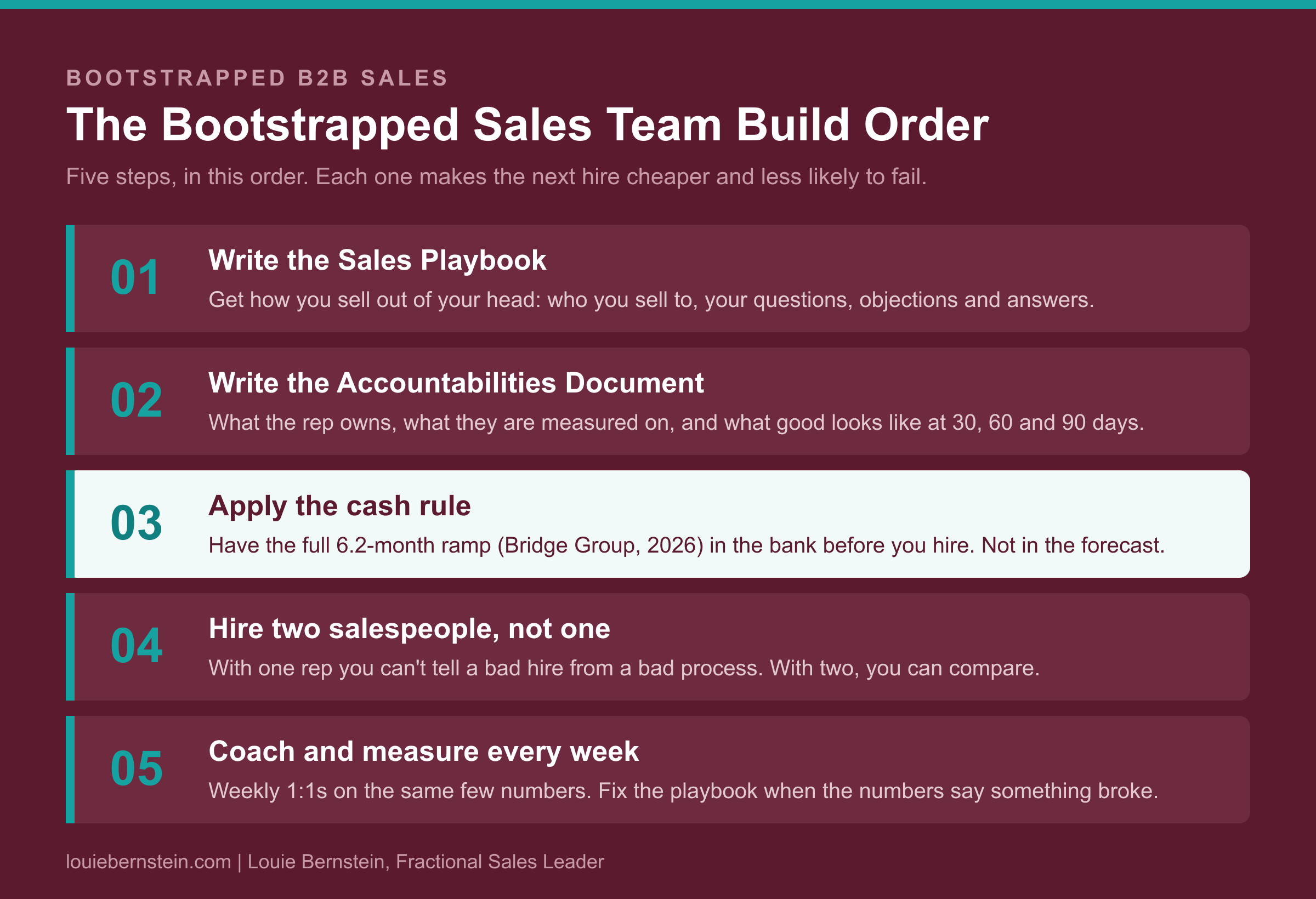
A bootstrapped company should build its sales team in five steps: write the Sales Playbook, write the Accountabilities Document, apply the cash rule, hire two salespeople together, then coach and measure every week. The order matters because each step makes the next hire cheaper and less likely to fail.
1. Write the Sales Playbook
Your sales process lives in your head. Get it on paper: who you sell to, the questions you ask, the objections you hear, and what you say back. A Sales Playbook is what lets a new rep sell the way you sell without you on every call.
2. Write the Accountabilities Document
Write down what the salesperson owns, what they're measured on, and what good looks like at 30, 60 and 90 days. A Sales Accountabilities Document keeps you from hiring someone and then figuring out the job after they start.
3. Apply the cash rule
Have the ramp paid for before the offer goes out. If the cash isn't there, keep selling and keep documenting until it is. It may feel slow. It's also how bootstrapped companies stay alive.
4. Hire two salespeople, not one
With one rep, you can't tell a bad hire from a bad process. With two, you can compare. I've written about why founders should never hire one salesperson. It costs more up front, so it's another reason the cash rule comes first.
5. Coach and measure every week
Hold a weekly 1:1 with each rep and look at the same few numbers every time: meetings booked, deals moved forward, deals lost and why. Fix the playbook when the numbers tell you something's broken.
What did 22 years bootstrapping MindIQ teach me about building a sales team?
Twenty-two years bootstrapping MindIQ taught me that bootstrapped founders rarely fail at sales hiring because they spend too little. They fail because they save money in the wrong places, skipping the system to afford the salesperson, and then pay for it in lost months and failed hires.
What I got wrong
I hired my first two salespeople without a playbook. It was a costly, frustrating mistake. They were smart people. They just had nothing to follow except me, and I was too busy selling to teach them.
I also worked more than 55 hours a week for most of those 22 years. I felt I had to do everything. As a bootstrapped company, early on, you kind of have to. But not after 5, 10 or 15 years. Looking back, I was squeezing pennies so hard they were costing me dollars.
Where bootstrapped founders usually get this wrong
Here's the pattern I see over and over in fractional engagements. The bootstrapped founder decides they can't afford a seasoned salesperson, so they hire the cheapest one they can find and hope that person figures out the process. They don't. Nobody can figure out a process that only exists in the founder's head. Six months later the rep is gone, the money is gone, and the founder is back closing every deal.
The cheap hire is usually the expensive one. The system is what makes a reasonably priced hire work.
Why I'd stay bootstrapped
I once held a job as Chief Sales Officer at a company that took venture money after a record year. When the investment was final, I was told nothing would change. That's when I knew it would. I was let go in less than 90 days.
Outside money changes who you answer to. I think bootstrapping is an attitude: you want to build a business where you only have one person to answer to. If that's you, you can absolutely build a sales team. You just have to build it in the right order.
Spend on the system before you spend on the salesperson. The system is what keeps the salesperson.
When does Fractional Sales Leadership make sense for a bootstrapped company?
Fractional Sales Leadership makes sense for a bootstrapped company when the founder is still closing most of the deals, revenue is somewhere between $1M and $10M ARR, and there's no written sales process yet. A Fractional Sales Leader builds the process, hires and coaches the first reps, and hands it off without a full-time executive salary.
Signs you're ready
- You close most of the deals, and revenue stalls when you take a week off.
- You've hired a salesperson before and it didn't work, and you're not sure why.
- You have enough cash for a rep's ramp but not for a $250K to $400K VP of Sales.
- You can't hand a new hire a written playbook today.
When it's too early
If you're under $1M ARR and still figuring out who buys and why, Fractional Sales Leadership is probably too early. You need more customers first. If the budget is tight, my Founders Corner coaching is $1,400 a month for one session a week over 12 weeks, and it's built for founders still doing the selling themselves.
Most of my fractional clients renew for 6 to 12 months total. By then the playbook is written, the reps are hitting their numbers, and the founder is running the company instead of the pipeline. You can see how the work runs on the Fractional Sales Leader page.
Frequently Asked Questions
How much does Fractional Sales Leadership cost for a bootstrapped company?
Fractional Sales Leaders, Fractional VPs of Sales and Fractional CROs generally run $10K to $20K a month. My fee is $14K a month for 20 to 35 hours a week, in 12-week engagements that renew. That's roughly half the cost of a full-time VP of Sales at $250K to $400K a year.
Should a bootstrapped company hire commission-only salespeople to save cash?
Commission-only can look like free sales help, but it rarely saves a bootstrapped company money. A rep with no base salary will chase whatever closes fastest and leave when a paying job shows up. Pay a fair base, and protect your cash with the cash rule and a written playbook instead.
How long does it take to build a sales team without outside funding?
I'd plan on about a year from the first written playbook to two ramped salespeople. Writing the playbook and Accountabilities Document takes weeks, hiring takes a month or two, and a new account executive takes 6.2 months to fully ramp (Bridge Group, 2026). Rushing any step usually adds time, not saves it.
Can a Fractional Sales Leader also sell for my company?
A Fractional Sales Leader may join some deals to coach your reps or model the process, but the job is building the system, not carrying a quota. If revenue only happens when the Fractional Sales Leader personally sells, you've traded one bottleneck for another.
Is it a mistake to stay bootstrapped instead of raising money for sales?
No. In SaaS Capital's 2026 survey, bootstrapped companies grew at a median 20% versus 25% for equity-backed companies, while 83% of bootstrapped companies were profitable or near breakeven. Raise money if you need it for the product or the market. Don't raise it just to hire salespeople into a process nobody wrote down.
Build your sales team on your own cash, in the right order.
If you're a bootstrapped B2B founder at $1M to $10M ARR still closing most of the deals, let's look at your playbook, your cash and your next hire, and map out the build order that fits your business. Learn about Fractional Sales Leadership at LouieBernstein.com.
Schedule a 30-Minute CallAbout the Author

Louie Bernstein Fractional Sales Leadership
Louie Bernstein is a Fractional Sales Leader with 50 years of sales experience and has worked as a Fractional Sales Leader since 2017. He built and ran MindIQ for 22 years. He helps B2B founders at $1M to $10M ARR build repeatable sales systems so selling doesn't depend on the founder.