What information do they need without me in the presentation?
To get your champion to sell for you, hand them a presentation they can give in 10 minutes without you: the problem in their words, the cost of doing nothing in their numbers, one short answer for each person who has to say yes, a plan from yes to live, and how to bring you in. Buyers spend only 17% of their buying time with all suppliers combined (Gartner), so your champion makes the case without you.
Key Takeaways
- Your champion sells for you when they can present the case in about 10 minutes without you: the problem, the cost of doing nothing, one answer per approver, a plan with dates, and a way to call you in.
- B2B buyers spend only 17% of their buying time meeting with all potential suppliers combined (Gartner). The rest of the decision happens in meetings you'll never attend.
- Don't hand your champion your sales deck. Gartner's 2025 survey of 632 buyers found content built for the whole buying group made buyers three times more likely to report a high-quality deal.
- Before the internal meeting, have your champion present to your rep for 20 minutes while the rep plays the toughest person in the room.
- If you, the founder, are still the champion-maker in every deal, make the champion presentation a step in your sales playbook that your reps own and you review weekly.
Your champion loved the demo. They said, "Let me take this to the team." Then the meeting happened without you, and the deal went quiet.
Here's what happened in that room. Your champion stood up with your 24-slide deck, skipped to the pricing slide, and got asked three questions they couldn't answer. Finance wanted the payback. The VP wanted to know why now. Someone in IT asked where the data lives. Your champion said, "I'll find out." Nobody decided anything.
Your champion can't sell for you with your pitch. They can only sell with their own case, in their own words.
That's fixable. Your champion doesn't need to become a salesperson. They need the right information, in the right order, for the people in that room. Here's exactly what to give them.
What Information Does My Champion Need to Present Without Me?
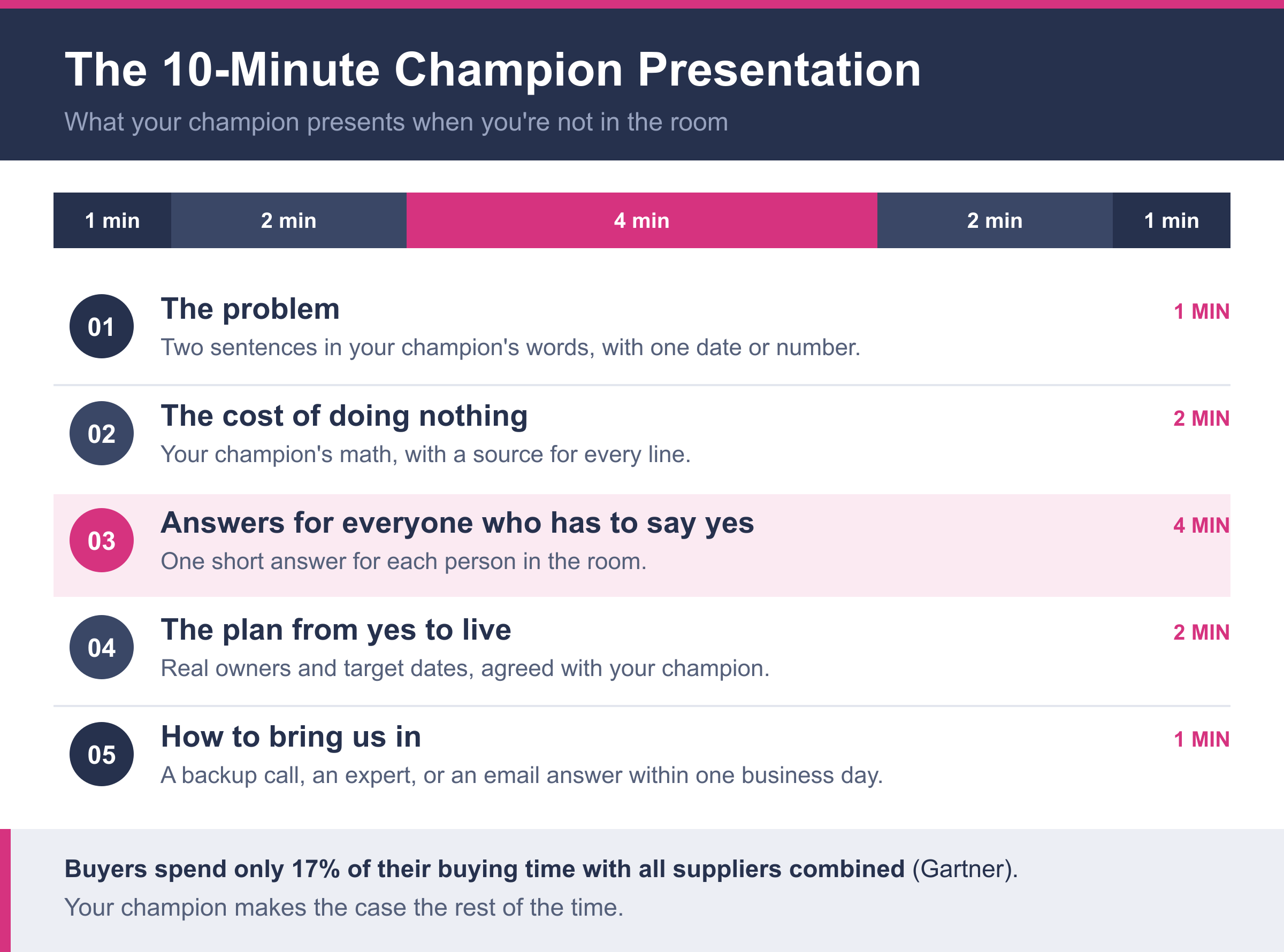
Your champion needs five pieces of information to present without you: the problem in their own words, the yearly cost of doing nothing in their numbers, one short answer for each approver, a plan from yes to live with owners and dates, and a clear way to bring you in. Each piece answers a question the room will ask.
The 10-minute run order
Build the champion presentation in the order the room thinks, not the order you pitch. Most internal meetings give your proposal a slot on a busy agenda, so plan for about 10 minutes.
- The problem (1 minute). Two sentences your champion would say to their boss, with one date or number that makes it urgent. Use their words from discovery, not your tagline.
- The cost of doing nothing (2 minutes). What the problem costs per year: hours lost, revenue delayed, workarounds paid for, and the risk if nothing changes. Every number gets a source the champion can name.
- Answers for everyone who has to say yes (4 minutes). One or two sentences for each person in the room. This is the biggest block because this is where deals stall.
- The plan from yes to live (2 minutes). The steps from decision to first result, with an owner and a target date for each one.
- How to bring you in (1 minute). A backup call, an expert from your team, an email answer within one business day, or 20 minutes with the decision maker.
Why the champion's numbers beat yours
Use your champion's math, even when it's lower than yours. When the CFO asks, "Where did this number come from?", your champion can say, "Our last 12 months of invoices." They can't defend your ROI calculator, and they know it. For the full money side, see how to build a business case your buyer can take to the CFO.
Why Can't My Champion Just Use My Sales Deck?
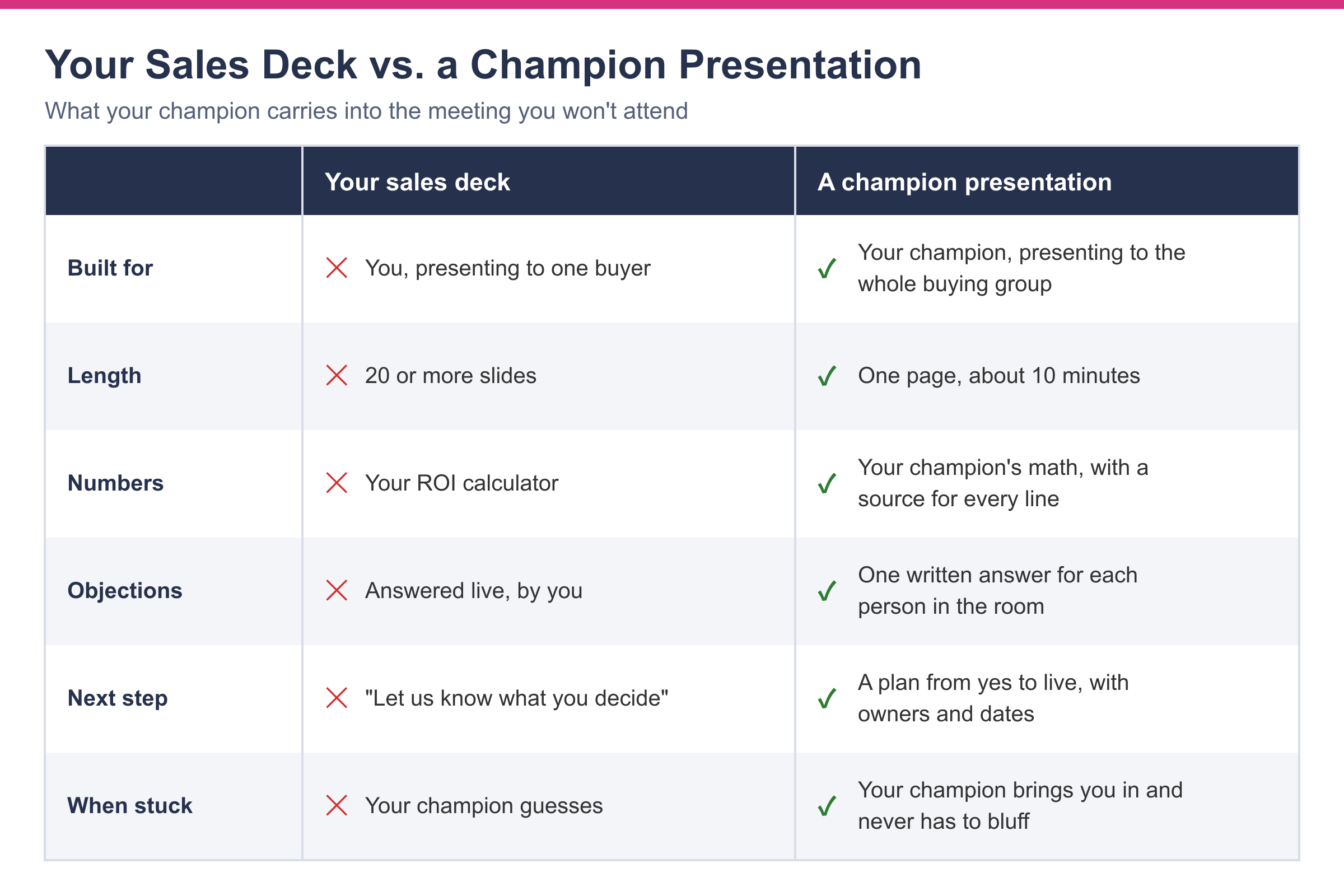
Your champion can't use your sales deck because it was built for you to present to one buyer, live, with you answering the questions. An internal presentation goes to a group with different priorities, and nobody from your company is there. The deck is too long, and the numbers are yours.
The buying group needs one shared case
Gartner surveyed 632 B2B buyers in August and September 2024 and found that content tailored to the buying group lifted consensus 20%, while content tailored to individuals cut consensus 59%. Buyers who experienced buying-group relevance were three times more likely to report a high-quality deal (Gartner, 2025).
Your sales deck usually does the opposite. It pitches features to whoever is watching. A champion presentation starts with the problem the whole group shares, then gives each person a short answer that ties back to it.
Give it to them in a format they can change
Send the champion presentation as an editable document, not a locked PDF. Your champion will paste parts of it into an email, cut a line that doesn't sound like them, and add a number from their own system. That's what you want. Once they've edited it, it's their case, and people defend their own case harder than they defend yours.
What Questions Will the Room Ask My Champion?
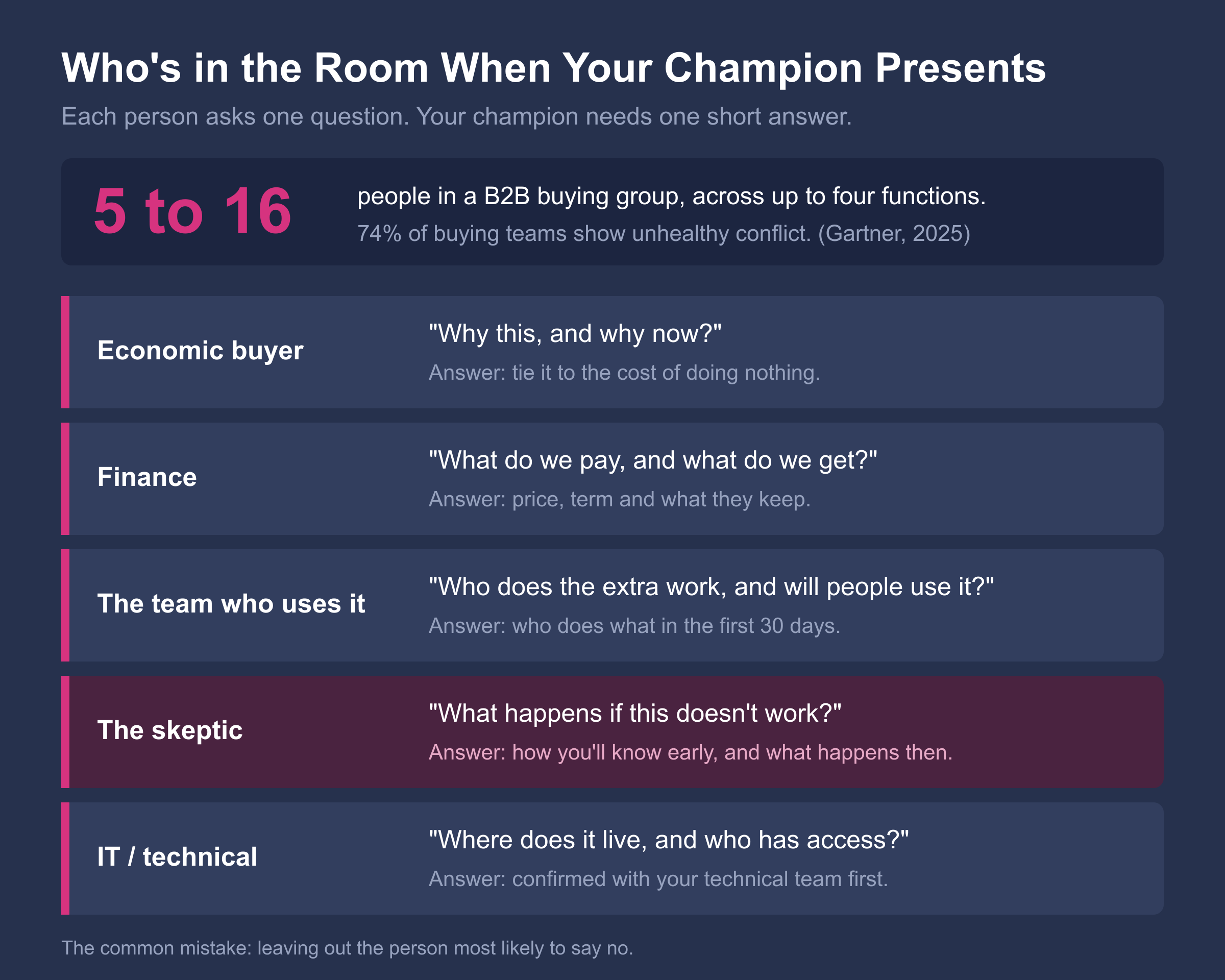
The room will ask your champion five kinds of questions, one from each type of person who has to say yes: the economic buyer, finance, the team who will use it, the skeptic, and IT. Your champion needs one short, written answer for each. A single unanswered question is often enough to push the decision to next quarter.
One question per person
- Economic buyer: "Why this, and why now?" Tie the answer to the cost of doing nothing.
- Finance: "What do we pay, and what do we get?" Price, term, and what they keep, compared to the cost of doing nothing.
- The team who uses it: "Who does the extra work, and will people use it?" Who does what in the first 30 days, and what gets easier for them.
- The skeptic: "What happens if this doesn't work?" The honest answer: how they'll know early, and what happens then.
- IT or technical: "Where does it live, and who has access?" Confirm the details with your technical team before you write the answer.
Gartner's research puts B2B buying groups at five to 16 people across as many as four functions, and found 74% of buying teams show unhealthy conflict during the decision (Gartner, 2025). Your champion walks into that room alone. If you're not sure who will be there, work it out with your champion first, using who really makes the decision in a B2B sale.
Match the room to the company's size
At a small company, the room is often one person: the owner. Keep the champion presentation short and go straight to the plan and a date. At a mid-size company, the champion is usually a manager or director, and the economic buyer is the VP or owner who signs. At a larger or investor-backed company, add a line for each extra approver: department head, finance, then the CEO or board.
How Do I Prepare My Champion Before the Internal Meeting?
Prepare your champion with one 20-minute rehearsal a few days before the internal meeting. Your champion presents the case to your rep, and your rep plays the toughest person in the room. The rehearsal shows you which answers are weak while there's still time to fix them, and it gives your champion confidence.
Four steps that make the rehearsal work
- Ask the one question that matters. "Who will push back, and what will they say?" Write each objection down.
- Let your champion fix the wording. If a sentence sounds like a salesperson wrote it, your champion rewrites it. Their voice carries further than yours.
- Agree on the "I don't know" answer. Your champion should never bluff. Give them a line: "Good question. I'll have the answer by tomorrow." Then make sure your rep delivers it within one business day.
- Book the debrief now. Put a call on the calendar for the same day as the internal meeting, while your champion still remembers who said what.
Ask to be the backup, not the presenter
Ask your champion if you can listen by phone or sit in as backup for technical questions. Don't ask to take over the meeting. You'll get invited more often when your champion sees you as someone who helps them look good, and less often when they see you as someone pushing for a close.
Why Am I Still the Champion in Every Deal?
You're still the champion in every deal because you do the champion work yourself. The founder builds the relationship, writes the case and shows up to save the deal, so nothing gets written down for the reps. When the founder steps back, the reps find someone who likes them, and then they wait.
Where founders usually get this wrong
When I work with founders at $1M to $10M ARR, I see the same pattern again and again. The reps have contacts in every account. They take calls and say nice things. But the contact never introduces the rep to anyone else, never shares how the last purchase got approved, and never warns them when the deal is in trouble. I call that contact a fan.
A real champion shows you by what they do: they share inside information, set up meetings with the other people who decide, and correct your numbers. If your rep can't name one thing the contact has done to move the deal, find another champion.
If you're still the champion in every deal your company wins, your company doesn't have a sales process. It has you.
Keep the champion presentation honest
Here's the rule I give every rep: never put a claim in the champion presentation you can't prove. Your champion's name is on it now. Confirm delivery dates with your team before they go in the plan. And sell what the customer actually needs. A deal the customer wouldn't choose after doing the math turns into a cancellation at the first renewal.
There's real money at stake in getting this right. Matt Dixon and Ted McKenna's research on 2.5 million recorded sales conversations, published in The JOLT Effect (2022), found 40% to 60% of lost deals ended in no decision (Challenger). A champion who can't answer the room's questions is how a lot of those deals end.
Make it a step in your playbook
Your reps will only do this every time if it's written into your sales playbook. The rep fills in the champion presentation right after discovery. The champion corrects the numbers and the wording. Rep and champion rehearse for 20 minutes. The rep debriefs the same day as the internal meeting. Log the presentation, the champion and the meeting date in your CRM, and review every open one in your weekly pipeline meeting. That's how you stop being the person who has to show up to save the deal.
How Do You Help Your Champion Sell Your Solution Internally?
Frequently Asked Questions
Should I offer to give the internal presentation myself?
Offer to be the backup, not the presenter. Most buying groups want to hear the case from one of their own, and a champion who presents it builds their own commitment to the decision. Ask to listen by phone or join for the technical questions, and let your champion lead.
What if my champion won't share their numbers?
If your champion won't help you build the cost of doing nothing, treat it as a warning sign about the deal. Start with ranges they're comfortable with, like hours a month or deals lost last year. If they still won't engage, they may be a fan, not a champion, and you need another contact.
How long should a champion's internal presentation be?
Plan for about 10 minutes and one page. Internal meetings usually give a purchase decision a short slot on a busy agenda. A champion presentation longer than that gets skimmed, and the questions that matter get skipped.
Should the champion presentation include price?
Yes, include the price, the term and what the customer keeps, written in the answer for finance and compared to the yearly cost of doing nothing. If price is missing, finance will ask, your champion will guess, and the decision gets delayed until someone calls you.
What should my rep do if the internal meeting happens and the champion goes quiet?
Your rep should already have a debrief booked for the same day. If the champion misses it, the rep sends a short note asking two questions: "Who pushed back, and what did they say?" Then the rep uses the agreed check-in date in the plan to follow up, instead of chasing with "just checking in."
Stop being the champion in every deal.
If you're a $1M to $10M ARR B2B founder and your reps still need you to save their deals, let's build the process that lets them win without you. Learn about Fractional Sales Leadership at LouieBernstein.com.
Schedule a 30-Minute CallAbout the Author

Louie Bernstein Fractional Sales Leadership
Louie Bernstein is a Fractional Sales Leader with 50 years of sales experience and has worked as a Fractional Sales Leader since 2017. He built and ran MindIQ for 22 years. He helps B2B founders at $1M to $10M ARR build repeatable sales systems so selling doesn't depend on the founder.