How do I do it without going broke along the way?
Move your product up market when four signals show up together: bigger customers are finding you, they stay and expand better than your small ones, they buy the same thing for the same reason, and your core business can pay for the test. Then don't move the whole company. Run a capped test, count the cash you'll carry until the first big payment clears, and write down your stop date first.
Key Takeaways
- It's time to move a product up market when bigger customers are pulling you there, renewing better than small customers, buying for one repeatable reason, and your core business can fund the test.
- One big logo asking for a demo isn't a market signal. Former Segment CRO Joe Morrissey calls mistaking early enterprise interest for product-market fit the biggest upmarket mistake he's seen (a16z, 2022).
- Bootstrapped private B2B SaaS companies spend a median 96% of ARR (SaaS Capital, 2026 survey). At that rate, a $5M ARR company has about $200K a year to fund a move up market.
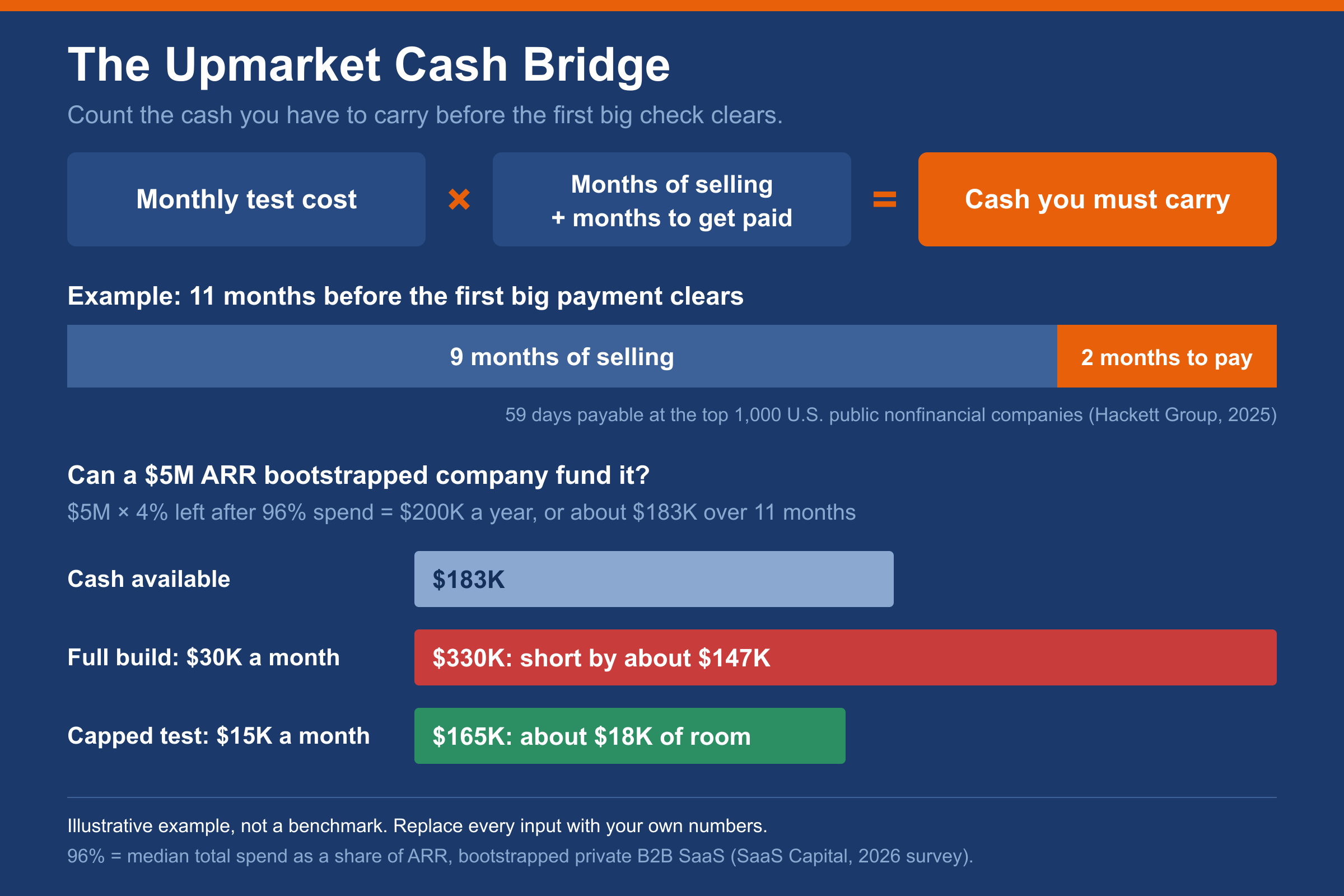
- Calculate your Cash Bridge before you spend a dollar: monthly test cost multiplied by months of selling plus months to get paid.
- A signed contract can still be two months from cash. Days payable outstanding at the top 1,000 U.S. public nonfinancial companies is 59 days (Hackett Group, 2025).
- Keep your core team selling your core product. Hire for the bigger market only after three deals close with the same buyer, the same reason, no custom work, and first payments cleared.
You just closed a deal three times your normal size. Everybody's high-fiving. Now you're wondering if you've been selling to the wrong companies all along.
Maybe you have. But the high-five leaves something out. Bigger customers take longer to buy, ask for more, and pay later. Your costs start today. Their money shows up much later.
I bootstrapped MindIQ for 22 years, and I've lost everything twice in business. So when a founder tells me they're moving up market, I don't ask about the product first. I ask how many months they can go without the money.
A signature doesn't make payroll. A cleared check does.
How do I know it's time to move my product up market?
It's time to move your product up market when four signals show up together: Pull, Stick, Repeat and Core. All four come from your own customer records, so you can check them this week. One signal isn't enough, because each one covers a different way a move up market fails.
If you're staring at one specific big deal, run my five-check Upmarket Readiness Test on that deal. These four signals answer a bigger question: should the product go after a bigger market at all?
Pull: are bigger customers already finding you?
Pull your closed deals from the last 12 months. Count the customers at three times your average deal or more who came to you without a special campaign. My rule of thumb is that you want at least three. One is a lucky break. Three is a pattern worth testing.
Stick: do bigger customers stay and expand?
Split your net revenue retention by customer size. SaaS Capital's 2025 benchmarks for private B2B companies say "higher net retention correlates with higher ACVs," with a 102% median at $25,000 to $50,000 in annual contract value (SaaS Capital, 2025). If your bigger customers retain worse than your small ones, your product isn't ready for them.
Segment learned this the hard way. As much as 20% of its ARR came from enterprise use cases that weren't the best fit. As the company got clear on which big customers it served, enterprise gross revenue retention rose from 63% to 92% (a16z, 2022).
Repeat: are they buying the same thing for the same reason?
List your five biggest deals. Write down the buyer's title, the problem, and anything you gave away to win. Same title and same problem means you have a market. Five different stories means you have five exceptions. Segment's warning sign was free consulting used to cover product gaps. If you can't describe that buyer in a sentence, start with defining your ideal customer.
Core: can your current business pay for this?
Your current customers will fund this test. If they're leaving or growth has stalled, there's nobody to pay the bill. Fix the core first.
Now score it. Four yeses and you run a capped test. Three, and you fix the missing one. Two or fewer, and you've got more money to make in the market you're already in. That scoring is my rule of thumb, not an industry standard.
What are the false signals that push founders up market too early?
The most common false signals are one big logo showing interest, an investor who wants bigger deals, and a core market that has gotten hard. Each one feels like a reason to move up market. None of them shows that larger buyers need your product and will keep paying for it.
- A famous company asked for a demo. Curious people at big companies book demos all day long. Interest costs them nothing.
- Your investor wants a bigger average deal. A bigger average deal is an outcome. Your investor isn't making payroll in month nine.
- Your small customers keep churning. Bigger customers may stay longer, but a weak product or sloppy onboarding will follow you up the ladder.
- A competitor moved up market. You don't know their cash position, and you don't know if it's working.
Where founders usually get this wrong
I think founders get the order wrong. They start with the sales plan. I start with the cash. Your best rep can learn a longer sale. Your bank account can't learn to wait.
How much cash does it take to move up market?
Moving up market takes enough cash to pay for the test until the first large customer's payment clears. Calculate that number with a Cash Bridge: monthly test cost multiplied by months of selling plus months to get paid. Costs begin on day one, while revenue from larger customers arrives much later.
Add up the monthly test cost
Include the time of whoever sells these deals, security and compliance work, product work for the bigger buyer, legal review, and travel. Count a reassigned rep at full cost, because the deals that rep stops closing are real money too.
Use honest months
Measure how long your biggest deals took, then add time. Segment needed sellers who could run cycles lasting "as long as 9 or 12 months" (a16z, 2022). That's one company, so use your own number if you have one.
Then add the wait for payment. Days payable outstanding at the top 1,000 U.S. public nonfinancial companies is 59 days, according to the Hackett Group's 2025 survey. That figure covers all their suppliers. A small vendor rarely gets better treatment.
Run the math on one example
Take a bootstrapped company at $5M ARR. Bootstrapped private B2B SaaS companies spend a median 96% of ARR (SaaS Capital, 2026 survey), which leaves 4%, or $200K a year. Nine months of selling plus two months to get paid is 11 months, so about $183K is available.
A full build at $30K a month costs $330K, which is about $147K short. A capped test at $15K a month costs $165K and leaves about $18K of room. These inputs are illustrative. ARR isn't cash, so replace every number with your own.
How do I move up market without going broke?
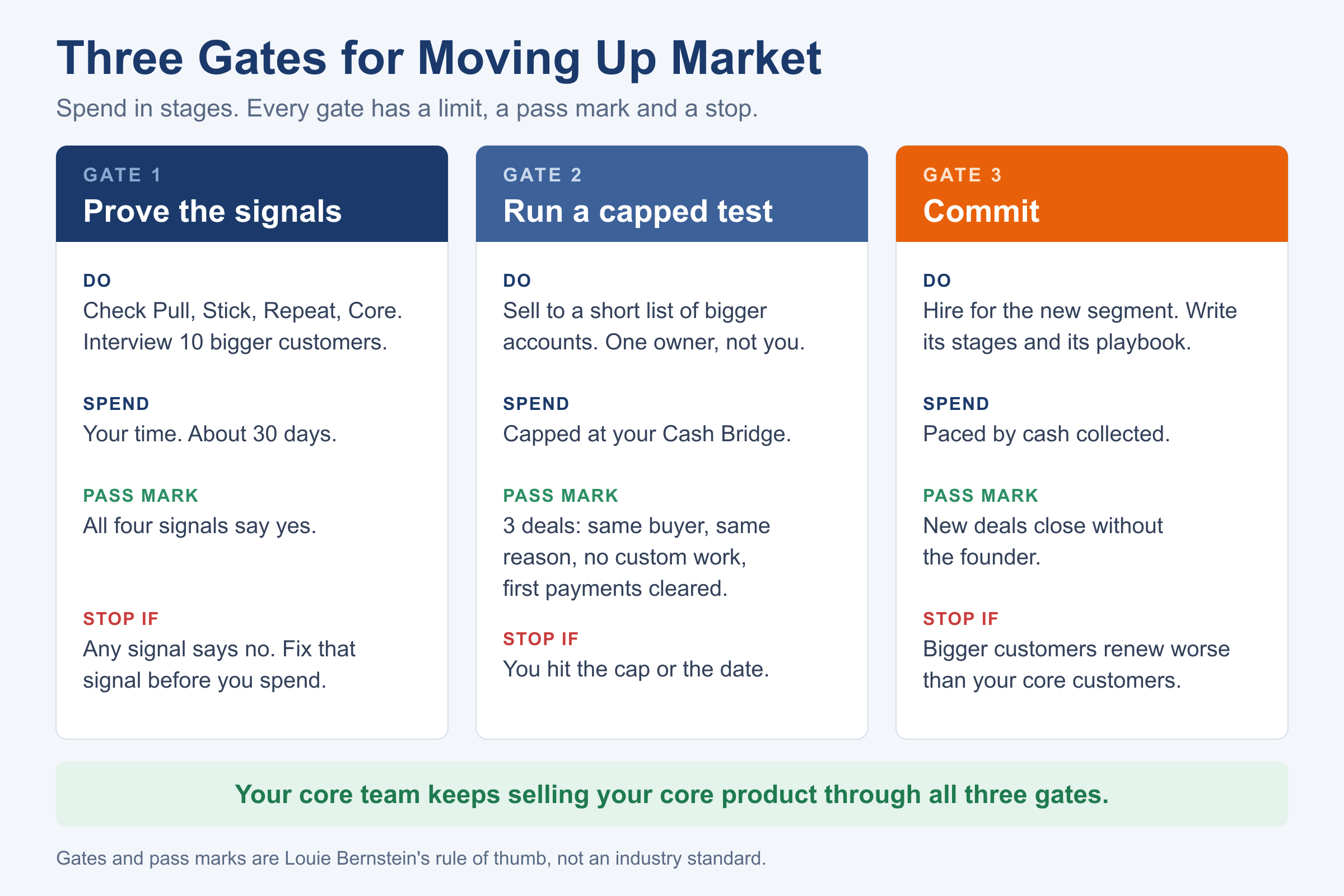
Move up market without going broke by spending in three gates: prove the signals, run a capped test, then commit. Your core team keeps selling your core product the entire time. Each gate has a spending limit and a pass mark, so one bad bet can't touch payroll.
Gate 1: Prove the signals
Spend about 30 days and almost no money. Check Pull, Stick, Repeat and Core. Interview 10 bigger customers or prospects and ask what they'd need to buy, renew and expand. Fill out one real security questionnaire and count the "no" answers.
Gate 2: Run a capped test
Pick a short list of bigger accounts that match the same buyer and problem. Name one deal owner who isn't you. Set your Cash Bridge as the spending cap and write down the stop date. Pass Gate 2 with three signed deals: same buyer, same reason, no custom work, and first payments cleared.
Gate 3: Commit
Now hire for the new market. Write its stages and its playbook. Let the cash you've collected set the pace.
Five rules that protect the cash
- Get paid early. Ask for annual payment up front and charge for implementation. A paid pilot puts money in the bank before the full contract.
- Negotiate payment terms before the verbal yes. Once procurement has your paperwork, you've lost your bargaining power.
- Build for a pattern, never a person. Segment cut 27 engineering priorities down to 3 themes (a16z, 2022). If only one buyer wants it, it can wait.
- Watch customer concentration. A new whale can become your next risk. Over 10% of revenue puts one customer in the watch zone, and over 20% needs a written plan.
- Lock up payroll. My rule of thumb: put three months of payroll in a separate account before the test starts. It's off limits.
Don't burn the boats. Your small customers are the ones paying for the trip.
What happens if the move up market doesn't work?
If a capped move up market doesn't work, you lose a budgeted amount and learn what bigger buyers actually want. An uncapped move can cost you the core business too. Set your stop date and spending cap before the test starts, while no live deal is tempting you to keep going.
What 50 years in sales has taught me
The most expensive words in a small company are "one more quarter." I've heard "it's with legal" for 50 years. Sometimes it's true. Sometimes it's hope-ium with a nice letterhead.
I've lost everything twice in business. Nobody who's been through that thinks a verbal yes is money. When you hit your stop date, go back to the market that's been paying your bills. Stop on schedule and you still have a company.
Who should run the move up market if I'm still closing the deals?
Someone other than the founder should own the day-to-day move up market, because a founder who closes every big deal proves only that the founder can close it. For a $1M to $10M ARR company, a Fractional Sales Leader can build the test without a full-time executive's salary.
A full-time VP of Sales runs $250K to $400K a year. That's a big line in a Cash Bridge, and you'd be hiring before you know the market is real. I work with founders as a Fractional Sales Leader for $14K a month, 20 to 35 hours a week, in renewable 12-week engagements. That's roughly half the cost. Count my fee in your Cash Bridge like anything else.
My job is to run the gates with your real numbers, coach a rep through the longer sale, and keep you out of the closer's seat. If the answer turns out to be "not yet," I'll say so.
Can Your Reps Sell a Six-Figure Deal? Check whether your team can run the longer sale before Gate 2.
Frequently Asked Questions
Q: Should I stop selling to smaller customers when I move up market?
No. Smaller customers fund the move up market, so keep selling to them through all three gates. Consider changing your focus only after bigger customers have renewed and your new market brings in enough cash to carry itself.
Q: Do I need SOC 2 before I sell to bigger companies?
Ask your Gate 1 interviews before you pay for it. In a Secureframe benchmark survey of 255 security, compliance and IT professionals in October 2025, 38% had lost revenue or bids for lack of certification and 47% saw delayed sales cycles (Secureframe, 2026 report). If your target buyers require it, put it in the Cash Bridge.
Q: How long does it take to move a product up market?
Plan on more than a year. You need at least one full sales cycle to see whether bigger buyers will sign, plus a renewal to see whether they stay. There's no reliable industry timeline, so measure your own biggest deals.
Q: Should I raise outside money to move up market?
I'd wait until after Gate 2. Outside money can pay for more reps, but it won't shorten a buyer's procurement process. Raise money to scale something you've proven, after three deals show the new market is real.
Q: Could I just raise my prices instead of moving up market?
Often that's the cheaper first move. A price increase tests whether your product is worth more without a longer sales cycle or new buyers. Learn how to raise prices without losing customers before you fund a new market.
Find out if your product is ready for a bigger market
In 30 minutes, we'll check your four signals and rough out your Cash Bridge, so you know what you can afford to test.
Schedule a 30-Minute CallAbout the Author
Louie Bernstein is a Fractional Sales Leader with 50 years of sales experience and has worked as a Fractional Sales Leader since 2017. He built and ran MindIQ for 22 years. He helps B2B founders at $1M to $10M ARR build repeatable sales systems so selling doesn't depend on the founder.