Maybe. A rep who closes fast, simple deals is not automatically ready for a six-figure deal. Before you hand them one, check five things: do they already work with more than one person per deal, write down next steps with dates, keep the CRM clean, ask for help early, and talk about business results instead of features. Then close the skill gaps with weekly coaching, give big deals their own forecast rules, and settle the comp questions before the deal closes, not after.
Key Takeaways:
- Closing small deals fast and closing big deals slowly are different jobs. A great small-deal rep can still struggle with a six-figure deal.
- Check five habits before you hand a rep a big deal. My rule of thumb: four out of five means ready with coaching. Fewer means not yet.
- Six skills change on big deals: discovery, the business case, the long cycle, the mutual action plan, procurement, and forecasting. Each one can be coached.
- Forecast big deals one at a time, on buyer actions only. Never let one deal cover a hole in the quarter.
- Settle the comp questions up front: when commission is paid, how a whale deal affects quota, and who gets credit.
- Develop your current reps when big deals are occasional. Hire a different profile when big deals become your main business.
A big logo is finally in your pipeline. It's worth more than any deal your team has closed. Your best rep is excited. You're nervous.
Your rep is good. They close a deal every week or two, and buyers like them. But every deal they've closed had one buyer, one problem, and a signature inside a month.
This one has seven people on the buyer's side. A security review. A legal team. A purchasing department. A decision that might take two quarters. Your rep has never seen anything like it.
So the question isn't really "Is my rep good?" It's "Is my rep ready for this kind of deal, and if not, what do I do about it?" Get that wrong, and you end up right back where you started, on every call, running the deal yourself.
A rep who's great at small deals isn't failing when a big deal confuses them. They're doing a job nobody trained them for.
Why a great small-deal rep isn't automatically ready
Small deals reward speed. Get the buyer excited, show the product, send the proposal, follow up until they sign. A rep who's great at that has trained themselves to move fast and keep things simple.
Big deals punish exactly those habits. Moving fast with one excited person gets you a champion with no budget. Keeping it simple means you never meet the people who can say no. And following up "until they sign" turns into months of polite check-in emails while the deal quietly dies.
How to tell if a rep is ready for a bigger deal
Don't judge it by their quota attainment. Plenty of reps hit quota on small deals and would struggle on a big one. Look at their habits instead. These five tell you more than any number.
1. They already work with more than one person per deal
Look at their last ten closed deals. How many had two or more contacts in the CRM? A rep who sells to one person on every deal will sell to one person on a big deal too. That's how big deals die.
2. They end every meeting with a next step and a date
Not "I'll follow up next week." A booked meeting, on both calendars, with an agenda. On a small deal, loose follow-up costs you a few days. On a six-month deal, it costs you the deal.
3. Their CRM tells the real story
Pull up three of their open deals. Can you tell, without asking them, who's involved, what happens next, and why the buyer cares? If it isn't in the CRM, it never happened. On a big deal, the CRM record is how you and a coach help without getting on the calls.
4. They ask for help early
Some reps ask for help when a deal first looks shaky. Others wait until it's lost. Big deals go wrong slowly, and the fixes only work early. A rep who hides problems will hide them on the big one too.
5. They talk about business results, not features
Listen to one of their calls. Do they ask what the problem costs the buyer, or do they jump to the demo? Executives on big deals don't buy features. They buy a result they can defend to their boss.
Big Deal Readiness Check
- Do at least half of their recent deals have two or more buyer contacts in the CRM?
- Does every open deal have a next step with a date?
- Can you read any deal record and know who, what's next, and why?
- Have they raised a deal problem before you found it, in the last quarter?
- On their calls, do they ask what the problem costs before they demo?
My rule of thumb: 4 or 5 yeses, hand them the deal with a coach. 2 or 3, let them run it with a coach in every weekly review and a plan to close the gaps. 0 or 1, they're not ready yet. Keep building the habits on smaller deals first.
The skill gaps, and how to coach each one
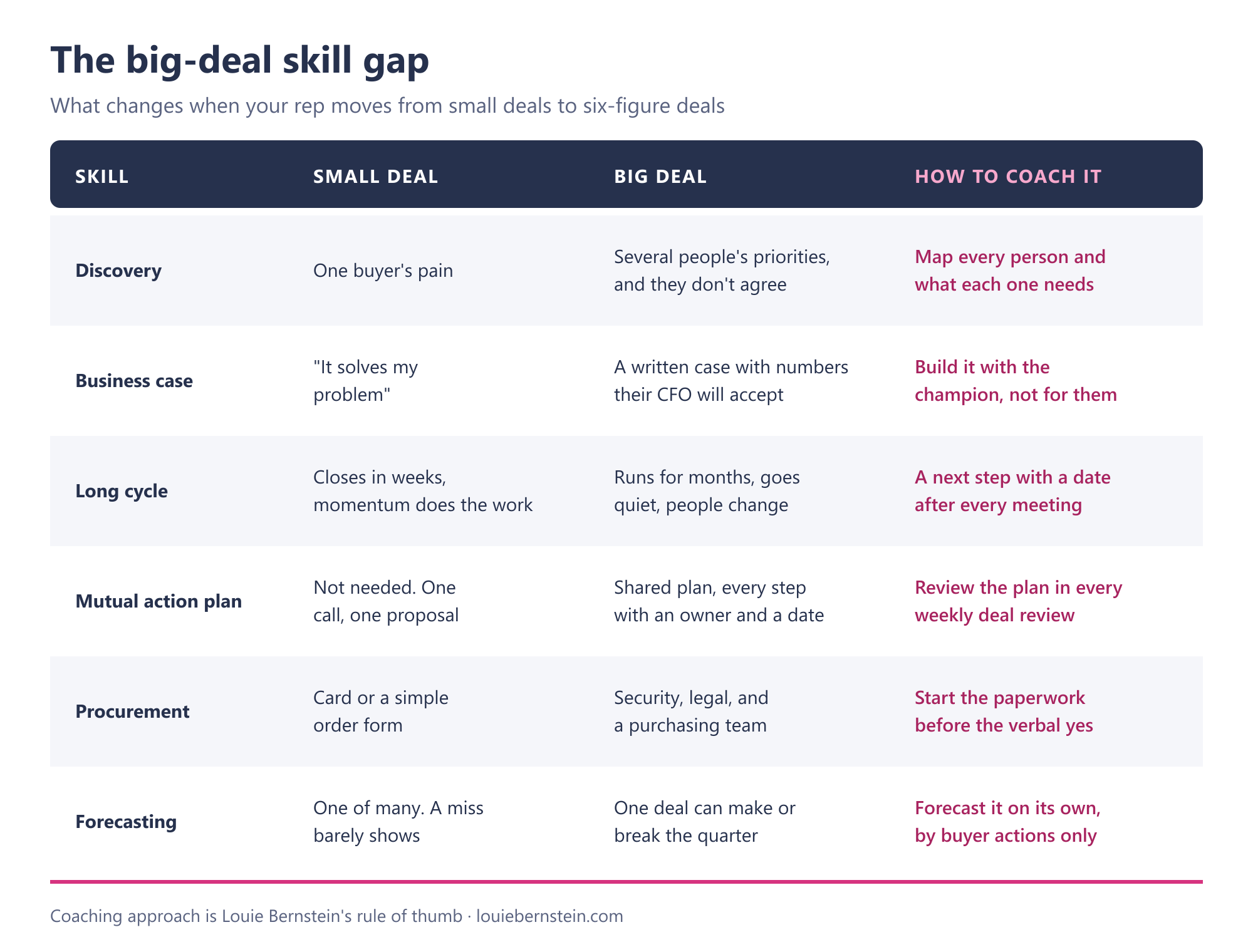
The table above shows the six skills that change. Forecasting gets its own section below. Here's how to coach the other five. None of it needs a training program, just a weekly deal review and someone who has run big deals before.
Discovery across many people
On a small deal, discovery means finding one person's pain. On a big deal, the rep has to learn what the CFO, the IT lead, the daily user, and the executive each need, and where they disagree. Coach it by asking the rep to fill in one line per person: name, role, what they care about, what they've said so far. Blanks are the to-do list. The multi-threading playbook covers how to reach those people.
Building the business case
Big buyers need a written reason to spend the money, with numbers their finance team will believe. Coach the rep to build it with the champion, using the buyer's own numbers. A case the rep writes alone gets ignored. A case the champion helped write gets forwarded to the CFO. And if there's no clear cost to waiting, read why no decision is your biggest competitor.
Managing a long cycle
Small-deal reps are used to momentum. Big deals go quiet for weeks. People go on vacation, change jobs, and get pulled onto other projects. Coach one rule: no meeting ends without the next one booked. If the buyer won't book it, that's a signal, and it goes in the weekly review.
Running a mutual action plan
A mutual action plan is the shared list of steps from today to signature and kickoff, with an owner and a date on each side. Small-deal reps have never needed one. Coach it by making the plan the first thing you look at in every deal review. I cover how it also keeps the founder out of the deal in your first enterprise deal will pull you back into sales.
Handling security, legal, and procurement
This is where most first big deals stall. The buyer says yes, and then three new teams show up. Coach the rep to ask about those steps early and start them in parallel. The full playbook is in the deal isn't done when they say yes. If the buyer asks for a pilot first, see pilots that turn into contracts.
Coach the rep through the first big deal, and you get a big-deal rep. Run it for them, and you get a rep who watched you sell.
Big deals need their own forecast rules
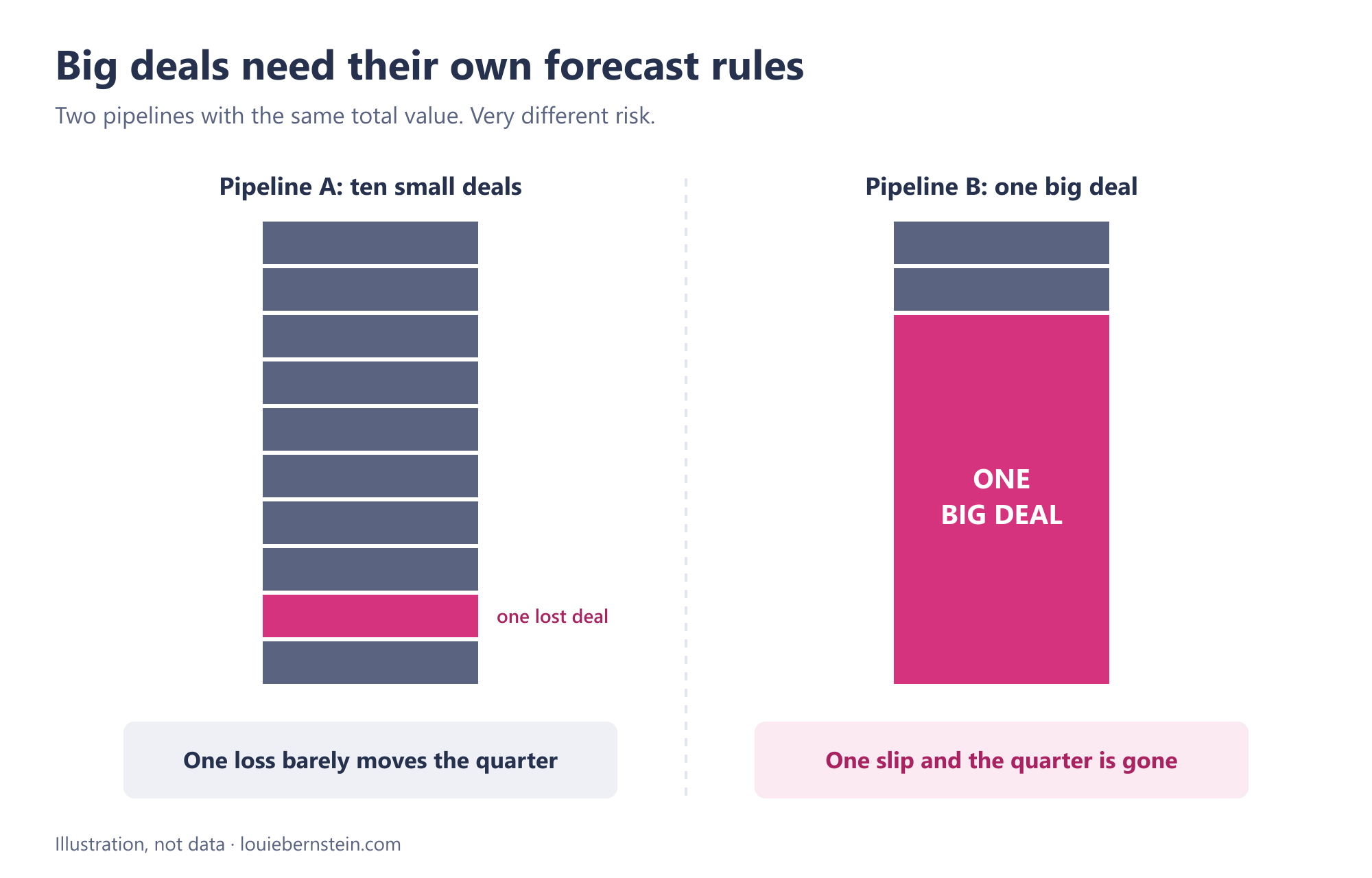
With ten small deals, losing one barely shows. With one big deal, a single slip can wipe out the quarter. Same pipeline value. Very different risk. That's why big deals can't be forecast the same way as everything else.
These four rules are my rule of thumb, not an industry standard.
- Forecast big deals one by one. Put each one on its own line in the forecast, separate from the rest of the pipeline. Never blend it into a weighted total where it hides.
- Commit only on buyer actions. A big deal goes in the commit number only when the buyer has done things you can see: the executive meeting happened, a signature date is on the mutual action plan, and security, legal, or procurement has started. "They love us" doesn't count. That's the same idea as action-based pipeline stages instead of hope-based ones.
- Plan the quarter as if it slips. Build the rest of the pipeline so you can still hit the number if the big deal moves out a quarter. If you can't, you have a coverage problem, not a big-deal problem. Pipeline math for founders shows how to check that.
- Review it every week with the same questions. What did the buyer do since last week? What's the next step and its date? Who on their side haven't we met yet? What could push it out? Do it inside your normal pipeline review, not in a side conversation with the founder.
If forecasting already feels like guesswork, start with why founders can't forecast. One big deal makes a shaky forecast much worse.
The comp questions a big deal raises
Your comp plan was built for small deals that close every few weeks. A six-figure deal breaks it in a few predictable places. Answer these questions before the deal closes. Answering them after, when there's a big check on the table, is how you lose a good rep.
How does the rep get paid during a long cycle?
If your rep spends four months on one big deal, their small-deal commissions drop. If their pay drops with it, they'll quietly go back to chasing small deals. Decide now whether anything changes for that stretch, and write it down.
When is the commission paid?
Big deals often come with payment terms, annual billing, or a pilot that converts later. Decide whether commission is paid on signature, on first payment, or split. The rep should know the answer before the deal closes, not learn it on their paycheck.
What does one whale deal do to quota?
One huge deal can make a rep's year in a single month. Then they coast. Or it slips, and a good rep looks like a failure. Decide ahead of time how a deal that size counts toward quota. I cover quota setting in setting a quota reps can hit.
Who gets credit when others help?
On a big deal, the founder, a sales engineer, and maybe a second rep all play a part. If credit is unclear, people fight over it after the deal closes. Settle it in writing at the start. For the bigger traps in comp design, see comp plan mistakes.
Salespeople don't quit companies, they quit chaos. A big commission paid under rules nobody wrote down is chaos.
Develop your reps, or hire a different profile?
Founders ask me this as soon as the first big deal shows up. My rule of thumb comes down to how often big deals happen.
- Develop your current reps when big deals are occasional. A few a year, mixed in with your normal business. Pick the rep who scores best on the readiness check, give them a coach, and let them learn on the first one.
- Hire a different profile when big deals become your main business. If most of next year's revenue depends on six-figure deals, you need at least one rep who has already sold them, again and again, at a company your size.
Don't swap your whole team because one big logo showed up. Your small-deal reps still pay the bills. And don't hire someone because they sold big deals at a famous company. Selling with a famous logo and a full support team is a different job than selling with neither.
Bigger deals need a written process with owners. Without one, they pull the founder back into the closer seat.
Where a Fractional Sales Leader fits
This is the coaching seat. I run the readiness check with the founder, pick the rep for the first big deal, and coach that rep every week until it closes. I build the forecast rules for big deals and run them in the pipeline review. And I help the founder settle the comp questions before they turn into an argument.
I've spent 50 years in sales, including 22 years building MindIQ into an INC 500 company. The goal is simple: your reps learn to sell big deals, and you stay out of the closer seat.
This is the last article in the series on moving upmarket. Start at whether you're ready, then the steps after the yes, the founder's role, and pilots.
Frequently Asked Questions
Q: Can an SMB sales rep sell enterprise deals?
Some can, with coaching. Look at their habits, not their quota. Reps who already work with several people per deal, book every next step, keep a clean CRM, ask for help early, and talk about business results usually make the jump.
Q: How should I forecast one large deal?
Put it on its own line, separate from the rest of the pipeline. Count it in your commit number only after the buyer has taken visible steps, like booking a signature date or starting procurement. Then build the rest of the quarter so you can still hit the number if it slips.
Q: What happens to quota when a rep lands a whale deal?
Without a rule, the rep either coasts for the rest of the year or looks like a failure if the deal slips. Decide ahead of time how a deal that size counts toward quota, and put it in the comp plan.
Q: Should I hire an enterprise rep or train my current team?
My rule of thumb: train your current reps when big deals are occasional. Hire someone who has already sold big deals at a company your size when those deals become most of your revenue.
Is your team ready for bigger deals?
In 30 minutes we'll run the readiness check on your reps and map what has to change before you hand them the big ones.
Schedule a 30-Minute CallAbout the Author
Louie Bernstein
Fractional Sales Leader with 50 years of sales experience helping $1M–$10M ARR companies build scalable, repeatable sales systems. Founder of MindIQ (INC 500). LinkedIn Top Voice in Sales Management, Sales Operations, and Sales Coaching.