Your first enterprise deal will pull you back into sales unless you decide your role before the first meeting. Write it down: the rep owns the deal, you're the executive sponsor, and someone coaches the rep. Put your two or three founder moments on a mutual action plan the buyer can see. Then show up for those moments, and only those.
Key Takeaways:
- Big deals pull founders back in for three reasons: the stakes feel too high, the buyer expects the CEO, and the team has never sold a deal this size.
- Taking the deal back costs more than your time. The rest of the pipeline goes unmanaged, the rep learns nothing, and the buyer only talks to you from then on.
- Decide three roles before the first meeting: the rep is the deal owner, the founder is the executive sponsor, and a coach runs strategy with the rep.
- Use a mutual action plan the buyer can see. It puts the rep at the center and shows exactly when the founder appears.
- Plan your founder moments. My rule of thumb is three: executive alignment, the final commitment, and kickoff.
- Timing matters. Win rates dropped about 6% when an evaluation started with an executive, and rose about 5% when executives came in around the third touchpoint (Gong, 2026).
You spent a year getting out of sales. You hired a rep, maybe two. You built a pipeline with real stages. Some weeks you didn't get on a single sales call, and it felt great.
Then a big logo shows up. Bigger than anything you've closed. Five times your average deal, maybe more. Your rep has never sold anything this size. Neither has anyone else on the team.
So you get on the first call. Just to be safe. Then the second. By the third week, you're writing the proposal at night, the buyer is texting you directly, and your rep is taking notes in meetings about their own deal.
It happens almost every time. And it's not because founders are control freaks. It's because nobody decided ahead of time what the founder's job is on a big deal. With no plan, the default wins. And the default is the founder.
The big deal doesn't pull you back in. The missing plan does. Decide your role before the first meeting, or the deal will decide it for you.
Why does the biggest deal pull the founder back in?
Three forces show up on almost every first big deal. Name them, and they lose a lot of their pull.
The stakes feel too high to delegate
One deal could be 20% of your year. Maybe more. When that much rides on one deal, handing it to a rep who's never sold one this size feels reckless. So you take it "just this once." But there's always another big deal, and "just this once" becomes how big deals work at your company.
The buyer expects to meet the CEO
Bigger companies are taking a risk on a smaller vendor. Their executive wants to look the CEO in the eye and hear that you'll stand behind the product. That's fair. The mistake is thinking that means you run the deal. It means you show up for one meeting with their executive. The rest of the deal still belongs to your rep.
Your team has never sold a deal this size
This is the real one. More people on the buyer's side, more steps, longer waits. Your rep doesn't know what to do when the champion goes quiet or when a new stakeholder appears in week six. You do, or at least you think you do. So you step in. And the rep never learns.
What does it cost when the founder takes the deal back?
Your hours are the smallest cost. Here are the bigger ones.
- The rest of the pipeline goes unmanaged. While you chase one big logo, nobody runs the weekly pipeline review. Ten smaller deals drift. The big one might close. Several small ones quietly don't.
- The rep learns nothing. The first big deal is the best training your rep will ever get. If you run it, they watch. Next time a big deal shows up, you're back on it, because they still haven't done one.
- The buyer only talks to you. Once the buyer learns the fastest way to get an answer is to text the founder, every question goes to the founder. Your rep becomes a messenger on their own deal. And after the signature, the customer still calls you.
- Your best rep notices. Taking a big deal away from a good rep tells them where they stand. Salespeople don't quit companies, they quit chaos. A founder who swoops in on every big deal is chaos.
If you're still deciding whether to go after deals this size at all, start with the upmarket readiness test. This article assumes the deal is already in your pipeline.
Decide the roles before the first meeting
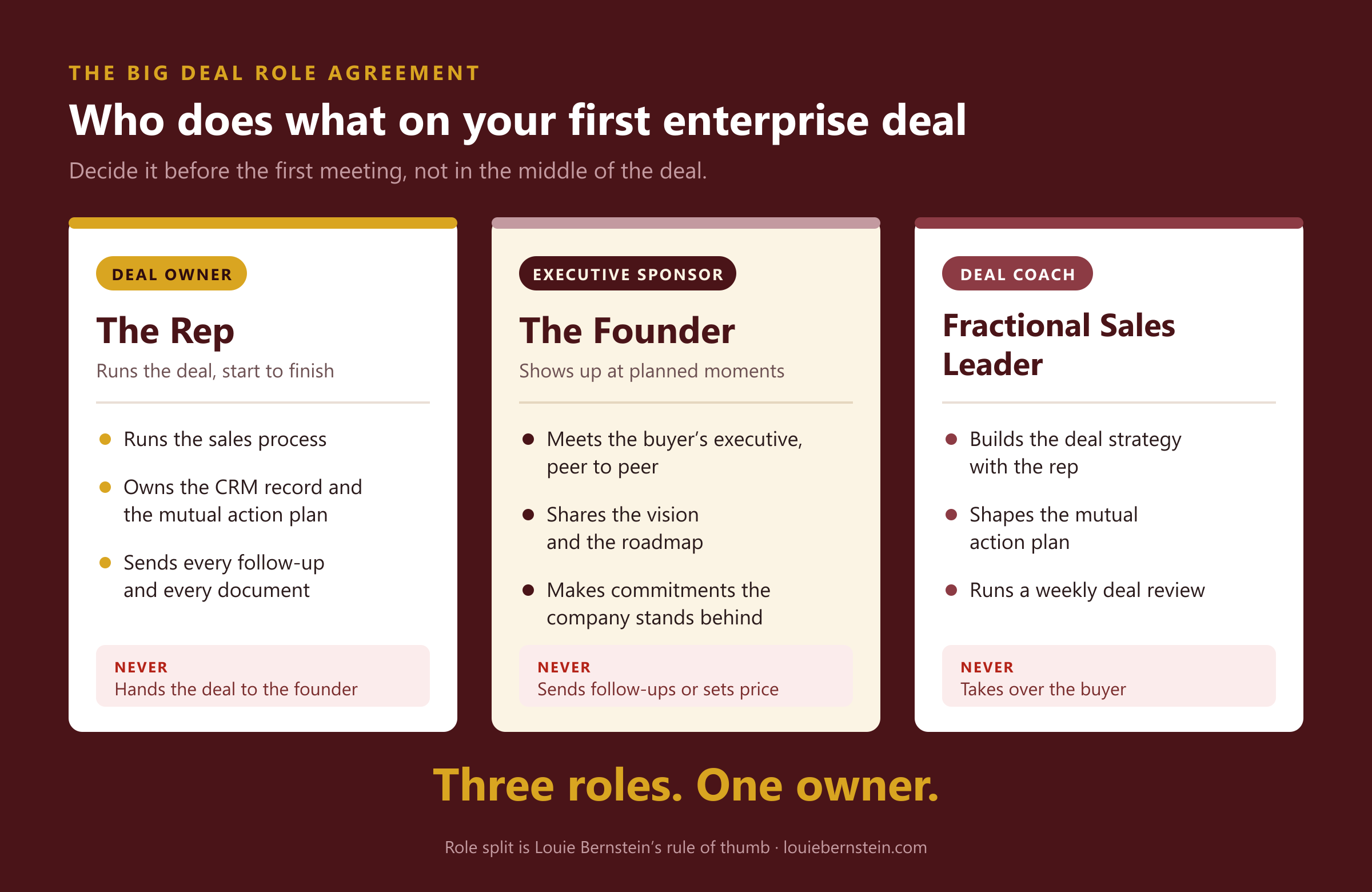
The fix is simple to say and hard to do. Before the first meeting with the big prospect, sit down with your rep and decide who does what. Write it down. Three roles.
The rep is the deal owner
The rep runs the sales process from first meeting to signature. They own the CRM record and the mutual action plan. They send every follow-up and every document. When the buyer has a question, it goes to the rep, and the rep pulls in whoever can answer it. If it isn't in the CRM, it never happened, and the rep is the one keeping it in the CRM.
The founder is the executive sponsor
Your job is narrower and more valuable. You meet the buyer's executive, peer to peer. You share where the company and the product are going. You make the commitments only a CEO can make, like a roadmap promise or a service guarantee the company will stand behind. You don't send follow-ups. You don't set price. You don't chase the champion.
Someone coaches the rep
The rep can't own a deal this size alone the first time. Someone has to coach them through it, behind the scenes. That person builds the deal strategy with the rep, helps shape the mutual action plan, and runs a weekly deal review. It can be a sales leader, a Fractional Sales Leader, or, if you're disciplined, you. But if it's you, coach from the sidelines. Never from the buyer's calls.
Three roles. One owner. The buyer should never wonder who's running the deal.
The Big Deal Role Agreement
Here's the short list I have founders and reps agree to before the first meeting. Copy it into the deal record.
Big Deal Role Agreement
- The rep is the deal owner. Their name is on the CRM record and the mutual action plan.
- Every buyer email, call, and document goes through the rep.
- The founder joins only for the moments on the plan. Each one has a goal written down before the meeting.
- The rep runs every meeting, including the ones the founder attends. The founder speaks to their part, then hands it back.
- If the buyer contacts the founder directly, the founder replies within a day, copies the rep, and points the buyer back to the rep.
- Price and terms follow written rules. The founder doesn't make side deals.
- The rep and the coach review the deal every week. The founder gets a short written update, not a seat in the meeting.
- Anything not covered here follows the escalation rule.
That last line matters. The role agreement covers the big deal. For everything else, when a deal hits trouble and someone wants the founder on a call, you need a general rule. I cover that in the escalation rule.
Use a mutual action plan the buyer can see
A mutual action plan is a shared, written list of the steps both sides need to take to get from today to a signed contract and a live customer. Each step has a date and a name on each side. The buyer can see it. You update it together.
On a big deal, the plan does two jobs. First, it keeps a long deal moving. Everyone can see what's next and who's late. Second, and this is the part founders miss, it shows the buyer who runs the deal. The rep's name is on it. The rep sends it, updates it, and walks through it on every call. When the founder shows up, it's because the plan said so.
Build it with your champion early, ideally right after discovery. Start from their go-live date and work backward. A good plan for a big deal usually includes:
- The evaluation steps, with who on their side needs to see what.
- The executive alignment meeting, with a date and both executives named.
- Security, legal, and procurement, each with an owner on both sides.
- The signature date and who signs.
- Kickoff, with who attends from each side.
Each step should finish when the buyer does something, not when you hope they will. That's the same idea behind action-based pipeline stages. If you need help writing those finish lines, see why your pipeline stages need exit criteria. And if your champion can't name the other people on their side, you have a different problem. The multi-threading playbook covers how to fix it.
Plan your founder touchpoints
Most founders join a big deal at random. A call here, an email there, whenever they get nervous. That's what trains the buyer to go around the rep. Instead, pick your moments ahead of time and put them on the plan.
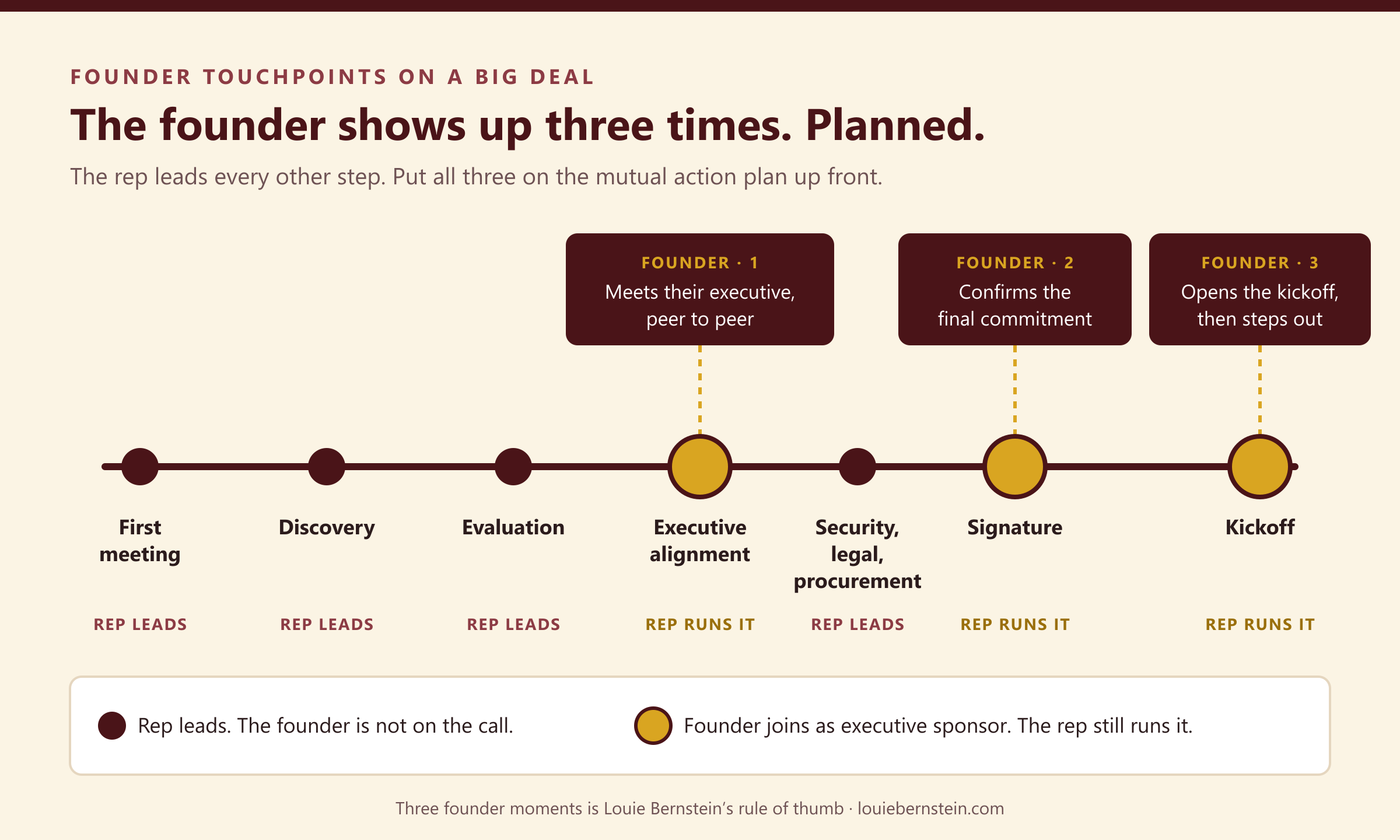
My rule of thumb is three moments. Not more.
Moment 1: Executive alignment
You meet their executive, peer to peer. The goal is to confirm the business reason for the deal, share where your company is headed, and answer the question every executive asks a smaller vendor: "Will you be around, and will you take care of us?" The rep sets up the meeting, preps you on who'll be there and what they care about, and runs the agenda. You talk. Then the rep sends the follow-up.
Notice where this sits. Not at the first meeting. After discovery and evaluation, once the rep has built the case. Gong analyzed more than a million sales cycles that involved executives. When an evaluation started with an executive, win rates dropped about 6%. When executives came in around the third touchpoint, win rates rose about 5% (Gong, 2026). That data is about the buyer's executives. The lesson for your side is the same: the top-level meeting works best once the groundwork is done.
Moment 2: The final commitment
Near the signature, the buyer's executive sometimes wants to hear one more time that you'll stand behind what was promised. A short call works. You confirm the commitments. You don't reopen price or terms. Those follow the rules you set before the deal started. If you haven't set them yet, read the discount trap first.
Moment 3: Kickoff
You open the kickoff, thank the team, and say who owns the relationship from here. Then you leave the meeting. That last part matters more than it sounds. If you stay for the whole kickoff, the new customer will treat you as their main contact for the next year.
Every other step, the rep leads
First meeting, discovery, evaluation, security, legal, procurement: the rep runs all of it. You can help behind the scenes, like reading the proposal. But you're not on the buyer's calls. The paperwork steps after the yes are where founders get pulled back in the most. I cover how to give each one an owner in the deal isn't done when they say yes.
Show up three times, on purpose. Every extra appearance teaches the buyer to call you instead of your rep.
What if you're already back in the deal?
Maybe you're reading this with a big deal already in progress, and you're the one running it. You can still hand it back. Do it on purpose, not by going quiet.
- Write the role agreement now. Same list as above. Agree to it with your rep this week.
- Build the mutual action plan with the rep's name on it. Have the rep send it to the champion and walk through it on the next call.
- Tell the buyer directly. Something like: "Going forward, Sam runs this project day to day. I'll be at the executive meeting and kickoff. Sam has my full backing." Buyers respect a clear structure. They don't respect a founder who slowly disappears.
- Stop replying first. When the buyer emails you, reply within a day, copy the rep, and let the rep answer the substance.
It will feel slower for a week or two. That's the cost of training the buyer and the rep at the same time. For a step-by-step way to hand off deals by size, see the founder sales hand-off ramp.
Where a Fractional Sales Leader fits
This is the deal coach seat. I work with founders and their reps on exactly this moment. We write the role agreement before the first meeting. I build the deal strategy and the mutual action plan with the rep. I run the weekly deal review, so the founder doesn't have to sit in it. And I prep the founder for the three moments that are theirs.
I've spent 50 years in sales, including 22 years building MindIQ into an INC 500 company. Get the roles right on the first big deal, and your rep learns to sell big deals. Get it wrong, and you're the closer again.
The next article in this series covers a common trap on the way to a big deal: pilots, and how to keep a pilot from turning into free work.
Frequently Asked Questions
Q: Should the founder be involved in enterprise deals?
Yes, as executive sponsor, not as deal owner. The founder meets the buyer's executive, shares the vision, and makes commitments the company will stand behind. The rep runs the deal from first meeting to signature.
Q: What does an executive sponsor do on a sales deal?
They show up at a few planned moments to build trust at the top. Usually that's an executive alignment meeting, a final commitment before signature, and the kickoff. They don't send follow-ups, set price, or chase the champion.
Q: When should the CEO meet the buyer's executive?
After discovery and evaluation, once the rep has built the case. Gong found win rates dropped about 6% when an evaluation started with an executive and rose about 5% when executives came in around the third touchpoint (Gong, 2026).
Q: What is a mutual action plan?
A shared, written list of every step both sides need to take to get to a signed contract and a live customer, with a date and an owner on each side. On a big deal, it also shows the buyer that the rep runs the deal and when the founder will appear.
Q: What if the buyer only wants to talk to the founder?
Reply within a day, copy the rep, and point the buyer back to the rep for anything day to day. Tell them clearly who runs the project and when you'll be involved. Most buyers want a clear structure more than they want the CEO on every call.
Q: My rep has never sold a deal this big. Shouldn't I just run it?
If you run it, they still won't have sold one, and the next big deal lands on you too. Let the rep own it, and give them a coach who builds the strategy with them and reviews the deal every week.
Is a big deal pulling you back into sales?
In 30 minutes we'll write your role agreement, map your founder moments, and get the deal back in your rep's hands.
Schedule a 30-Minute CallAbout the Author
Louie Bernstein
Fractional Sales Leader with 50 years of sales experience helping $1M–$10M ARR companies build scalable, repeatable sales systems. Founder of MindIQ (INC 500). LinkedIn Top Voice in Sales Management, Sales Operations, and Sales Coaching.