You can raise prices without losing many customers if you run the increase as a sequence, not an announcement. Prove the new price on new deals first. Decide grandfathering by segment. Send a founder-signed notice, prepare a renewal talk track, and lock down discount authority. Do the math before you panic: on a 15% increase, 13% of customers would have to leave because of the increase before revenue drops.
Key Takeaways:
- A price increase breaks even on revenue until churn caused by the increase reaches increase ÷ (1 + increase). For a 15% increase, that's 13% of customers.
- Raise prices on new proposals first. If new buyers accept the higher price, you have evidence before you touch a single existing customer.
- Grandfather existing customers for a fixed period, not forever. Permanent legacy pricing leaves you running multiple price books with no end date.
- Companies realize only 43% of their intended price increases on average (Simon-Kucher Global Pricing Study 2025). Most of the loss happens in sales execution, not in the announcement.
- Before the notice goes out, write down who can approve a discount, track list price vs. final price in your CRM, and pay commission on net price.
If you have read this far into the series, you probably believe you're underpriced. You've seen the math. Maybe you've tested a higher number on a few new deals. Then you freeze.
The fear isn't new customers. It's the ones already paying. The early accounts who took a chance on you. The ones you know by first name.
Warren Buffett told the Financial Crisis Inquiry Commission in 2010 that pricing power is “the single-most important decision in evaluating a business” (FCIC transcript). A business that needs a prayer session before raising price, he said, is a terrible business. You don't need a prayer session. You need a plan.
Article 1 covered why founders underprice. Article 2 covered testing a higher price. Article 3 covered building the value case. This one covers the increase itself.
How many customers will I actually lose if I raise prices?
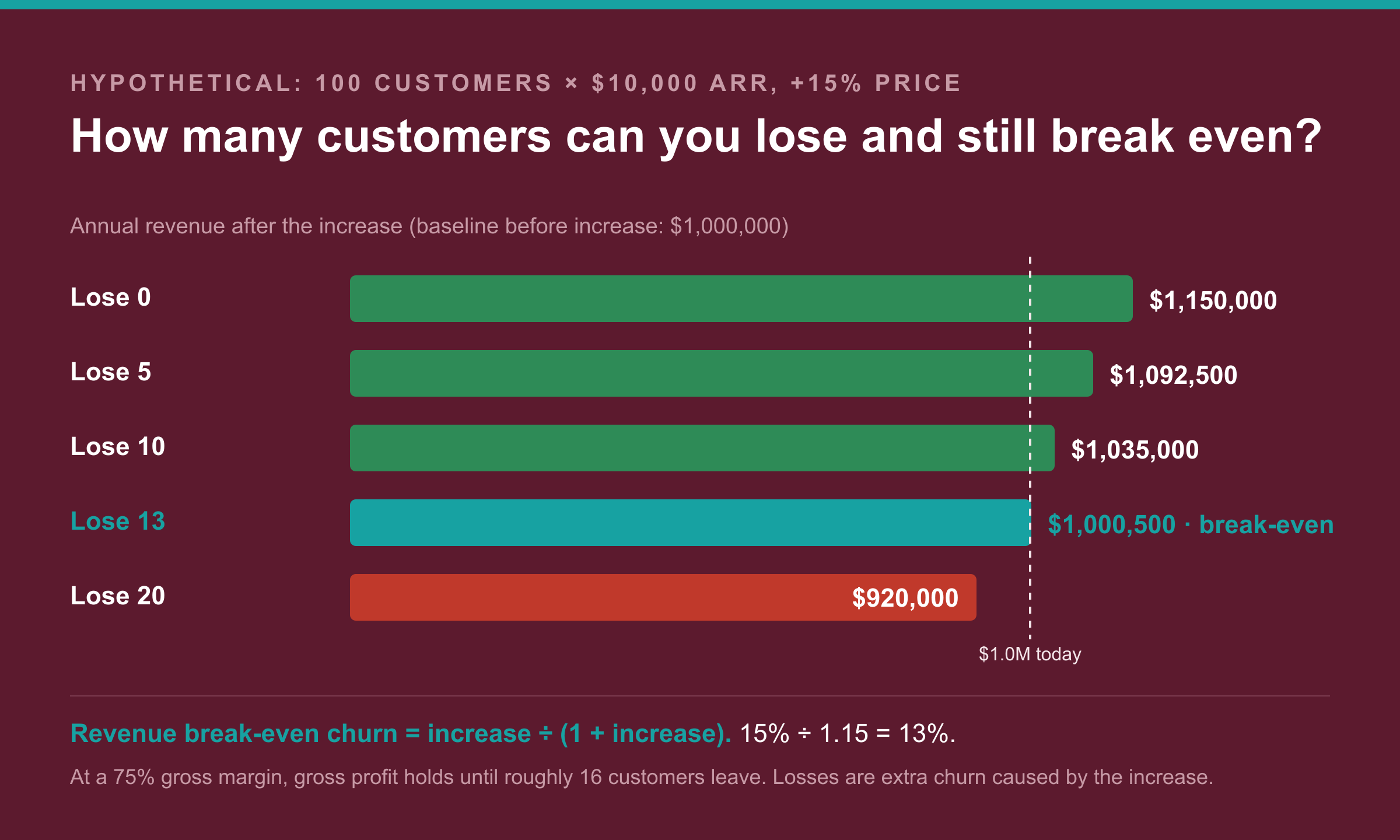
Most B2B founders will lose far fewer customers than it takes to make a price increase a loss. On a 15% increase, revenue only falls if more than 13% of customers leave because of the increase. Run that break-even number for your own price before you decide the increase is too risky.
Run the break-even math
Here's a hypothetical. You have 100 customers paying $10,000 a year. That's $1,000,000 in revenue. You raise the price 15%, to $11,500.
| Customers lost to the increase | Annual revenue | Gross profit at 75% margin |
|---|---|---|
| None (before the increase) | $1,000,000 | $750,000 |
| 0 | $1,150,000 | $900,000 |
| 5 | $1,092,500 | $855,000 |
| 10 | $1,035,000 | $810,000 |
| 13 | $1,000,500 | $783,000 |
| 20 | $920,000 | $720,000 |
The formula is simple: break-even churn equals the increase divided by one plus the increase. 15% ÷ 1.15 = 13%. Gross profit holds even longer, because every customer who leaves also takes their delivery cost with them. At a 75% gross margin, you could lose about 16 customers before gross profit falls below today's number.
Be honest about what the math leaves out
Those 13 customers are extra losses caused by the increase, on top of your normal churn. Most companies already lose some revenue every year. SaaS Capital's 2026 survey of more than 1,000 private B2B SaaS companies found median gross revenue retention of 91% for bootstrapped companies at $3M–$20M ARR (SaaS Capital, 2026).
Lost customers also take away future expansion and referrals. And if one customer is 20% of your revenue, the averages don't apply to that account. Handle it separately.
I looked for a trustworthy public benchmark on how much churn a price increase causes. The figures that circulate online trace back to secondary blogs, not published studies. So don't borrow someone else's percentage. Use the break-even number and your own renewal history.
Should I raise prices on new deals before existing customers?
Yes. Put the new price on new proposals first, because new buyers have no anchor to your old number. If comparable prospects accept the higher price at a similar win rate, you've proven the price before risking a single existing relationship. If they don't, you've learned that cheaply.
Use the next 10 proposals test from Article 2. Quote one higher price to 10 comparable new prospects. Keep scope, terms, and discount rules the same. Record every objection and every concession.
Testing new deals first also gives you a sentence you'll need at renewal: “That's the price every new customer pays today.” A renewal conversation is much easier when the new price is already normal in the market, not a theory.
Should I grandfather existing customers, and for how long?
Grandfather existing customers for a fixed period, usually until their next renewal or up to 12 months, not forever. A time limit shows good faith without locking you into two price books permanently. Decide by segment, because a blanket rule treats your most valuable accounts the same as your least profitable ones.
Compare the three options
| Option | What it protects | What it costs |
|---|---|---|
| Permanent | Goodwill with early customers | Old prices forever, multiple price books, and reps quoting the wrong number |
| Time-limited | Trust, plus time to budget | A delayed increase with a clear end date |
| None | Revenue, right away | The highest risk of surprise and pushback |
Paddle argues against permanent legacy pricing and recommends giving existing customers twelve months at their current rate before the increase takes effect (Paddle, 2021). The hidden cost of permanent grandfathering shows up in operations. Every old price is another exception in billing, in proposals, and in your reps' heads.
Where founders usually get this wrong
Here's what I see over and over in founder-led companies. The founder protects the earliest customers the longest. Those are often the smallest, cheapest, most custom accounts. The friendship is real. So is the margin they cost you.
Sort accounts by two things: account value and relationship strength. High-value, strong-relationship customers get a personal call and the longest runway. Small accounts on deeply discounted legacy deals may get the shortest runway, or none.
Also remember that the same dollar increase feels different at different sizes. I wrote in my sales training years ago that a $5,000 increase isn't a big deal on a $150,000 order, but it's a big deal on a $15,000 order. Look at the increase as a percentage of what each customer pays, and plan the conversation around that.
Grandfathering is a bridge, not a destination. Put an end date on it.
What should a price increase notice include?
A price increase notice should state the new price, the effective date, the reason, what has improved, and a named person to call. The founder should sign it. A notice from the founder signals that the decision is considered and final, while a notice from billing reads like a system change nobody owns.
Check your contracts first. Many agreements set notice periods or caps on increases. Where the contract is silent, my recommendation is 60–90 days before renewal, early enough for the customer to fit it into their budget.
Use a five-part outline
- The change. Current price, new price, and the date it takes effect.
- The reason. One or two honest sentences. Rising costs and new investment are both legitimate.
- What improved. Specific features, service, or results since they signed.
- Their runway. Any grandfathering period or option to lock the current rate with a longer term.
- Who to call. A real name, phone number, and email. Not a support queue.
Your customers are already seeing increases from other vendors. Simon-Kucher's 2025 study of more than 2,200 business leaders found 80% of companies passed cost increases on to customers (Simon-Kucher, 2025). Vertice measured SaaS price inflation at 16.4% in June 2026 (Vertice). A well-explained increase is normal. A surprise isn't.
What do I say at renewal to make a price increase stick?
At renewal, lead with the value the customer has already confirmed, then state the new price plainly and stop talking. The renewal call is where founder-led companies give increases back, because the founder feels guilty and offers a concession before the customer asks. Trade terms if you must. Don't trade away the increase.
A short talk track
Build this on the value number from Article 3, the one the customer agreed to:
- “When we started, you told us [problem] was costing you about [confirmed number]. Where does that stand today?”
- “Since you signed, we've added [specific improvement].”
- “Our price for new customers is now [new price]. Your renewal will move to [new price] on [date].”
- Pause. Let them respond.
When the customer pushes back
Ask before you answer: “Is it the amount, the timing, or whether it's worth it?” Each needs a different response. For timing, offer a phased increase or a later effective date. For amount, offer a longer term at a locked rate. For value, go back to discovery. If the customer can't see the value, a discount won't fix that.
If you have an increase coming and open deals in the pipeline, you have a truthful reason for buyers to decide now. I wrote about that close in my sales training years ago, with one rule: it has to be true. Never invent a deadline.
How do I stop my reps from discounting the increase away?
Stop reps from discounting away a price increase by writing down discount authority, tracking list price against final price in your CRM, and paying commission on net price. Without those three controls, reps paid only on bookings will trade the increase for a faster signature. In my experience, most of it leaks out within two quarters.
Sales execution is where most price increases actually fail. Simon-Kucher found the average company realizes only 43% of its intended price increases, down 5 points in two years (Simon-Kucher, 2025). The price list goes up. The invoices don't follow.
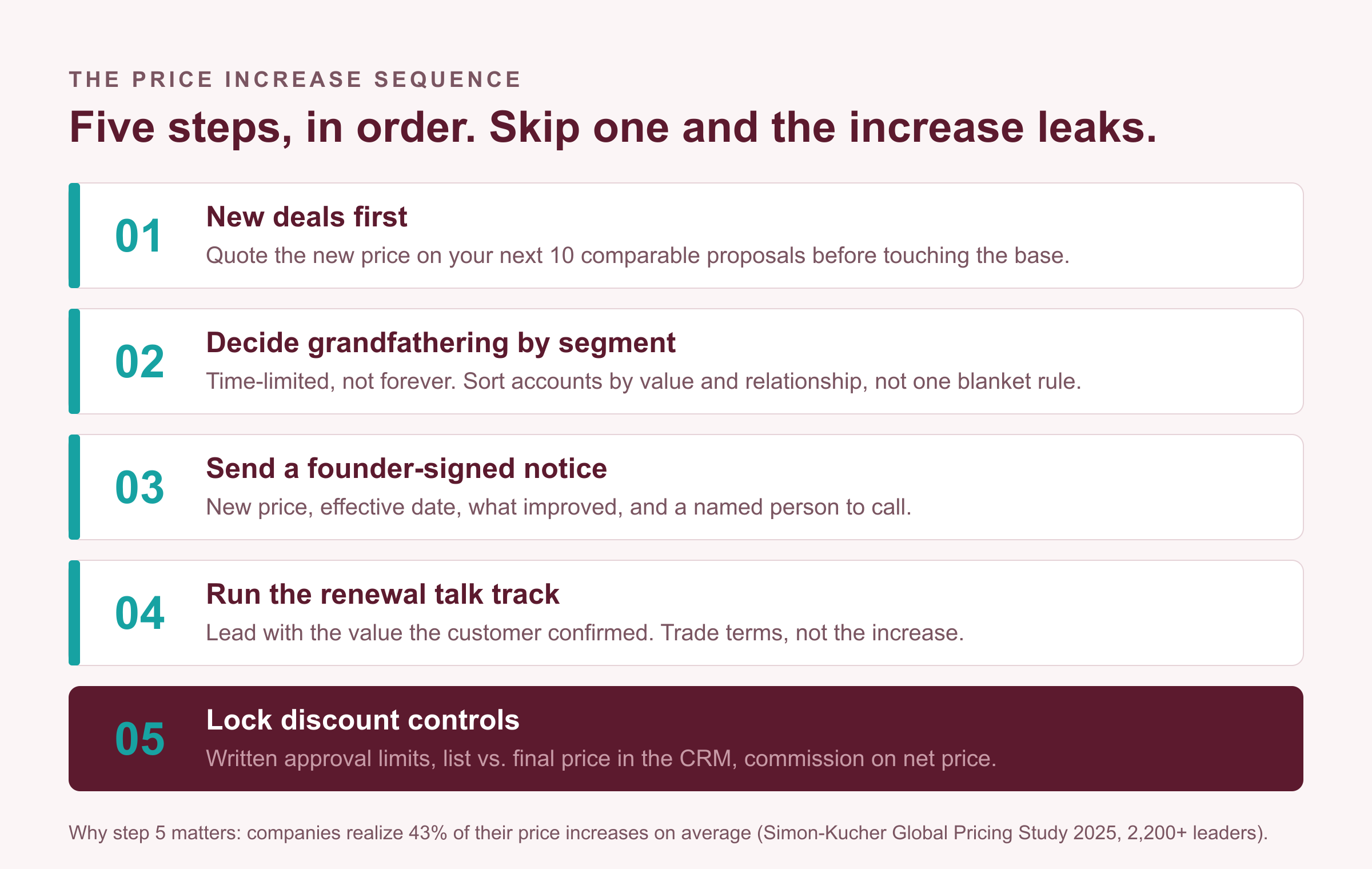
Install three controls before the notice goes out
- Written discount authority. Set how much a rep can approve, what needs the founder, and what nobody can approve. Every discount gets something back, like a longer term or faster payment.
- List vs. final price in the CRM. Add both fields to every deal and renewal. Review the gap monthly by rep. What you don't track, you won't see leaking.
- Commission on net price. If a rep earns the same on a discounted deal as a full-price deal, you're paying them to discount.
What 50 years in sales has taught me
I've been the founder under pressure. During a recession at MindIQ, we brainstormed every way to bring in cash. Discounts. Cash discounts. Shorter contracts. Everything was on the table. It got us through. It also taught me how fast price goes out the window when a founder is scared.
Your reps feel that same pressure at the end of every quarter. The difference is they're giving away your margin, not theirs. I covered the guardrails in detail in The Discount Trap. Put them in writing before you raise a single price.
You set the price once. Your sales process defends it every day, or gives it away.
Related ReadingCost-Plus Pricing Is Killing Your Margin →
Frequently Asked Questions
Q: How big should my first price increase be?
Size the first increase to what your new-deal test supports, not to what feels comfortable. If comparable new buyers accepted the higher price at a similar win rate, that's your evidence. Run the break-even math on the number before you announce it.
Q: Should I raise prices on everyone at once or in waves?
Raise prices in waves, starting with new deals and then existing customers at their renewal dates. Waves spread the workload for your team and let you adjust the talk track after the first few renewals.
Q: What if my biggest customer threatens to leave?
Treat a customer who represents a large share of revenue as its own negotiation, not part of the general increase. Meet in person, review the confirmed value, and offer term options such as a phased increase. Decide your walk-away point before the meeting.
Q: Is it better to add features and raise the price at the same time?
Pairing an increase with a real improvement makes the conversation easier, but don't delay a needed increase waiting for a release. Customers accept increases they can connect to value. List what has already improved since they signed.
Q: Do I need a pricing consultant to raise prices?
You need a pricing specialist for willingness-to-pay research, complex packaging, or a formal pricing study. You don't need one to run an increase well. I'm a Fractional Sales Leader. I install the renewal process, discount approvals, and CRM tracking that make the increase stick.
A price increase only holds if your sales system holds it.
If you're at $1M to $10M ARR, still running every renewal yourself, and nervous about raising prices, let's build the process that protects the increase. Learn about Fractional Sales Leadership at LouieBernstein.com.
Schedule a 30-Minute CallAbout the Author
Louie Bernstein
Louie Bernstein is a Fractional Sales Leader and the founder of MindIQ. He helps B2B founders build repeatable sales systems through Sales Playbooks, clear sales processes, pipeline management, and coaching.