What Has to Come Out of Your Head and Onto Paper Before a Rep Can Close Like You Do?
Build a sales process that works without you by writing down what happened on the deals you won, then replacing the four advantages a rep can't borrow from a founder: your title, your authority, your product depth, and your gut. Define each stage by an action the buyer takes. Hand the written process to a rep, stay off the calls, and fix whatever breaks.
Key Takeaways
- A sales process works without the founder when a rep can run every stage from written rules, without calling the founder for an answer, a price, or permission.
- Founders close with four advantages a rep doesn't have: the title, the authority to change a price, deep product knowledge, and a gut feel for which buyers are real. Each advantage needs a written replacement.
- Companies with a defined sales process showed an 18% difference in revenue growth over companies without one (Vantage Point and Sales Management Association, 62 B2B companies, 2015).
- Define each sales stage by one action the buyer takes, such as booking the next meeting or confirming a decision date. Don't define a stage by what the rep did.
- This week, pull your last 10 won deals and write down the steps every one of them followed. That list is the first draft of your sales process.
- Average rep ramp is 6.2 months (Bridge Group, 2026). A new rep with nothing written down spends those months guessing.
Founders tell me they don't have a sales process. I think they do. They've closed every deal with it.
The trouble is where the process lives. It's in your head, and a rep can't get in there. So the rep watches you sell, tries to copy you, and loses deals you would have won.
If you're a founder at $1M to $10M ARR and you're still the closer, the fix is to get the process onto paper in a form somebody else can run.
You need to replace your presence with a process.
Why does your sales process stop working when you stop selling?
A founder's sales process stops working when the founder stops selling because the process was never separate from the founder. You close with advantages no rep has: your title, your authority to change a price, and years of product knowledge. Take the founder off the call and those advantages leave too.
The four advantages a rep can't borrow
Most sales process advice starts with stages. I'd start with what you bring to a call that a rep never will.
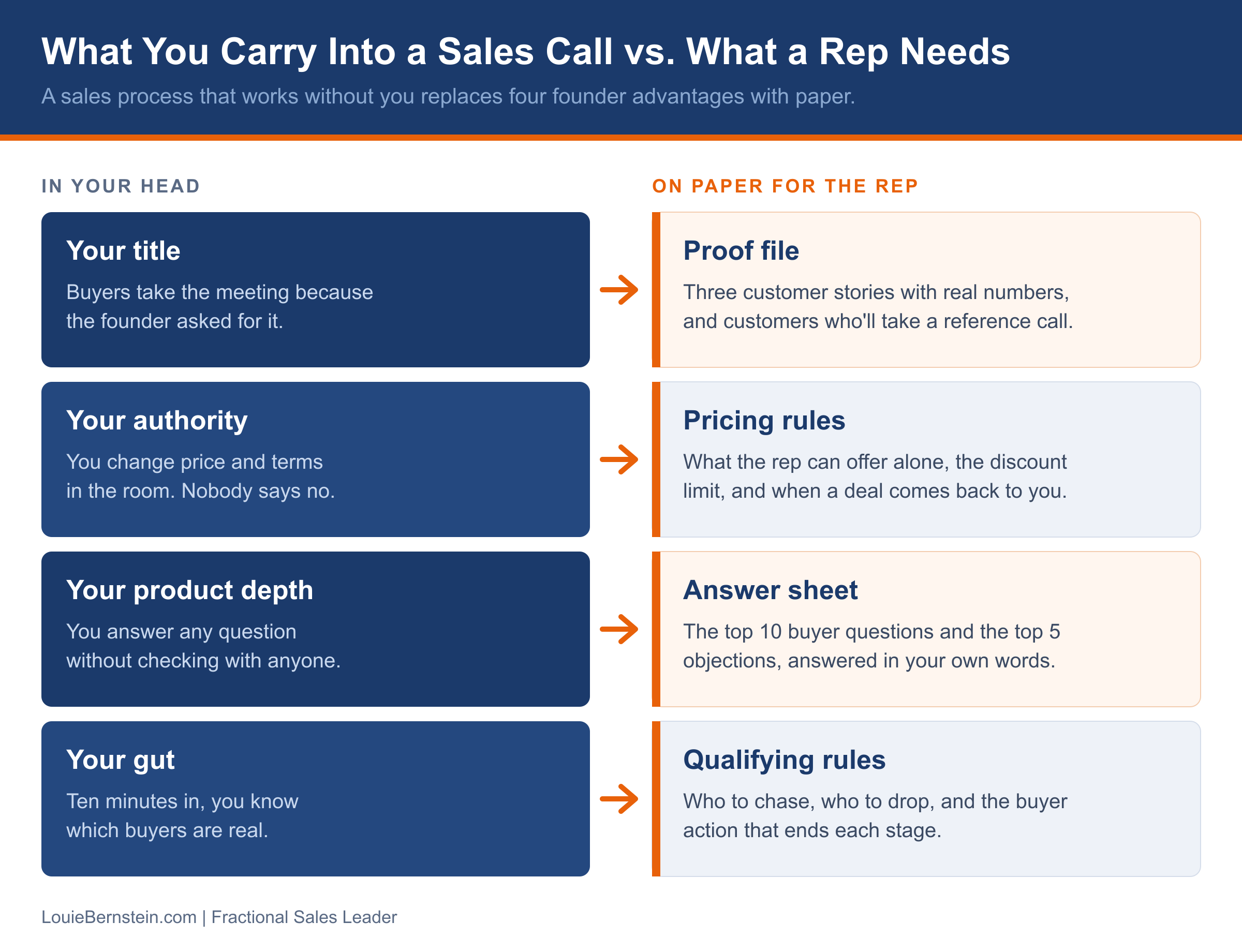
- Your title. Buyers take the meeting because the founder asked for it. A rep with the same email gets ignored.
- Your authority. You can change the price, the terms, or the start date in the room. A rep has to say "let me check."
- Your product depth. You answer any question without looking anything up. A rep three weeks in can't.
- Your gut. Ten minutes into a call, you know which buyers are real. You've never had to explain how you know.
A stage list replaces none of those four. That's why a founder can hand a rep a tidy five-stage process and still end up back on every call.
What a missing sales process costs you
Rep ramp is already slow. The 2026 Bridge Group report on 158 B2B companies puts average ramp to full productivity at 6.2 months, the highest in the study's history. Only 48% of reps hit quota, down from 51% in 2024.
Here's my math, not Bridge Group's. The same report puts median on-target earnings at $200,000 a year. At that rate, 6.2 months of ramp is about $103,000 in on-target pay before the rep is fully productive. That's the average across companies. I wouldn't expect a rep with nothing written down to beat the average.
What has to come out of your head before a rep can close like you do?
Four things have to come out of a founder's head before a rep can close: proof that stands in for your title, pricing rules that stand in for your authority, written answers that stand in for your product depth, and qualifying rules that stand in for your gut. All four belong in your Sales Playbook.
1. A proof file, to replace your title
A buyer trusts you because you built the company. A rep has to borrow trust from your customers. Write up three customer stories with real numbers: the problem, what you did, and what changed. Add the names of customers who'll take a reference call. Keep each story short enough for the rep to tell in two minutes.
2. Pricing rules, to replace your authority
You've been making pricing calls on the spot for years. Write the rules down. What can the rep offer without asking? What's the discount limit? Which terms never change? Then write one rule for when a deal comes back to you. I've covered that rule in the founder escalation rule. Without it, every deal is an exception and you're still the closer.
3. An answer sheet, to replace your product depth
Write down the top 10 questions buyers ask and the top 5 objections you hear, with the exact way you answer each one. Use your words, the ones that have worked. Don't make your rep learn the answers the hard way, one lost deal at a time.
4. Qualifying rules, to replace your gut
Your gut is a set of rules you've never said out loud. Say them. Which companies do you chase? Which ones do you walk away from, and what did you hear that told you to walk? Look at the deals you lost or dropped. The reasons you dropped them are your qualifying rules.
Your gut is a set of rules you've never said out loud. A rep can follow rules. A rep can't follow your gut.
How do you turn your won deals into stages a rep can follow?
Turn won deals into sales stages by listing the steps your last 10 closed deals had in common, then naming each stage by the action the buyer took to move forward. Most founders at $1M to $10M ARR end up with four to seven stages. A stage where the buyer never does anything is a stage you can cut.
Start with what happened on your wins
Pull your last 10 closed-won deals. Forget the stages in your CRM for a minute. What happened, in order, from first contact to signed contract? Write down the steps every deal shared. I call that the golden path. It's proven, because those deals closed.
Then spend one week capturing the raw material. Every question a buyer asks. Every objection you handle. The exact words you use when a deal stalls. Don't judge it yet. Just get it out of your head.
Define each stage by what the buyer does
For each stage, write the one action the buyer must take to move to the next one. The test is what the buyer does. What the rep does doesn't count. "Sent the proposal" is rep activity. "Buyer confirmed the budget and a decision date" is progress. I go deeper on this in why pipeline stages need exit criteria.
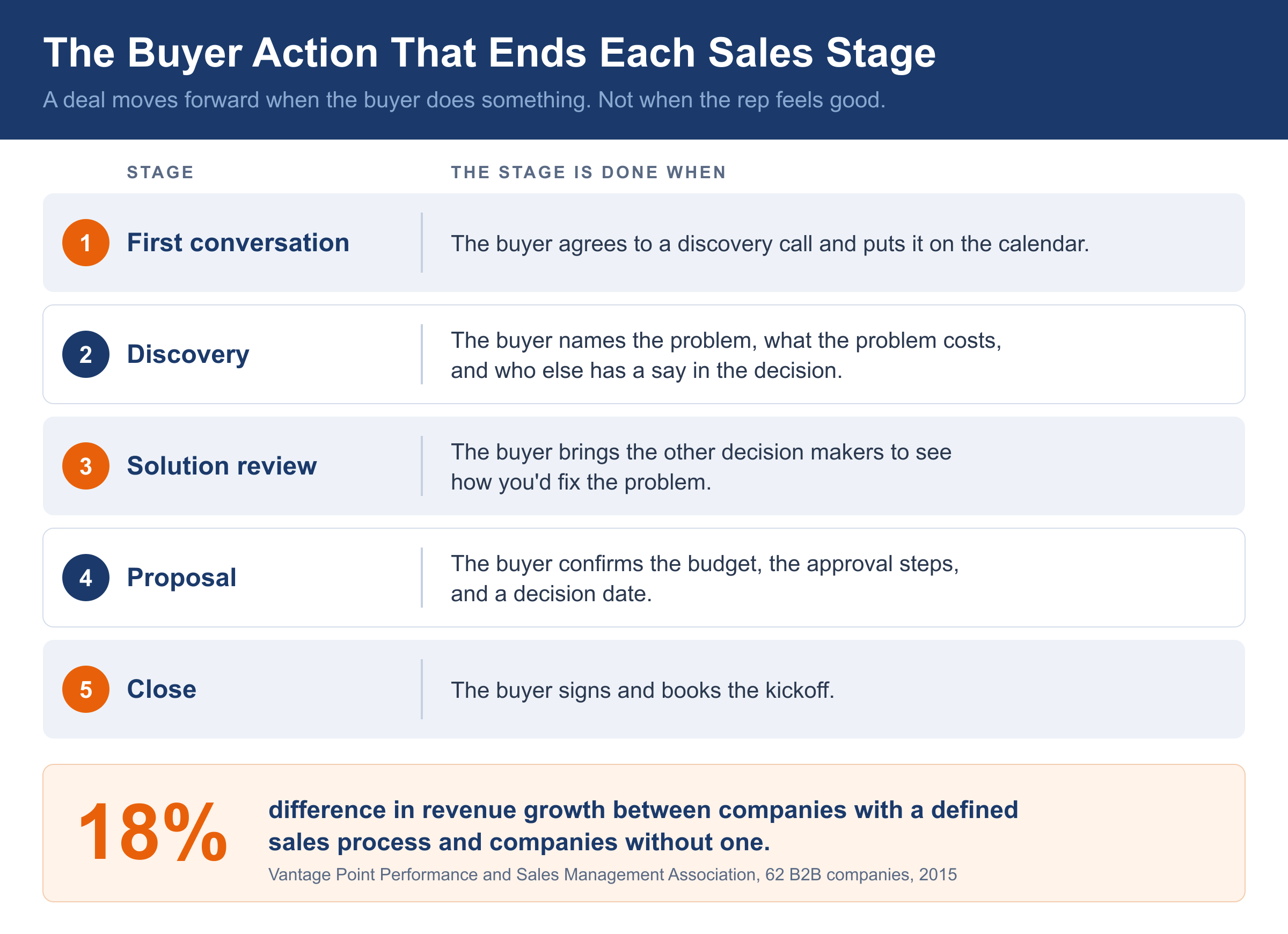
Those five stages are an example. Yours come from your own wins.
Does a defined sales process pay off?
The best study I know on a defined sales process is old, and I'll tell you its limits. In 2015, Vantage Point Performance and the Sales Management Association surveyed 62 B2B companies and published the results in Harvard Business Review. Companies with a defined, formal sales process showed an 18% difference in revenue growth over companies without one.
Companies that did three things showed 28% higher revenue growth: they defined the sales process, spent at least three hours a month per rep managing the pipeline, and trained their managers to do it. Most of those 62 companies were large. Yours isn't. I think a defined process matters even more in a small company, because a small company has no layers of management to cover for a missing one.
Write what the rep says and sends at each stage
A stage name tells the rep where the deal is. It doesn't tell the rep what to do next. For each stage, add:
- The questions to ask, and why you ask each one.
- The email, one-pager, or customer story to send.
- The buyer action that ends the stage.
Keep it to a page per stage. A rep will read one page. Nobody reads a binder.
Where do founders usually get the written sales process wrong?
Founders usually get the written sales process wrong by writing down the process they wish they ran instead of the one that closed their deals. The written version looks clean. The real version has the favor, the shortcut, and the price exception that won the deal, and none of them made it onto the page.
What I've seen in real sales teams
When I sit down with a founder to write the process, I ask about one won deal at a time. Somewhere in the story I hear something like, "Well, on that one I called their CEO myself." Or, "I threw in the first few months free." The founder doesn't think of those moves as part of the process. I think they're the most important part, because they're the moves a rep can't make without written permission.
So write down the exceptions. If you'd make the same move again, it's a rule, and the rep needs it. If you wouldn't, say so, or the rep will hear about it from a customer and offer it anyway.
"It's in my head, but I can explain it"
I hear that sentence from founders all the time. Explaining the sale to a new rep feels like a handoff. The rep nods, rides along on a few calls, and tries to sell the way you do. But you were selling with your title and your authority, and the rep has neither.
I spent 22 years building MindIQ and got it onto the Inc. 500. I did it the hard way, and it took me too long to figure this out: founders don't scale their sales. Their systems do. You can't expect a rep to read your mind, or to repeat your results by watching you.
How do you test whether the sales process works without you?
Test the sales process by having someone else run a real deal from the written pages while you stay off the call. Every time the rep comes to you for an answer, a price, or a judgment call, you've found a gap in the process. Write the missing rule down that day.
Test before you hire
You don't need a rep on payroll to find the first gaps. Hand your written process to someone who doesn't sell and see how far they get in a practice conversation. I've laid out how to run that in the transfer test before your first sales hire.
Keep a log of every time the rep needs you
Once a rep is running deals, keep a simple log. Three columns: what the rep asked, which stage the deal was in, and which rule was missing. Review the log once a week and add the rule to the playbook. If the same question shows up twice, the process has a hole. Don't blame the rep for it.
Watch three numbers every quarter
A sales process is never finished. Buyers change, your product changes, and your price changes. Each quarter, look at three numbers:
- The percentage of deals that move from each stage to the next.
- The number of days deals sit in each stage.
- The number of deals that closed with no founder on a call.
The third number tells you whether the process works without you. If that number isn't going up, you still own the sale.
When to get help building it
Some founders can't find the hours to do this, because they're busy closing the deals. Getting the process out of the founder's head is where I start as a Fractional Sales Leader. I work with founders in 12-week engagements to write the process, test it with the team, and get the founder off the calls. You get the sales leadership without hiring a full-time VP of Sales before the system exists.
Frequently Asked Questions
How long does it take to build a sales process that works without the founder?
A first draft takes days when you work from deals you've already won. Getting the sales process to hold up without the founder takes longer, because the gaps only show when a rep runs real deals. Plan to keep revising through the rep's first full sales cycle.
Should I build the sales process before I hire my first rep?
Yes. Build the sales process before the first rep starts. A rep hired into a company with no written process has to guess, and you'll have no way to tell a bad rep from a missing process. A rough written draft beats a perfect one that only exists in your head.
What if every deal I close is different?
Deals differ in the details, but won deals usually share the same buyer actions: a problem named, the decision makers in the room, a budget confirmed, a date set. If your last 10 wins share nothing, you're selling to too many kinds of buyers. Settle on your best-fit customer first.
Will a written sales process make my reps sound scripted?
No. A written sales process sets the stages, the rules, and the answers that work. The rep still brings their own voice to the conversation. Reps sound scripted when they're handed lines to read. Give them the reasons behind each question and they'll ask it their own way.
Do I need a CRM before I write the sales process?
No. Write the sales process first, on paper or in a document. Then set up the CRM stages to match the buyer actions you defined. A CRM built before the process just stores guesses in neat columns.
Get the sales process out of your head.
If you're a $1M to $10M ARR B2B founder and you're still the closer, let's look at what a rep would need on paper to win your deals. Learn about Fractional Sales Leadership at LouieBernstein.com.
Schedule a 30-Minute CallAbout the Author
Louie Bernstein is a Fractional Sales Leader since 2017 with 50 years of sales experience. He founded MindIQ and helps B2B founders at $1M to $10M ARR build repeatable sales systems, written accountabilities, and teams that sell without constant founder intervention.