Key Takeaways:
- A full-time VP of Sales runs ~$400K a year fully loaded, and ~70% of first VP hires fail within 12 months (SaaStr). That's a coin-flip bet with your runway on the table.
- A VP scales a system, they don't build one. Hire one before you have a repeatable, documented motion and you're paying executive money for founder work they usually can't do.
- The de-risk move flips the order: build the system first, then hire a rep into a machine that already works. Cheaper, faster, dramatically less risky.
- A Fractional Sales Leader installs the playbook, pipeline, qualification, and onboarding for a fraction of a $400K VP, and has built the system dozens of times.
- That sequence turns the riskiest move in your company's life into a predictable, staged one, no runway bet required.
Every founder eventually hits the same fork in the road. Sales is working, barely, on your own effort, and you know you need help to scale. The instinct is to make one big, decisive move: hire a VP of Sales, hand them the keys, and go build the rest of the company. It feels bold and grown-up. It's actually the riskiest bet you can make with your runway.
Look at the odds. Roughly 70% of first VP of Sales hires fail within 12 months (SaaStr), and a bad first sales hire costs $200K or more all-in, plus a year of lost pipeline. A full-time VP of Sales runs you around $400K a year fully loaded. So the "bold move" is really a $400K bet on a coin flip, with your company's runway on the table. That's not decisive. That's reckless.
There's a smarter way to make this bet, one that de-risks it almost entirely. Instead of betting the runway on a person, you build the system first and then hire a rep into a machine that already works. Let me walk through how to de-risk your first sales hire, so it becomes a predictable, staged move instead of an all-or-nothing gamble.
The Real Cost of Getting the First Hire Wrong
The true cost of a bad first hire is much bigger than the salary line. Add it up: the salary and ramp you spent, the deals mismanaged on the way out, the year of pipeline that never got built, the opportunity cost of a year not growing, and the quiet hit to your own confidence and the team's morale. Conservatively, that's $200K and twelve months, and for a company at your stage, twelve months is an eternity.
Worse, it compounds. While you're cleaning up a failed hire and restarting the search, the competitors who got it right are pulling ahead. The wrong first hire doesn't just cost you money, it costs you a full lap in the race. That's why the goal isn't just to hire well eventually, it's to make the first hire much harder to get wrong in the first place.
Why the $400K VP Is the Wrong First Move
The VP-first instinct fails for one clear reason: a VP of Sales scales a system, they don't build one from scratch. Their skill is taking a proven motion and multiplying it across a team. Hire one before you have a repeatable, documented motion and you're paying executive-level money for someone to do the founder's job of figuring out how the company actually wins, which they usually can't do, because they weren't there for your first fifty deals and don't carry your context.
It's also simply too expensive to be wrong about. At around $400K a year, a single failed VP hire can genuinely end a company at your stage. That's not a bet you can afford to place on a coin flip, which is the whole argument I make in can't afford a full-time VP of Sales.

Building the System Before You Add the Headcount
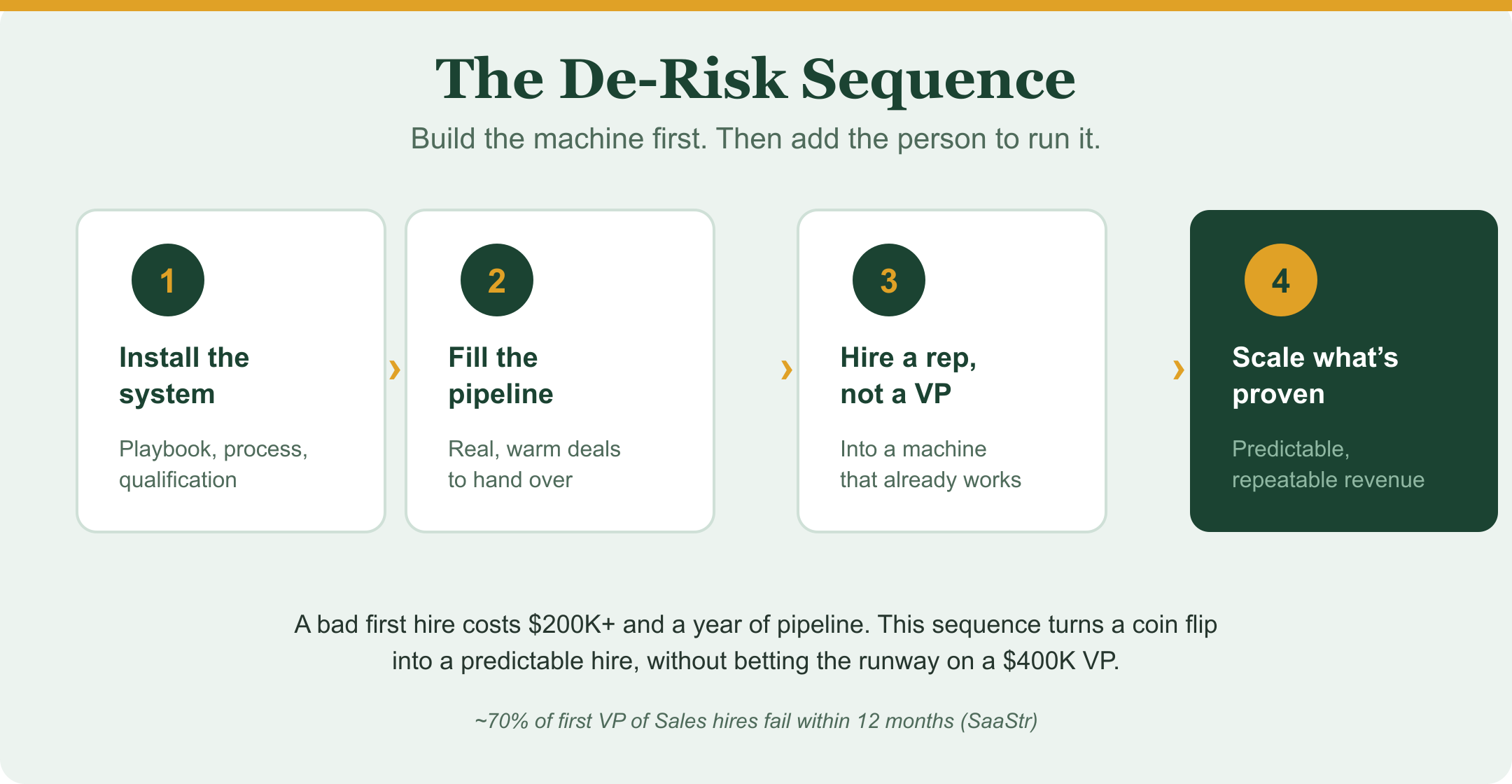
The de-risk move flips the order most founders use. Instead of headcount first and system later, you build the system first and add the headcount into it. That means the documented playbook, the filled pipeline, the qualification bar, and the onboarding plan, all the pieces I've laid out across this series, in place before you bring anyone on.
This single reordering changes everything about the risk. You're no longer betting on whether one expensive person can somehow reverse-engineer your winning motion under quota pressure. You're installing a proven machine and then hiring someone to run it, which is a far cheaper, faster, and more reliable thing to do. The bet stops being "will this hire work out?" and becomes "will this person run a system we already know works?", a question with a much better answer.
How a Fractional Leader Installs What the Hire Needs
This is where a Fractional Sales Leader earns their keep. For a fraction of a $400K VP's cost, they install exactly what your first hire needs to succeed: the documented playbook, the cleaned-up pipeline, the qualification criteria, the written onboarding plan, and the coaching cadence to run alongside it. They've built this same system dozens of times across other companies, so they can do it in weeks, not the year it would take you to figure it out alone while also running everything else.
The founder gets senior sales leadership and a proven playbook without the senior salary and without the all-or-nothing bet. You keep your runway, you get the system, and you get it fast. That's a fundamentally different risk profile than handing $400K and your future to a single new executive and hoping.
Hiring the Rep Into a Machine That Already Works
With the system installed, you hire a rep, not a VP, into a machine that already works. They inherit a documented playbook, a warm pipeline, clear qualification, and a real onboarding plan. Instead of stepping into the vacuum that sinks most first hires, they step onto a runway. Their odds flip from the 70–80% failure base rate to a genuine, coachable shot at succeeding, and they cost a fraction of what a VP would.
"Don't hire a person and hope they build the machine. Build the machine, then hire the person to run it. That single reordering is the whole de-risk."
Turning a Coin-Flip Hire Into a Predictable One
Put the sequence together, system first, fractional leadership to install it, then a rep into the machine, and you've turned the single riskiest move in your company's life into a predictable, staged one. You're no longer betting the runway on a coin flip. You're scaling a proven motion with the right person, at the right time, at a fraction of the cost and a fraction of the risk. And when you eventually do want a full-time VP, you'll hire them into a working machine too, which is exactly when a VP actually succeeds.
This is precisely what I do as a Fractional Sales Leader for founders between $1M and $10M in ARR: install the system, de-risk the hire, and get you to predictable, repeatable revenue without the $400K bet. One honest caveat: if you don't yet have a proven, repeatable motion of your own, even this sequence is premature, there's nothing real to systematize yet. In that case, stay in the seat and prove the motion first, which is the whole point of why first sales hires fail. But the moment you've got a motion that works, de-risking the hire this way is the highest-leverage move available to you.
Related Reading
Frequently Asked Questions
Q: How do I de-risk my first sales hire?
Flip the order. Instead of hiring an expensive person and hoping they build a sales motion, build the system first, the playbook, pipeline, qualification, and onboarding, and then hire a rep to run it. That single reordering changes the bet from "can this hire figure out how we win?" to "can this person run a system we already know works?" The second question has a far better answer. A Fractional Sales Leader can install that system for a fraction of a VP's cost, so you keep your runway while removing most of the risk.
Q: Why is hiring a VP of Sales first a mistake?
Because a VP scales a system, they don't invent one. Hire one before you have a repeatable, documented motion and you're paying executive money for founder work they usually can't do, since they weren't there for your first fifty deals. It's also too expensive to be wrong about: at roughly $400K a year, one failed VP can end a company at your stage, and about 70% of first VP hires fail within 12 months (SaaStr). Bring in a VP later, to scale a motion that's already proven, and their odds of success are dramatically better.
Q: What does a bad first sales hire actually cost?
Far more than the salary. Add the salary and ramp you spent, the deals mismanaged on the way out, the year of pipeline that never got built, the opportunity cost of not growing, and the hit to team morale. Conservatively that's $200K and twelve months. And it compounds, while you recover and restart the search, competitors who got it right pull ahead. The wrong first hire doesn't just cost money, it costs you a full lap in the race, which is why making the hire hard to get wrong matters so much.
Q: How does a Fractional Sales Leader de-risk the hire?
By installing everything the hire needs before they start, for a fraction of a $400K VP's cost. That means the documented playbook, the cleaned-up pipeline, the qualification criteria, the written onboarding plan, and the coaching cadence. Because a fractional leader has built this system dozens of times, they can do it in weeks rather than the year it would take a founder alone. You get senior sales leadership and a proven playbook without the senior salary and without betting your future on a single new executive. Then you hire a rep into a machine that already works.
Q: Should I hire a rep or a VP first?
A rep, into a system, not a VP into a vacuum. Once the playbook, pipeline, and process are in place, a rep can run the proven motion and get to productivity far more reliably, and at a fraction of a VP's cost. The VP comes later, when you have a working machine and a team to scale, which is exactly the situation VPs are good at and the one where they actually succeed. Leading with a VP before there's a system to scale is how founders end up in the 70% failure statistic.
Q: When is it too early to even do this?
When you don't yet have a proven, repeatable motion of your own. The whole de-risk sequence assumes there's a winning motion worth systematizing and handing off. If you're pre-product-market fit or you haven't personally closed enough deals to know your repeatable way to win, building the system is premature, there's nothing real to install yet. In that case, stay in founder-led sales, prove the motion, and document it as you go. Once it's proven, de-risking the hire with a system-first approach is the highest-leverage move you can make.
De-risk the hire. Keep the runway.
If you're a founder between $1M and $10M in ARR, I'll install the system, de-risk your first sales hire, and get you to predictable, repeatable revenue, without the $400K bet. See how it works at louiebernstein.com.
Schedule a 30-Minute CallAbout the Author
Louie Bernstein
Fractional Sales Leader with 50 years of sales experience helping $1M–$10M ARR companies build scalable, repeatable sales systems. Founder of MindIQ (INC 500). LinkedIn Top Voice in Sales Management, Sales Operations, and Sales Coaching.