Key Takeaways:
- Unpredictable revenue is almost never a sales-talent problem. It's a visibility problem. You can't forecast a pipeline that only lives in your head.
- Only 45% of sales leaders and sellers have high confidence in their own forecast accuracy (Gartner). More than half the people whose job is predicting revenue don't trust their own number, and they have RevOps teams. You're doing it alone.
- Revenue is delayed pipeline. If your sales cycle runs 90 days, next quarter's number is being created, or not created, right now. If you can't see the pipeline, you can't see the revenue coming.
- The fix is a system, not a bigger team: one CRM with real stage definitions and exit criteria, a weekly pipeline review and monthly forecast cadence, and a one-page scorecard of leading indicators.
- Companies that use structured forecasting are 28% more likely to hit quota than the ones running on gut feel (CSO Insights). The instinct isn't the problem. The lack of a system around it is.
- You can build the whole thing in a quarter. A Fractional Sales Leader installs it with you, then hands you the keys, so the founder sees what's real versus what's hoped-for.
Here's the pattern I see in almost every founder-led company between $1M and $10M ARR. The pipeline lives in your head, or in a spreadsheet you only half-trust. The forecast is a number you feel more than you calculate. And every quarter ends the same way. A scramble.
You're not bad at sales. You're flying without instruments.
And here's the part that should make you feel better and worse at the same time. Gartner found that only 45% of sales leaders and sellers have high confidence in their own organization's forecast accuracy (Gartner). Read that again. More than half of the professionals whose entire job is to predict revenue don't believe their own numbers. They have RevOps teams, forecasting software, and dedicated analysts. You're doing this between customer calls, payroll, and everything else.
So no, you're not the problem. The good news is that predictable revenue isn't a personality trait or a headcount you can't afford yet. It's a system. Three parts. You can start building it this week.
Why Your Revenue Feels Random (It Isn't)
Start with one idea, because it changes how you see everything else. Revenue is delayed pipeline. The deals that close next quarter are being created, qualified, and advanced right now. If your sales cycle is 90 days, this quarter's activity is next quarter's revenue. That means your revenue was never actually random. You just couldn't see it coming, because you had no instrument pointed at the thing that predicts it.
A mental list is not a pipeline. A spreadsheet you update when you remember is not a pipeline. Both feel like visibility. Neither one is. And when you're the person who closes every deal, the gap is invisible, because your authority and relationships carry deals that were never really qualified. Most founders at this stage are quietly carrying a shadow pipeline, a stack of deals that look real on the forecast but fall apart the moment anyone but you tries to close them.
You can't forecast what you can't see. And you can't see a pipeline that only exists in your head.
Precision isn't even the goal at your stage. Gartner puts median forecast accuracy at 70% to 79%, and only 7% of organizations hit 90% or better (Gartner). You don't need to join that 7%. You need to go from "I have no idea" to "I can see the quarter eight weeks out and I know where the gap is." That jump is worth more to a founder than any decimal point of accuracy.
Step 1: One CRM, Real Stage Definitions, and Exit Criteria
This is the foundation, and it's where most founders either have nothing or have a CRM that's become a graveyard. The goal is simple. Every live deal lives in one place, and every deal sits in a stage that means something.
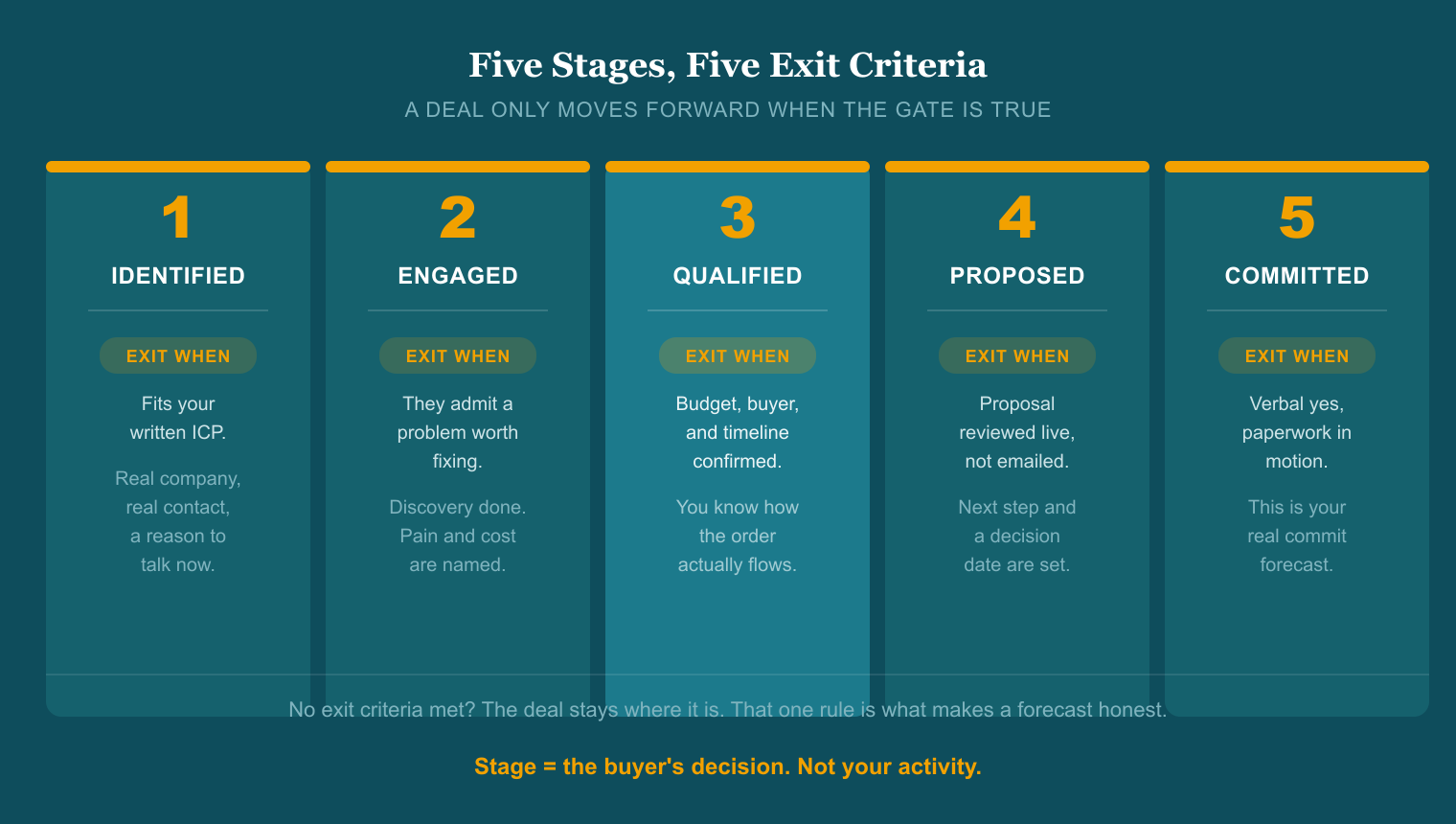
Stages describe the buyer's decision, not your activity
Here's the most common mistake. Founders name their stages after what they did. "Demo done." "Proposal sent." "Followed up." Those describe your activity, and your activity tells you nothing about whether the deal will close. A proposal you sent to someone with no budget is not progress. It's motion.
Name your stages after where the buyer is in their decision instead. Have they admitted a problem worth solving? Have they confirmed budget, authority, and a timeline? Have they agreed on a path to a decision? When your stages track the buyer's commitment instead of your effort, the pipeline finally tells you the truth.
Exit criteria are the gate that keeps the pipeline honest
An exit criterion is the one thing that must be true before a deal is allowed to move to the next stage. Not "I feel good about it." A written, checkable fact. A deal can't leave "Qualified" until budget, buyer, and timeline are confirmed and you know how the order actually flows through their company. No exit criteria met? The deal stays where it is. That single rule is what turns a wish list into a forecast you can trust. It's also the exact discipline that separates a qualified deal from a polite conversation.
One more thing about the CRM. It doesn't have to be expensive or complicated. It has to be one place, used every single day. Most CRMs don't fail because the software is bad. They fail on adoption, and a CRM nobody updates rots quickly. B2B contact data decays roughly 30% a year (Dun & Bradstreet), so a system you touch once a month is wrong before the quarter ends. Simple and used beats powerful and ignored, every time.
Step 2: A Forecasting Cadence You Actually Keep
A clean CRM is a snapshot. A cadence is what makes it a movie. This is the rhythm that turns your pipeline from a static list into a living forecast, and it's less work than the quarter-end scramble it replaces.
The weekly pipeline review (30 minutes)
Same time every week, 30 minutes, no exceptions. Right now it's just you. Later it's you and your first rep. The agenda is short:
- What moved forward, and did it meet the exit criteria to earn that move?
- What's stuck, and what's the specific next step with a date attached?
- What's new this week? New qualified pipeline created is your earliest signal of future revenue.
- What should be killed? A dead deal you keep on the board is lying to your forecast.
Commit, Best Case, and Pipeline
Stop forecasting with one number. Use three buckets. Commit is what you'd bet your own money will close this period. Best Case is the realistic upside if things break your way. Pipeline is everything qualified that's still in play. Reporting all three, every month, does something a single number never will. It shows you the range you're actually operating in, and it makes it obvious when Commit is too thin to hit the target while there's still time to do something about it.
Pipeline coverage, and why a blind 3x lies to you
Coverage is the total value of qualified pipeline divided by your target for the period. The common rule of thumb is 3x to 4x (Clari). If you need $500K and you're carrying $1.5M in qualified pipeline, that's 3x. But the 3x rule only holds if you actually win about a third of your qualified deals. If your real win rate is 20%, you need closer to 5x, and a founder applying a generic 3x is quietly under-covered every quarter without knowing it. Know your real win rate first. Then the coverage number tells you the truth.
A forecast isn't a prediction you make once a quarter. It's a number you update every week from evidence. The cadence is the system. The gut feel is what it replaces.
This is the difference between hoping and knowing. Companies that run structured forecasting are 28% more likely to hit quota than those relying on manual judgment alone (CSO Insights). The cadence is cheap. Missing your number by surprise is not.
Step 3: Leading Indicators and a One-Page Scorecard
Lagging tells you the past. Leading tells you the future.
Closed-won and percent-to-quota are lagging indicators. They're the scoreboard after the game is over. Useful, but they can't change the outcome, because by the time they move, the quarter is already decided. Leading indicators are the ones that move first: new qualified pipeline created, meetings booked, stage-to-stage conversion, average deal age. Those are the numbers that let you fix a bad quarter while there's still a quarter left to fix. I've argued before that qualified pipeline created predicts revenue better than quota does, and it's the first metric I'd put on any founder's scorecard.
The founder's one-page scorecard
You don't need a dashboard with 40 charts. You need one page you can read in 60 seconds, updated weekly. For most founders at this stage, it's these:
- New qualified pipeline created this week and this month
- Total qualified pipeline and your coverage ratio against target
- Commit, Best Case, and Pipeline for the current period
- Win rate and average sales cycle length
- Stage-to-stage conversion, so you can see where deals actually die
That one page is the whole point. It lets you separate what's real from what's hoped-for, in a glance, without a RevOps team.
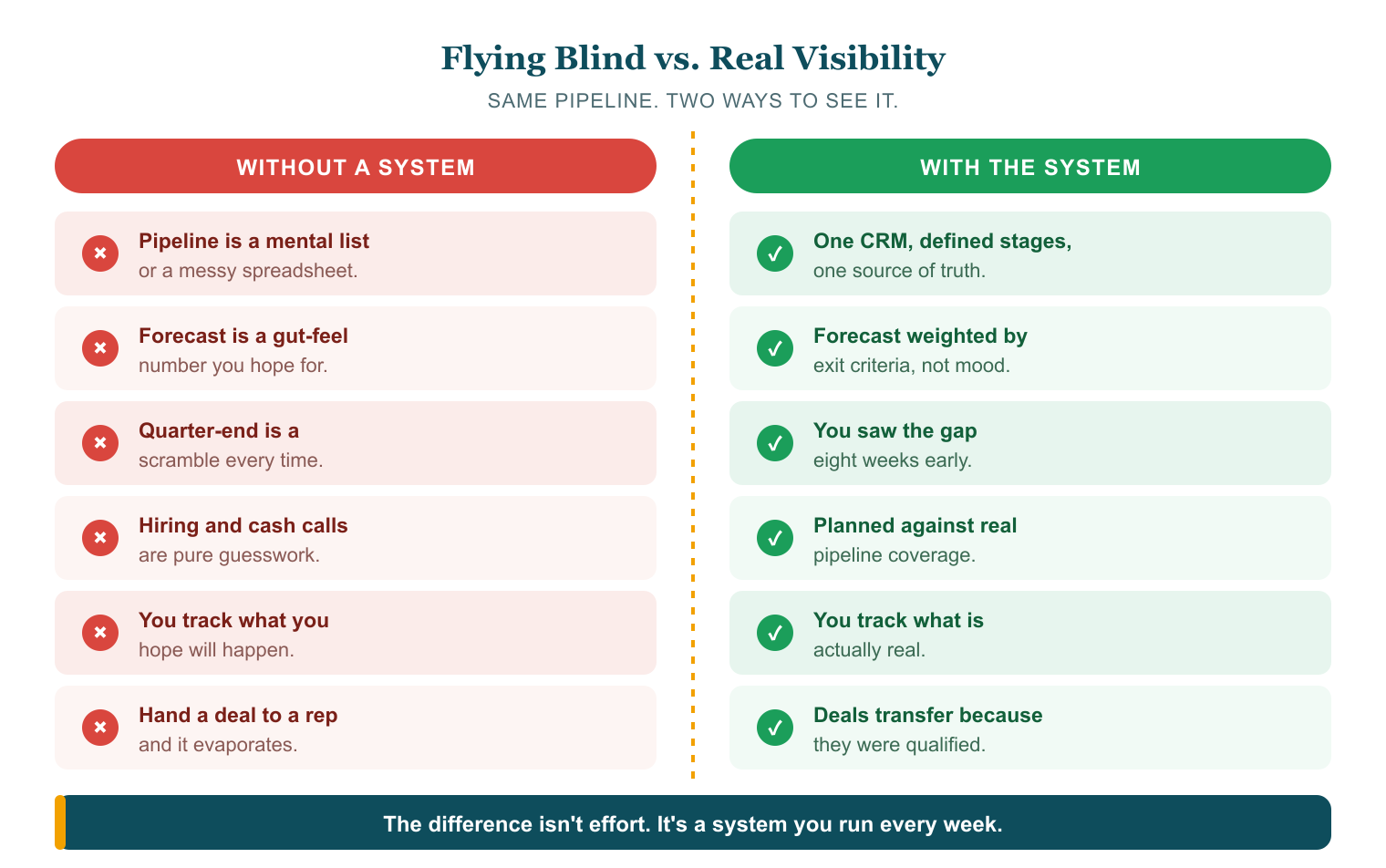
This is also what buys back your time. Salesforce found reps spend under 30% of their time actually selling (Salesforce), and a founder running on gut feel spends even more of the week guessing, chasing, and re-deriving the same answers. A scorecard you trust replaces the guessing. That's hours back, and a business you can finally plan hiring and cash around with confidence.
When This Won't Work Yet
I'll be straight with you, because it matters. If you have no repeatable sales motion at all, this system won't save you. A CRM, a cadence, and a scorecard make a repeatable motion visible and predictable. They can't invent one. You can't systematize chaos, and dashboards over a business that doesn't yet know who it sells to or why people buy will just give you very organized confusion.
If that's you, the first job isn't forecasting. It's nailing the motion: a clear ICP, a real reason people buy, and a rough repeatable process from first conversation to close. That's foundational work, and it's the piece you build before you instrument it. It's also work I do with founders, so if you're at stage zero, the honest answer is that we'd define the sales process first, then wire the visibility on top.
But if you're already closing deals, just inconsistently and invisibly, then you're the exact person this fixes. You have a motion. It's living in your head. The three steps above are what pull it out of your head and turn it into something you can see, staff, hand off, and repeat without you being the single point of failure.
Frequently Asked Questions
Q: What's the difference between pipeline visibility and a forecast?
Visibility is knowing what deals exist, what stage they're really in, and what has to be true for each to advance. A forecast is what you build on top of that visibility, an evidence-based estimate of what will close and when. You can't have a trustworthy forecast without visibility first. That's why the CRM and exit criteria come before the forecasting cadence. Skip the foundation and your forecast is just a nicely formatted guess.
Q: Which CRM should a $1M to $10M founder use?
The one your team will actually update every day. At your stage, a lightweight CRM like HubSpot, Pipedrive, or Close is plenty. The tool matters far less than the stage definitions and exit criteria you put inside it. I've watched founders spend three months choosing a CRM and zero months defining what their stages mean. That's backwards. Get a simple tool, define the stages properly, and use it daily. You can always graduate to something heavier later.
Q: How much pipeline coverage do I need to hit my number?
Start with 3x to 4x as a rule of thumb, then correct it with your real win rate. If you close a third of your qualified deals, 3x works. If you close 20%, you need about 5x to have the same confidence. The mistake is treating 3x as a law of nature. Calculate your actual win rate over the last 12 months, and let that set your target coverage.
Q: How often should I run a pipeline review?
Weekly for the pipeline review, monthly for the forecast roll-up. Weekly is frequent enough to catch a stuck deal while you can still do something about it, and short enough that it never becomes a burden. Thirty minutes is the target. When you add your first salesperson, this same meeting becomes how you coach and hold the line on qualification, so building the habit now while it's just you pays off twice.
Q: My CRM is already a mess. Where do I start?
Don't try to fix history. Draw a line. Define your stages and exit criteria first, then run every open deal through the new definitions once. Deals that don't meet the criteria for the stage they're sitting in either move back or get killed. It's uncomfortable, and it usually shrinks your pipeline on paper. That's not a loss. That's the shadow pipeline leaving. What's left is real, and a smaller real pipeline is worth more than a big fictional one.
Q: Can a Fractional Sales Leader really install this in a quarter?
Yes, and that's usually how I scope it. A Fractional Sales Leader isn't a consultant who hands you a slide deck and leaves. I set up or clean up the CRM, write the stage definitions and exit criteria with you, build the forecasting cadence and the scorecard, and run the rhythm alongside you until it sticks. Then you own it. You get the system a full-time VP of Sales would build, without the full-time cost, and without waiting until you can afford one to finally see your revenue coming.
Stop guessing at your own revenue.
If your pipeline lives in your head and your forecast is a gut call, let's fix that. In 30 minutes I'll show you where your visibility is leaking and what the CRM, cadence, and scorecard would look like for your business. See how I help founders build predictable revenue at louiebernstein.com.
Schedule a 30-Minute CallAbout the Author
Louie Bernstein
Fractional Sales Leader with 50 years of sales experience helping $1M–$10M ARR companies build scalable, repeatable sales systems. Founder of MindIQ (INC 500). LinkedIn Top Voice in Sales Management, Sales Operations, and Sales Coaching.