Key Takeaways:
- A quarterly forecast scramble beats nothing, but it loses badly to a short weekly review. Weekly is what catches a slipping deal while you can still save it.
- Only 45% of sales leaders trust their own forecast (Gartner). The weekly review is where you earn that trust, by inspecting deals instead of collecting optimistic status updates.
- The whole meeting is five questions: what moved and why, the next step and date, what's sat too long, how many contacts, and what the rep needs from you. That's it.
- Inspect the deal, don't interrogate the rep. "What has to be true for this to close?" surfaces reality without putting anyone on the defensive. "What's the update?" just invites a hopeful story.
- Run the same five questions every week and the forecast gets boring, predictable, and accurate. Boring is the goal. Boring is what lets you plan hiring, cash, and growth with confidence.
Most sales meetings are theater. The founder asks "how's the pipeline?", each rep narrates an optimistic story about their deals, everyone nods, and the meeting ends with everyone knowing exactly as much as they did going in. Then the quarter closes light and everyone's surprised.
A real pipeline review is a completely different thing. It's not a status update. It's a weekly inspection that tests whether each deal is actually what the rep says it is, catches problems while there's still time to fix them, and quietly makes your forecast more accurate every single week.
Only 45% of sales leaders have high confidence in their forecast (Gartner). The weekly review is where the other 55% could start earning it. Here's exactly how to run one.
Why Quarterly Panic Beats No Review but Loses to Weekly
Plenty of founders only really look at the pipeline when the quarter is ending and the number is in doubt. That quarterly panic is better than nothing, barely, but it fails at the one thing that matters: timing. By the time you notice a deal has stalled at quarter's end, it's been dead for weeks and there's nothing you can do.
A monthly review is better. A weekly review is where it clicks. The reason is simple: deals slip in small increments, a missed next step here, a contact who went quiet there, and those small slips are only catchable when they're small. Weekly cadence is short enough that a deal can't drift far before you spot it. Given that 86% of B2B purchases stall somewhere in the process (Forrester), your job is to catch the stall in week one, not month three.
A deal you inspect weekly can be saved. A deal you look at once a quarter can only be mourned. Cadence is the whole game.
The Handful of Questions That Run the Meeting
You don't need an elaborate agenda. A great weekly review is the same five questions, asked every week, about the deals that matter most. That's the entire meeting.
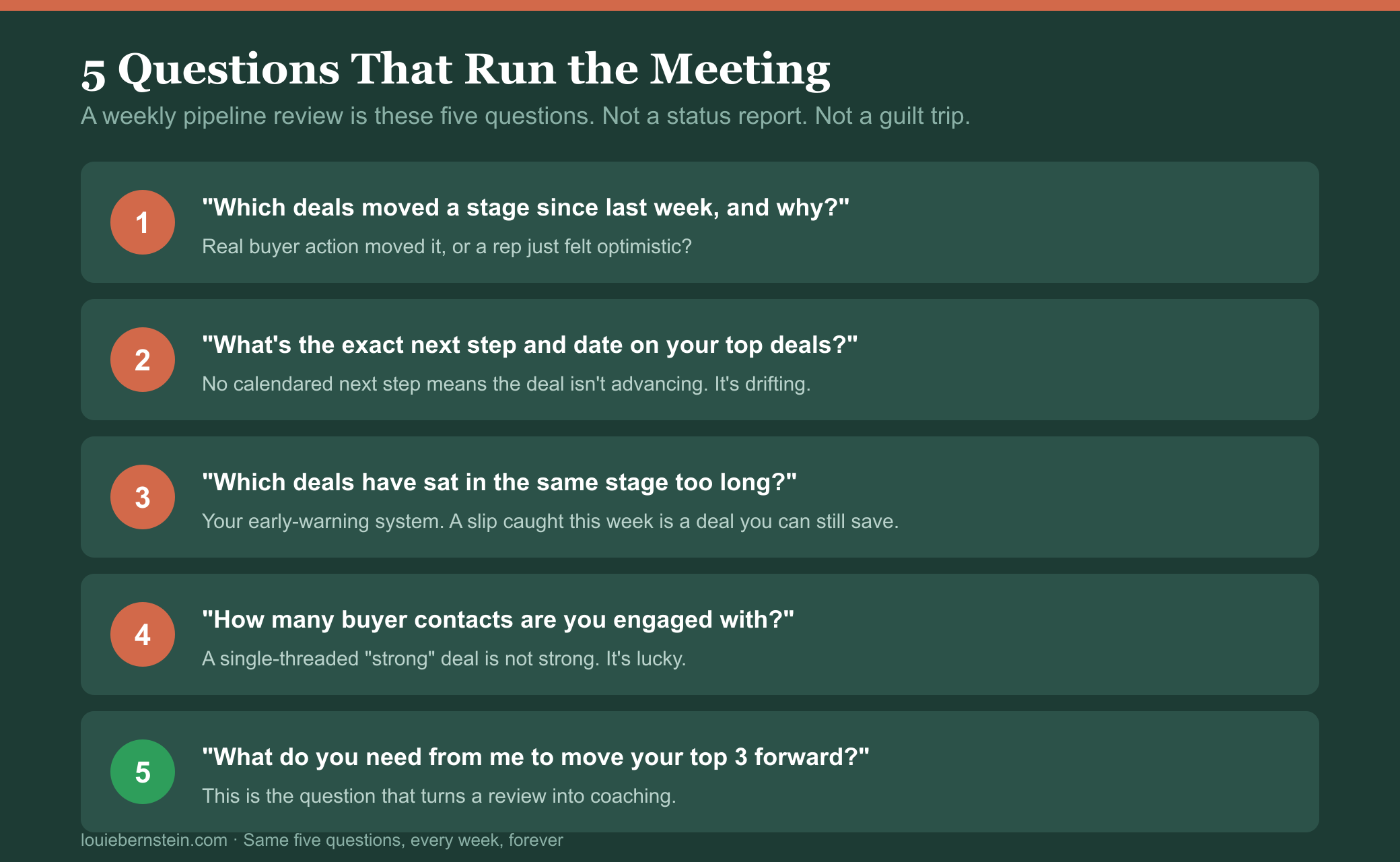
Notice what these five do together. Questions one through four inspect reality, they test whether deals are actually advancing, whether they have a real next step, whether any have stalled, and whether they're multi-threaded. Question five flips the meeting from inspection to help. The consistency is the point: when reps know these exact questions are coming every week, they show up prepared, and the CRM gets updated before the meeting because it has to be.
Inspecting Deals Without Interrogating Reps
Here's the trap that ruins pipeline reviews: they turn into interrogations. The founder grills, the rep gets defensive, and everyone learns to perform confidence instead of surfacing truth. The fix is to inspect the deal, not the person.
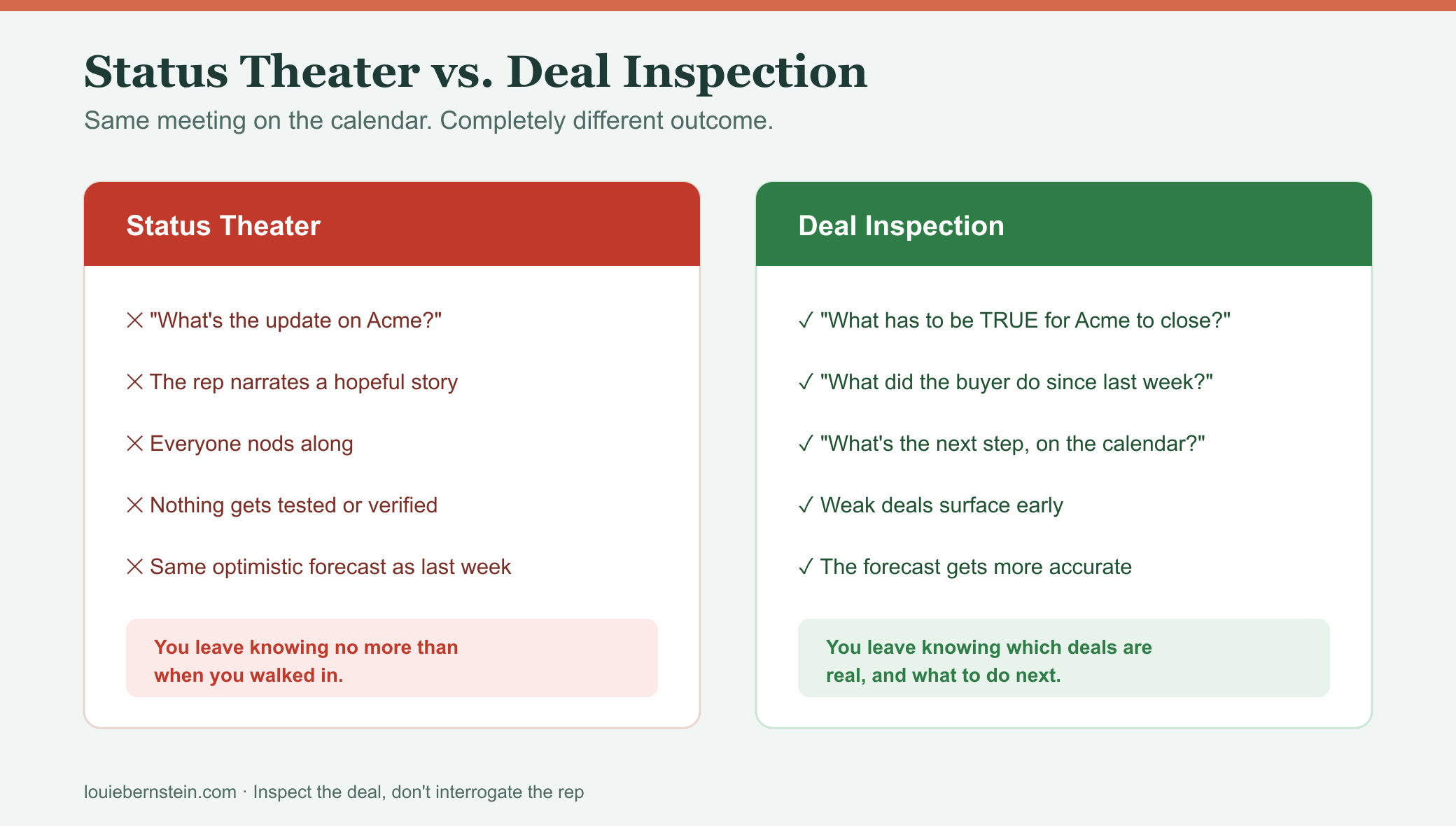
The difference is in the questions. "What's the update on Acme?" invites a story and puts the rep on stage. "What has to be true for Acme to close, and what did the buyer do since last week?" puts the deal on the table and the rep on your side of it, examining it together. It's my favorite move from years of running these: ask them to walk you through their top three deals and, for each, what has to be true for it to close. A rep who inspects their own deals is a rep you can coach. A rep who only narrates is one you need to teach how to inspect. And always ask the old sales-floor follow-up: "then what happens?" It exposes exactly where the plan runs out.
Catching the Slip Before It Slips
The single most valuable output of a weekly review is early warning. A deal rarely dies in one dramatic moment. It slips: the close date moves a week, then another, then it's been in "Proposal" for six weeks with no movement. Each slip is small and forgivable on its own. Together they're a lost deal.
Weekly cadence catches slips while they're still small. When you ask "which deals have sat in the same stage too long?" every week, a deal can only overstay by a few days before it's flagged. Then you can act, re-engage the champion, force a next step, or make the call to mark it dead and stop wasting time on it. This is the same discipline as the time-in-stage limits I wrote about in why "no decision" is your biggest competitor. The review is where you enforce it.
Turning the Review Into Coaching, Not Status
The best pipeline reviews don't just measure, they develop. Every stuck deal is a coaching opportunity in disguise. When a rep can't answer "what has to be true to close?", that's not a failure to punish. It's a gap to fill, together, right there in the meeting.
That's what question five is for: "What do you need from me to move your top three forward?" It signals that you're on the rep's team, and it surfaces the real blockers, a stalled champion, a missing exec sponsor, a pricing objection they don't know how to handle. You solve those together, and the rep gets better every week. Over time your reviews stop being about catching people out and become the highest-leverage coaching hour in your week. That shift, from status to coaching, is a big part of what separates a manager who inspects from one who makes the CRM the meeting.
A pipeline review that only measures makes reps defensive. One that also coaches makes them better. Same meeting, same five questions, completely different culture.
The Cadence That Makes the Forecast Boring (in a Good Way)
Here's the payoff. When you run the same tight review every week, something wonderful happens: the forecast stops surprising you. No more heroic quarters and no more gut-punch misses. Just a steadily accurate number that inches up or down in ways you saw coming. Boring. And boring is exactly what you want from a forecast.
A boring forecast is a forecast you can build a company on. You can hire the next rep because you know the revenue is coming. You can sign the lease, fund the roadmap, and sleep at night, because the number in your head and the number in reality have finally converged. That convergence is the entire point of everything in this series, from stopping stalls to fixing your CRM. The weekly review is where it all comes together.
If you've never run a review like this, or your current one is status theater, this is exactly the operating rhythm a Fractional Sales Leader installs and runs for $1M to $10M ARR companies, without the cost of a full-time VP of Sales. And if you're a solo founder with no team to review yet, run the five questions on yourself every Monday morning. Inspecting your own deals weekly is the single best habit you can build before you ever hire.
Frequently Asked Questions
Q: How often should I run a pipeline review?
Weekly. A monthly review is better than a quarterly scramble, but weekly is where it works, because deals slip in small increments and small slips are only catchable when they're small. A weekly cadence means a deal can't drift far before you spot it and act. Keep it short and focused, 30 to 45 minutes for a small team, run off the same five questions every time.
Q: What questions should I ask in a pipeline review?
Five: (1) Which deals moved a stage since last week, and why? (2) What's the exact next step and date on your top deals? (3) Which deals have sat in the same stage too long? (4) How many buyer contacts are you engaged with on each? (5) What do you need from me to move your top three forward? The first four inspect reality; the fifth turns the review into coaching. Same five, every week.
Q: How do I inspect deals without making reps defensive?
Inspect the deal, not the person. Instead of "what's the update on Acme?", which invites a hopeful story, ask "what has to be true for Acme to close, and what did the buyer do since last week?" That puts the deal on the table and the rep beside you examining it, rather than on the stand defending it. Have them walk you through their top three deals and what must be true for each to close.
Q: What's the difference between a status meeting and a pipeline review?
A status meeting collects updates: reps narrate, everyone nods, nothing is tested, and you leave knowing no more than when you arrived. A pipeline review inspects deals: it tests what has to be true, what the buyer actually did, and what the next step is, so weak deals surface early and the forecast gets more accurate. Same slot on the calendar, completely different outcome.
Q: How does a weekly review actually improve my forecast?
By catching slips early and testing every deal against reality each week, so optimistic and stalled deals get corrected before they distort the number. Over time the forecast stops surprising you: no heroic quarters, no gut-punch misses, just a steadily accurate number. Only 45% of sales leaders trust their forecast (Gartner); a disciplined weekly review is one of the most reliable ways to join the group that does.
Q: I'm a solo founder with no team. Should I still do this?
Yes. Run the five questions on yourself every Monday morning. Walk your own top deals: what moved, what's the next step, what's stalled, how many contacts, and what's blocking you. Inspecting your own pipeline weekly is the single best habit to build before you hire, and it means that when you do bring on a rep or a Fractional Sales Leader, the operating rhythm is already in place for them to step into.
Want a pipeline review that actually predicts revenue?
In 30 minutes I'll show you how to run the five-question weekly review, inspect deals without interrogating your reps, and make your forecast boring in the best way. See how a Fractional Sales Leader can help at louiebernstein.com.
Schedule a 30-Minute CallAbout the Author
Louie Bernstein
Fractional Sales Leader with 50 years of sales experience helping $1M–$10M ARR companies build scalable, repeatable sales systems. Founder of MindIQ (INC 500). LinkedIn Top Voice in Sales Management, Sales Operations, and Sales Coaching.