What Coverage, Velocity, and Capacity Numbers Show You've Passed the Point of Diminishing Returns?
Founder-led sales starts costing more than it returns when your next selling hour produces less than the delay it causes on every other deal. Three numbers show the flip: workable coverage (the pipeline you actually have time to work) falls below what your target needs, sales velocity drops as you add deals, and your sales calendar runs above about 80% booked. When two of the three show up, start moving deals to a team.
Key Takeaways
- Founder-led sales passes the point of diminishing returns when adding deals to the founder's plate lowers revenue per day instead of raising it.
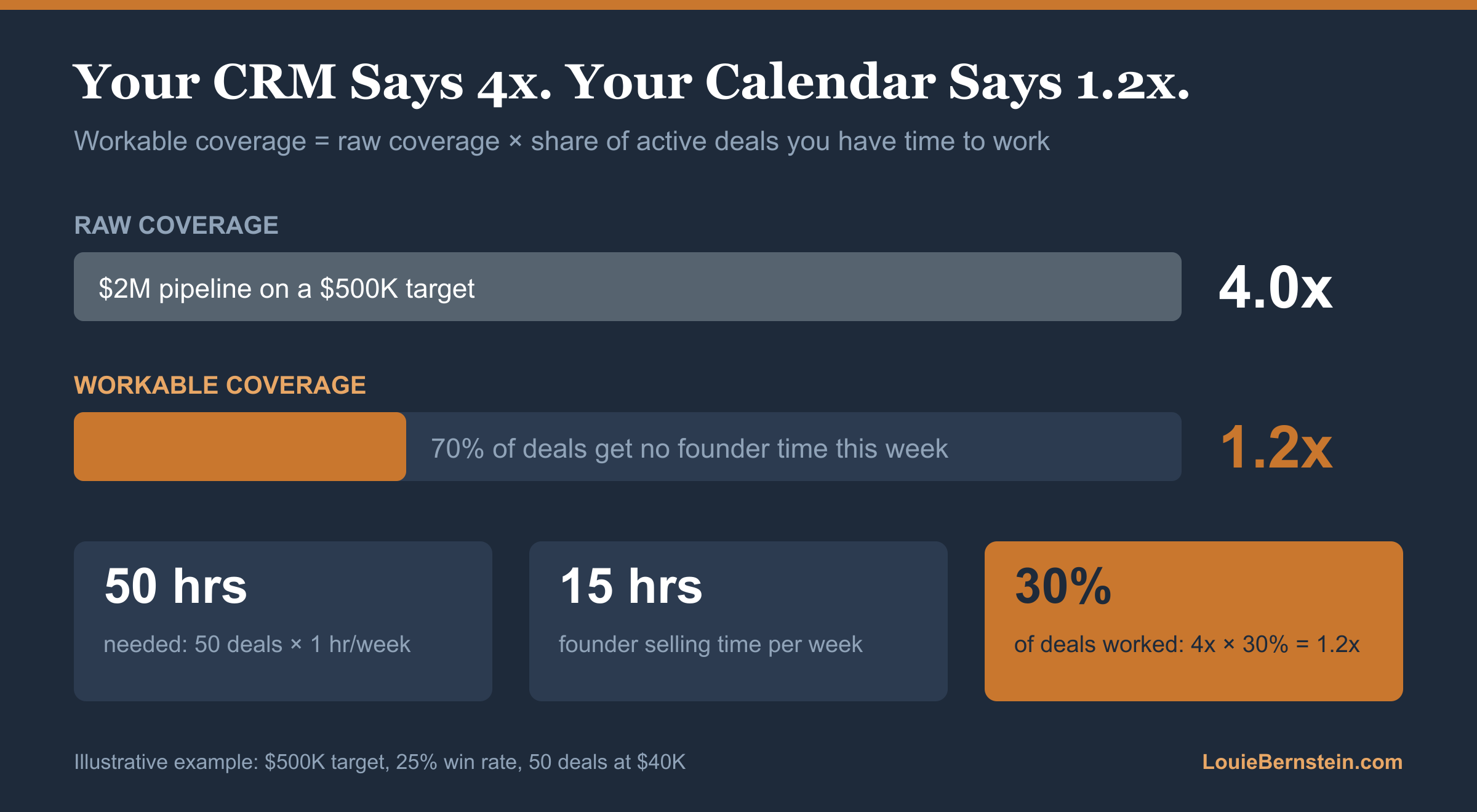
- Workable coverage is raw pipeline coverage multiplied by the share of active deals you have time to work. A founder with 4x coverage who can work 30% of the deals really has 1.2x.
- Deals that slip lose: 44% of deals were pushed and win rates fell 67% when they slipped (Ebsta/Pavilion, 2024). Deals waiting on a busy founder are slipping deals.
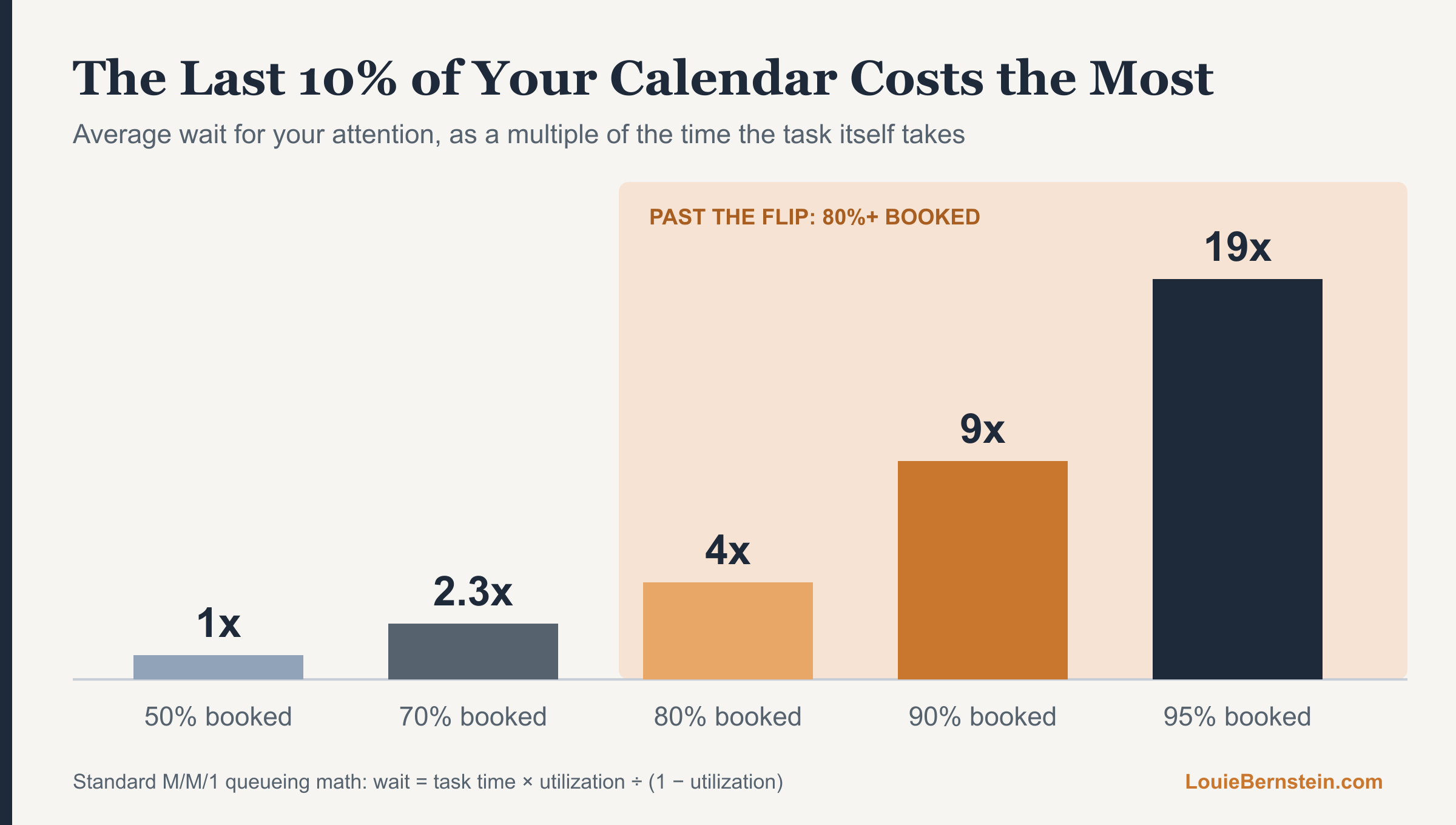
- Standard queueing math says that at 80% booked, work waits about 4x as long as it takes to do. At 90% booked, it waits about 9x.
- Pull three numbers this week: active deals times hours per deal, revenue per day over the last two quarters, and the share of your sales hours already booked. If two are red, start the handoff now, because a new AE takes about 6.2 months to ramp (Bridge Group, 2026).
Founders don't stop being good closers. You'll probably still have the best win rate in the company on the day you hand off your last deal.
The problem is that you stop being a big enough closer. Your calendar has a fixed number of hours, and the pipeline keeps growing. At some point the next deal you take on doesn't add revenue. It just pushes three other deals back a week.
Your win rate tells you how good you are. Your calendar tells you how much that's worth.
That's the flip. It happens quietly, and most founders feel it long before they can name it. Here's how to measure it.
What Does It Mean When the Math Flips on Founder-Led Sales?
The math flips on founder-led sales when the marginal return of a founder selling hour falls below its cost. Early on, every hour you sell is the best hour in the company. Later, each added deal gets a thinner slice of your time and slows the deals already in motion, so total output stops rising.
Average return hides the problem
Founders judge their selling by averages: win rate, average deal size, total bookings. Averages look great right up until they don't, because your best deals pull them up. The number that matters is marginal: what did the last ten hours you put into sales actually produce, compared with what those hours would have produced spent on hiring, product, or a key customer?
When your annual cost of founder-led sales starts showing up as stalled deals and postponed CEO work, the marginal hour has already gone negative.
Before and after the flip
| Before the flip | After the flip |
|---|---|
| ✓ You can work every qualified deal every week | ✕ Some deals go a week or more untouched |
| ✓ More pipeline means more revenue | ✕ More pipeline means longer cycles |
| ✓ Buyers hear back the same day | ✕ Buyers wait days for a proposal or price |
| ✓ Close dates mostly hold | ✕ Close dates slide quarter to quarter |
| ✓ CEO work gets done on schedule | ✕ Hiring, product, and finance decisions wait |
| ✓ Your calendar has open selling hours | ✕ Your sales hours are 80% or more booked |
What Coverage Number Shows You Can't Work Your Own Pipeline?
Workable coverage shows whether your pipeline is real or just a list. It's your raw pipeline coverage multiplied by the share of active deals you have time to work each week. Raw coverage counts every deal. Workable coverage counts only the deals somebody is actually advancing, which is what closes.
How to calculate workable coverage
Raw coverage is pipeline divided by target, and the multiple you need is about 1 divided by your win rate, as I explained in pipeline math for founders. Workable coverage adds a capacity check:
- Count active qualified deals.
- Estimate the hours a week each deal needs: calls, prep, proposals, follow-up. Use your calendar, not your memory.
- Multiply to get the hours your pipeline requires.
- Divide your real weekly selling hours by that number. That's the share you can work.
- Multiply raw coverage by that share.
An illustrative example
A founder wants $500K in new bookings this quarter and wins 25% of qualified deals, so the target needs 4x coverage, or $2M. The pipeline has exactly that: 50 deals at $40K. Each active deal needs about an hour a week, so the pipeline needs 50 hours. The founder has 15 selling hours. That's 30% of the deals, so workable coverage is 1.2x, not 4x.
The CRM says the quarter is covered. The calendar says it's already short. Untouched deals don't close at your normal rate, and nobody notices until the last two weeks of the quarter.
What Velocity Signal Shows Deals Are Waiting on You?
The velocity signal is revenue per day falling while your deal count rises. Sales velocity is opportunities times win rate times deal size, divided by cycle length in days. When a founder adds deals and velocity drops, the extra deals are lengthening the cycle and lowering the win rate faster than they add volume.
Run it on your last two quarters
Take a quarter where you had 20 active deals, a 25% win rate, $40K deals, and a 90-day cycle. Velocity is $2,222 a day. Now say the pipeline grows to 30 deals, but because you're stretched, the cycle stretches to 140 days and the win rate slips to 20%. Velocity drops to $1,714 a day. You added 50% more pipeline and got 23% less revenue per day. Those numbers are illustrative, but the pattern isn't.
The win rate drop is the expensive part. Ebsta and Pavilion found 44% of deals were pushed, and win rates fell 67% when a deal slipped (Ebsta/Pavilion, 2024). A deal waiting for your price approval or your proposal is a deal slipping. If you want to dig into the formula itself, here's my breakdown of B2B sales velocity.
The two numbers to watch
- Cycle length by quarter. If your average days to close rose two quarters in a row while deal size held steady, look at your calendar first.
- Days waiting on the founder. List every open deal whose next step belongs to you, and count the days since it landed there.
What Capacity Number Tells You Your Calendar Is Full?
The capacity number is the share of your available sales hours already booked. Above about 80%, waiting time explodes rather than growing steadily. That's standard queueing math, not a sales theory: as any desk, server, or person gets close to fully booked, each new request waits far longer than it takes to handle.
Why 80% is the line
In the simplest queueing model (M/M/1), average wait equals the time a task takes multiplied by utilization divided by one minus utilization. At 50% booked, work waits about as long as it takes. At 80%, about 4x. At 90%, about 9x. At 95%, about 19x. Real calendars are messier than the model, but the curve has the same shape: the last 10% of your calendar costs more than the first 50%.
So if a proposal takes you two hours and your sales hours are 90% booked, the model says the buyer waits about 18 working hours just to get in line. That's two business days before you even open the document.
Your selling hours are fewer than you think
Professional reps spend only 28% of their week actually selling (Salesforce State of Sales, 2022, 7,775 respondents). A founder also has a company to run. When I ask founders to count real selling hours from last month's calendar, the number almost always comes in lower than the one they quoted me. Use the calendar number.
Where Do Founders Usually Get the Timing Wrong?
Founders usually get the timing wrong by waiting until the math has already flipped before they start building a team. By the time the calendar is full and deals are slipping, a new hire is still months from carrying weight. The right time to start the handoff is when the numbers turn yellow, not red.
What I learned running MindIQ
I ran MindIQ for 22 years, and for a long stretch I was my own best salesperson. That felt like a strength. It was a ceiling. My need to be in on every deal capped how fast the company could grow, and I didn't see it because my win rate looked fine. The averages were good. The marginal hours weren't.
I see the same pattern when I audit founder-led sales teams now. The founder measures how well they sell, never how much selling their calendar can actually hold. Then a big quarter arrives, the calendar breaks, and the founder hires in a panic.
The ramp makes late hiring expensive
The average AE takes 6.2 months to ramp, the longest in the study's history, and only 48% of reps hit quota (Bridge Group, 2026, 158 B2B companies). Hire when you're at 95% booked and you'll spend six more months over capacity while the new rep learns. My rule of thumb: when your sales hours stay above 70% booked for a full quarter, start writing down how you sell, so the next person has something to learn from.
What Should You Do Once the Math Has Flipped?
Once the math has flipped, stop adding deals to your own plate and start moving whole segments of the pipeline to a system someone else can run. The goal isn't to vanish from sales. It's to spend your limited hours where they still produce more than they cost, and hand off the rest.
- Score the three numbers. Workable coverage against target, revenue per day for two quarters, and the share of sales hours booked. Two reds means act now.
- Keep the deals only you can win. Usually that's the largest strategic deals. Everything else is a candidate for handoff.
- Write the playbook before the hire. Your ICP, qualification rules, stages, and pricing limits go into a Sales Playbook, and the decisions each person owns go into an Accountabilities Document.
- Hand off the smallest deals first. They're the lowest risk and teach a new rep your process fastest.
- Re-run the numbers monthly. Workable coverage should rise as your share of active deals falls.
This is where a Fractional Sales Leader fits. A full-time VP of Sales costs $250K to $400K a year. Most fractional sales leaders run $10K to $20K a month; I charge $14K a month for 20 to 35 hours a week, in 12-week renewable engagements, at roughly half the cost of a full-time VP. That buys you the playbook, the hiring, and the coaching while you keep the deals that still need you.
Frequently Asked Questions
At what ARR does founder-led sales usually stop working?
There's no fixed ARR line, because the flip depends on deal size, cycle length, and the hours each deal needs. A founder selling a few large deals hits it later than one selling many small deals. Use your calendar, not a revenue number.
How many hours a week should each deal take?
Measure it rather than guess. Pull last month's calendar, add up the time on calls, prep, proposals, and follow-up for active deals, and divide by the number of active deals. Early-stage deals need less time than deals in negotiation.
Can I just work longer hours to fix the capacity problem?
Longer hours raise your capacity a little and the CEO work you skip gets worse. Queueing math works on the share of time booked, so a 70-hour week that's 90% booked still produces long waits. Adding hours delays the flip. It doesn't remove it.
Isn't more pipeline always good?
More pipeline is good only when someone has time to work it. If added deals lengthen your cycle and drop your win rate, your revenue per day can fall even as pipeline grows. Check workable coverage before you celebrate a big pipeline number.
Should my first hire be a salesperson or a sales leader?
If you have no written process, a salesperson hired into chaos will struggle. Only 48% of reps hit quota in a 2026 Bridge Group study whose sample skews toward companies with engaged revenue leadership. Build the playbook and the management rhythm first, either yourself or with a Fractional Sales Leader, then hire.
What if only one of the three numbers is red?
One red number is a warning, not a verdict. A red capacity number with healthy velocity means you're close. Start documenting how you sell now and re-check every month, so you're ready before the second number turns.
Find out if your math has already flipped
Bring your pipeline and last month's calendar. In 30 minutes we'll run your workable coverage, velocity, and capacity numbers together, and you'll know whether to keep selling or start the handoff. Learn more at LouieBernstein.com.
Schedule a 30-Minute ConversationAbout the Author
Louie Bernstein is a Fractional Sales Leader with 50 years of sales experience and has worked as a Fractional Sales Leader since 2017. He founded and ran MindIQ, an Inc. 500 company, for 22 years. He helps B2B founders at $1M to $10M ARR build repeatable sales systems and teams that can sell without the founder in every conversation.
Subscribe to The Sunday Starter for practical sales leadership advice.