How Do You Separate Live Deals From Future Buyers?
Remove a deal from your active sales pipeline when the buyer no longer has a current buying process you can verify. Keep the relationship and its history. Move a good-fit future buyer to nurture with an owner and a specific return trigger. Close an ended opportunity with an honest reason. Before removing a delayed deal, check whether the buyer is still completing agreed work toward a purchase.
Key Takeaways
- Remove opportunities from active pipeline when current buyer evidence no longer supports an active purchase. Preserve the CRM record.
- Separate three decisions: active selling, nurture for a future trigger, and closed opportunities with a reason. Future interest does not belong in this quarter's forecast.
- Forrester reported in 2024 that 86% of B2B purchases stalled. A delay alone cannot tell you whether a deal has ended (Forrester).
- Audit your 10 oldest open opportunities this week. Record the last buyer action, the blocker, the next agreed action, and the person responsible.
- Require fresh qualification before a nurtured account returns to active pipeline. An opened email or an unchanged old proposal does not qualify.
A full pipeline can keep a founder busy without helping the company grow. You send another follow-up. You review the same proposal. You move the close date again. Meanwhile, a buyer with a problem you can solve waits for your attention.
For a B2B founder at $1M to $10M ARR, the cost goes beyond an inaccurate report. You still close most of the business. Every old opportunity you personally rescue takes time from coaching the rep who should eventually replace you in those conversations.
A future customer deserves a follow-up plan. That doesn't earn the customer a place in today's revenue forecast.
The useful question is whether a buying process exists now. Once you answer that, you can decide where the opportunity belongs without treating every quiet buyer as a lost cause.
How Do You Know a Deal No Longer Belongs in Active Pipeline?
A deal no longer belongs in active pipeline when you cannot verify a current buying effort after checking with the buyer. Look for evidence that the problem is still a priority, someone owns the decision, and an agreed action will move the purchase forward. A seller's follow-up task supplies none of that evidence.
Ask what changed on the buyer's side
Start with the last meaningful buyer action. Did the buyer supply requirements, introduce an approver, confirm a budget discussion, or review contract changes? Record what happened and when. Sending another deck is your activity. It does not show that the buyer is still buying.
Then ask a direct question: 'Is solving this still a priority for this planning period? If so, what needs to happen next, and who will own it?' You want a useful answer, including a clear no. Give the buyer room to explain a change instead of demanding a meeting to defend your forecast.
If the need has disappeared, the project was canceled, or the buyer chose another provider, close the opportunity with that reason. If the company still fits but the project has no current owner or funded window, remove the opportunity from active selling and decide whether nurture has a credible purpose.
Separate removal from deletion
Removing a deal means changing its status and reporting treatment. Keep contacts, notes, proposals, objections, and the original outcome. Deleting the record destroys the information that will make a future conversation useful. For the entry standard, use what makes a deal qualified. This decision asks whether that qualification still holds.
Should You Keep, Nurture, or Close a Quiet Deal?
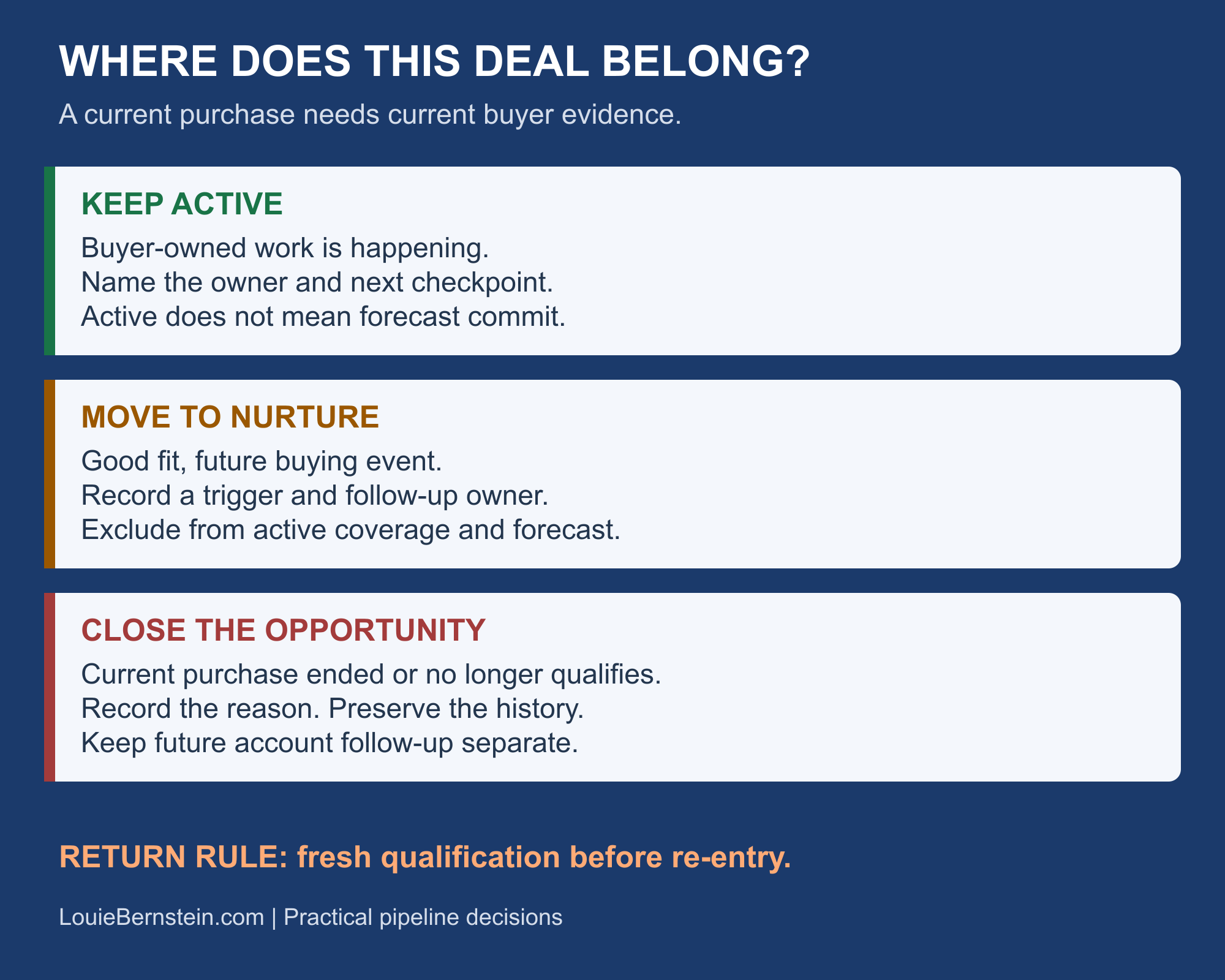
Keep a quiet deal active when buyer-owned work still supports a current purchase. Move a good-fit account to nurture when a named future event could restart buying. Close the opportunity when the current purchase has ended. Record the reason and owner so a smaller pipeline produces better decisions rather than lost follow-up.
Keep active when there is work to manage
A security review can take time and still be real. A buyer may be waiting for a budget committee meeting with a confirmed date. Keep the opportunity active if the buyer confirms the work, the owner, and the next checkpoint. Adjust the expected close date to the actual process. Active does not automatically mean committed revenue.
Nurture when the future has a reason
A prospect whose budget reopens in February needs a February plan. Record the budget event, who will contact the buyer, and what you will send beforehand. Avoid a holding bucket called 'nurture' where every old deal goes to disappear. If there is no known trigger, record that uncertainty and use a low-effort review cadence.
Close when the opportunity has ended
Closed-lost should describe the opportunity, not declare that the account can never buy. Distinguish competitor selected, no decision, project canceled, poor fit, and unresponsive after a defined follow-up plan. Preserve those differences for win-loss analysis. If your CRM requires a closed outcome for paused opportunities, use a clear reason such as 'deferred, future review' and retain the account-level nurture task.
These are operating decisions you define in your Sales Playbook. The labels can vary by CRM. The financial rule should not: future or closed opportunities stay out of active coverage and the current forecast.
How Long Should You Wait Before Removing a Deal?
Wait long enough to test the buyer's actual process, rather than applying one age limit to every opportunity. Use your own stage history to flag unusual delays, then ask the buyer to confirm the blocker and next action. Treat age as a review signal; make the removal decision from evidence.
An overdue deal needs a decision, not another automatic extension
Set a review date when the buyer misses an agreed action. Check whether the task changed, the owner changed, or the priority changed. A rep should not move the close date to next month without recording the reason. Repeated extensions without new buyer evidence are a strong reason to take the opportunity out of active pipeline.
Be careful about treating every pause as rejection. Forrester's 2024 buying research found an average of 13 internal participants in buying decisions, with 89% of purchases involving at least two departments. Those broad B2B findings aren't timing benchmarks for your company. They explain why a real purchase can slow down while several people do necessary work.
Gartner reported in May 2025 that 74% of B2B buyer teams showed unhealthy conflict during the decision process. The survey covered 632 B2B buyers in August and September 2024. A founder should ask whether stakeholders agree on the problem and next step before assuming that another reminder will solve the delay.
Use a small, explicit recovery plan
Agree on a limited follow-up sequence appropriate to the relationship. Ask one useful status question, offer help with the stated blocker, and explain when you will pause active pursuit if there is no response. Respect a request to stop contact. Don't invent a universal number of days or touches and call it an industry standard.
For a buyer who does reply, make the next checkpoint specific: 'After the committee meets on Tuesday, can we confirm the decision on Thursday?' If the buyer cannot name any purchase-related action, the account may still be worth knowing. The current opportunity has not earned continued active status.
Why Should Founders Apply the Same Rule to Their Own Deals?
Founders should apply the same removal rules to their own deals because personal relationships can outlast a live buying process. A founder's access may keep a conversation warm even after the project loses priority. Giving those opportunities special treatment teaches reps that status depends on who owns the relationship rather than buyer evidence.
What building MindIQ taught me about the handoff
I built and ran MindIQ for 22 years. I know how much of a founder's selling can stay in the founder's head. In my writing about qualification, I've described how prospects defer to founders and how a deal that felt solid with the founder can fall apart when a rep takes over. That is a reason to test the evidence before the handoff.
If the reason for keeping a deal is 'I know the CEO,' write down what that relationship has produced in the current purchase. Has the CEO assigned someone to evaluate the offer? Confirmed the problem? Agreed to a decision meeting? A rep needs those facts. Your confidence does not transfer with the account record.
Put your own oldest deal through the rule before you ask a rep to close theirs.
In the next pipeline meeting, review one founder-owned opportunity alongside one rep-owned opportunity. Ask the same questions and accept the same answers. When your own deal moves to nurture, explain why. You make the standard credible by using it when the answer is inconvenient.
The work connects to buyer-verified stage exit criteria, but solves a different problem. Exit criteria control advancement. Removal rules decide whether an opportunity still belongs in active selling at all.
How Do You Clean the Pipeline Without Losing Future Revenue?
Clean the pipeline by assigning every reviewed opportunity a status, a reason, an owner, and a next action or return trigger. Keep the historical record intact. Then separate active coverage from nurture reporting and require fresh qualification for re-entry. That gives future buyers a plan without inflating today's revenue outlook.
Run a first cleanup with 10 opportunities
- Choose your 10 oldest open opportunities, including your own. Use a manageable sample to agree on the rule before reviewing everything.
- Read the latest buyer evidence. Note the last meaningful action, current blocker, decision owner, and agreed next step.
- Resolve uncertainty with the buyer. Don't close a real opportunity just because the rep's notes are weak.
- Assign active, nurture, or closed status. Record the reason, follow-up owner, and date or event that needs attention.
- Recalculate coverage and the forecast using eligible active opportunities. Record the cleanup separately so the team can explain the change.
Explain the drop without celebrating it as growth
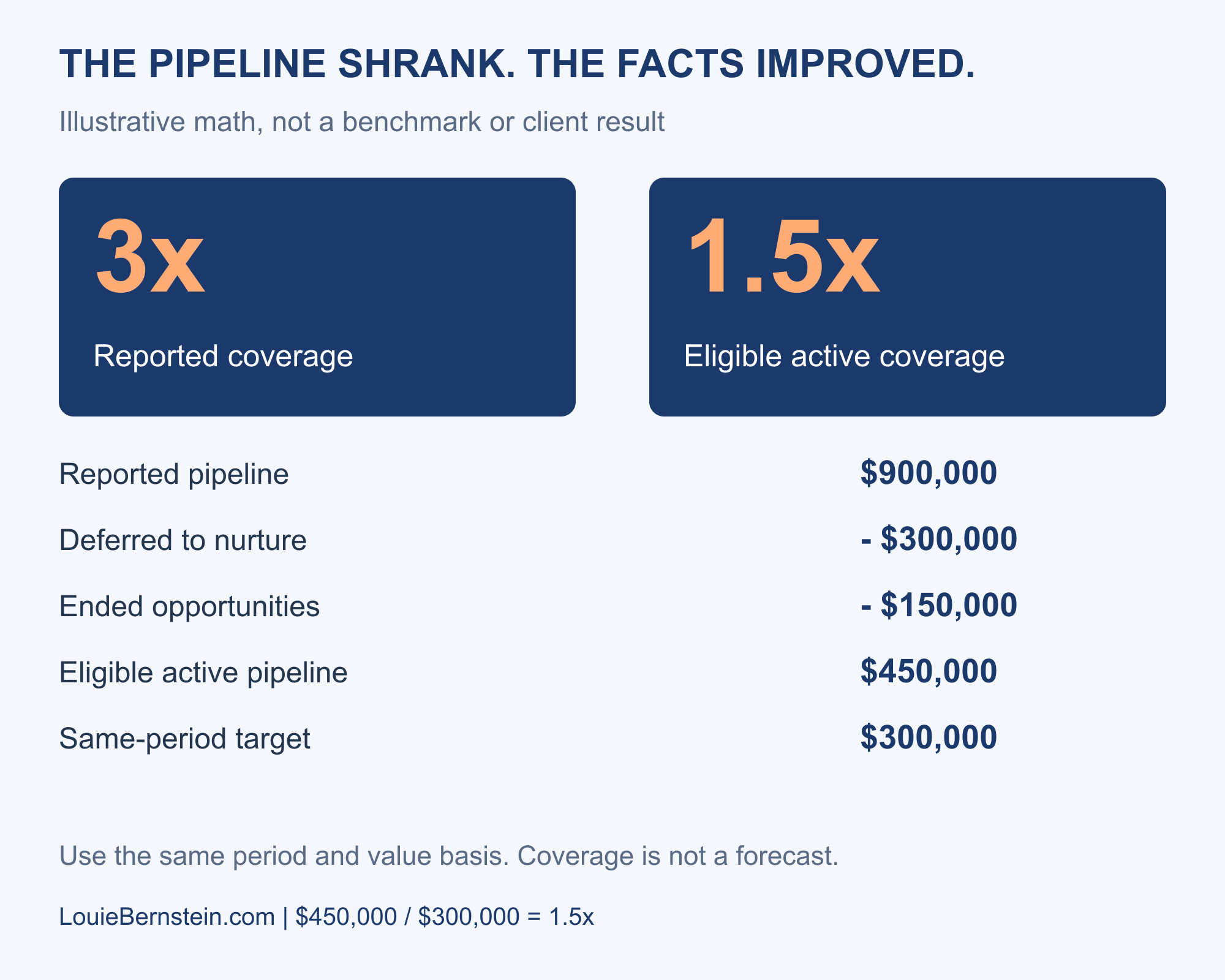
Here is illustrative math, not a client result: a $900,000 pipeline against a $300,000 target appears to offer 3x coverage. Move $300,000 of deferred opportunities to nurture and close $150,000 of ended opportunities. Eligible active pipeline is $450,000, or 1.5x coverage. No revenue was created or lost by changing the labels.
Use consistent units and periods. Compare new ARR pipeline with a new ARR target for the same period, for example. Coverage does not apply a win rate or prove those deals will close on time. The smaller number tells you how much qualified opportunity you actually have available to work.
Give returning deals a new entrance test
When a nurtured buyer returns, confirm what changed: budget approval, a new owner, a funded project, or another real event. Recheck scope, decision process, and timing. If the CRM supports reopening, preserve the original dates and reason history. If you create a new opportunity, link the old one and prevent duplicate value in reporting.
Track active pipeline separately from nurture accounts due for review. Review reactivated opportunities and their outcomes without counting an email reply as a recovered deal. Keep closed-lost records in your win-rate denominator according to a consistent definition. A cleanup should not make historical performance look better by hiding losses.
If your company has no formal system yet, start with a spreadsheet and these decisions. You can establish the rule before buying software. A Fractional Sales Leader can turn the rule into a Sales Playbook, CRM routine, and coaching habit your team can run without pulling you into every deal.
Pipeline Math for Founders: Coverage, Velocity, and Win Rate
Frequently Asked Questions
Q: Should I tell the buyer I am closing the opportunity?
Tell the buyer you are pausing active pursuit when a short, respectful message will help clarify expectations. Keep internal CRM terminology out of the conversation. Explain when you will follow up, if appropriate, and respect requests for no further contact.
Q: Should a deferred opportunity count as a sales loss?
Use the CRM outcome and reason consistently. If a closed-lost status is required, distinguish deferred from competitor losses and poor fit. Document how each reason enters win-rate reporting, so a cleanup cannot quietly change the meaning of the metric.
Q: Can I automate deal removal?
Automate alerts and review tasks before automating closure. A rule can flag an overdue buyer action, but a person should check for live procurement work, missing notes, or a changed decision date. Automatic closure needs tested exceptions and an audit trail.
Q: What if my rep disagrees with removing a deal?
Ask the rep to show the current buyer evidence and propose a dated recovery plan. Give documented evidence more weight than confidence. If uncertainty remains, set a review date and keep the opportunity out of committed revenue until the forecast requirements are met.
Q: What should I show investors after a pipeline cleanup?
Show a reconciliation of the starting pipeline, deferred value, ended opportunities, and remaining active value. Explain the definitions and keep them consistent in future reports. Report the resulting coverage gap and the actions you will take to address it.
Give every opportunity an honest next step.
If you are still carrying the sales function at $1M to $10M ARR, let's look at the rules behind your pipeline. I help founders build a sales system the team can run. Learn more at louiebernstein.com.
Schedule a 30-Minute CallAbout the Author

Louie Bernstein Fractional Sales Leadership
Louie Bernstein is a Fractional Sales Leader with 50 years of sales experience and has worked as a Fractional Sales Leader since 2017. He built and ran MindIQ for 22 years. He helps B2B founders at $1M to $10M ARR build repeatable sales systems so selling doesn't depend on the founder.