How do you decide what needs your attention when cash, customers, people, and sales all feel urgent?
B2B founders should act first on business worries that threaten a dated obligation or an important customer commitment, using evidence to judge the consequence and time available. Separate confirmed problems from unanswered questions, then assign each concern an owner and a next decision date. A worry about next week's payroll needs a different response from a worry about next year's competition. Treating both as today's emergency leaves the business reacting to whichever concern feels loudest.
Key Takeaways
- Act first on business worries with a serious consequence and a near deadline, while checking the facts behind each concern.
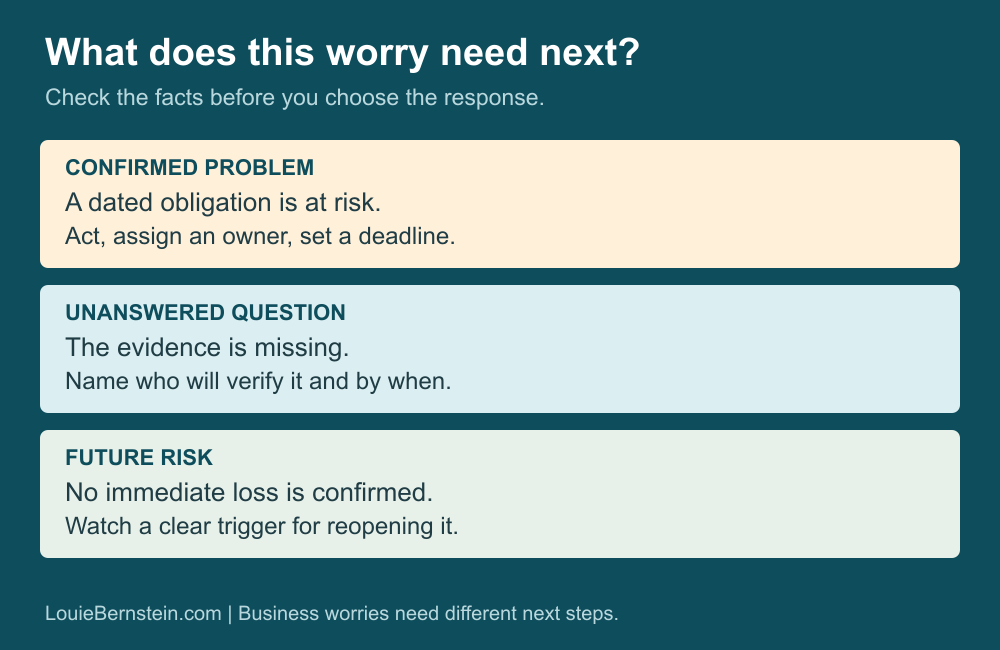
- A confirmed shortfall, an unanswered question, and a possible future risk require different next steps.
- In the Federal Reserve Banks' 2026 report, 22% of financing applicants received none of the funding they sought. Unapproved borrowing belongs outside your confirmed cash plan.
- Give each concern one owner, one next action, and a date when a decision must be made.
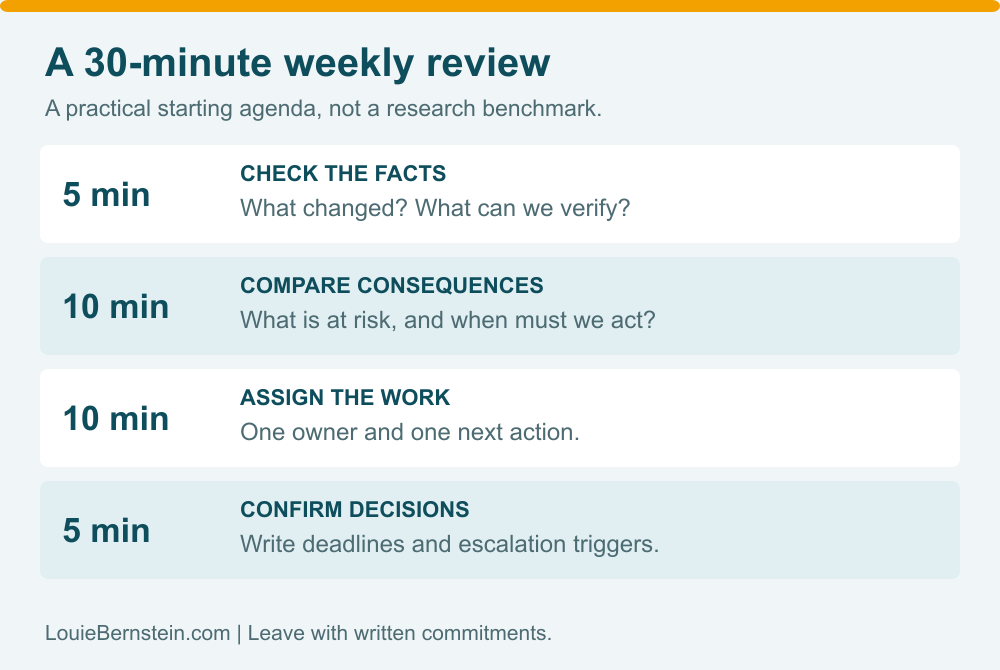
- Start with a 30-minute weekly review. That meeting length is a practical starting point, not a research benchmark.
You can have a good business and still wake up with a bad list.
The big customer hasn't answered. A salesperson wants to talk. A deal you expected this month has slipped. Payroll is coming. And somebody sent you an article about a competitor using AI.
You can't give every concern the same hour. You also can't assume the concern keeping you awake is the one that could hurt the business most.
Before you give a worry your whole day, write down what could happen and when you need to decide.
How can I tell whether a business worry needs action now?
A business worry needs action now when the evidence points to a meaningful loss and waiting would remove a useful option. Name the obligation, the likely consequence, and the last date you can act. If those facts are missing, the immediate job is to get them from someone who can verify them.
Turn the concern into a statement you can check
“I'm worried about cash” doesn't tell anyone what to do. “If the payment due Friday arrives two weeks late, we can't cover the following payroll from available cash” gives your finance person something to check.
Write the concern in the buyer's or employee's actual terms when possible. Has the customer said they're cutting spending? Or did they miss a call? Those facts justify different responses.
For each concern, ask: What do we know? What are we assuming? Who can find out? By when would waiting make the problem harder to fix?
Some decisions deserve immediate escalation even when information is incomplete. A potential data breach, a safety issue, or a legal deadline shouldn't wait for the weekly meeting. Bring the right specialist into the decision.
Check the time left to respond
A renewal six months away may need attention today if the customer takes four months to evaluate alternatives. A competitor's announcement might deserve a scheduled customer conversation before you change your product plan.
Urgency comes from the time needed to respond compared with the time remaining. Put both dates on the page. An owner who says “we're on it” should be able to tell you when the evidence will be ready.
Which business worries belong at the top of my list?
Put imminent obligations and customer commitments at the top of a B2B founder's worry list, then examine risks that could interrupt future revenue. Cash availability, promised delivery, and unresolved customer decisions deserve an evidence check before optional projects. The order should reflect your company's actual exposure, rather than a generic ranking of founder fears.
Start with what the company has already promised
Check payroll dates, major invoices, contractual delivery promises, and customer decisions that require a response. Ask finance to distinguish available cash from expected receipts. Ask delivery to identify promises the team can't currently meet.
The Federal Reserve Banks' 2026 Report on Employer Firms found that 42% of financing applicants received all they sought, while 22% received none. Among firms with debt, 59% used a personal guarantee. These findings describe surveyed U.S. small employers, not specifically B2B firms at $1M to $10M ARR.
The survey used a nationwide convenience sample of 6,525 employer firms in 2025. The figures explain why I wouldn't treat an anticipated financing approval as money already available. Your own records determine whether your business has a cash problem.
Then check where one event could do outsized damage
A customer, employee, supplier, or founder can carry more responsibility than the business can easily replace. Name the dependency and the recovery time. Don't declare a universal safe percentage or pretend every important account is about to leave.
I've covered how to reduce customer concentration separately. Here, the question is whether a current customer risk outranks the other decisions competing for your time.
What if several founder worries come from the same problem?
When several founder worries share a cause, work on the cause while protecting the immediate obligation. A weak sales process can create hiring doubts, unreliable forecasts, and constant founder interruptions at the same time. Fixing each symptom separately can leave the same operating gap generating another worry next week.
What building MindIQ taught me about responsibility
I built and ran MindIQ for 22 years. I know the founder's chair from sitting in it. With 50 years in sales, I've learned to ask a plain question before recommending another sales hire: what will that person have to work with?
If the answer is “they can ask me,” the company is adding another person who needs the founder. The new hire may be good. The missing instructions still need to be written.
A founder can worry about the rep's performance, their own calendar, and next month's revenue without noticing how much of the work still lives in their head. My recommendation is to put the sales process and accountabilities on paper before expecting independence.
For a founder without a sales system, this review still helps. It should identify building a basic process as real work with an owner. It can't turn a hopeful pipeline into a reliable revenue engine by itself.
Ask what would stop the worry from returning
If every proposal needs your approval, inspect the pricing and approval rules. If every stalled deal comes back to you, inspect qualification and the agreed next step. If every rep asks what to do next, inspect the playbook and coaching.
Those questions point toward building a sales process that works without you. Keep the urgent customer conversation moving while someone takes responsibility for the underlying sales work.
How do I turn my worries into a weekly operating review?
Turn founder worries into a weekly operating review by recording the evidence, consequence, owner, next action, and decision date for each material concern. Start with a 30-minute meeting and end with written commitments. The review earns its place when people leave knowing what they'll do before the next meeting.
Use one page and make the decisions visible
You don't need another reporting tool to begin. A shared document is enough. Keep confirmed problems separate from questions still being investigated, so an assumption doesn't quietly become a fact.
- State the concern. Describe a specific event that could affect the business.
- Record the evidence. Include the source and the date checked. Say when information is missing.
- Name the consequence. Identify the money, customer promise, or operating responsibility at risk.
- Assign an owner. One person brings back the answer or completes the action.
- Set the decision date. Choose a date that leaves enough time to respond.
As an illustrative example, a customer has an overdue invoice and a renewal coming up. Finance checks the payment status. The account owner checks the renewal decision and stakeholders. You decide whether founder involvement would help once those facts are available.
Don't let the meeting become a recital of everything that could go wrong. Close an item when the evidence resolves it. Move a future risk to a watch list with a clear trigger for reopening it.
Agree on what brings you back sooner
An owner needs an escalation rule. “Call me if it gets worse” leaves too much room for interpretation. “Call me today if the customer confirms the payment will miss Friday” tells the person what matters.
The same principle applies to sales. Define which customer commitments, pricing exceptions, or missing decision makers require help. Otherwise your team either escalates everything or waits until your choices have narrowed.
Which business worries should I stop carrying myself?
Stop carrying business worries yourself when a capable person has the authority, information, and time to manage the work. Keep the decisions that require founder judgment, and ask others to own investigation and execution. Delegation works when the handoff includes a standard for success and a clear point for escalation.
Give the work to the right person
Your finance adviser can check a cash forecast. Your delivery leader can verify whether a promise is achievable. A sales leader can inspect deals, coach reps, and hold the team to written accountabilities.
A Fractional Sales Leader makes sense when sales questions keep returning because nobody owns the sales system. The job includes process, coaching, pipeline discipline, and accountability. Financial, legal, and technical risks still need people qualified to handle them.
Write the responsibility into an Accountabilities Document. Include what the person decides, what they report, and when they bring you in. If you keep overriding decisions inside that authority, expect the work to return to your desk.
“Keep me informed” works better when you agree on what you need to know and when.
Leave room for concerns that need a private conversation
Some founder concerns involve confidence, family commitments, or a decision you aren't ready to discuss with employees. Talk those through with a trusted adviser or peer. You don't have to put every personal concern into a team document.
At your next review, look for a practical change: fewer unanswered questions, earlier decisions, and work completed without your rescue. If the list keeps growing, check whether owners have the authority to act and whether you've made room for the work you assigned.
Frequently Asked Questions
Should I share the whole worry list with employees?
Share the concerns employees need to act on, with the facts and responsibilities they need. Keep confidential personnel matters and sensitive financial details with the appropriate people. Give the team useful information rather than asking employees to absorb every uncertainty you're feeling.
Should I score every business risk from one to five?
Use scores only when everyone agrees what the numbers mean. A short description of the consequence and deadline is often more useful for a small B2B team. Avoid multiplying guesses into a precise-looking number that hides the missing evidence.
What if I don't have a management team yet?
Run the review yourself and use advisers for the facts you can't verify alone. Assign actions to named people rather than nonexistent departments. If all the work still belongs to you, choose what you'll defer so the urgent work can actually happen.
Can AI help me organize founder worries?
AI can help format notes and suggest questions to investigate. Check the output against your records, and follow your company's data rules before sharing sensitive information. A generated answer doesn't confirm a customer's intentions, a cash balance, or a contractual obligation.
What if my leadership team disagrees about the priority?
Compare the consequences, deadlines, and evidence behind each concern. Ask what waiting would prevent you from doing. If the disagreement rests on a missing fact, assign someone to verify it before the decision date, rather than resolving the argument by seniority.
Give the sales worries someone to answer to.
If you're a $1M to $10M ARR B2B founder and every sales question still comes back to you, let's look at the process and accountabilities your team needs. Learn about Fractional Sales Leadership at LouieBernstein.com.
Schedule a 30-Minute CallAbout the Author

Louie Bernstein Fractional Sales Leadership
Louie Bernstein is a Fractional Sales Leader with 50 years of sales experience and has worked as a Fractional Sales Leader since 2017. He built and ran MindIQ for 22 years. He helps B2B founders at $1M to $10M ARR build repeatable sales systems so selling doesn't depend on the founder.