What should a B2B founder change before the next sale creates a customer promise the team can't keep?
Keep selling when delivery is full by qualifying demand for a start date and scope your team can actually support. Have the delivery owner approve capacity before you promise the work. Offer a later start, a smaller useful first phase, or qualified additional help when the economics work. If none fits the buyer's deadline, decline the engagement. Keep prospecting so tomorrow's pipeline stays healthy while protecting the commitments you've already made.
Key Takeaways
- Keep selling when delivery is full, but sell only a start date and scope the delivery owner has approved.
- Separate a signed contract, its start date, and the customer's first useful result. A signature doesn't create delivery capacity.
- Check the scarce skill or resource needed for the next engagement. Company-wide spare hours can hide a fully booked specialist.
- In an illustrative capacity plan, 20 available hours cover only 50% of a new job requiring 40 hours. A better close doesn't fill the missing hours.
- Before the next proposal goes out, record the scope, resource requirement, approved start date, buyer dependencies, and who can authorize an exception.
The buyer wants to sign. Your team wants you to stop promising next Monday.
That's a hard place for a founder to stand. You worked for the opportunity. Turning away revenue feels wrong. You tell yourself the team will find a way, and you can jump in if they need you.
For a $1M to $10M ARR B2B company, that promise can put existing customers, your calendar, and the next renewal under pressure. Before you agree to the date, find out what making it possible would require.
The customer is buying the result you promised. Your delivery team has to have room to produce it.
Should I stop selling when my delivery team is full?
Keep prospecting and qualifying while the delivery team is full, but separate selling from promising an immediate start. Today's capacity shortage doesn't tell you what next quarter's demand will be. Discuss timing early, confirm the buyer can wait, and offer an approved future start rather than inventing room in the current schedule.
Find out what the buyer's deadline means
“We need to start next week” needs a follow-up question. What happens next week? Is there a contractual date, a board commitment, or a preference? What needs to be completed, and who else must contribute?
A buyer who needs one assessment before a budget meeting may have a different requirement from a buyer who needs a complete implementation before a system shuts down. Get the required outcome in writing before you offer a smaller first phase.
Don't describe a discovery session as progress toward an implementation unless it actually helps the buyer. Splitting the invoice doesn't split the work.
Keep the future pipeline moving
Give prospects the real availability window during qualification. Some will wait. Others won't. Record both outcomes so you can see whether timing is costing you enough qualified demand to justify more capacity.
A growing wait list also needs care. An interested prospect without an agreed commitment isn't guaranteed future work. Keep checking the buyer's decision, dependencies, and willingness to start in the period you're discussing.
This is one specific concern from my article on which business worries B2B founders should act on first. When a new sale threatens a dated customer promise, the capacity question needs an answer before the proposal becomes a commitment.
How do I know how much delivery capacity I can sell?
Calculate sellable delivery capacity by skill and time period, after subtracting work already committed, necessary internal work, leave, and a realistic allowance for uncertainty. Then compare the remaining capacity with the effort and sequence the new customer needs. Use the resource that limits delivery, rather than adding everyone's open hours together.
Check the person or resource the work must pass through
Your team might have plenty of open hours while the one person who can configure the customer's integration is booked. The bottleneck could also be equipment, a security review, a senior approval, or customer-side access.
Name that constraint. Ask how much time the next job needs from it, in which weeks, and what happens if the estimate is wrong. A project manager's available afternoon can't replace a specialist's missing week.
Run the math before agreeing to the date
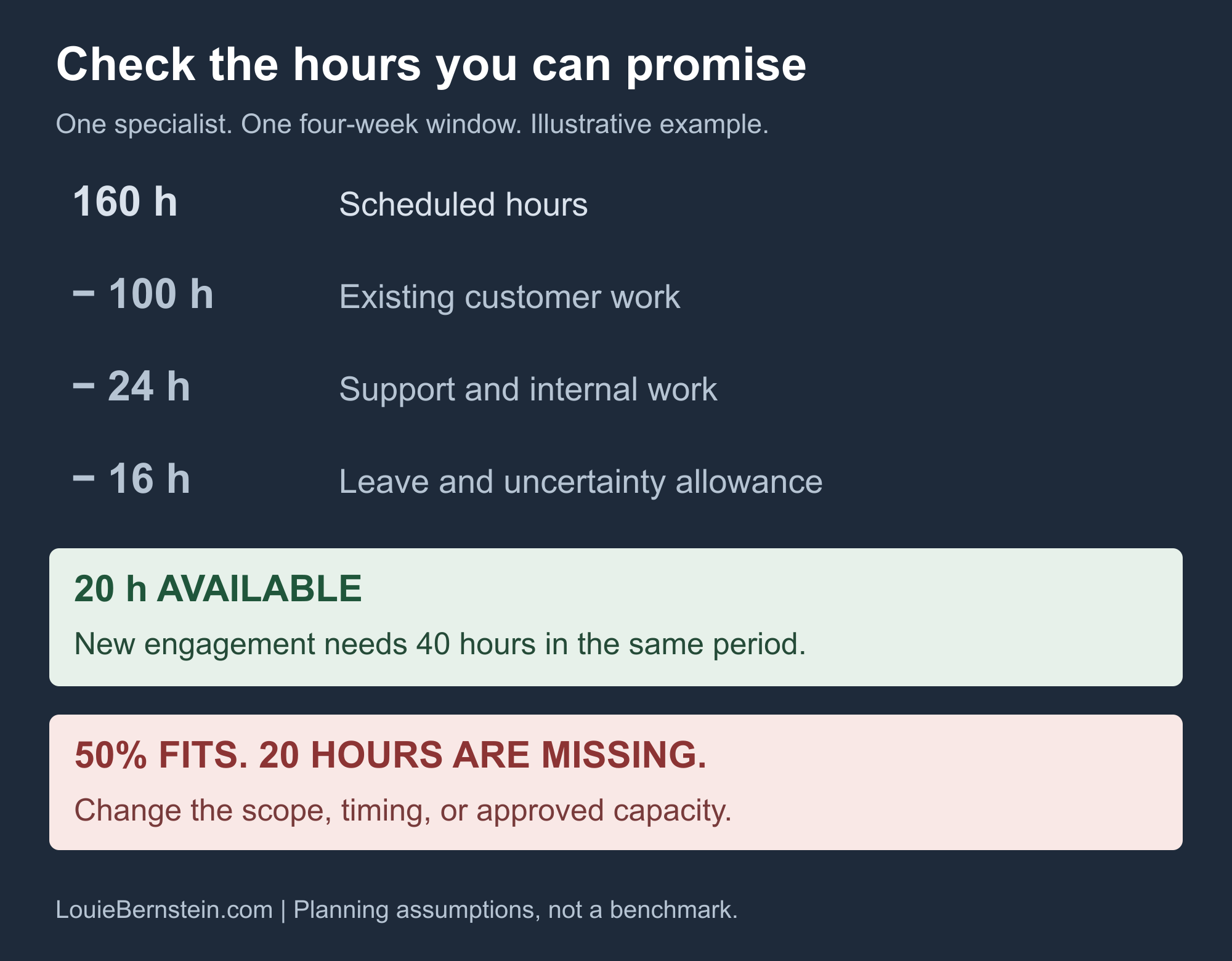
Here's an illustrative four-week plan for one specialist. Start with 160 scheduled hours. Subtract 100 hours already committed to customers, 24 for support and internal work, and a separate 16-hour allowance for leave and uncertainty. That leaves 20 hours for new work.
The next engagement requires 40 hours from that specialist during the same period. Only 50% of the required hours fit. The plan is short by 20 hours. These are planning assumptions, not a client result or recommended staffing ratio.
Now you have a decision you can explain. Shift the work to a verified later window, reduce the required work with the buyer's agreement, or add qualified capacity. Calling the job strategic doesn't change the arithmetic.
Use outside benchmarks carefully
SPI Research's 2026 professional services benchmark, covering 509 firms and their 2025 results, reports 66.4% employee billable utilization and 73.8% of projects delivered on time. These are professional services averages, not targets for every small B2B company.
Those figures don't prove that spare hours caused late projects, or that your team has room. They measure different things. Check your own schedule, skill mix, commitments, and completed work before telling a customer you're available.
What can I offer a buyer when I can't start immediately?
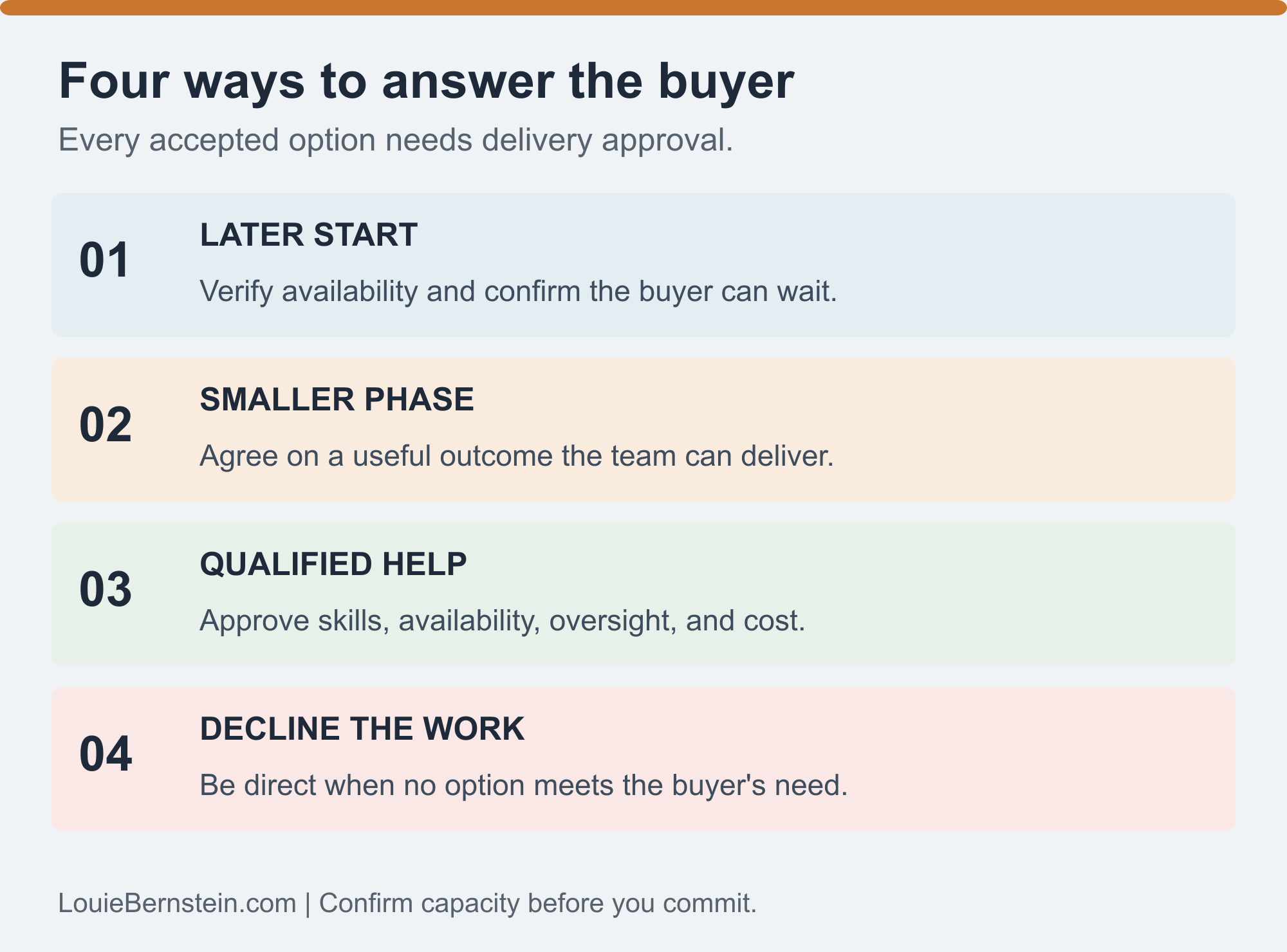
Offer a later confirmed start, a smaller first phase that produces a useful outcome, or approved additional delivery capacity. Each option must meet the buyer's actual need at an acceptable cost. If the deadline and required scope can't change and qualified help isn't available, tell the buyer you can't responsibly accept the work.
A later start with a clear commitment
Say, “We can deliver the scope we've discussed. Our delivery lead has approved a start in the week of December 7, provided your data and access are ready. Does that work with your deadline?” Use the actual dates from your schedule, not the illustrative date in this example.
Explain what reserves the slot, how long an offer remains open, and what happens if buyer inputs arrive late. Have the appropriate people review those terms. Don't imply a deposit can reserve an unlimited amount of work or a date the team hasn't approved.
A smaller outcome that stands on its own
A paid assessment or a phased rollout can work when the first phase is useful and your team can deliver it. Specify what the buyer receives, what isn't included, and whether the later phase has a reserved date or needs separate approval.
Don't promise a pilot merely to get the signature if the same unavailable specialist must run it. Recheck capacity for the proposed phase. A smaller price tag doesn't guarantee a smaller load on the constraint.
Qualified help, with the full cost included
A contractor or partner can add capacity when the person has the skills, availability, permissions, and oversight the work needs. Include onboarding, review time, rework risk, and any customer approval requirements. Your employee may still be the bottleneck if every contractor decision needs that employee's attention.
If the deal depends on a person you haven't found yet, treat the capacity as unconfirmed. Don't use an anticipated hire to justify a firm start date.
Who should approve a delivery promise before a deal closes?
The delivery owner should approve the feasibility of the scope and schedule before sales makes a firm promise. Sales owns confirming the buyer's requirements and recording the agreement. The founder sets the exception rules, but an exception must identify where the capacity will come from and which existing commitment, if any, would change.
Put a capacity check into the sales process
Before a proposal promises a start, record five things: the agreed outcome and scope, the scarce resources required, the approved start window, the buyer's dependencies, and the person who authorized the commitment. Attach the approval to the opportunity.
Approval can be quick for a standard offer with a current schedule and clear limits. Custom work, rush dates, and unusual dependencies need a specific review. A policy that requires the founder to approve every routine quote will keep the founder in the middle.
Use your Sales Playbook for the questions and approved language. Use the Accountabilities Document to define who decides and when an exception comes back to you. Review these rules with the team before expecting people to follow them.
What I bring from the founder's chair
I built and ran MindIQ for 22 years. I've written about a question I ask founders: “Do I want a deal or a customer?” That question matters when the business is full. A signature followed by a promise you can't keep is a poor start to a customer relationship.
My article on revenue growth hiding a bad sales model examines what the top line can conceal. Here, I'd ask who will deliver the next customer's result before celebrating the sale.
If the plan is for you to finish the work at night, put your hours into the capacity and cost plan. Then ask which founder responsibility those hours replace. Don't build an exception policy around work nobody records.
If a rush order changes another customer's date, name that customer before you approve the rush.
What should I review each week to keep sales and delivery aligned?
Review upcoming commitments, available capacity at the constraint, and qualified opportunities likely to need that capacity in the same period. Keep signed work separate from possible work. Compare promised dates with actual starts and results, then adjust estimates and approval rules when the same gap appears repeatedly.
Read the pipeline against the delivery schedule
Bring the sales and delivery owners together around one view. Include each near-term opportunity's likely start, resource need, decision date, and dependencies. Don't treat a probability-weighted workload as a physical schedule: two possible jobs may both require the same person next Monday.
Agree how tentative capacity is handled. A verbal conversation shouldn't block a slot forever. Equally, sales shouldn't sell the same scarce time twice because neither contract has been signed yet.
Look for a repeated mismatch before adding headcount
Track deals lost because of timing, starts delayed after commitment, estimate overruns, and rush work that displaces another job. Separate a short spike from repeated qualified demand you can serve profitably. More staff won't solve a missing skill or an offer that creates too much unpriced work.
A Fractional Sales Leader can build the qualification, proposal approval, coaching, and pipeline review that connect selling to real availability. Delivery still owns feasibility. If you have no sales system yet, begin with one written approval rule for the next proposal and improve it from actual work.
Before your next sales call, ask your delivery owner: “What can we promise today, and what must come back for approval?” Give your reps an answer they can use without calling you from the buyer's office.
Frequently Asked Questions
Should I discount a deal because the customer has to wait?
Don't offer a discount automatically. First confirm whether the later start still meets the customer's need. A concession should have a clear reason and approval, with its effect on margin understood. A lower price won't make an impossible deadline acceptable.
Can I charge a rush fee?
A rush fee can make sense when you can provide the faster service and explain the terms. Verify the actual capacity and additional cost first. Charging more doesn't give you permission to break another customer's commitment or promise an unavailable specialist.
Should sales commissions depend on project completion?
Review incentives with finance and the delivery leader before changing a commission plan. Sellers should be accountable for promises they control, while delivery problems outside their control need separate treatment. Write and communicate any approved changes before they take effect.
Does this apply to SaaS companies with little delivery work?
Yes, when onboarding, integration, migration, or support limits the next customer's success. Check that scarce resource. If customers activate without meaningful staff involvement, the main constraint may sit elsewhere; don't impose a services approval process where it adds no value.
What if we already promised a date we can't meet?
Verify the shortfall with delivery and tell the customer promptly. Explain the feasible options, their consequences, and the decision needed. Document any revised agreement. Don't wait for the customer to discover the delay or offer another unapproved date to soften the conversation.
Give your team a promise they can keep.
If you're a $1M to $10M ARR B2B founder and every start date or exception comes back to you, let's put the qualification and approval rules into your sales process. Learn about Fractional Sales Leadership at LouieBernstein.com.
Schedule a 30-Minute CallAbout the Author

Louie Bernstein Fractional Sales Leadership
Louie Bernstein is a Fractional Sales Leader with 50 years of sales experience and has worked as a Fractional Sales Leader since 2017. He built and ran MindIQ for 22 years. He helps B2B founders at $1M to $10M ARR build repeatable sales systems so selling doesn't depend on the founder.