How do you protect customer work when one person's absence could stop the business?
If your best employee is the only one who knows how to finish important customer work, treat the dependency as an operating risk you own. Identify the tasks that can't wait, assign a backup, capture the decisions and exceptions, and provide approved access and authority. Then have the backup complete a representative task without coaching from the expert. Keep the expert involved in improving the process, and protect time for both people to learn.
Key Takeaways
- Reduce key person risk by proving someone else can complete critical customer work, rather than counting how many instructions you've saved.
- Prioritize tasks by the customer consequence and time available to recover. The employee's job title won't tell you what breaks first.
- A backup needs usable knowledge, approved access, clear authority, and enough time to do the work.
- In APQC's 2025 retirement knowledge survey, 52% cited lack of time as a capture barrier. Knowledge transfer needs scheduled time, not another request added to a full week.
- Start with one critical task this week. Agree on a completion standard, rehearse the handoff, and fix the first gap the backup finds.
Your best employee should be able to take a vacation.
If one absence stops a renewal quote, a client report, or an implementation, the company has a problem to solve. Thanking the employee for always answering the phone won't solve it.
For a $1M to $10M ARR B2B founder, the temptation is to become the backup yourself. That can keep a customer moving today. It also gives you another job to carry while you're still closing most of the sales.
“Call me if you get stuck” leaves the work dependent on the person who's supposed to be away.
How do I find the employee knowledge my business depends on?
Find critical employee knowledge by tracing customer commitments to the tasks required to fulfill them, then asking who can finish each task without the usual expert. Start with work that has a near deadline or a serious consequence if delayed. Record the missing skill, decision, access, or authority that would stop a substitute.
Start with the promise to the customer
List the work due soon: a renewal quote, a technical demonstration, an integration fix, a monthly report, or an approval needed to keep delivery moving. Ask the task owner to show what completion looks like.
For each item, write the deadline, the customer impact of a delay, the primary owner, and the person you believe could cover it. Then check that belief. A colleague who watched the expert once may still need help at every important decision.
Don't begin by asking everyone to document their entire job. You'll get a large assignment with no clear finish. Choose the work where another person's absence would leave the fewest options.
Separate a staffing shortage from a knowledge gap
If two people know how to do the work but neither has time, that's a capacity problem. If the backup has time but can't interpret the customer's configuration, that's a knowledge gap. If the backup knows the process but can't approve the quote, authority is missing.
Those problems need different fixes. My article on selling when delivery is already full covers capacity. Here, the question is whether someone else can perform the work when the expert is unavailable.
Check the quiet dependencies
Look beyond visible production work. One employee may know why a contract has unusual terms, which customer contact approves changes, or where the current project files live. A workflow can stop before anyone reaches the technical task.
Ask, “What do people come to you to find out?” Follow that with, “Which of those answers would matter if you couldn't respond?” Include the expert in choosing what to transfer first.
What should I document before an important employee is absent?
Document the information a qualified backup needs to produce the customer outcome: the trigger, required inputs, main steps, decision rules, common exceptions, completion standard, and escalation route. Keep current customer context with the work. A recording can help explain the task, but the backup also needs a short, searchable reference.
Capture the choices an expert makes
A screen recording shows where someone clicked. It may not explain why they chose that option, what made the case unusual, or when they would stop and ask for approval.
Have the backup ask questions while the expert works through a representative example. What signals a problem? Which mistakes are hard to reverse? What evidence says the task is finished? Capture the reasoning in the employee's own practical language.
Use a standard case and an important exception. You don't need a catalog of every possible failure before starting, but the reference should identify situations outside the backup's competence.
Keep live customer facts current
A general procedure won't tell the backup what you promised this customer last Thursday. Store current scope, deadlines, open issues, contacts, and approved exceptions in the shared customer record. Link the procedure from the place where the work is assigned.
Name the person responsible for updates. An old instruction that looks official can be harder to detect than a missing instruction. When the process changes, update the reference and check whether the backup needs another practice run.
Make room for the transfer
APQC's 2025 survey of 1,000 respondents found that 30% of organizations captured departing retirees' knowledge most of the time or always, while 41% rarely or never did. Lack of time was a barrier for 52%. These findings concern retirement knowledge capture, not the likelihood that your employee will leave or your backup will fail.
The practical question for a small B2B founder is what you'll remove from the expert's and backup's workload to make the transfer happen. If nothing changes on the calendar, the assignment competes with every customer deadline already there.
How do I know whether the backup can actually do the work?
Verify a backup by having the person complete a representative task using the agreed instructions, approved access, and normal escalation rules while the expert observes without prompting. Compare the result and elapsed time with the completion standard. Record every intervention the expert had to make, then correct the cause and repeat the relevant part.
Watch the work change hands
Start with a safe rehearsal, such as a sample quote or a test environment, where mistakes won't affect a customer. Agree which actions require approval. Move into supervised customer work only when the people responsible consider that appropriate.
The expert can first demonstrate the task. On the next attempt, the backup does the work and explains the choices. During the test, pause rather than guess when the backup reaches a real limit.
A legitimate escalation to another authorized person can be part of a working backup plan. Requiring the unavailable expert's answer at every exception means the dependency remains. Decide which situations the backup can handle and who covers the rest.
Count tested coverage honestly
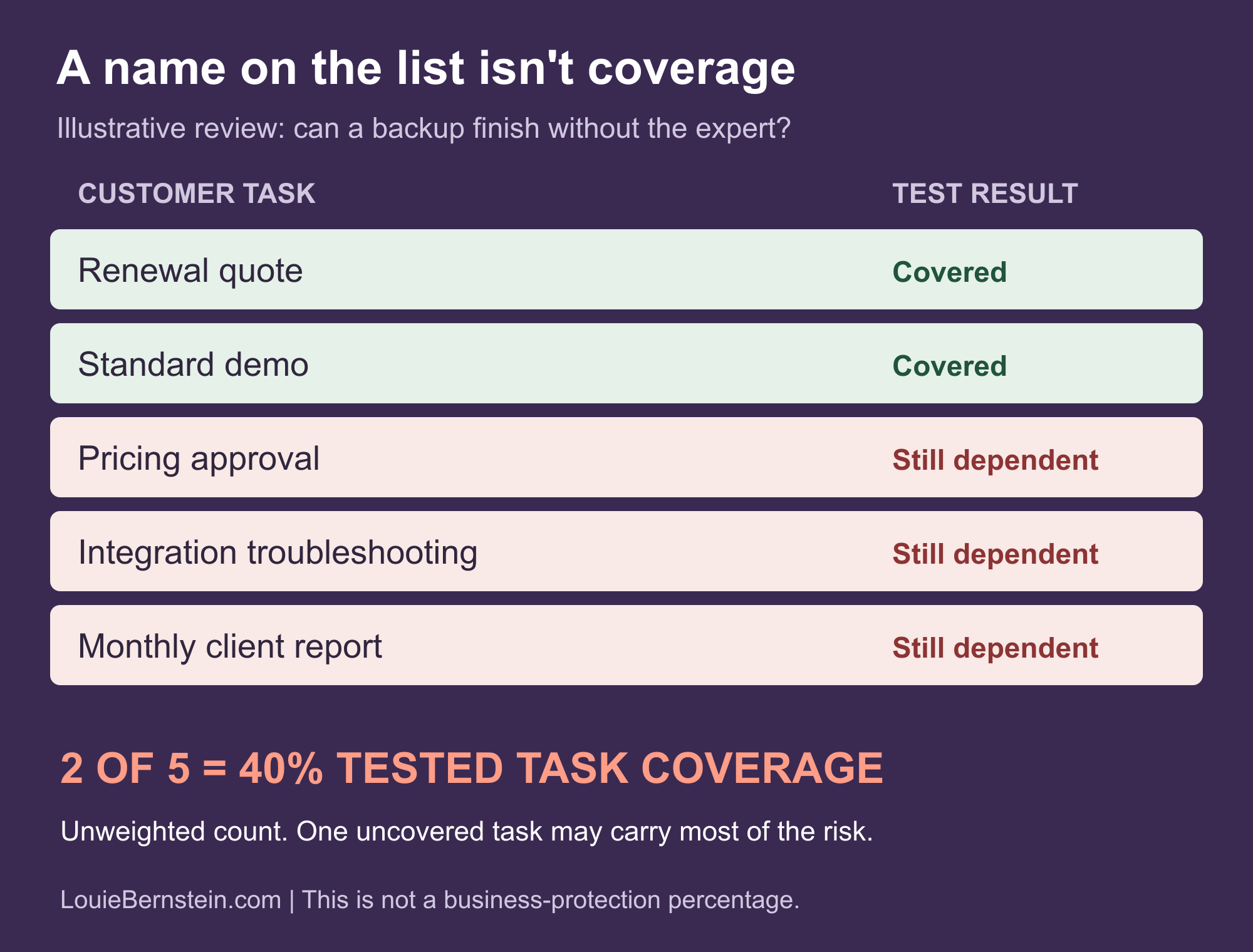
Here's an illustrative review of five chosen tasks. A backup successfully prepares a renewal quote and runs a standard demonstration. Pricing approval, integration troubleshooting, and the monthly client report still need the primary employee.
Two of five tasks have tested backup coverage: 40%. The number is an unweighted count of the selected tasks. It doesn't mean the company is 40% protected, because one uncovered task could carry most of the customer risk.
Keep the task list beside the number. A percentage is useful only if you can see which customer commitments remain exposed.
Check more than the instructions
A knowledgeable backup can still be blocked by an unavailable license, missing permissions, or an approval rule nobody delegated. Arrange access through your normal authorization process and test it before the absence. Don't build the handoff around borrowing the employee's password.
Give the backup enough time as well. If the work takes longer while they're learning, account for that in the schedule. The customer shouldn't discover your training gap through a missed delivery date.
How do I ask my best employee to share knowledge without making them feel replaceable?
Explain that knowledge sharing protects customer commitments and lets the employee step away without remaining on call. Ask the expert to help set the standard, choose the backup, and identify the decisions worth teaching. Recognize the teaching work, protect the time it takes, and be honest about any actual role changes.
Give the expert a useful role in the plan
Say, “You know where this work gets difficult. I want us to cover it properly when you're away. Which task should we start with, and who has the foundation to learn it?”
Then agree what you will take off the employee's plate during the transfer. Don't make the expert responsible for training someone while keeping every existing deadline unchanged. If coverage changes are part of a broader response to business difficulty, explain that context directly to the team.
APQC's structured knowledge transfer guidance recommends prioritizing critical knowledge, setting a defined transfer plan, and involving learners actively. For a small company, that can be one task, one qualified backup, and a clear demonstration of competence.
What I've learned about handing off responsibility
I built and ran MindIQ for 22 years. In my sales work, I tell founders to prepare a Sales Playbook, an Accountabilities Document, and a 30-60-90 Day Plan before handing selling to a new hire. Each answers a different question: how the work is done, what the person owns, and when progress should be demonstrated.
The same distinction helps with backup coverage. Instructions describe how. The responsibility and authority must be assigned. A practice run shows whether the person can perform. Sending a file doesn't settle all three.
A backup doesn't need to become a copy of your best employee. The backup needs a clear scope they can handle and a route for the work they can't. Preserve the expert's judgment while making more of the routine work transferable.
The first gap the backup finds is useful information. Fix the process before judging the person.
What should I do first if we have no backup plan?
Begin with one critical customer task, assign a primary owner and a qualified backup, and schedule a bounded transfer and rehearsal. Record what the backup can complete and what still needs help. Expand to the next task after fixing the first serious gap, rather than announcing a company-wide documentation project with no time to finish it.
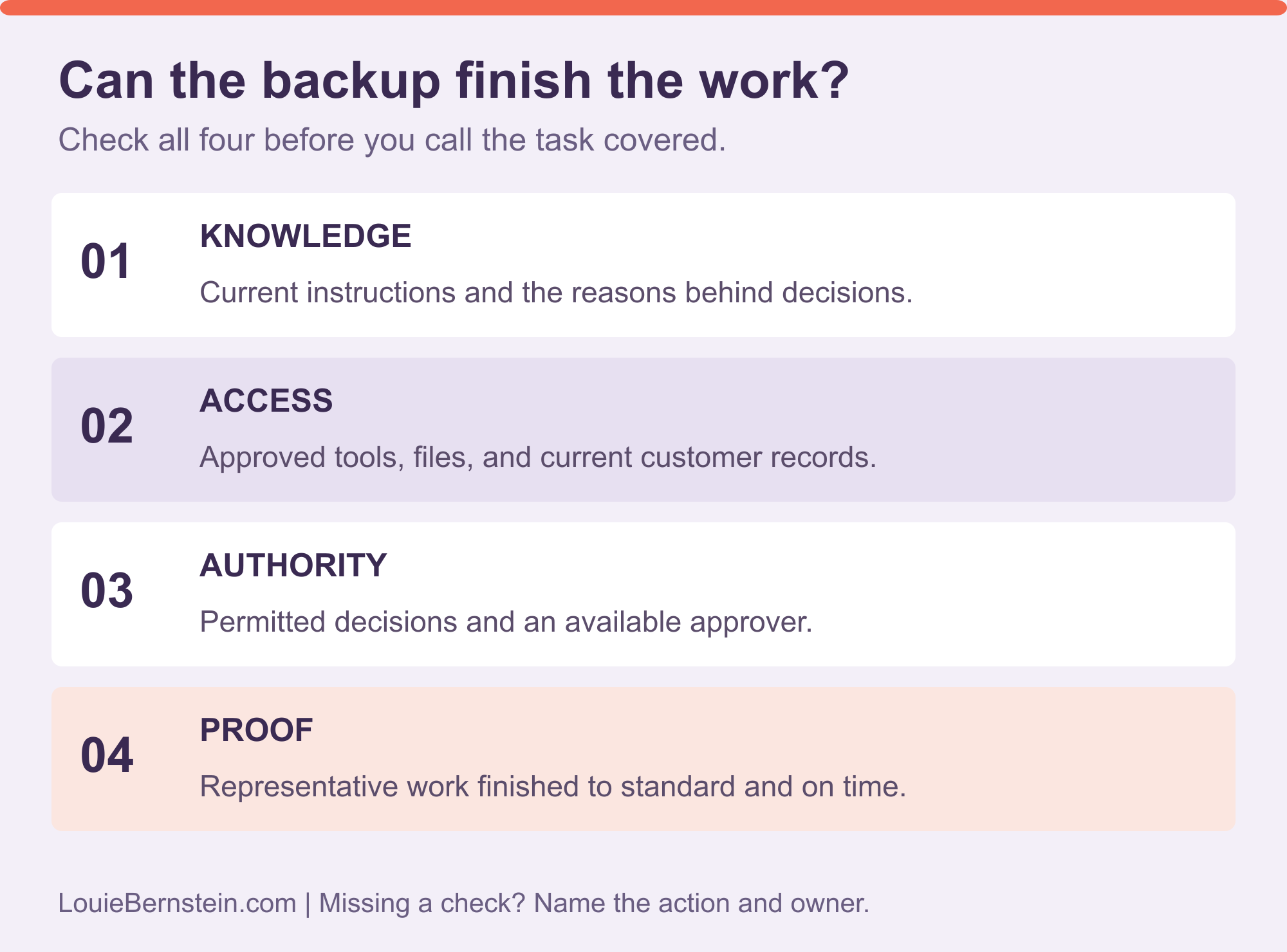
Use four checks for the first task
- Knowledge: Can the backup find the current instructions and explain the decisions?
- Access: Can the backup reach the approved tools, files, and customer information?
- Authority: Can the backup make the permitted decisions and reach an available approver for exceptions?
- Proof: Has the backup completed a representative task to the agreed standard within the required time?
If one check fails, write the next action, owner, and date. Avoid describing the task as covered merely because someone agreed to help. Use the same approach to evidence and ownership from the founder-worries review.
Keep the coverage usable
Review coverage when the process changes, the backup changes roles, or a customer introduces a new requirement. Give the backup occasional practice so the knowledge stays usable. Choose the interval from the work's frequency and risk, rather than a universal quarterly rule.
If the company is too small to have an internal backup, consider qualified outside help, a narrower service commitment, or a longer agreed turnaround. Verify availability and responsibilities before relying on any option. A name on a partner list isn't tested coverage.
A Fractional Sales Leader can help define coverage for quoting, demos, proposals, renewals, and customer account knowledge through the Sales Playbook, coaching, and written accountabilities. Technical delivery still needs the appropriate expert. You can start this review without a complete sales system; start with the next customer task you can't afford to leave waiting.
Frequently Asked Questions
Is key person insurance enough to protect customer work?
Insurance can't teach a backup how to complete the work or give the person approved access and authority. Review any financial protection with a qualified insurance adviser. Keep the operating plan separate: who will perform the task, to what standard, and how soon?
Can AI turn an employee's recordings into a backup plan?
AI can help organize recordings and draft instructions, subject to your company's data rules. Have the expert check the result and the backup test it. A plausible written answer doesn't prove the person can recognize an exception or complete the customer task.
What if the employee is already absent and we can't reach them?
Identify the customer commitments at risk, gather approved records, and find qualified help for the work you can't safely perform. Tell affected customers promptly if a promise needs to change. Don't guess at a high-consequence technical task just to appear responsive.
Should I tell customers we are training a backup?
Explain coverage when it affects their contacts, access, or delivery arrangements. Introduce the backup where useful and confirm any required permissions. Customers need to know how their work will continue and whom to contact, without receiving unnecessary details about individual employees.
Should every employee learn every other employee's job?
No. Prioritize the tasks that protect important customer commitments and match them to people with the right foundation. Some work requires specialist competence or authorization. Define a workable fallback for those tasks instead of pretending general cross-training makes everyone interchangeable.
Make the next handoff something you can trust.
If you're a $1M to $10M ARR B2B founder and quotes, demos, or customer decisions stop when one person is away, let's look at the coverage your sales process needs. Learn about Fractional Sales Leadership at LouieBernstein.com.
Schedule a 30-Minute CallAbout the Author

Louie Bernstein Fractional Sales Leadership
Louie Bernstein is a Fractional Sales Leader with 50 years of sales experience and has worked as a Fractional Sales Leader since 2017. He built and ran MindIQ for 22 years. He helps B2B founders at $1M to $10M ARR build repeatable sales systems so selling doesn't depend on the founder.