How can a B2B founder share hard facts without making promises or creating needless panic?
Tell your team when verified business problems affect their work, priorities, or reasonable expectations about the company. Explain what you know, what remains uncertain, what you've decided, and what happens next. Give employees a date for the next update and room to ask questions. Don't promise job security, funding, or a recovery date you can't support. Share the information people need to understand the situation while handling personal and confidential matters through the appropriate conversations.
Key Takeaways
- Tell employees about verified difficulties that change their work or expectations, with enough context to explain the decisions you need them to carry out.
- Separate facts, open questions, decisions, employee actions, and the next update. A worry isn't a confirmed forecast.
- Only 16% of U.S. employees strongly agreed their leadership communicated effectively in August 2026, according to Gallup. Giving an update doesn't prove people understood it.
- Answer staffing and pay questions with the facts you can support today. If a decision is still open, say so and explain when you'll return to it.
- End with written priorities, named owners, a channel for questions, and a specific next update date you can honor.
Your team doesn't need you to pretend the business is doing well.
They need to know what changed, what you're doing about it, and what it means for their work. A cancelled hire, tighter spending approvals, and a quiet sales pipeline already give people questions.
If you're a $1M to $10M ARR B2B founder still carrying most of the sales, the conversation can feel personal. You built the business. Saying the numbers are short can feel like admitting you failed. Prepare the business explanation before you walk into the meeting.
You can be honest about uncertainty and still be clear about what happens next.
When should I tell employees the business is struggling?
Tell employees when a verified problem changes priorities, customer commitments, staffing plans, or other matters they need to understand to do their jobs. Check the facts and prepare the immediate response first. Don't wait for a complete recovery plan if people are already being asked to work under changed conditions.
Define the problem before calling the meeting
“The business is struggling” could mean bookings missed plan, a customer payment is late, margin has fallen, or available cash won't support the current spending plan. Those aren't the same problem. Ask finance and the relevant operating owner to verify the numbers and the time period.
Separate a poor month from a confirmed pattern. Say what the figures show and what they don't yet tell you. A deal slipping into next quarter doesn't automatically mean the company is about to close.
My article on which business worries founders should act on first helps sort the concern before it becomes the message. Your employees need checked information, not every scenario you've imagined at night.
Don't let changes arrive without an explanation
If you freeze discretionary spending, explain the purpose, the boundaries, and who can approve an exception. If you change selling priorities, tell reps which prospects to pursue and which work to stop.
You don't need to announce every rough draft of a budget. You do need to explain decisions people are expected to follow. If an urgent decision must happen before the full update, give the relevant explanation promptly rather than leaving a changed rule to speak for itself.
How much financial detail should I share with the team?
Share enough verified financial detail to explain the problem, its practical consequence, and the decisions employees need to understand. Use consistent definitions and dates, and distinguish confirmed figures from assumptions. Keep individual personnel matters and confidential customer details with the people who need them, while giving the wider team an accurate business explanation.
Use numbers that answer a real question
For example, a hypothetical company might say, “New bookings were below our plan last month. We've paused discretionary purchases while we review the next quarter's spending.” Add the actual size of the gap if it helps employees understand the scale and you can explain it accurately.
Don't put a bank balance on a slide without explaining what commitments it must cover. Don't present a proposed loan as approved money. Ask your finance adviser to help you explain cash, revenue, bookings, and margin correctly when those distinctions matter.
The aim is to make the business situation understandable. Flooding people with a spreadsheet doesn't relieve you of explaining the decisions.
Make the unknowns explicit
Say which customer decision, collection date, or financing outcome is still open. Explain the action being taken to learn more and who owns it. “We don't know yet” is more useful when it comes with a next step.
Share scenarios only when the assumptions are clear. A downside case is a possibility under stated conditions. It isn't a decision you've already made, and it isn't a prediction employees should be expected to decode.
Check whether your explanation lands
Gallup reports that 16% of U.S. employees strongly agreed their leadership communicated effectively in August 2026. In a separate August 2025 survey, 58% of leaders rated themselves exceptional or outstanding at clear communication, while 33% of managers gave their direct leader those ratings.
Those are different perspectives and survey items, not proof of what your team thinks. They give a founder a reason to check understanding. Ask employees to explain the priority changes in their own words and invite the questions your first explanation left unanswered.
What should I say in the first team update?
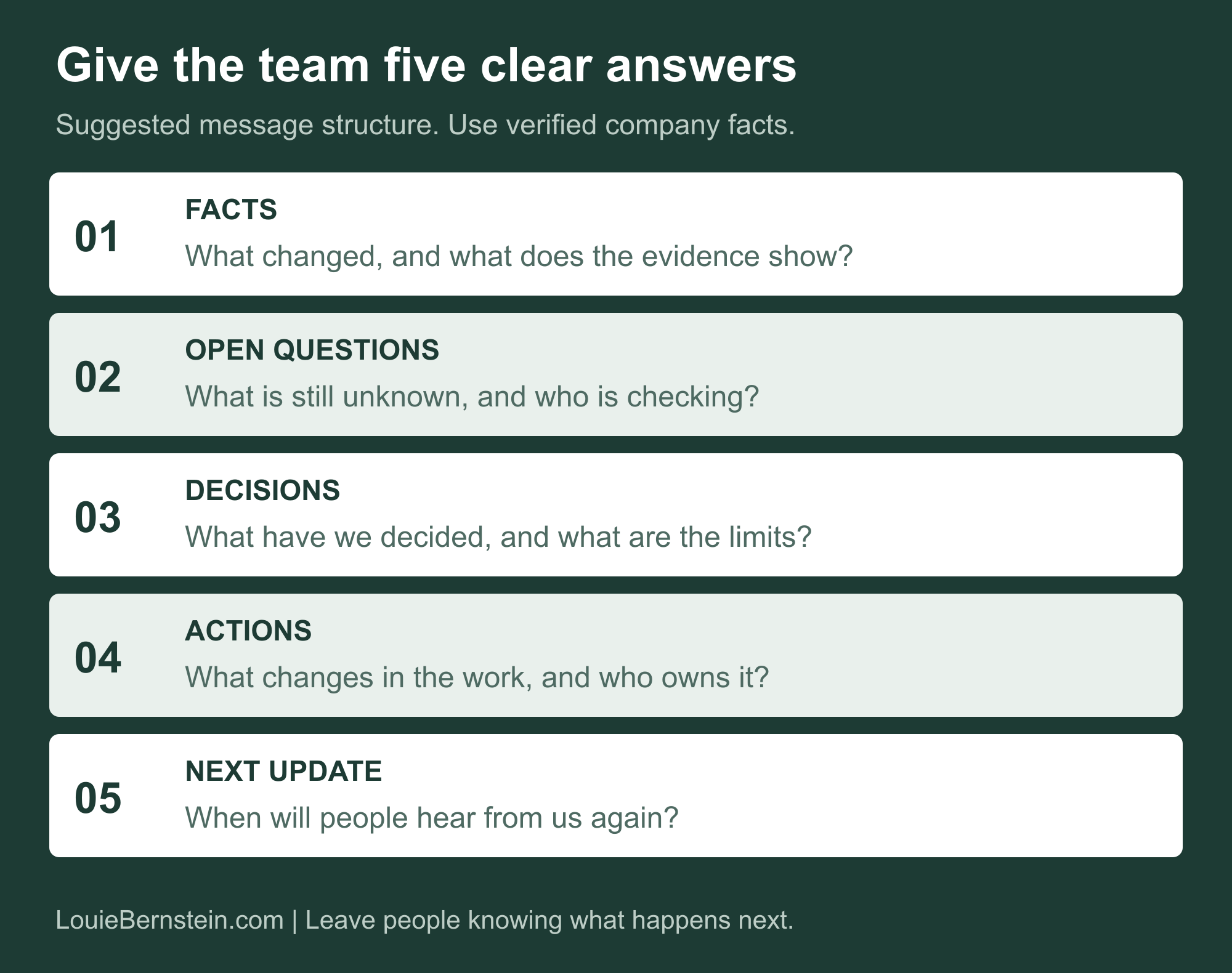
Build the first update around five parts: verified facts, open questions, decisions already made, actions people should take, and the next update date. Keep the explanation short enough to follow and specific enough to use. Let employees hear the situation from the person responsible, then give them a written version they can revisit.
Prepare five clear answers
- What do we know? Name the problem, the period measured, and the relevant consequence.
- What don't we know yet? Identify the open question and how you're checking it.
- What have we decided? Explain the immediate response and its limits.
- What should people do? State the work that changes, who owns it, and what should stop.
- When will we update you? Give a date, channel, and person responsible for the next communication.
This is a suggested message structure, not a researched meeting formula. Use the parts that fit the actual problem. Don't fill a section with a guess because a template has an empty space.
Give managers the same facts
If you have managers, brief them close to the team announcement so they can answer consistently. Provide the same definitions, decisions, and open questions. Ask them to bring unanswered questions back to you rather than adding their own assurances.
For a small team without management layers, you may give the update yourself and follow with individual conversations. Don't assume a written message alone is enough for news that materially changes someone's work.
Keep the meeting focused on the business
You can acknowledge that the situation is difficult. You can take responsibility for a decision that didn't work. Neither requires turning employees into the audience for your personal financial fears.
Tell people what you're doing, what you need from them, and where they can raise concerns. A trusted adviser or peer is a better place to work through the emotions you haven't yet turned into a business decision.
How do I answer questions about jobs, pay, and the company's future?
Answer questions about jobs, pay, and the company's future with current facts and the limits of what you can know. State decisions accurately, identify matters still under review, and avoid guarantees. Handle decisions affecting specific people through the appropriate individual conversations and HR or legal process, alongside the wider business explanation.
Don't promise an outcome to end an uncomfortable question
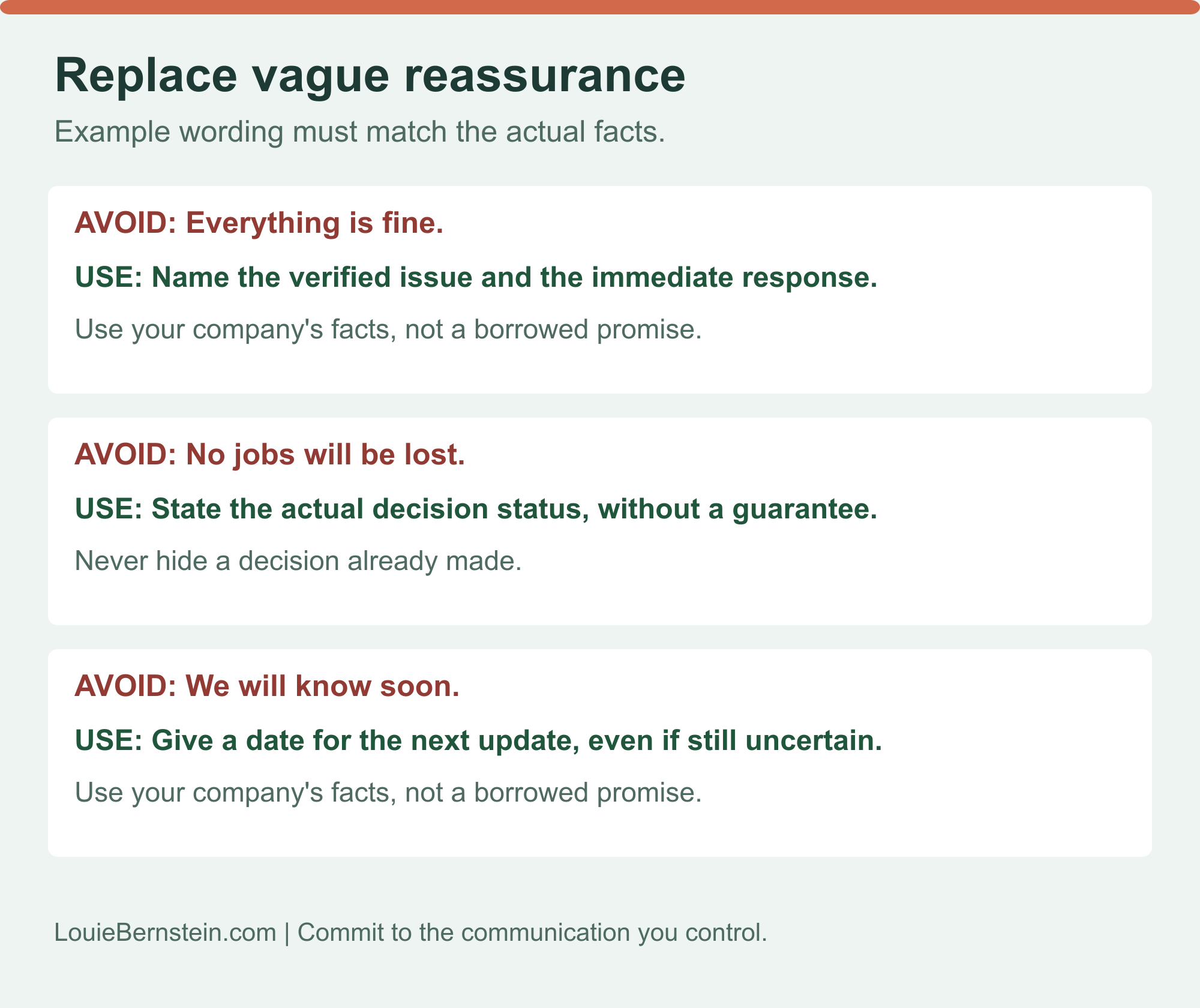
“Nobody needs to worry” doesn't answer whether anything has changed. “No one will lose their job” makes a promise about the future. If no staffing decision has been made, say exactly that, provided it's true. Don't use that wording to conceal a decision already taken.
Distinguish “no decision has been made” from “we aren't considering changes.” If changes are being considered, don't deny the review. Explain what you can share now and the process for giving people more information.
If you discover a pay or staffing issue, get the appropriate qualified advice and arrange the required communication promptly. A general article or team meeting can't settle an individual employment obligation.
Use a commitment you can control
You may not control whether the next contract closes. You can control whether the team gets an update on the date you set. Commit to the communication, the review, and the actions you actually own.
For an illustrative example, “I'll update everyone on Friday, even if the customer hasn't decided” tells the team when they'll hear from you. It doesn't promise the customer will rescue the quarter.
What I've seen when expectations stay unwritten
I've written about a salesperson who hit 135% of quota, moved into a new role, and ended up on a PIP without written expectations for that role. The management failure was expecting the person to perform against a standard nobody had explained.
A difficult quarter can create the same kind of confusion. A founder starts asking reps for faster closes, smaller deals, or different accounts without saying what changed. Then the founder judges people against the new priority.
Put the changed expectation in writing. If responsibilities move, update the Accountabilities Document and explain what support the person will receive. The company missing plan doesn't give you a useful reason to leave the team's job undefined.
How do I keep the team informed after the first conversation?
Keep employees informed through a reliable update schedule, a short written recap, and answers to the questions people actually raise. Report what changed, what remains open, and whether the agreed actions happened. If nothing material has changed, say so at the promised time rather than letting silence replace the next update.
Make the recap usable
Record the checked facts, decisions, owners, dates, and open questions. Keep one current version so managers don't distribute different explanations. Provide a way to ask privately about personal concerns and a way to raise questions relevant to everyone.
Choose the update frequency from the pace of the decisions. A weekly update can be a starting point, but a material change may need an earlier conversation. Don't wait for the calendar if an earlier statement needs correction.
Before ending each update, ask, “What are you still unclear about, and what do you need to do your work?” Listen for conflicting priorities and questions people were reluctant to ask in the group.
Connect the message to the work
If spending changes, specify which approvals change. If customer work is at risk, identify its owner and feasible response. If people are taking on coverage, make room for the work. The employee-knowledge installment covers how to check that a backup can actually deliver.
A Fractional Sales Leader can turn a revenue concern into clear sales priorities, a checked pipeline, coaching, and written accountabilities. Financial, employment, and delivery questions still need the appropriate owners. Even without a complete sales system, you can tell the team what you know and assign the next action.
Before your next update, remove any sentence you couldn't defend if an employee asked, “How do you know?” Then make sure the remaining message tells people what happens next.
Frequently Asked Questions
Should I send an email or hold a meeting?
Use a conversation for significant news that changes people's work or raises immediate concerns, then provide a written recap. For a distributed team, choose a format employees can access and a way to ask questions. Routine progress updates may need less ceremony.
What if someone asks a question I can't answer publicly?
Explain the boundary honestly and arrange the appropriate follow-up. Don't speculate about another employee, a confidential negotiation, or an unverified figure. Share the business facts you can discuss and identify how affected people will receive the information relevant to them.
What if I previously said everything was fine?
Correct the earlier message clearly. Explain what changed or what you got wrong, give the verified facts, and state the next action. Don't blame employees for remembering the assurance you gave them. Set a communication commitment you can now keep.
Should the team use the same message with customers?
No. Customer communication should address the customer's commitments, service, and decisions with accurate approved information. An internal budget discussion isn't a customer script. Give employees a named person and agreed guidance for questions they can't answer.
What if an employee becomes upset or wants to leave?
Listen, offer a private conversation, and answer the person's practical questions honestly. Employees have their own financial and career decisions to make. You can't guarantee their reaction, and you shouldn't pressure them into confidence you haven't earned.
Give the sales team a clear next step.
If you're a $1M to $10M ARR B2B founder and a difficult quarter has left sales priorities unclear, let's look at the pipeline, process, and accountabilities your team needs. Learn about Fractional Sales Leadership at LouieBernstein.com.
Schedule a 30-Minute CallAbout the Author

Louie Bernstein Fractional Sales Leadership
Louie Bernstein is a Fractional Sales Leader with 50 years of sales experience and has worked as a Fractional Sales Leader since 2017. He built and ran MindIQ for 22 years. He helps B2B founders at $1M to $10M ARR build repeatable sales systems so selling doesn't depend on the founder.